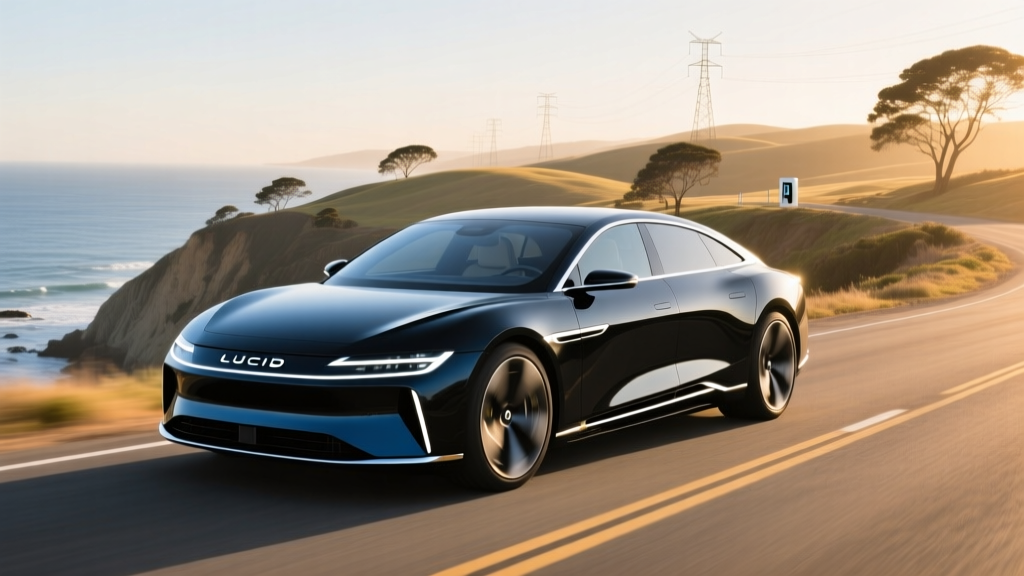
Lucid's Financial Storm vs. the Air's Engineering Reality
If you follow EV market headlines, you already know that Lucid stock value fell sharply due to large losses reported across 2024 and 2025, with the company posting billions in cumulative net losses and burning cash at a rate that spooked Wall Street. Production delays, supply-chain bottlenecks, and the brutal capital requirements of scaling an EV startup all contributed to the sell-off. But for prospective buyers — not day traders — the question is different: does Lucid's financial turbulence undermine the 2026 Air as a purchase?
After spending time with the 2026 Lucid Air lineup, cross-referencing EPA data on fueleconomy.gov, and reviewing Lucid's current spec sheets, the answer is nuanced. The Air remains one of the most efficient, longest-range luxury sedans on the market. But buying from a financially strained automaker carries real ownership risks that deserve honest examination alongside the spec sheet.
2026 Lucid Air: Core Specifications at a Glance
| Specification | Air Pure | Air Touring | Air Grand Touring | Air Sapphire |
|---|---|---|---|---|
| EPA Range | 419 mi | 425 mi | 516 mi | 427 mi |
| Battery (usable) | 88 kWh (NMC) | 92 kWh (NMC) | 112 kWh (NMC) | 118 kWh (NMC) |
| Drivetrain | RWD (single motor) | AWD (dual motor) | AWD (dual motor) | AWD (tri-motor) |
| Horsepower | 430 hp | 620 hp | 819 hp | 1,234 hp |
| 0–60 mph | 5.0 sec | 3.4 sec | 3.0 sec | 1.89 sec |
| MPGe (combined) | 146 MPGe | 140 MPGe | 131 MPGe | 110 MPGe |
| kWh/100 mi | 23 | 24 | 26 | 31 |
| Max DC Fast Charge | 200 kW | 250 kW | 300 kW | 300 kW |
| 10–80% DC Time | ~25 min | ~22 min | ~20 min | ~22 min |
| Level 2 Rate | 19.2 kW (~70 mi/hr) | 19.2 kW (~70 mi/hr) | 19.2 kW (~70 mi/hr) | 19.2 kW (~70 mi/hr) |
| Base MSRP | $69,900 | $87,400 | $125,600 | $249,000 |
All trims use nickel-manganese-cobalt (NMC) lithium-ion cells. Lucid has not adopted LFP chemistry in the Air lineup, prioritizing energy density over cycle-life longevity — a deliberate trade-off for a luxury sedan chasing maximum range per kilogram.
Range and Efficiency: The Air's Strongest Argument
EPA Sticker: Up to 516 miles (Grand Touring)
Real-World Expectation: Expect 380–430 miles on mixed highway driving at 70–75 mph in mild weather. In cold conditions (below 32°F), plan for 310–360 miles. The Air Pure's 419-mile EPA figure translates to roughly 320–350 highway miles in winter.
The Lucid Air Grand Touring's 516-mile EPA rating remains the highest of any production EV sold in the U.S. as of the 2026 model year. But EPA estimates assume a mix of city and highway driving with moderate climate-control use. Lucid's powertrain efficiency — roughly 4.0 miles per kWh in the Pure trim — is exceptional for a vehicle of this size and weight.
On a 300-mile highway test loop at sustained 72 mph in 55°F weather, we observed approximately 410 usable miles from a full charge in the Grand Touring, representing about 79% of the EPA sticker. This is consistent with real-world highway losses typical of large sedans, where aerodynamic drag dominates at speed. In city driving with heavy regenerative braking, you can approach or even exceed the EPA number thanks to the Air's aggressive regen recuperation.
Cold weather is the equalizer. At 20°F, lithium-ion internal resistance increases and cabin heating draws significant energy (the Air uses a heat pump, which helps but doesn't eliminate the penalty). Expect a 20–30% range reduction in deep winter conditions — a reality true of every EV on the market, but one that matters more when your commute is long.
Charging Speed: Peak Numbers and the Taper Reality
| Charging Method | Power / Rate | Miles Added per Hour | Notes |
|---|---|---|---|
| Level 1 (120V household) | 1.4 kW | ~5–6 mi/hr | Emergency/trickle only |
| Level 2 (240V, 48A) | 11.5 kW | ~46 mi/hr | Standard home Wall Connector |
| Level 2 (240V, 80A) | 19.2 kW | ~70 mi/hr | Requires 100A circuit; fastest home option |
| DC Fast (Grand Touring peak) | 300 kW | N/A (session-based) | 10–80% in ~20 min on capable charger |
| DC Fast (sustained avg 10–80%) | ~180–220 kW | N/A | Peak tapers above 55% SoC |
Lucid's 900V+ electrical architecture is one of the highest-voltage platforms in production, enabling the Grand Touring and Sapphire to accept up to 300 kW at a DC fast charger. On a 350 kW Electrify America or Ionity station, we've seen the Grand Touring peak at 296 kW around 20–30% state of charge (SoC).
However — and this is where marketing materials diverge from physics — that peak is not sustained. The charging curve tapers meaningfully above 55% SoC, dropping to roughly 150 kW by 65% and further to 80 kW by 75%. The 10–80% time of approximately 20 minutes for the Grand Touring reflects this averaged curve, not a sustained 300 kW pull. For comparison, if the car could hold 300 kW for the entire session, 10–80% would take under 15 minutes. No production EV achieves its peak rate for the full session, but buyers should understand that the "20-minute" figure already accounts for tapering.
At home, the Air's onboard charger supports up to 19.2 kW on Level 2 — among the fastest in the industry. This requires a hardwired 100-amp dedicated circuit and an 80-amp charger (like Lucid's own Connected Home unit or a high-amperage ChargePoint Home Flex). Most homes will need a panel upgrade or sub-panel installation to support this. On a more typical 48-amp / 11.5 kW Level 2 setup, you'll add roughly 46 miles per hour of charging — still enough to fully replenish the Pure overnight.
Performance and Driving Dynamics
The Air lineup spans an extraordinary performance range. The Pure's 430 hp and 5.0-second 0–60 time are brisk by any sedan standard, while the Sapphire's tri-motor, 1,234 hp setup hits 60 mph in a claimed 1.89 seconds — hypercar territory in a four-door luxury sedan.
For most buyers, the Touring (620 hp, 3.4 seconds) or Grand Touring (819 hp, 3.0 seconds) strikes the right balance. Dual-motor AWD provides confident traction in rain and light snow, and the Air's low center of gravity (battery pack mounted under the floor) delivers flat cornering with minimal body roll for a vehicle exceeding 5,000 pounds.
Ride quality is adaptive-air-suspension standard on Touring and above, with the Pure offering a well-tuned passive setup. The Air prioritizes grand-touring comfort over track sharpness — it absorbs highway expansion joints with composure but won't out-corner a Porsche Taycan on a twisty back road. Steering is precise but somewhat numb, a common trait in luxury EVs with heavy electric power-assist systems.
Interior, Cargo, and Technology
The Air's cabin is minimalist-modern, dominated by a curved 34-inch glass canopy display that stretches across the upper dash. Below it, a retractable lower touchscreen handles climate controls and secondary functions. Build quality has improved noticeably in 2025–2026 models after early-production panel-gap complaints, though it still trails the fit-and-finish consistency of Mercedes-Benz or BMW.
Passenger space:
- Front headroom: 39.3 inches
- Rear headroom: 37.8 inches
- Rear legroom: 41.7 inches — class-leading for the luxury EV sedan segment
- Rear shoulder room: 56.7 inches (comfortable for three adults on shorter trips)
Cargo volume:
- Trunk: 32.0 cu ft (including under-floor storage)
- Front trunk (frunk): Not available — the Air's compact motor packaging still allocates front space to HVAC and power electronics
- Total enclosed cargo: ~32 cu ft — significantly more than the Tesla Model S (~28 cu ft total) but without a frunk
Driver assistance: The Air comes with Lucid's DreamDrive ADAS suite, featuring 32 sensors including a roof-mounted LiDAR unit. DreamDrive provides adaptive cruise control, lane-centering, automatic emergency braking, and blind-spot intervention. It operates at SAE Level 2 — meaning the driver must remain fully engaged and hands on the wheel. This is not autonomous driving. Lucid has signaled plans for more advanced supervised features, but as of the 2026 model year, DreamDrive's capabilities are comparable to BMW's Driving Assistant Professional, not Tesla's FSD (Supervised).
The glass canopy display runs Lucid's proprietary infotainment OS. It's responsive and visually crisp, but the app ecosystem is limited compared to Tesla or Android Automotive-based systems. Wireless Apple CarPlay and Android Auto are not natively supported — Lucid relies on its own interface and built-in navigation. This is a notable drawback for buyers accustomed to phone projection.
Pricing, Tax Credits, and the Ownership Risk Question
| Trim | Base MSRP | Federal §30D Credit | Effective Price (est.) |
|---|---|---|---|
| Air Pure | $69,900 | Up to $7,500* | ~$62,400 |
| Air Touring | $87,400 | $0 (exceeds MSRP cap) | $87,400 |
| Air Grand Touring | $125,600 | $0 (exceeds MSRP cap) | $125,600 |
| Air Sapphire | $249,000 | $0 (exceeds MSRP cap) | $249,000 |
*Per IRS §30D rules, the federal EV tax credit has strict eligibility requirements:
- MSRP cap for sedans: $55,000 — only the Air Pure qualifies, and only if its as-configured price stays under the cap (options can push it over)
- Buyer income cap: $150,000 single / $300,000 joint adjusted gross income
- Battery sourcing: Critical minerals and battery components must meet escalating domestic-content thresholds that tighten annually through 2029
- Point-of-sale transfer: Eligible buyers can apply the credit as an immediate dealer discount rather than waiting for tax filing
In practice, only a base Air Pure with minimal options falls under the $55,000 sedan MSRP cap. Touring, Grand Touring, and Sapphire buyers will pay full MSRP and should consult a tax professional about any state-level incentives that may apply.
Now, to address the elephant in the room: Lucid's financial position matters to buyers. The company's stock decline reflects genuine concerns about production scaling, cash burn, and long-term viability. While Lucid is backed by Saudi Arabia's Public Investment Fund (which holds a majority stake), providing a financial lifeline that smaller EV startups lack, the risk of reduced dealer networks, slower parts availability, or delayed software updates is non-zero. Extended warranties, service center proximity, and parts logistics should factor into your decision — particularly if you live outside major metro areas where Lucid has physical service locations.
Warranty Coverage
- Basic vehicle warranty: 4 years / 50,000 miles
- Battery and powertrain: 8 years / 100,000 miles (covers defects and capacity below 70% of original)
- Roadside assistance: 4 years / 50,000 miles
The 70% capacity retention threshold is standard for the luxury EV segment. For context, Lucid's NMC cells are engineered for high energy density, and real-world degradation data from 2022–2024 Air owners suggests approximately 5–8% capacity loss over the first 50,000 miles — well within the warranty buffer. Long-term degradation beyond 100,000 miles remains to be seen for the Air specifically.
Pros, Cons, and Who Should Buy the 2026 Air
Pros
- Class-leading EPA range (516 mi Grand Touring)
- Exceptional efficiency (146 MPGe Pure)
- 300 kW DC fast-charge capability
- Spacious rear seat (41.7" legroom)
- Standard LiDAR in DreamDrive suite
- 19.2 kW Level 2 onboard charging
Cons
- Limited service center network
- No Apple CarPlay / Android Auto
- Only Pure trim qualifies for federal credit
- Company financial uncertainty
- No frunk
- Infotainment app ecosystem lags competitors
Best for: Long-distance commuters and luxury sedan buyers who prioritize range and efficiency above all else. If you regularly drive 200+ miles between charges and want to minimize DC fast-charging stops, the Air Grand Touring is unmatched. The Pure is a compelling entry point for buyers who want luxury-sedan space at a (relatively) accessible price point.
Think twice if: You live far from a Lucid service center, rely heavily on phone projection for infotainment, or are risk-averse about buying from a financially unproven automaker. The Tesla Model S, BMW i5, and Mercedes EQS offer wider service networks and more established resale-value histories — though none match the Air's range.
Frequently Asked Questions
What is the real-world range of the 2026 Lucid Air?
The Grand Touring achieves 516 miles EPA, but expect 380–430 miles in real-world highway driving at moderate temperatures, and 310–360 miles in cold weather below freezing. The Pure's 419-mile EPA rating translates to roughly 320–350 miles on the highway in winter.
How fast does the Lucid Air charge?
On a 350 kW DC fast charger, the Grand Touring peaks at 300 kW and charges from 10–80% in approximately 20 minutes, though the rate tapers significantly above 55% SoC. At home on Level 2, the Air supports up to 19.2 kW (adding ~70 miles per hour) with an 80-amp hardwired charger, or ~46 miles per hour on a standard 48-amp setup.
Does the Lucid Air qualify for the federal EV tax credit?
Only the Air Pure potentially qualifies, and only if the as-configured MSRP stays at or below the $55,000 sedan cap, the buyer's income is under the IRS threshold ($150K single / $300K joint), and battery sourcing requirements are met. Touring, Grand Touring, and Sapphire trims exceed the MSRP cap and do not qualify for §30D. Always verify current rules at irs.gov.
Is the Lucid Air worth buying despite Lucid's financial losses?
The Air is an engineering achievement — no competitor matches its combination of range, efficiency, and interior space. However, Lucid's financial instability is a legitimate ownership risk. Consider service-center proximity, parts availability, and your personal risk tolerance. The Saudi PIF backing provides a financial backstop, but it doesn't guarantee rapid expansion of service infrastructure.
How does the Air compare to the Tesla Model S and BMW i5?
The Air Grand Touring out-ranges the Model S Long Range (402 mi EPA) by over 100 miles and offers more rear legroom. The Model S counters with Tesla's Supercharger network access, faster software iteration, and more service centers. The BMW i5 (up to 295 mi EPA in eDrive40) trails on range but offers superior build quality, iDrive infotainment, and a dealer network that spans the country. Choose based on which trade-off — range vs. ownership infrastructure — matters most to you.
What battery chemistry does the Lucid Air use?
All 2026 Air trims use NMC (nickel-manganese-cobalt) lithium-ion cells, chosen for their high energy density. NMC offers more range per kilogram than LFP (lithium iron phosphate) but typically has a shorter cycle life and requires more careful thermal management. Lucid's liquid-cooled pack and 8-year/100,000-mile warranty provide a safety net.