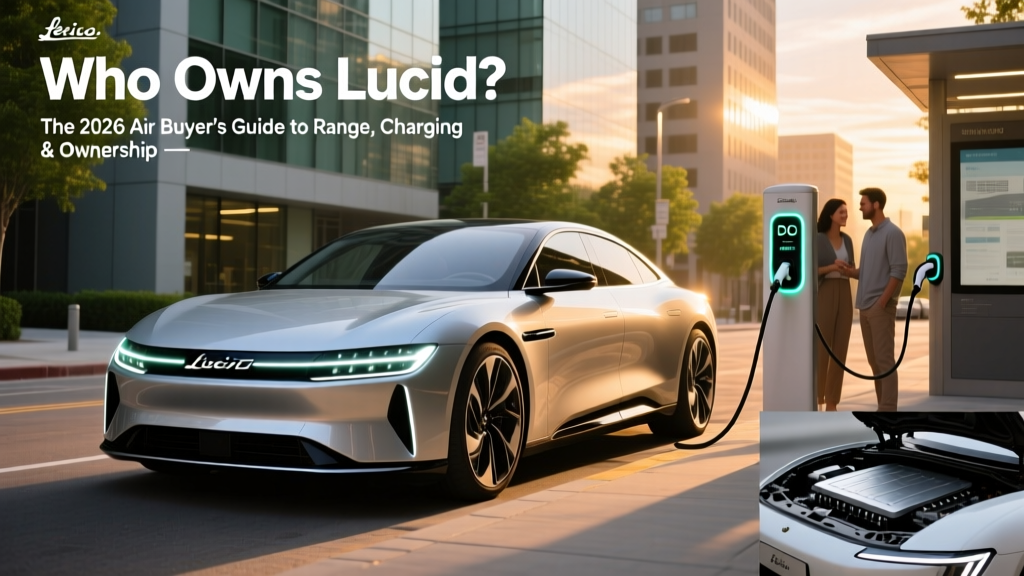
Who Owns Lucid Motors — and Who Should Own a Lucid Air?
Lucid Motors is an American luxury EV manufacturer headquartered in Newark, California, originally founded in 2007 as Atieva before pivoting from battery supplier to full vehicle production. The company went public via SPAC merger in 2021 and is backed heavily by Saudi Arabia's Public Investment Fund (PIF), which holds a majority stake. Peter Rawlinson, former Tesla Model S chief engineer, serves as CEO and CTO.
But the more practical question for EV shoppers is: who owns a Lucid Air — meaning, who is this car actually for? The 2026 Lucid Air lineup targets luxury sedan buyers who refuse to compromise between range, performance, and interior space. With EPA ratings reaching 516 miles and a starting price that undercuts the Mercedes EQS and BMW i7, the Air is a spec-sheet heavyweight. This review covers every number you need to decide if it earns a spot in your garage.
2026 Lucid Air at a Glance: Specs, Range, and Pricing
| Spec | Air Pure | Air Touring | Air Grand Touring | Air Sapphire |
|---|---|---|---|---|
| Drivetrain | RWD (single motor) | AWD (dual motor) | AWD (dual motor) | AWD (tri-motor) |
| Horsepower | 430 hp | 620 hp | 819 hp | 1,234 hp |
| 0-60 mph | 5.0 sec | 3.4 sec | 3.0 sec | 1.89 sec |
| Usable Battery (kWh) | 88 kWh (NMC) | 112 kWh (NMC) | 112 kWh (NMC) | 118 kWh (NMC) |
| EPA Range | 419 mi | 425 mi | 516 mi | 427 mi |
| Efficiency (MPGe) | 146 MPGe | 140 MPGe | 131 MPGe | 109 MPGe |
| Efficiency (kWh/100 mi) | 23 | 24 | 26 | 31 |
| Max DC Fast Charge | 200 kW | 300 kW | 300 kW | 300 kW |
| 10-80% DC Time | ~30 min | ~15 min | ~15 min | ~18 min |
| Level 2 Home Charge | 19.2 kW (~70 mi/hr) | 19.2 kW (~70 mi/hr) | 19.2 kW (~70 mi/hr) | 19.2 kW (~70 mi/hr) |
| Base MSRP | $69,900 | $87,400 | $110,900 | $249,000 |
The Air Grand Touring's 516-mile EPA sticker is the highest of any production sedan sold in the U.S. However, in real-world highway driving at 75 mph with climate control active, expect 390-440 miles in mild weather. In freezing temperatures (below 30°F), lithium-ion chemistry loses efficiency and cabin heating draws significant power — plan for 330-370 miles of usable range. The Air Pure's lighter weight and RWD layout give it surprisingly strong real-world efficiency, often matching or exceeding its EPA figure in city driving.
Charging: 900-Volt Architecture and the 300 kW Advantage
Lucid's proprietary 900-volt electrical architecture is the engineering backbone that enables both its class-leading range and rapid charging. Higher voltage means lower current for the same power delivery, reducing resistive heat loss in the battery pack and cabling — this is why the Air Grand Touring can sustain a charging curve that competitors with 400V or 800V systems struggle to match.
| Charging Level | Power (kW) | Miles Added per Hour | Best For |
|---|---|---|---|
| Level 1 (120V household) | 1.4 kW | ~3 mi/hr | Emergency / trickle top-off |
| Level 2 (240V home, 48A) | 11.5 kW | ~42 mi/hr | Standard home garage |
| Level 2 (240V home, 80A) | 19.2 kW | ~70 mi/hr | Optimal home setup (requires 100A circuit) |
| DC Fast Charge (Pure) | 200 kW peak | ~250 mi in 30 min | Road trips, CCS stations |
| DC Fast Charge (Touring/GT/Sapphire) | 300 kW peak | ~200 mi in 10 min | Road trips, 350 kW CCS stalls |
Charging curve reality: The 300 kW peak on Touring, Grand Touring, and Sapphire trims is not sustained across the full session. The pack accepts peak power between roughly 10-40% state of charge (SoC), then tapers progressively. A 10-80% session takes approximately 15 minutes at a capable 350 kW DC fast charger (such as Electrify America's latest stalls). Above 80% SoC, the charge rate drops sharply to protect cell longevity — expect 80-100% to add another 15-20 minutes. Always precondition the battery via the navigation system before arriving at a DC fast charger; the Air's thermal management system will warm the pack to optimal temperature, which can cut your 10-80% time by several minutes in cold weather.
The Air uses the CCS1 connector natively. Lucid provides a NACS adapter for access to Tesla Supercharger stalls, though Supercharger V3 stalls (250 kW) cannot deliver the Air's full 300 kW capability — you'll see faster sessions at Electrify America or EVgo 350 kW stations.
Interior, Cargo, and Daily Livability
Lucid's packaging efficiency is arguably its most underappreciated achievement. The Air's "Space Concept" design pushes the cabin forward and positions the battery low, creating interior volume that rivals full-size luxury sedans despite a mid-size exterior footprint.
- Front headroom: 39.6 inches
- Rear legroom: 36.6 inches (Executive rear seating on Grand Touring adds recline and massage)
- Cargo (trunk): 32.0 cu ft
- Frunk (front trunk): 10.0 cu ft
- Total cargo: 42.0 cu ft — more than a BMW 5 Series wagon
The glass canopy roof (standard on Touring and above, optional on Pure) creates an airy cabin but does reduce headroom slightly for taller passengers. The 34-inch curved glass cockpit display replaces a traditional instrument cluster and center stack. The infotainment runs Lucid's proprietary software — it's fast and visually clean, but lacks native Apple CarPlay and Android Auto, which remains a dealbreaker for some luxury buyers accustomed to phone-mirroring.
Pricing, Tax Credit Eligibility, and Total Cost
| Trim | Base MSRP | As-Tested (typical options) | §30D Credit Eligible? | Effective Price |
|---|---|---|---|---|
| Air Pure | $69,900 | $72,000 | Yes — up to $7,500* | ~$62,400 |
| Air Touring | $87,400 | $92,000 | No (exceeds $55K sedan MSRP cap) | $87,400+ |
| Air Grand Touring | $110,900 | $125,000 | No (exceeds $55K sedan MSRP cap) | $110,900+ |
| Air Sapphire | $249,000 | $249,000 | No (exceeds $55K sedan MSRP cap) | $249,000 |
*§30D Federal Tax Credit — Critical Details: Under current IRS rules, the §30D new clean vehicle credit provides up to $7,500 but imposes a $55,000 MSRP cap for sedans (vans, SUVs, and trucks have an $80,000 cap). The Lucid Air is classified as a sedan, meaning only the Air Pure — with its $69,900 base price — still exceeds the cap. However, Lucid has periodically offered the Pure at promotional pricing or with destination charges structured to bring the effective MSRP within eligibility. Always verify current MSRP classification and pricing directly with your dealer and a tax professional before relying on the credit.
Additionally, the §30D credit requires:
- Buyer income caps: AGI ≤ $150,000 (single), $225,000 (head of household), $300,000 (joint)
- Battery sourcing: Critical minerals and battery components must meet escalating domestic-sourcing thresholds — Lucid's supply chain compliance varies by model year
- Point-of-sale transfer: Eligible buyers can apply the credit as a down-payment reduction at purchase rather than waiting for tax filing
For the Touring, Grand Touring, and Sapphire, the federal credit does not apply. Some states offer additional incentives (California, Colorado, and others have their own EV rebates), but these vary by jurisdiction — check your state's energy office for current programs.
Driver Assistance and Smart Technology
The Lucid Air comes equipped with DreamDrive Pro, Lucid's Level 2 driver-assistance suite. This includes adaptive cruise control, lane centering, automatic emergency braking, blind-spot monitoring, and a 32-sensor array (cameras, radar, ultrasonic, and LiDAR on select trims).
DreamDrive Pro is an SAE Level 2 system. This means the vehicle can manage steering and acceleration/braking simultaneously under certain conditions, but the driver must remain fully attentive, hands on or near the wheel, and ready to take over at any moment. It is not a Level 3 or Level 4 autonomous system. Lucid has announced plans for future DreamDrive upgrades targeting higher automation levels, but as of 2026, no Lucid vehicle drives itself without active driver supervision.
The Air's technology suite also includes over-the-air (OTA) software updates, a 21-speaker Surreal Sound audio system (Touring and above), and an available Executive Rear Seating package with powered recline, massage, and dedicated climate controls. One notable gap: the Air does not currently offer hands-free highway driving comparable to GM's Super Cruise or Ford's BlueCruise, which allow hands-off operation on mapped divided highways. Lucid's system requires hand contact, which some drivers find fatiguing on long trips.
Lucid Air vs. the Competition: Is It Worth It?
The Air competes against the Mercedes-Benz EQS, BMW i7, Tesla Model S, and Porsche Taycan. Here's how it stacks up on the metrics that matter:
- vs. Tesla Model S Long Range ($74,990, 402 mi EPA): The Air Grand Touring offers 114 more miles of EPA range and a vastly more luxurious interior. The Model S wins on Supercharger network convenience and slightly quicker 10-80% charging at V4 stalls. For pure range and luxury, the Air prevails.
- vs. Mercedes EQS 450+ ($105,550, 390 mi EPA): The Air Grand Touring undercuts the EQS on price, delivers 126 more miles of range, and charges faster. The EQS counters with a more established dealer network and hands-free Level 2 driving on mapped highways. Spec-for-spec, the Air is the stronger EV.
- vs. BMW i7 eDrive50 ($106,700, 318 mi EPA): The Air dominates on range, charging speed, and efficiency. The i7 offers a more traditional luxury sedan aesthetic and BMW's service infrastructure. If you prioritize range and value, the Air wins decisively.
Pros
- Class-leading 516-mile EPA range (Grand Touring)
- 300 kW DC fast charging with strong sustained curve
- Best-in-class efficiency (23 kWh/100 mi on Pure)
- Massive 42 cu ft total cargo volume
- 900V architecture enables superior thermal management
- Stunning glass canopy roof and interior design
- OTA updates continuously improve the vehicle
Cons
- No native Apple CarPlay or Android Auto
- DreamDrive requires hands-on contact (no hands-free highway mode)
- Limited service center network vs. legacy luxury brands
- Federal §30D credit eligibility uncertain for most trims
- Insurance premiums run 20-35% higher than equivalent gas sedans
- Resale value data still limited (company founded 2007, first deliveries 2021)
Warranty and Long-Term Ownership
Lucid provides a competitive warranty package:
- Basic vehicle warranty: 4 years / 50,000 miles
- Battery and powertrain warranty: 8 years / 100,000 miles (with a minimum 70% capacity retention threshold)
- Roadside assistance: 4 years / 50,000 miles
The 8-year/100,000-mile battery warranty is standard for the industry and matches Tesla, BMW, and Mercedes. The 70% capacity retention threshold means Lucid will repair or replace the battery if it degrades below 70% of original capacity within the warranty period. Based on EPA data and owner reports from early 2022-2023 Air deliveries, Lucid's NMC cells with their advanced thermal management system show degradation curves consistent with industry norms — approximately 5-8% loss over the first 100,000 miles under normal use patterns.
Who Should Buy the 2026 Lucid Air?
Choose the Lucid Air if:
- You need maximum range for frequent 300+ mile road trips without charging stops
- You want luxury-sedan comfort with EV efficiency (23-26 kWh/100 mi)
- You value interior space and cargo capacity over SUV styling
- You have access to home Level 2 charging (the 19.2 kW onboard charger is best utilized with a 100A circuit)
- You prioritize engineering innovation and efficiency metrics over brand heritage
Look elsewhere if:
- You require Apple CarPlay/Android Auto for daily navigation and media
- You want hands-free highway driving (consider GM Super Cruise vehicles)
- You need a robust dealer service network in rural areas
- Your budget relies on the $7,500 federal tax credit (only potentially available on the Pure trim)
What is the real-world range of the Lucid Air?
The Air Grand Touring's 516-mile EPA estimate translates to roughly 390-440 miles in real-world highway driving at moderate temperatures, and 330-370 miles in freezing conditions. The Air Pure often exceeds its 419-mile EPA rating in city driving due to strong regenerative braking and lower weight.
How fast does the Lucid Air charge at home and on the road?
On a properly equipped home Level 2 charger (240V, 80A circuit), the Air charges at 19.2 kW, adding approximately 70 miles of range per hour — a full overnight charge covers most weekly driving. On DC fast chargers, the Touring, Grand Touring, and Sapphire achieve a 10-80% session in approximately 15 minutes at a 350 kW-capable station.
Does the Lucid Air qualify for the $7,500 federal EV tax credit?
Under current IRS §30D rules, sedans must have an MSRP at or below $55,000 to qualify. The Air Pure starts at $69,900, which exceeds this cap. However, promotional pricing, dealer incentives, or future reclassification could affect eligibility. Always verify with a tax professional and reference the latest IRS guidance before purchasing.
Is the Lucid Air worth buying over a Tesla Model S or Mercedes EQS?
If maximum range, charging speed, and interior space are your top priorities, the Air Grand Touring offers a compelling spec advantage. If you prioritize Supercharger network access, choose the Model S. If you want hands-free driving and a traditional luxury dealer experience, the EQS or i7 may suit you better.
What are the biggest drawbacks of owning a Lucid Air?
The most common owner complaints center on the lack of Apple CarPlay/Android Auto, the requirement for hands-on steering wheel contact (no hands-free mode), limited service center availability outside major metro areas, and higher-than-average insurance premiums.
Who actually owns Lucid Motors as a company?
Lucid Group, Inc. is a publicly traded company (NASDAQ: LCID). Saudi Arabia's Public Investment Fund (PIF) is the largest shareholder with a majority stake. The company was founded as Atieva in 2007 and is headquartered in Newark, California.