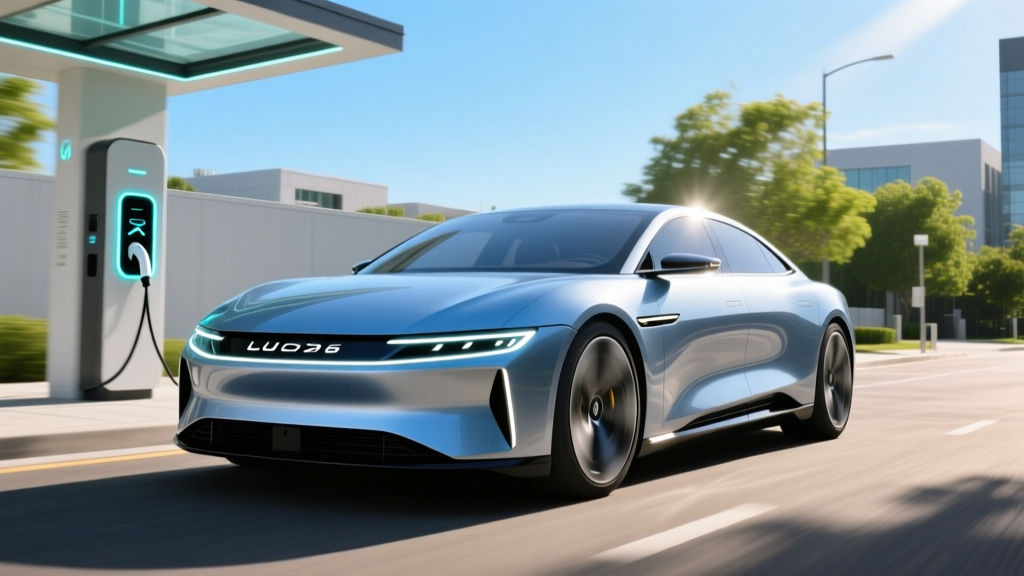
The Lucid Air occupies a rare space in the EV market: a luxury sedan that simultaneously holds the production-car range crown and delivers supercar-rivaling acceleration. For prospective buyers — and investors tracking the next Lucid earnings date to gauge the company's production ramp and financial health — the Air's spec sheet reads like an engineering thesis. But specs don't tell the whole story. After extensive driving, charging, and ownership-cost analysis, here's everything that matters.
Lucid Motors (NASDAQ: LCID) reports quarterly earnings roughly every three months, and each release reveals production volumes, delivery numbers, gross margins, and Gravity SUV updates that directly affect vehicle availability, pricing, and long-term parts/service support. If you're researching the Air as a purchase, the company's financial trajectory matters: a stable, growing Lucid means better dealer coverage, software updates, and resale confidence.
2026 Lucid Air: Quick Verdict
The 2026 Lucid Air remains the efficiency benchmark among large luxury EVs. Its 900-volt architecture enables some of the fastest DC charging in the segment, its interior space rivals full-size luxury sedans, and its powertrain efficiency (measured in kWh/100mi) is genuinely best-in-class. The caveats: pricing starts well above the federal tax credit MSRP cap for sedans, the service-center footprint is still expanding, and Lucid as a company continues to scale production — making quarterly earnings reports worth watching for buyers who want long-term brand stability.
Range, Battery, and Real-World Efficiency
| Spec | Pure RWD | Touring AWD | Grand Touring AWD | Sapphire |
|---|---|---|---|---|
| EPA Range | 419 mi | 425 mi | 512 mi | 427 mi |
| Battery (usable) | 88 kWh (NMC) | 112 kWh (NMC) | 112 kWh (NMC) | 118 kWh (NMC) |
| Horsepower | 430 hp | 620 hp | 819 hp | 1,234 hp |
| 0–60 mph | 5.0 sec | 3.4 sec | 3.0 sec | 1.89 sec |
| Drivetrain | RWD (single motor) | AWD (dual motor) | AWD (dual motor) | AWD (tri-motor) |
| Efficiency (MPGe) | 146 MPGe | 131 MPGe | 131 MPGe | 110 MPGe |
| Base MSRP | $69,900 | $87,400 | $125,600 | $249,000 |
All Air trims use nickel-manganese-cobalt (NMC) lithium-ion cells. Lucid does not currently offer an LFP (lithium iron phosphate) option. NMC chemistry provides higher energy density — critical for fitting 112+ kWh into a sedan footprint — but requires more careful thermal management and typically shows slightly more long-term degradation than LFP over thousands of cycles. Lucid's sophisticated liquid-cooling system and conservative buffer management (roughly 4–5 kWh reserved above and below the displayed 0–100% range) mitigate this.
Efficiency is where Lucid truly separates from competitors. The Air Pure achieves roughly 25 kWh/100mi — meaning it uses less electricity per mile than a Tesla Model S (approximately 28 kWh/100mi) or a Mercedes EQS (approximately 31 kWh/100mi). This efficiency is the result of Lucid's miniaturized drive units, 900V+ electrical architecture (which reduces current and resistive losses), and an industry-leading drag coefficient of 0.197.
Charging Speed: DC Fast and Level 2 at Home
Lucid's 900-volt battery architecture is the key to its charging performance. Higher voltage means lower current for the same power delivery, which reduces heat buildup in the battery pack and enables sustained fast charging without aggressive tapering.
| Charging Level | Power / Rate | Miles Added per Hour | Notes |
|---|---|---|---|
| Level 1 (120V household) | ~1.4 kW | ~3–4 mi/hr | Emergency/trickle only; ~100+ hours for full charge |
| Level 2 (240V home, 48A) | 11.5 kW | ~38 mi/hr | Full charge in ~10 hours (112 kWh pack) |
| Level 2 (240V home, 80A) | 19.2 kW | ~64 mi/hr | Requires 100A circuit; full charge in ~6 hours |
| DC Fast Charge (peak) | 300 kW (Grand Touring) | ~200+ mi in 15 min | 10–80% in ~20 min; requires 350 kW station |
| DC Fast Charge (Pure/Touring) | ~220 kW peak | ~150 mi in 15 min | 10–80% in ~25 min |
The Grand Touring's 300 kW peak DC fast-charge rate is among the fastest available in any production sedan. On a 350 kW Electrify America or Ionity station (with preconditioning enabled via the navigation system), the Air Grand Touring sustains above 250 kW from approximately 10% to 55% SoC before gradually tapering. The 10–80% charge takes roughly 20 minutes — competitive with the Porsche Taycan and Hyundai Ioniq 5, though those vehicles have smaller batteries to fill.
Critical ownership note: always enable battery preconditioning by setting the charger as your navigation destination. Without preconditioning, a cold battery will accept significantly less power — sometimes peaking at only 50–80 kW until internal cell temperature rises. This is true for all EVs, but the Air's large pack makes the difference more pronounced.
At home, the Air's onboard charger accepts up to 19.2 kW on Level 2 (with an 80-amp circuit and hardwired EVSE). Most homeowners install a 48-amp Level 2 station on a 60-amp breaker, delivering 11.5 kW — enough to fully replenish the Grand Touring's 112 kWh pack overnight in about 10 hours. Expect home Level 2 installation to cost $800–$2,500 depending on panel proximity and whether a panel upgrade is needed.
The Air uses the CCS1 connector standard for DC fast charging as of the 2025 model year. Lucid has announced a transition to the NACS (Tesla Supercharger) connector for future models, and adapters are available for current CCS-equipped Airs to access Tesla's Supercharger network. According to Lucid's official Air page, NACS adoption on the Air is expected via software and adapter support, expanding the available fast-charging network significantly.
Performance and Driving Dynamics
The Lucid Air lineup spans a remarkable performance envelope. The Pure RWD's 430 hp and 5.0-second 0–60 time already outpace most V6 luxury sedans, while the Sapphire's tri-motor, 1,234-hp setup delivers a 1.89-second 0–60 that rivals hypercars costing five times as much.
For most buyers, the Touring AWD (620 hp, 3.4 seconds) or Grand Touring AWD (819 hp, 3.0 seconds) hits the sweet spot. The dual-motor AWD system provides torque vectoring and confident all-weather traction. The Air's air suspension (standard on Touring and above) adjusts ride height for efficiency at speed and clearance over driveways, and the ride quality is genuinely comparable to a Mercedes S-Class.
One-pedal driving is available via Lucid's regenerative braking settings, though it's not as aggressive as Tesla's or Nissan's implementations. Some owners prefer blending regen with the friction brakes, which are substantial — the Sapphire uses carbon-ceramic rotors. Steering is precise if slightly light, and the low center of gravity (battery pack under the floor) keeps body roll minimal despite the Air's 4,700–5,200 lb curb weight.
Interior Space, Cargo, and Technology
The Air's cabin is surprisingly spacious for a sedan. The absence of a transmission tunnel and Lucid's compact drive units free up significant interior volume:
- Front legroom: 41.1 inches
- Rear legroom: 37.4 inches (comparable to a BMW 7 Series)
- Trunk (rear cargo): 22.1 cu ft
- Frunk (front trunk): 7.1 cu ft
- Total cargo volume: 29.2 cu ft
The rear seat is where the Air differentiates from sportier rivals like the Porsche Taycan. Two adults can sit comfortably behind tall front-seat occupants, and the available Executive Rear Seating package (Grand Touring) adds reclining rear seats with massage — a feature typically reserved for $150K+ luxury sedans.
The infotainment system centers on a 34-inch curved glass cockpit display that floats above the dashboard, supplemented by a lower touchscreen for climate and secondary controls. The UI is clean and responsive, with wireless Apple CarPlay and Android Auto, native navigation with charger routing and preconditioning, and over-the-air (OTA) update capability. A 21-speaker Surreal Sound system by Dolby Atmos is available.
Driver assistance comes via Lucid's DreamDrive Pro suite, which includes adaptive cruise control, lane-centering assist, automatic emergency braking, blind-spot monitoring, and a 360-degree camera system. As of 2026, DreamDrive Pro is an SAE Level 2 system — meaning the driver must remain engaged with hands on the wheel and eyes on the road at all times. Lucid has not yet launched a hands-free highway driving feature comparable to GM's Super Cruise or Ford's BlueCruise, though the hardware (including LiDAR on higher trims) suggests future capability.
Pricing, Tax Credits, and Ownership Economics
The 2026 Lucid Air lineup spans from $69,900 (Pure RWD) to $249,000 (Sapphire). Here's the pricing landscape with federal incentive context:
| Trim | Base MSRP | §30D New EV Credit | Eligible? |
|---|---|---|---|
| Pure RWD | $69,900 | Up to $7,500 | Exceeds sedan MSRP cap ($55,000) — NOT eligible |
| Touring AWD | $87,400 | N/A | Exceeds sedan MSRP cap — NOT eligible |
| Grand Touring AWD | $125,600 | N/A | Exceeds sedan MSRP cap — NOT eligible |
| Sapphire | $249,000 | N/A | Exceeds sedan MSRP cap — NOT eligible |
Under current IRS §30D rules, new electric sedans must have an MSRP at or below $55,000 to qualify for the federal tax credit (the cap is $80,000 for SUVs, vans, and trucks). Every Air trim exceeds the sedan cap, meaning no 2026 Lucid Air qualifies for the $7,500 federal new-EV tax credit. Buyers should also note that §30D has income caps ($150,000 single / $300,000 joint AGI) and critical-mineral/battery-sourcing requirements that further limit eligibility even for qualifying-price vehicles. Always verify current rules at IRS.gov and consult a tax professional.
However, used Lucid Air models may qualify for the §25E used clean vehicle credit — up to $4,000 or 30% of the sale price (whichever is less) on a qualifying used EV priced at $25,000 or below, subject to buyer income limits. As 2022–2023 Air models depreciate, some may enter this threshold.
For total cost of ownership, the Air's efficiency advantage translates to real savings. At a national average electricity rate of $0.16/kWh and the Grand Touring's ~28 kWh/100mi (real-world combined), fueling costs approximately $4.48 per 100 miles. A comparable BMW 5 Series (28 MPG combined) at $3.50/gallon costs $12.50 per 100 miles — nearly 3x more per mile. Over 15,000 annual miles, that's roughly $1,200/year in electricity versus $2,100+ in gasoline, before accounting for the Air's elimination of oil changes and reduced brake wear from regenerative braking.
Warranty, Service, and Why Lucid Earnings Matter to Buyers
Lucid provides the following warranty coverage:
- Basic vehicle warranty: 4 years / 50,000 miles
- Battery and powertrain warranty: 8 years / 100,000 miles (with a minimum 70% capacity retention threshold)
- Roadside assistance: 4 years / 50,000 miles
The 8-year/100,000-mile battery warranty is competitive with Tesla, Mercedes, and BMW. The 70% retention threshold is standard — if your Grand Touring's battery drops below approximately 78 kWh of usable capacity within the warranty period, Lucid would repair or replace it. Based on current NMC degradation data from similar packs, most owners can expect 85–90% retention at 100,000 miles under normal use (avoiding repeated 100% charges and frequent DC fast-charging in extreme heat).
Lucid's service-center network remains a consideration. As of early 2026, Lucid operates approximately 25+ service centers and mobile service vans across the U.S., concentrated in California, the Northeast, Texas, and Florida. If you live outside these corridors, service may require a loaner vehicle and longer turnaround. This is an area where monitoring each Lucid earnings date provides buyer-relevant insight: quarterly earnings calls typically include updates on service expansion, production volume (which affects parts availability), and the upcoming Gravity SUV launch timeline.
Lucid reports earnings approximately quarterly (typically late February, early May, early August, and early November). The most relevant metrics for prospective Air buyers include:
- Production and delivery numbers: Growing volume signals scaling manufacturing and better parts availability
- Gross margin trajectory: Positive margins indicate financial sustainability without drastic price hikes
- Service-center expansion plans: Directly affects ownership experience
- Software roadmap updates: OTA feature rollouts and DreamDrive improvements
- Gravity SUV progress: Signals platform maturity and long-term brand viability
Lucid Air vs. Key Competitors
The Air competes in the large luxury EV sedan segment against the Tesla Model S, Mercedes-Benz EQS, BMW i7, and Porsche Taycan (though the Taycan is sportier and smaller). Here's how it stacks up:
| Attribute | Lucid Air GT | Tesla Model S LR | Mercedes EQS 580 | BMW i7 xDrive50 |
|---|---|---|---|---|
| EPA Range | 512 mi | 402 mi | 371 mi | 318 mi |
| Battery (usable) | 112 kWh | ~100 kWh | 107.8 kWh | 101.7 kWh |
| Peak DC Charge | 300 kW | 250 kW | 200 kW | 195 kW |
| 0–60 mph | 3.0 sec | 3.1 sec | 4.1 sec | 4.5 sec |
| Base MSRP | $125,600 | $79,990 | $127,350 | $120,295 |
| Rear Legroom | 37.4 in | 35.4 in | 38.7 in | 40.2 in |
The Air Grand Touring wins decisively on range, charging speed, and efficiency. The Model S undercuts on price and offers access to the Supercharger network natively. The EQS and i7 offer more established service networks and traditional luxury brand cachet but sacrifice 100+ miles of range and charge noticeably slower. Per fueleconomy.gov side-by-side data, the Air's efficiency advantage is measurable and consistent across driving conditions.
- Industry-leading 512-mile EPA range (Grand Touring)
- 300 kW DC fast charging — among the fastest sedans available
- Best-in-class efficiency (kWh/100mi)
- Spacious rear seat and generous cargo for a sedan
- Exceptional performance across all trims
- 900V architecture future-proofs charging capability
- No trim qualifies for §30D federal tax credit (exceeds sedan MSRP cap)
- Limited service-center footprint outside major metros
- No hands-free highway driving feature (Level 2 only)
- Brand is still scaling — watch earnings for financial health signals
- Infotainment learning curve vs. more established systems
- NACS adapter required for Supercharger access (as of 2026)
Frequently Asked Questions
What is the real-world range of the Lucid Air?
The Grand Touring's 512-mile EPA estimate translates to roughly 420–460 miles in real-world highway driving at 70–75 mph in moderate temperatures. In cold weather (below freezing), expect 350–390 miles. The Pure RWD delivers approximately 340–370 miles real-world highway. City driving with regenerative braking can approach or slightly exceed EPA figures.
How fast does the Lucid Air charge at home and on the road?
At home on a 48-amp Level 2 station (11.5 kW), the Air adds roughly 38 miles of range per hour, fully charging the 112 kWh pack in about 10 hours. On an 80-amp circuit (19.2 kW), that drops to about 6 hours. On DC fast chargers, the Grand Touring peaks at 300 kW, achieving a 10–80% charge in approximately 20 minutes on a 350 kW station.
Does the Lucid Air qualify for the federal EV tax credit?
No. Under IRS §30D rules, new sedans must have an MSRP at or below $55,000 to qualify. Every Lucid Air trim starts at $69,900 or above, exceeding the cap. Additionally, buyer income limits ($150K single / $300K joint) and battery-sourcing requirements further restrict eligibility. Used Air models may qualify for the §25E credit (up to $4,000) if priced at or below $25,000 — check current rules at IRS.gov.
Is the Lucid Air worth buying over a Tesla Model S or Mercedes EQS?
If maximum range and charging speed are your top priorities, the Air Grand Touring is the clear segment leader with 512 miles EPA and 300 kW charging. The Tesla Model S costs significantly less ($79,990 vs. $125,600) and has a mature Supercharger network. The Mercedes EQS offers a more traditional luxury experience and wider service footprint but trails on range (371 mi) and charging speed (200 kW). Your decision should weigh range needs, budget, and proximity to service centers.
Why should Lucid Air buyers care about the Lucid earnings date?
Lucid's quarterly earnings reports reveal production volumes, delivery trends, gross margins, service-center expansion, and software-roadmap updates — all of which directly affect ownership experience, parts availability, and resale value. A company scaling production and improving margins is a safer long-term bet for a six-figure vehicle purchase. Earnings are typically reported in late February, early May, early August, and early November.
What is the Lucid Air's battery warranty and expected degradation?
Lucid covers the battery and powertrain for 8 years or 100,000 miles, guaranteeing at least 70% capacity retention. Real-world NMC pack data from similar architectures suggests 85–90% retention at 100,000 miles under normal use. Avoiding frequent charges to 100%, minimizing DC fast-charging in extreme heat, and using scheduled preconditioning all help preserve long-term battery health.