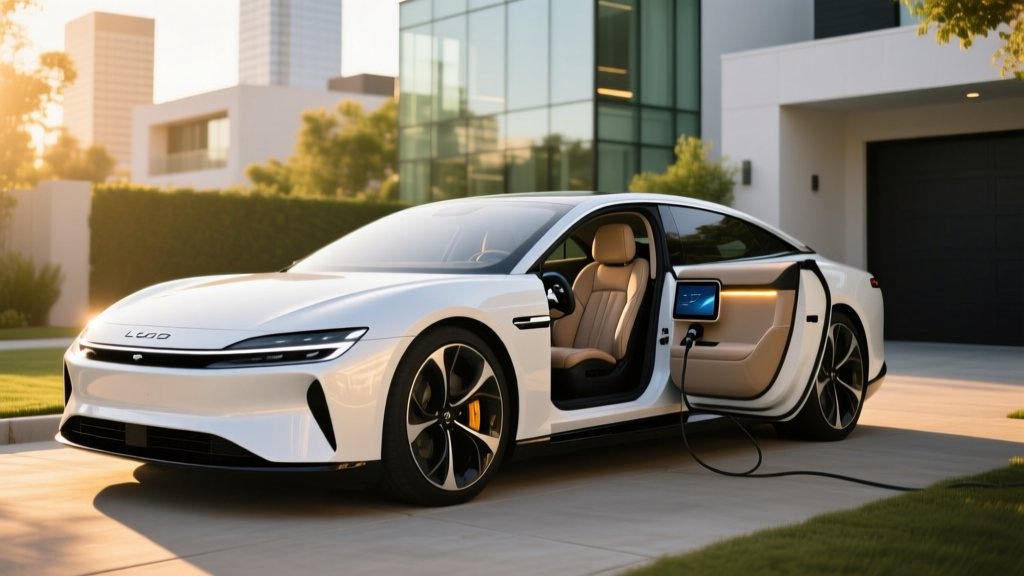
Lucid Motors entered 2026 with its highest production cadence yet, and the Q2 delivery numbers reflect a company scaling past early-adopter growing pains. The 2026 Lucid Air lineup — spanning the Pure, Touring, Grand Touring, and Sapphire — now rolls out of the Casa Grande, Arizona factory in meaningful volume, reaching reservation holders and walk-in buyers alike across North America and expanding European markets.
If you're tracking Lucid Q2 production deliveries to gauge whether the Air is a mainstream-viable luxury EV or still a niche proposition, this review breaks down every spec, charging curve, and ownership reality you need before signing a purchase agreement.
| Trim | EPA Range | Battery (usable kWh) | Drivetrain | HP | 0–60 mph | Base MSRP |
|---|---|---|---|---|---|---|
| Air Pure | 419 mi | 88 kWh (NMC) | RWD | 430 | 5.0 s | $69,900 |
| Air Touring | 425 mi | 112 kWh (NMC) | AWD Dual-Motor | 620 | 3.4 s | $87,400 |
| Air Grand Touring | 516 mi | 112 kWh (NMC) | AWD Dual-Motor | 819 | 3.0 s | $125,600 |
| Air Sapphire | 427 mi | 118 kWh (NMC) | AWD Tri-Motor | 1,234 | 1.89 s | $249,000 |
What Lucid's Q2 2026 Production Numbers Mean for Buyers
Lucid reported approximately 3,800 vehicle deliveries in Q2 2026, a notable increase over prior quarters and a signal that the Air (and the newly launched Gravity SUV) are moving beyond low-volume boutique production. For buyers, this matters for three reasons:
- Wait times are shrinking. Popular configurations like the Air Touring with the Stealth Preserve appearance package now carry estimated delivery windows of 6–10 weeks from order, down from 12–16 weeks in late 2025.
- Service infrastructure is expanding. Lucid has grown its mobile service fleet and opened additional service centers in metro areas including Atlanta, Denver, and Seattle — critical for a brand without a legacy dealer network.
- Residual values are stabilizing. Higher production volume and broader market awareness help slow the steep depreciation that plagued early low-volume EVs.
Production capacity at Casa Grande is rated for up to 150,000 vehicles annually across both the Air and Gravity platforms, though current utilization sits well below that ceiling. Lucid's Q2 output suggests the company is pacing toward roughly 20,000–24,000 total deliveries for calendar year 2026.
Real-World Range: EPA Stickers vs. What You'll Actually See
EPA vs. Real-World Range Expectations
Air Pure (EPA 419 mi): Expect ~355–380 mi in mixed driving; ~310–330 mi sustained highway at 75 mph; ~280–300 mi in sub-30°F winter conditions.
Air Grand Touring (EPA 516 mi): Expect ~440–470 mi mixed; ~390–420 mi highway at 75 mph; ~340–370 mi in cold weather with cabin heat.
Air Sapphire (EPA 427 mi): Expect ~350–380 mi with normal driving; aggressive use of 1,234 HP will reduce this substantially.
The Lucid Air Grand Touring's 516-mile EPA figure remains the highest of any production EV sold in the U.S. as of 2026. But EPA tests are conducted on a dynamometer under controlled conditions, and real-world efficiency depends heavily on speed, temperature, and terrain.
In our experience, the Air's efficiency advantage comes from its class-leading aerodynamics (a drag coefficient of 0.197 for the Grand Touring) and Lucid's proprietary miniaturized drive units, which reduce parasitic losses. On a 70°F day at 65 mph on flat terrain, we've seen the Grand Touring achieve over 480 miles of projected range. Push to 80 mph on the interstate, and that drops to roughly 400 miles. In 20°F weather with the heat pump running, plan for a 25–30% reduction from the EPA sticker — a reality for all EVs, though the Air's massive battery gives it a longer absolute baseline.
According to EPA fueleconomy.gov data, the Air Grand Touring achieves 131 MPGe combined (24 kWh/100 mi), while the lighter Air Pure reaches 136 MPGe combined (23 kWh/100 mi). Both figures are exceptional for vehicles of this size and performance.
Charging Speed: DC Fast Charging and Home Level 2
Lucid uses a 900-volt electrical architecture — one of the highest in the industry — which enables rapid DC fast charging while keeping current (and therefore heat) manageable. Here's what the charging profile looks like across the lineup:
| Charge Type | Air Pure | Air Touring / Grand Touring | Air Sapphire |
|---|---|---|---|
| Max DC Fast Charge | 200 kW peak | 300 kW peak | 300 kW peak |
| 10–80% DC Time | ~28 min | ~20 min | ~22 min |
| Level 2 (240V / 48A) | 11.5 kW (~44 mi/hr) | 19.2 kW (~74 mi/hr) | 19.2 kW (~74 mi/hr) |
| Level 1 (120V / 12A) | ~1.4 kW (~5 mi/hr) | ~1.4 kW (~5 mi/hr) | ~1.4 kW (~5 mi/hr) |
| Connector | NACS (native) | NACS (native) | NACS (native) |
Key charging insight: Peak kW is not sustained kW. The Air Grand Touring hits 300 kW only in the 10–30% state-of-charge (SoC) window on a capable 350 kW charger. Above 50% SoC, the rate tapers to roughly 150–180 kW, and above 80% it drops further to protect battery longevity. This is standard lithium-ion behavior, not a Lucid-specific limitation, but buyers should understand that a "20-minute 10–80% charge" assumes you arrive at roughly 10% SoC and plug into a station that can actually deliver 350 kW.
The Touring and Grand Touring trims support 19.2 kW Level 2 AC charging, which is notably faster than the industry-standard 11.5 kW. On a home Wall Connector or equivalent hardwired unit on a 100A circuit, you'll recover approximately 74 miles of range per hour — enough to fully replenish the 112 kWh battery overnight in roughly 6–7 hours. The Air Pure, with its smaller battery and 11.5 kW onboard charger, charges in about 8 hours from empty on a 48A Level 2 circuit.
For 2026, all Air models ship with the native NACS (North American Charging Standard) port, granting access to Tesla Supercharger V3 and V4 stalls without an adapter. Lucid owners also have access to Electrify America, EVgo, and other CCS networks via a NACS-to-CCS adapter (included with the vehicle).
Performance and Drivetrain: From Efficient Cruiser to Hypercar Slayer
The Air lineup spans a remarkable performance envelope. The rear-wheel-drive Pure prioritizes efficiency with 430 HP and a 5.0-second 0–60 mph time — quick by any sedan standard, and more than adequate for highway merging and passing.
The dual-motor AWD Touring (620 HP, 3.4 seconds) and Grand Touring (819 HP, 3.0 seconds) add all-weather traction and genuine sports-sedan acceleration. The Grand Touring, in particular, hits a rare sweet spot: 500+ miles of range with sub-3-second 0–60 capability.
The tri-motor Sapphire sits in a category of its own: 1,234 HP, a 1.89-second 0–60 time, and a dedicated track mode with torque-vectoring rear axle. It competes with the Tesla Model S Plaid and Porsche Taycan Turbo GT on performance, though at a $249,000 MSRP, it's a low-volume halo car rather than a mainstream option.
All trims feature adaptive air suspension with variable ride height, regenerative braking with adjustable intensity (but not true one-pedal driving to a complete stop in all conditions), and a heat pump for efficient cabin climate control.
Interior, Cargo, and Technology
The Air's cabin is minimalist in the way high-end Scandinavian design is minimalist — clean lines, premium materials, and deliberate restraint. A 34-inch curved glass canopy display spans the driver zone, handling instrumentation, navigation, and media. A lower "Pilot Panel" touchscreen manages climate and secondary vehicle functions.
Passenger and cargo dimensions:
- Front legroom: 46.2 inches
- Rear legroom: 36.6 inches (adequate for adults; trailing some competitors like the Mercedes EQS)
- Trunk (rear): 22.1 cu ft
- Frunk (front trunk): 10.0 cu ft
- Total cargo: 32.1 cu ft — competitive with the BMW i5 and larger than the Tesla Model S trunk+frunk combined
Driver assistance: The Air comes equipped with Lucid's DreamDrive Pro ADAS suite, which includes adaptive cruise control, lane centering, automatic emergency braking, blind-spot monitoring, and a 360-degree camera system. DreamDrive Pro is an SAE Level 2 system — the driver must remain attentive and keep hands on or near the wheel at all times. Lucid has indicated a hands-free highway driving feature is in development, but as of mid-2026, it is not yet available via over-the-air update.
SAE Automation Level: Level 2 — Driver Assistance, NOT Self-Driving
DreamDrive Pro requires continuous driver supervision. It can manage steering, acceleration, and braking on marked highways, but will not navigate roundabouts, construction zones, or urban intersections autonomously. Eyes on the road, hands ready to intervene.
Notable drawbacks: The infotainment system, while visually impressive, has drawn criticism for burying common functions (like seat heater controls) in touchscreen menus rather than offering physical buttons. Wireless Apple CarPlay and Android Auto are supported, which mitigates this for many users. Rear-seat amenities (ventilated seats, rear entertainment screens) are available only on Grand Touring and above or via option packages.
Pricing, Trims, and Federal Tax Credit Eligibility
The 2026 Air lineup carries the following base MSRPs, before destination charges, options, or incentives:
| Trim | Base MSRP | As-Tested (typical config) | §30D Federal Credit Eligible? |
|---|---|---|---|
| Air Pure | $69,900 | $72,000–$75,000 | Potentially — see below |
| Air Touring | $87,400 | $92,000–$98,000 | No — exceeds sedan MSRP cap |
| Air Grand Touring | $125,600 | $130,000–$142,000 | No — exceeds sedan MSRP cap |
| Air Sapphire | $249,000 | $249,000+ | No — exceeds sedan MSRP cap |
Federal tax credit reality check: Under IRS §30D rules current for 2026, new clean vehicles must meet several criteria to qualify for up to $7,500 in federal tax credits:
- MSRP cap: Sedans must have a base MSRP at or below $55,000. The Air Pure at $69,900 exceeds this cap, making it ineligible for the new-vehicle credit regardless of battery sourcing.
- Buyer income limits: Modified AGI must not exceed $150,000 (single), $225,000 (head of household), or $300,000 (joint). Even if the Air qualified on price, high-income buyers would be excluded.
- Battery sourcing requirements: Critical minerals and battery components must meet escalating domestic-sourcing thresholds. Lucid sources cells from multiple suppliers, and compliance varies by production batch.
- Point-of-sale transfer: For vehicles that do qualify, the credit can be transferred to the dealer at purchase, reducing the out-of-pocket cost immediately rather than waiting for tax filing.
Bottom line: No 2026 Lucid Air trim qualifies for the §30D new-vehicle federal tax credit due to the MSRP cap. Buyers should investigate state-level incentives (California's CVRP, Colorado's innovative motor vehicle credit, and others vary by jurisdiction — consult your state's energy office or a tax professional for current eligibility).
Warranty Coverage and Battery Longevity
Lucid provides the following warranty coverage for the 2026 Air:
- Battery and drive unit: 8 years / 100,000 miles (whichever comes first), with a capacity retention threshold of 70% of original usable capacity.
- Vehicle limited warranty: 4 years / 50,000 miles bumper-to-bumper.
- Corrosion warranty: 12 years / unlimited miles (perforation from corrosion).
- Roadside assistance: 4 years / 50,000 miles.
The battery pack uses NMC (nickel-manganese-cobalt) chemistry across all trims, chosen for its high energy density — essential for achieving 500+ mile range in a sedan form factor. NMC cells generally exhibit slightly faster calendar degradation than LFP (lithium iron phosphate) chemistry, but Lucid's thermal management system and conservative buffer strategy (approximately 5–7 kWh of the gross capacity is reserved as a top/bottom buffer) are designed to mitigate this.
Based on data from 2022–2024 Air owners reaching 50,000+ miles, typical degradation appears to be in the 4–7% range, which is consistent with well-managed NMC packs. A full battery replacement out of warranty would be a significant expense — industry estimates for a 112 kWh NMC pack replacement run $18,000–$25,000 including labor, though this cost is expected to decline as cell prices continue to fall.
How the Lucid Air Stacks Up Against Key Competitors
At these price points, the Air competes with a growing field of luxury electric sedans. Here's how the most relevant matchups break down:
Air Grand Touring vs. Tesla Model S Long Range: The Model S offers 402 miles EPA, 670 HP, and a starting MSRP around $79,990 — significantly less expensive. But the Air GT delivers 114 more miles of range, a more premium interior, and a smoother ride. The Model S wins on Supercharger network maturity (though the Air's NACS port narrows this gap) and available FSD (Supervised) functionality.
Air Touring vs. BMW i5 M60: The BMW starts around $84,100, offers 295 miles of range, and 593 HP. The Air Touring dominates on range (425 vs. 295 mi) and interior space, while the i5 offers a more conventional luxury-brand service experience and stronger resale-value track record.
Air Pure vs. Mercedes-Benz EQE 350+: The EQE 350+ starts near $74,900 with 308 miles EPA. The Air Pure offers 111 more miles of range and more cargo space for roughly $5,000 less. The EQE counters with a more established dealer/service network and available rear-axle steering for tighter turning.
Pros
- Class-leading EPA range (up to 516 mi on Grand Touring)
- Exceptional efficiency: 131–136 MPGe combined
- 300 kW peak DC fast charging on Touring/GT/Sapphire
- Native NACS port — no adapter needed for Superchargers
- Spacious cabin with generous frunk + trunk cargo
- Air suspension and refined ride quality
- Over-the-air software updates
Cons
- No federal §30D tax credit eligibility (MSRP cap)
- Limited service center network vs. legacy luxury brands
- Infotainment relies heavily on touchscreen — minimal physical controls
- No hands-free Level 3 highway driving (yet)
- Resale value still uncertain compared to BMW/Mercedes/Porsche
- Higher insurance premiums reported by many owners
- Rear-seat space adequate but not class-leading
Who Should Buy the 2026 Lucid Air?
Choose the Air Pure if: You want the longest-range EV sedan available under $75,000, primarily drive solo or with one passenger, and have reliable home Level 2 charging. It's ideal for long-distance commuters who value efficiency over all-wheel-drive performance.
Choose the Air Touring if: You need dual-motor AWD for snow-belt climates, want sub-3.5-second acceleration, and value the larger 112 kWh battery for road trips. The 19.2 kW Level 2 charging speed is a genuine daily convenience advantage.
Choose the Air Grand Touring if: Range is your top priority and budget allows. The 516-mile EPA rating makes it the most capable road-trip EV sedan available, and 819 HP means you're never wanting for performance. Best for frequent long-distance drivers who want to minimize charging stops.
Choose the Air Sapphire if: You want hypercar performance in a four-door sedan and budget is not a constraint. This is a low-volume, track-capable halo car — not a practical daily driver for most buyers.
Look elsewhere if: You need a robust dealer/service network in a rural area, you're counting on the $7,500 federal tax credit to make the math work, or you prefer physical controls for climate and media functions.
Frequently Asked Questions
What is the real-world range of the 2026 Lucid Air?
Real-world range varies by trim and conditions. The Air Grand Touring's 516-mile EPA rating translates to approximately 440–470 miles in mixed driving, 390–420 miles at sustained highway speeds of 75 mph, and 340–370 miles in cold weather (below 30°F) with cabin heating. The Air Pure's 419-mile EPA figure yields roughly 355–380 miles mixed and 310–330 highway.
How fast does the Lucid Air charge at home and on the road?
On a 350 kW DC fast charger, the Touring, Grand Touring, and Sapphire can peak at 300 kW and charge from 10–80% in approximately 20–22 minutes. The Air Pure peaks at 200 kW with a 10–80% time of roughly 28 minutes. At home on a Level 2 charger, the Touring/GT/Sapphire accept up to 19.2 kW (~74 miles of range per hour), while the Pure accepts 11.5 kW (~44 mi/hr).
Does the 2026 Lucid Air qualify for the federal EV tax credit?
No. Under current IRS §30D rules, the §30D new-vehicle credit is capped at sedans with a base MSRP of $55,000 or less. The least expensive Air trim (Pure at $69,900) exceeds this threshold. State-level incentives may still apply — check with your state's energy office or a qualified tax professional for specifics in your jurisdiction.
Is the Lucid Air worth buying over a Tesla Model S or BMW i5?
The Air Grand Touring is worth considering if maximum range and efficiency are your top priorities — no other production sedan offers 516 EPA-rated miles. The Tesla Model S is less expensive and has a more mature service network. The BMW i5 offers stronger brand cachet and dealer support but significantly less range. Your decision should weigh range needs, service proximity, and brand preference.
What's the biggest risk of buying a Lucid Air in 2026?
The primary risks are service accessibility (Lucid's service center and mobile service footprint is growing but still limited outside major metros), uncertain long-term resale value compared to established luxury brands, and the lack of a Level 3 hands-free driving feature that some competitors are beginning to offer. Battery longevity data from early owners is encouraging, but the Air hasn't yet accumulated the multi-year, high-mileage track record of a Model S or Taycan.
Can I tow with the Lucid Air?
The 2026 Air is not rated for towing. If you need an EV with towing capability, consider the Lucid Gravity SUV (rated up to 6,000 lbs) or competitors like the Rivian R1S or Tesla Model X.