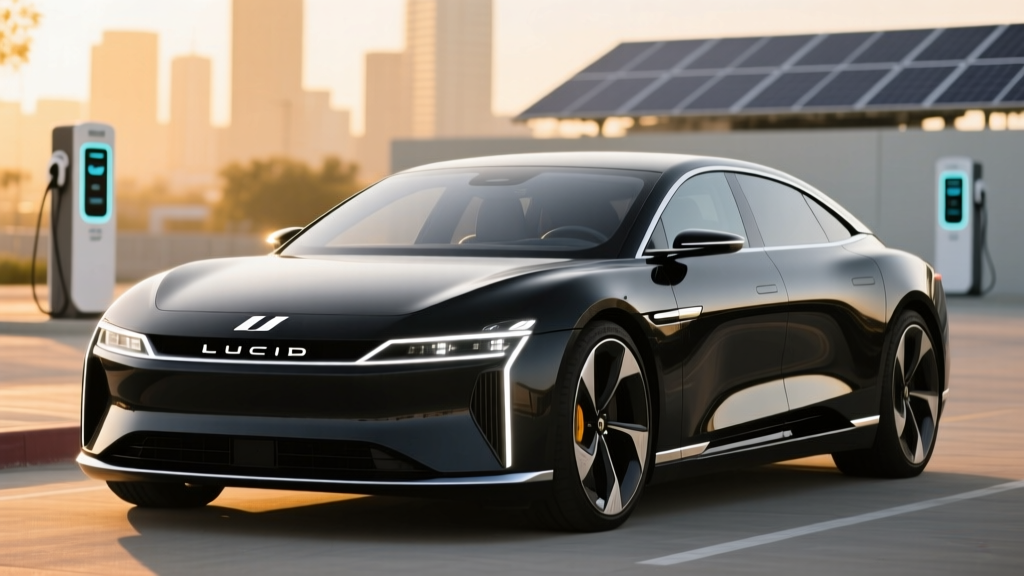
If you follow EV market news, you've likely seen the headline: Lucid stock faces significant risk if its main investor exits. Saudi Arabia's Public Investment Fund (PIF) holds roughly 60% of Lucid Motors, and any meaningful reduction in that stake would pressure the company's balance sheet, production continuity, and long-term parts support. For prospective buyers, that macro-level concern collides with a very practical question: is the 2026 Lucid Air still one of the most capable luxury electric sedans on the road, or does corporate uncertainty make it a risky purchase?
This review evaluates the 2026 Lucid Air on the metrics that matter to owners — real-world range, charging speed, interior space, pricing after federal incentives, and ownership viability — while addressing the investor-exit risk head-on.
2026 Lucid Air: Core Specifications at a Glance
| Spec | Air Pure | Air Touring | Air Grand Touring |
|---|---|---|---|
| EPA Range | 419 mi | 425 mi | 516 mi |
| Battery (usable) | 88 kWh (NMC) | 112 kWh (NMC) | 112 kWh (NMC) |
| Drivetrain | RWD (single motor) | AWD (dual motor) | AWD (dual motor) |
| Horsepower | 430 hp | 620 hp | 819 hp |
| 0–60 mph | 5.0 sec | 3.4 sec | 3.0 sec |
| Max DC Fast Charge | 200 kW | 300 kW | 300 kW |
| 10–80% DC Time | ~30 min | ~20 min | ~20 min |
| Level 2 Home Rate | 19.2 kW (~80 mi/hr) | 19.2 kW (~80 mi/hr) | 19.2 kW (~80 mi/hr) |
| MPGe (combined) | 146 MPGe | 131 MPGe | 131 MPGe |
| Efficiency | 23 kWh/100 mi | 26 kWh/100 mi | 26 kWh/100 mi |
| Base MSRP | $69,900 | $87,400 | $125,600 |
| Battery/Powertrain Warranty | 8 yr / 100,000 mi | 8 yr / 100,000 mi | 8 yr / 100,000 mi |
All trims use nickel-manganese-cobalt (NMC) lithium-ion cells. Lucid has not adopted LFP chemistry, which trades energy density for lower cost and longer cycle life. The Air's industry-leading efficiency — particularly the Grand Touring's ability to push 516 EPA miles from a 112 kWh pack — is a direct result of Lucid's miniaturized drive units and 900V+ electrical architecture.
Real-World Range: What the EPA Number Doesn't Tell You
The Touring and Pure trims see similar proportional reductions. The Pure's 419-mile EPA rating translates to roughly 330–360 highway miles and 280–310 miles in deep cold. According to fueleconomy.gov, the Air Grand Touring's combined 131 MPGe remains among the best in the luxury EV segment, though the lighter Pure actually achieves superior efficiency at 146 MPGe thanks to its single-motor RWD layout.
For context: a 300-mile highway road trip in the Grand Touring requires zero charging stops in fair weather. That's a meaningful advantage over competitors like the BMW i7 ( EPA 318 mi) or Mercedes EQS (EPA 352 mi), which typically need one fast-charge stop on the same route.
Charging Performance: 300 kW Peak, but Mind the Curve
| Charging Level | Power / Rate | Miles Added per Hour | Notes |
|---|---|---|---|
| Level 1 (120V) | ~1.4 kW | ~4–5 mi/hr | Emergency/trickle only |
| Level 2 (240V, 80A) | 19.2 kW | ~80 mi/hr | Requires hardwired 100A circuit |
| Level 2 (240V, 48A) | 11.5 kW | ~48 mi/hr | Standard home wall connector |
| DC Fast Charge | Up to 300 kW (peak) | ~1,200 mi/hr (at peak) | 10–80% in ~20 min; tapers sharply above 80% |
Lucid's 900V electrical architecture enables the Touring and Grand Touring to accept up to 300 kW at compatible DC fast chargers. However, like all EVs, the Air's charge curve is not flat. Peak 300 kW is sustained only between approximately 10–40% state of charge. From 40–60%, the rate drops to roughly 200–220 kW; from 60–80%, it further tapers to 120–150 kW. The 10–80% time of approximately 20 minutes is competitive with the Porsche Taycan and faster than the Tesla Model S.
Above 80% SoC, charging slows dramatically to protect cell longevity — expect 80–100% to take an additional 25–35 minutes. For road trips, the practical strategy is charging to 80% and moving on.
One important compatibility note: the 2026 Air ships with a NACS (Tesla-style) charge port, granting native access to Tesla Supercharger V4 stalls without an adapter. For Electrify America and other CCS networks, Lucid provides a NACS-to-CCS adapter. Home charging at the full 19.2 kW rate requires a 100-amp dedicated circuit and hardwired EVSE — a panel upgrade may be necessary for homes with older 100A or 150A service.
Interior Space, Technology, and Driver Assistance
The Air's cabin is one of its strongest selling points. Rear legroom measures 41.3 inches — more than the Mercedes S-Class — and the glass canopy roof creates an airy, open feel that no competitor matches. Cargo volume totals 32 cubic feet combined (22 cu ft trunk + 10 cu ft frunk), making the Air practical for airport runs and weekend trips alike.
The 34-inch curved glass cockpit display spans the entire dashboard, supplemented by a lower touchscreen for climate and secondary controls. Wireless Apple CarPlay and Android Auto are standard, as is a 21-speaker Surreal Sound Pro audio system on Touring and Grand Touring trims.
Lucid's DreamDrive Pro ADAS suite includes adaptive cruise control, lane-centering assist, automated lane changes, and a 32-sensor array (lidar, radar, cameras, ultrasonic). This is an SAE Level 2 driver-assistance system — the driver must remain attentive with hands on or near the wheel at all times. It is not autonomous driving. DreamDrive Pro is competitive with Tesla Autopilot and BMW Driving Assistant Professional but does not offer hands-free operation on mapped highways the way GM's Super Cruise or Ford's BlueCruise do.
Pricing, Tax Credits, and the Investor Risk Factor
The 2026 Lucid Air lineup prices as follows:
- Air Pure: $69,900 MSRP
- Air Touring: $87,400 MSRP
- Air Grand Touring: $125,600 MSRP
- Air Sapphire (performance halo): $249,000 MSRP
Federal EV tax credit eligibility under IRS §30D is a complex picture for Lucid. The §30D credit of up to $7,500 requires meeting battery component and critical mineral sourcing thresholds, MSRP caps ($55,000 for sedans), and buyer income limits ($150,000 single / $300,000 joint AGI). Because the Air is a sedan with an MSRP above $55,000 on all trims, it does not qualify for the new-vehicle §30D federal tax credit. Buyers should consult a tax professional regarding state-level incentives, which vary by jurisdiction and may partially offset the cost.
Now to the headline concern: Lucid stock faces significant risk if its main investor exits. The Saudi PIF has injected over $7 billion into Lucid since 2018, funding production ramp-up at the Casa Grande, Arizona factory and the development of the upcoming Gravity SUV. If PIF were to divest or significantly reduce its stake:
- Production continuity could be disrupted if capital dries up before Lucid achieves positive gross margins
- Parts and service support for existing vehicles would depend on Lucid's ability to remain solvent or find a buyer
- Warranty honoring is contractually required but practically dependent on the company's financial health
- Resale values would likely drop sharply on bankruptcy or acquisition speculation
That said, the Air is a shipping, proven product — not a concept. Over 10,000 units have been delivered, and the company's technology (particularly its drive-unit efficiency) has attracted licensing interest. The risk is real but should be weighed against the fact that even in a worst-case scenario, a Lucid acquisition by a larger automaker would likely preserve parts and service obligations.
Lucid Air vs. Key Competitors: Where It Wins and Loses
| Attribute | Lucid Air GT | Tesla Model S LR | BMW i7 xDrive50 | Mercedes EQS 580 |
|---|---|---|---|---|
| EPA Range | 516 mi | 402 mi | 318 mi | 352 mi |
| Battery | 112 kWh NMC | ~100 kWh | 101.7 kWh NMC | 108.4 kWh NMC |
| Max DC Charge | 300 kW | 250 kW | 195 kW | 200 kW |
| 0–60 mph | 3.0 sec | 3.1 sec | 4.5 sec | 4.1 sec |
| Base MSRP | $125,600 | $74,990 | $119,300 | $125,950 |
| Rear Legroom | 41.3 in | 35.4 in | 40.2 in | 38.7 in |
| Service Network | ~30 centers | 200+ centers | 400+ dealers | 380+ dealers |
Choose the Lucid Air If:
- Maximum range per charge is your top priority
- You value class-leading rear-seat space
- You want the most energy-efficient luxury EV sedan available
- You primarily live near a major metro with Lucid service access
Choose a Competitor If:
- You need widespread dealer service coverage (BMW, Mercedes)
- Hands-free highway driving matters (GM Super Cruise in the Cadillac Celestiq, or Tesla Autopilot)
- Corporate financial stability is a dealbreaker
- You want a sub-$80K luxury EV (Tesla Model S)
Ownership Costs and Long-Term Viability
The Air's 8-year/100,000-mile battery and powertrain warranty matches industry standards set by Tesla, Hyundai, and Kia. Lucid guarantees the battery will retain at least 70% of its original capacity during the warranty period. Based on NMC chemistry degradation data from similar packs, expect approximately 8–12% capacity loss over the first 100,000 miles under normal use — meaning a Grand Touring that started at 516 EPA miles would realistically offer 455–475 miles after five years.
Insurance costs are a real consideration: the Air Grand Touring averages $3,200–$4,100 annually for full coverage, roughly 30–40% higher than a comparable BMW i7, according to industry estimates. This reflects the Air's high repair costs, limited body-shop network, and expensive proprietary parts.
Charging costs are where the Air rewards owners. At the national average electricity rate of $0.17/kWh, fully charging the Grand Touring's 112 kWh pack costs approximately $19 — compared to roughly $65–$80 to fill a comparable gas sedan's tank. Over 15,000 miles per year, the Air Grand Touring uses about 3,900 kWh, or roughly $663 in home electricity. DC fast charging on road trips adds $400–$600 annually for typical users.
Who the 2026 Lucid Air Suits Best
Best for: High-mileage commuters and road-trippers who prioritize range above all else, luxury sedan buyers who want something distinctive from the German establishment, and tech-forward buyers who appreciate the Air's engineering achievements.
Not ideal for: Buyers in rural areas far from Lucid's limited service network, risk-averse purchasers uncomfortable with the company's financial uncertainty, or those who want hands-free Level 2+ highway driving.
Towing note: The Air is not rated for towing. If you need a luxury EV with towing capacity, look at the BMW iX (3,500 lb) or await the Lucid Gravity SUV.
Frequently Asked Questions
What is the real-world range of the 2026 Lucid Air?
The Grand Touring achieves an EPA-rated 516 miles. Real-world highway driving yields 400–440 miles in moderate weather and 340–380 miles in freezing temperatures. The Pure trim delivers roughly 330–360 highway miles from its 419-mile EPA rating.
How fast does the Lucid Air charge?
The Touring and Grand Touring accept up to 300 kW DC fast charging, reaching 10–80% in approximately 20 minutes at a compatible station. Home Level 2 charging at 19.2 kW adds roughly 80 miles per hour, but requires a 100-amp dedicated circuit. A standard 48A Level 2 charger adds about 48 miles per hour.
Does the Lucid Air qualify for the federal EV tax credit?
No. Under current IRS §30D rules, the new-vehicle credit has a $55,000 MSRP cap for sedans. Every Air trim exceeds this threshold. The used-EV credit (§25E, up to $4,000) may apply if you purchase a pre-owned Air for $25,000 or less — unlikely given current resale values. State incentives may partially offset costs; check your local jurisdiction.
Is it worth buying a Lucid Air given the investor risk?
The PIF's majority stake is both Lucid's lifeline and its vulnerability. If PIF exits, the company would need alternative capital within months. For risk-tolerant buyers who value the Air's unmatched range and efficiency, the car itself is excellent. For risk-averse buyers, leasing (which transfers residual-value risk to the lessor) may be a smarter approach than purchasing outright. As of early 2026, Lucid continues normal production and has not announced any changes to its investor relationship.
What are the biggest pros and cons of the 2026 Lucid Air?
- Industry-leading 516-mile EPA range (Grand Touring)
- Best-in-class efficiency (131–146 MPGe)
- Enormous rear-seat legroom (41.3 in)
- 300-kW DC fast charging capability
- NACS native charging (Supercharger access)
- Spacious trunk + frunk (32 cu ft total)
- No federal tax credit (MSRP above $55K sedan cap)
- Limited service network (~30 locations)
- Corporate financial uncertainty (PIF dependency)
- Touchscreen-heavy controls lack physical buttons
- High insurance premiums ($3,200–$4,100/yr)
- No hands-free driving mode (Level 2 only)
- No towing capability
How does the Air's warranty compare?
Lucid provides an 8-year/100,000-mile battery and powertrain warranty with a 70% capacity retention guarantee, plus a 4-year/50,000-mile basic vehicle warranty. This matches Tesla's coverage and is slightly below Hyundai's 10-year/100,000-mile powertrain warranty on the Ioniq 6.