Is Buying a Lucid Air in 2026 a Safe Bet?
If you've been watching the EV space, you've likely seen the headline: will Lucid go out of business? It's a fair question for any luxury-EV shopper considering a $70,000+ vehicle from a startup that has burned billions, delivered far fewer cars than projected, and operates in an increasingly crowded premium-sedan segment. This review tackles that concern head-on, but it also gives you what you actually need to make a purchase decision: hard numbers on the 2026 Lucid Air's range, charging speed, efficiency, pricing, and ownership economics.
Lucid's financial position has stabilized somewhat through continued backing by Saudi Arabia's Public Investment Fund (PIF), which holds a majority stake. The company secured additional capital infusions through 2025 and into 2026, and the launch of the Gravity SUV broadens its revenue base. That said, Lucid remains a low-volume manufacturer with cumulative deliveries well below those of Tesla, BMW, or Mercedes-Benz. Buying a Lucid Air today means accepting a degree of brand risk that you simply don't carry with a legacy automaker. We'll quantify that risk and help you decide whether the Air's technical excellence justifies it.
2026 Lucid Air: Quick Verdict
The 2026 Lucid Air remains the most efficient long-range luxury EV sedan on the market. Its powertrain technology — particularly the miniaturized drive units and 900V+ architecture — is genuinely class-leading. The Air Pure delivers an EPA-estimated 419 miles of range at a starting price that undercuts most rivals, while the Air Grand Touring pushes past 500 miles. Interior space is generous, the glass canopy roof is stunning, and ride quality is superb. The trade-offs are a less mature service network, uncertain long-term brand viability, an infotainment system that still lags behind Tesla's in responsiveness, and limited availability of the full $7,500 federal tax credit depending on battery sourcing.
| Spec | Air Pure | Air Touring | Air Grand Touring | Air Sapphire |
|---|---|---|---|---|
| EPA Range | 419 mi | 425 mi | 516 mi | 427 mi |
| Battery (usable) | 88 kWh (NMC) | 112 kWh (NMC) | 112 kWh (NMC) | 118 kWh (NMC) |
| Drivetrain | RWD (single motor) | AWD (dual motor) | AWD (dual motor) | AWD (tri-motor) |
| Horsepower | 430 hp | 620 hp | 819 hp | 1,234 hp |
| 0-60 mph | 5.0 sec | 3.4 sec | 3.0 sec | 1.89 sec |
| Max DC Charge Rate | 200 kW | 250 kW | 300+ kW | 300+ kW |
| 10-80% DC Fast Charge | ~25 min | ~22 min | ~20 min | ~20 min |
| Level 2 Rate | 19.2 kW (AC) | 19.2 kW (AC) | 19.2 kW (AC) | 19.2 kW (AC) |
| MPGe (combined) | 146 MPGe | 131 MPGe | 131 MPGe | 116 MPGe |
| Base MSRP | $69,900 | $77,900 | $110,900 | $249,000 |
Range and Efficiency: The Air's Biggest Advantage
Range is where the Lucid Air separates itself from every competitor. The Air Grand Touring's EPA-estimated 516 miles is the highest of any production EV sold in the U.S., and the base Air Pure's 419 miles still beats the Tesla Model S Long Range (~402 mi) and the Mercedes EQS (~390 mi). Efficiency is the real story: the Air Pure achieves an extraordinary 146 MPGe combined, which translates to roughly 23 kWh/100 miles — a figure that makes even the most efficient Tesla look slightly thirstier per mile.
EPA estimates assume a mix of city and highway driving at moderate temperatures. Here's what to expect in practice:
- Highway cruising (70-75 mph, 75°F): Expect ~85-90% of EPA — roughly 440-465 mi (Grand Touring), ~360-380 mi (Pure).
- Cold weather (30°F, highway): Plan for 25-35% range loss. Grand Touring drops to ~340-390 mi; Pure to ~270-315 mi.
- City/suburban mixed driving (moderate temps): You can approach or slightly exceed EPA numbers thanks to strong regenerative braking.
The Air's heat pump (standard on all trims) helps mitigate cold-weather loss compared to EVs without one, but physics is physics — any EV loses meaningful range below freezing.
Lucid achieves these numbers through a combination of factors: an exceptionally aerodynamic body (drag coefficient of 0.197), compact and lightweight permanent-magnet drive units developed in-house, and a high-voltage architecture that reduces current and heat loss. The result is a sedan that genuinely changes your relationship with charging stops on road trips. On a 500-mile drive, a Grand Touring owner may make one brief stop — or none at all, depending on conditions.
Charging Speed and Infrastructure
The Air's 900V+ electrical architecture enables some of the fastest DC charging in production. However, peak kilowatt numbers only tell part of the story — sustained charge rate and the shape of the charge curve matter more for real road trips.
| Charging Method | Power | Speed (approx.) | Notes |
|---|---|---|---|
| Level 1 (120V household) | ~1.4 kW | ~4-5 mi/hr | Emergency/top-up only |
| Level 2 (240V home, 48A) | 11.5 kW | ~35-40 mi/hr | Full charge in ~10-12 hrs |
| Level 2 (240V, 80A capable) | 19.2 kW | ~55-65 mi/hr | Requires 100A circuit; full charge in ~6-7 hrs |
| DC Fast (peak, Grand Touring) | 300+ kW | ~200+ mi in 15 min | At compatible 350 kW stations; tapers above 80% |
| DC Fast (peak, Pure/Touring) | 200-250 kW | ~150 mi in 15 min | Sustained rate depends on battery temp |
The Air uses a CCS1 connector natively. Lucid includes a NACS adapter (for Tesla Supercharger access) with new vehicles as of the 2025 model year, which significantly expands the usable fast-charging network. At a 350 kW Electrify America or Ionity station, the Grand Touring can accept over 300 kW at low states of charge, adding roughly 200 miles in about 15 minutes. However, like all EVs, charge speed tapers significantly above 80% state of charge — the final 20% can take as long as the first 60%.
For home charging, the Air's onboard charger supports up to 19.2 kW on Level 2 AC, which is among the highest available. To take full advantage, you'll need an 80-amp hardwired Level 2 charger on a 100-amp dedicated circuit. Most buyers install a 48-amp Level 2 unit (like a ChargePoint Home Flex or Tesla Wall Connector) on a 60-amp circuit, delivering about 11.5 kW — enough to fully recharge overnight for nearly all daily driving.
Performance and Driving Dynamics
Even the base Air Pure delivers brisk acceleration: 430 horsepower and a 5.0-second 0-60 mph time from a single rear motor. That's quicker than most gas-powered luxury sedans and more than adequate for daily driving and highway merging. Step up to the Touring (620 hp, 3.4 sec) or Grand Touring (819 hp, 3.0 sec) and you enter sports-car territory. The Sapphire, with its 1,234 hp tri-motor setup and 1.89-second 0-60, is a hypercar in sedan clothing — though at $249,000, it's a halo model, not a volume seller.
Ride quality across all trims is excellent. The Air uses a multi-link front and rear suspension with available air springs (standard on Grand Touring and Sapphire, optional on Touring). The result is a sedan that absorbs highway imperfections with composure while maintaining flat cornering. Steering is precise if slightly light on feel. The cabin is whisper-quiet at speed — among the best in the luxury segment for noise isolation.
Interior, Tech, and Cargo
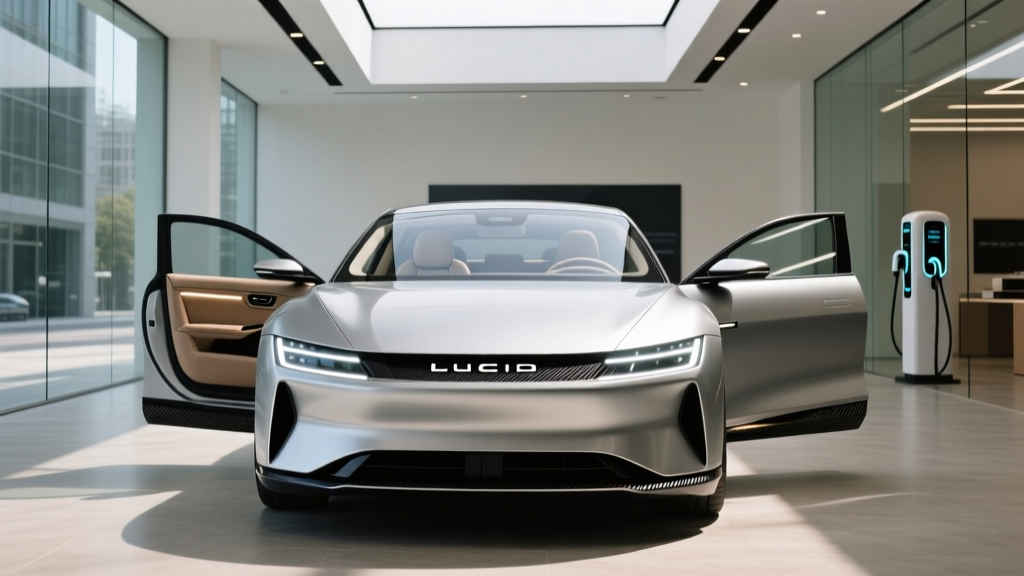
The Air's interior is defined by its glass canopy roof, which stretches from the windshield to the rear header, flooding the cabin with light. The upper touchscreen (34-inch curved glass cockpit display) handles navigation, media, and vehicle settings, while a lower retractable screen manages climate and secondary controls. The system runs Lucid's proprietary software — it's visually clean but not as snappy or app-rich as Tesla's interface. Wireless Apple CarPlay and Android Auto are standard, which many buyers will prefer.
Lucid's driver-assistance suite, called DreamDrive Pro, includes adaptive cruise control, lane-centering, automatic emergency braking, blind-spot monitoring, and a 360-degree camera. It's a solid Level 2 system (per SAE definitions), meaning the driver must remain fully engaged. It does not offer hands-free driving on mapped highways the way GM's Super Cruise or Ford's BlueCruise do — a notable gap at this price point.
Cargo and passenger space are strong:
- Trunk: 22.1 cu ft (rear) + 7.1 cu ft frunk = 29.2 cu ft total
- Rear legroom: 36.3 inches — competitive with the BMW 5 Series and Mercedes E-Class
- Front headroom: 39.3 inches (abundant thanks to the glass roof design)
The Air comfortably seats four adults on long trips. The rear seat is a two-place setup with a center armrest/console; there's no true five-passenger bench. For families needing three-across rear seating, the Tesla Model S or the upcoming Lucid Gravity are better fits.
Pricing, Tax Credits, and the Ownership Risk Question
Here's where the "will Lucid go out of business" concern meets your wallet. The 2026 Air Pure starts at $69,900, making it one of the most affordable long-range luxury EVs. But tax-credit eligibility is complicated and trim-dependent.
| Trim | Base MSRP | §30D Credit Eligible? | Est. After Credit |
|---|---|---|---|
| Air Pure | $69,900 | Partial — depends on battery sourcing compliance; subject to income caps | ~$62,400–$69,900 |
| Air Touring | $77,900 | Partial — same sourcing caveats; under $55K sedan MSRP cap? No — exceeds cap | $77,900 (no credit) |
| Air Grand Touring | $110,900 | No — exceeds §30D MSRP cap of $55,000 for sedans | $110,900 |
| Air Sapphire | $249,000 | No — exceeds MSRP cap | $249,000 |
Tax credit details matter. Under current IRS §30D rules, sedans must have an MSRP of $55,000 or less to qualify. The Air Pure at $69,900 exceeds this cap, meaning no Lucid Air trim currently qualifies for the new-vehicle federal tax credit based on MSRP alone. However, the used-EV credit (§25E) may apply if you purchase a pre-owned Air for $25,000 or less from a dealer — offering up to $4,000 (30% of sale price). State incentives (like California's CVRP or Colorado's innovative motor vehicle credit) may also apply — check your state's energy office for current programs.
On the business-risk question specifically: Lucid's majority owner, Saudi Arabia's PIF, has repeatedly injected capital, most recently through a $1.5 billion investment in late 2025. The company's cash runway extends into 2027 based on current burn rates and committed funding. However, annual deliveries remain well below 15,000 units, and the company has never been profitable. The risk isn't necessarily sudden bankruptcy — it's more likely a scenario of reduced production, delayed service parts, or acquisition. If you buy an Air, you're betting that PIF continues to back the company and that the Gravity SUV generates enough volume to sustain operations. That's a calculated risk, not a reckless one — but it's real.
Warranty, Service, and Long-Term Ownership
Lucid provides a competitive warranty package:
- Basic vehicle warranty: 4 years / 50,000 miles
- Battery and powertrain: 8 years / 100,000 miles (covers defects and capacity below 70% of original)
- Roadside assistance: 4 years / 50,000 miles
The battery pack uses NMC (nickel manganese cobalt) chemistry across all trims. NMC offers higher energy density than LFP, which is essential for the Air's range targets, but it's slightly more sensitive to repeated 100% charging. Best practice: charge to 80-90% for daily use and reserve 100% for road trips. Lucid's battery management system includes a robust thermal management loop to protect long-term health.
The service network is Lucid's biggest practical weakness. As of early 2026, Lucid operates roughly 20 service centers in the U.S., concentrated in major metro areas (California, New York, Miami, Chicago, etc.). Mobile service vans handle minor repairs in some regions, but collision repair and major drivetrain work require a physical center. If you live outside a major metro, service access is a legitimate concern — more so than the financial risk, day to day.
Pros
- Class-leading EPA range (up to 516 mi) and efficiency (146 MPGe)
- Exceptional ride quality and cabin quietness
- Fast DC charging (300+ kW peak on GT/Sapphire)
- Spacious interior with striking glass canopy
- Strong backing from Saudi PIF reduces near-term bankruptcy risk
- 19.2 kW Level 2 onboard charging is best-in-class
Cons
- No Lucid Air trim qualifies for §30D new-vehicle tax credit (MSRP cap)
- Service network is limited (~20 U.S. centers)
- Brand longevity risk — low-volume startup in a capital-intensive industry
- Infotainment is less polished than Tesla or Mercedes MBUX
- No hands-free highway driving (DreamDrive Pro requires hands-on)
- Rear seats only two passengers (no 3-across)
Lucid Air vs. Key Competitors
The Air competes in a narrow but growing segment: long-range luxury electric sedans priced from $70K to $120K. Here's how it stacks up on paper against the three most relevant rivals:
| Spec | Lucid Air Pure | Tesla Model S LR | Mercedes EQS 450+ | BMW i7 eDrive50 |
|---|---|---|---|---|
| EPA Range | 419 mi | ~402 mi | ~390 mi | ~318 mi |
| MPGe (combined) | 146 | ~124 | ~97 | ~86 |
| Battery (usable) | 88 kWh NMC | ~100 kWh | ~108 kWh | ~102 kWh |
| Max DC Charge | 200 kW | 250 kW | 200 kW | 195 kW |
| 0-60 mph | 5.0 sec | 3.1 sec | 5.9 sec | 5.5 sec |
| Base MSRP | $69,900 | ~$74,990 | ~$105,550 | ~$106,700 |
| Service Network | ~20 centers | 200+ centers | 380+ dealers | 350+ dealers |
The Air wins on range and efficiency, decisively. The Model S wins on performance-per-dollar and service infrastructure. The EQS and i7 win on brand cachet, dealer service, and interior opulence but sacrifice range and efficiency. Your priorities determine the right answer.
Who Should Buy the Lucid Air — and Who Shouldn't
Buy the Air if: You prioritize maximum range and efficiency above all else, you live near a Lucid service center, you value a quiet and spacious cabin for long-distance driving, and you're comfortable with the brand risk in exchange for best-in-class EV technology. The Air Pure at $69,900 is genuinely compelling for efficiency-focused luxury buyers.
Skip the Air if: You need a robust dealer/service network in a rural or smaller metro area, you want hands-free highway driving (look at BMW or Mercedes), you need five-passenger seating, or the thought of owning a car from a financially unproven startup keeps you up at night. In that case, the Tesla Model S, BMW i7, or Mercedes EQS offer more ownership security — at the cost of range and efficiency.
Frequently Asked Questions
Will Lucid go out of business in the next few years?
There is no imminent bankruptcy filing as of early 2026. Saudi Arabia's PIF holds a majority stake and has injected capital multiple times. However, Lucid has never been profitable, deliveries remain low, and the company depends on continued PIF support and the success of the Gravity SUV. The risk is real but not immediate — think acquisition or restructuring before outright collapse.
What is the real-world range of the Lucid Air?
The EPA rates the Air Grand Touring at 516 miles and the Air Pure at 419 miles. In real-world highway driving at 70-75 mph in moderate weather, expect about 85-90% of those figures (~440-465 mi for GT, ~360-380 mi for Pure). In cold weather (below 30°F), plan for 25-35% loss. These are still best-in-class numbers.
How fast does the Lucid Air charge at home and on the road?
At home on a 48-amp Level 2 charger (240V), the Air charges at about 11.5 kW, adding roughly 35-40 miles per hour — a full overnight charge. On a compatible 350 kW DC fast charger, the Grand Touring peaks above 300 kW and can add ~200 miles in about 15 minutes. The Pure and Touring peak at 200-250 kW. All trims taper significantly above 80% SoC.
Does the Lucid Air qualify for the federal EV tax credit?
No — under current IRS §30D rules, new sedans must have an MSRP at or below $55,000. The cheapest Air (Pure at $69,900) exceeds this cap. You may qualify for the used-EV credit (§25E, up to $4,000) on a pre-owned Air priced at $25,000 or less. State incentives may also apply — check your state energy office.
Is the Lucid Air worth buying over a Tesla Model S?
It depends on your priorities. The Air offers significantly better range (419-516 mi vs. ~402 mi), far superior efficiency (146 vs. ~124 MPGe), and a quieter, more luxurious ride. The Model S offers a vastly larger service and Supercharger network, a more mature infotainment system, and quicker acceleration in its dual-motor form. If range and efficiency are paramount, the Air wins. If service access and ecosystem maturity matter more, the Model S is safer.
What happens to my Lucid if the company goes under?
In a worst-case scenario (liquidation), parts availability and software updates would become concerns. However, Lucid's PIF backing makes an outright shutdown less likely than an acquisition or restructuring, which would typically preserve service obligations. The 8-year/100,000-mile battery warranty would be at risk in a liquidation, though. Buyers should weigh this when deciding on extended warranties or lease-vs-purchase.
How does the Lucid Air handle cold weather?
All Air trims include a heat pump, which improves cold-weather efficiency compared to resistive heating. Expect 25-35% range reduction in sustained sub-freezing highway driving. Preconditioning the battery while plugged in (via the Lucid app) helps preserve range and enables faster DC charging in cold conditions. Real-world winter range for the Grand Touring is approximately 340-390 miles — still very usable.
Sources: EPA range and efficiency data from fueleconomy.gov; Lucid Air specifications from Lucid Motors official site; federal tax credit rules from IRS §30D guidance.