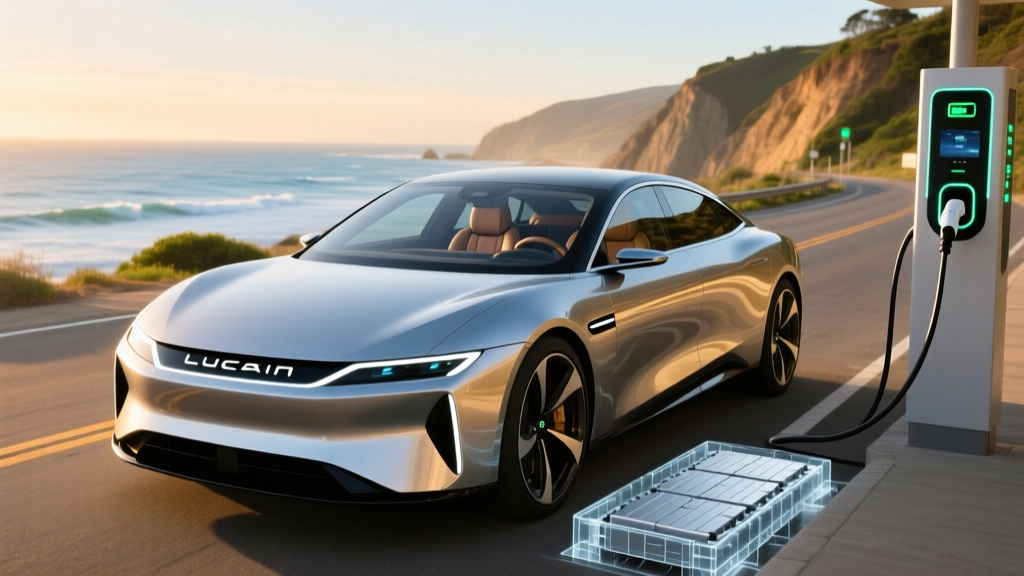
The Lucid Air launched with a bold promise: class-leading range wrapped in a luxury sedan that could outperform a Tesla Model S on efficiency and interior space. The 2023 model year delivered on much of that promise, introducing the more accessible Pure and Touring trims alongside the flagship Grand Touring and Sapphire. Now, with several model years of real-world ownership data behind it, the 2023 Lucid Air remains one of the most compelling used and certified-pre-owned luxury EVs on the market — but it's not without quirks that buyers need to understand before signing.
This review breaks down every spec that matters to an actual owner: real-world range versus the EPA sticker, charging-curve behavior at DC fast chargers, the nuances of its NMC battery chemistry, and whether you can still capture a federal tax credit on a 2023 model in 2026. Let's get into the numbers.
Lucid Air 2023: Key Specifications at a Glance
| Spec | Pure RWD | Touring AWD | Grand Touring AWD | Sapphire |
|---|---|---|---|---|
| EPA Range | 410 mi | 425 mi | 516 mi | 427 mi |
| Battery (usable) | 88 kWh (NMC) | 112 kWh (NMC) | 112 kWh (NMC) | 118 kWh (NMC) |
| Horsepower | 430 hp | 620 hp | 819 hp (1,050 w/ Sprint) | 1,234 hp |
| 0–60 mph | 5.0 sec | 3.4 sec | 3.0 sec | 1.89 sec |
| Drivetrain | RWD (single motor) | AWD (dual motor) | AWD (dual motor) | AWD (tri-motor) |
| Max DC Charge Rate | ~200 kW | ~300 kW | ~300 kW | ~300 kW |
| 10–80% DCFC Time | ~30 min | ~20 min | ~20 min | ~20 min |
| Level 2 Rate | 19.2 kW (~70 mi/hr) | 19.2 kW (~70 mi/hr) | 19.2 kW (~70 mi/hr) | 19.2 kW (~70 mi/hr) |
| EPA Efficiency | 140 MPGe (24 kWh/100mi) | 131 MPGe (26 kWh/100mi) | 131 MPGe (26 kWh/100mi) | 109 MPGe (31 kWh/100mi) |
| Original MSRP | $87,400 | $107,400 | $138,000 | $249,000 |
Source: EPA fueleconomy.gov and Lucid Motors specifications.
Real-World Range: What the EPA Sticker Doesn't Tell You
EPA Estimate: Up to 516 miles (Grand Touring w/ 19" wheels)
Real-World Highway (70 mph): Expect ~370–420 miles depending on temperature and terrain
Cold Weather (below 32°F): Expect 15–25% reduction — roughly 310–360 miles for the Grand Touring
City / Mixed Driving: Closest to EPA — 460–500+ miles achievable with regen use
The Lucid Air Grand Touring's 516-mile EPA rating remains one of the highest of any production EV sold in the United States. But as with every EV, the sticker number assumes a specific test cycle that doesn't perfectly mirror real-world highway cruising.
In independent testing and owner reports, the Grand Touring consistently delivers between 370 and 420 miles at sustained highway speeds of 70–75 mph in moderate temperatures (60–80°F). The Air's exceptional aerodynamic efficiency — a drag coefficient of just 0.197 — helps it hold range better at speed than most competitors, but physics still demands a toll at highway velocity.
The Pure RWD, with its smaller 88 kWh pack and lighter weight, tends to track closer to its 410-mile EPA figure in mixed driving because it's less penalized by mass. Touring owners report similar real-world results to the Grand Touring in percentage terms — roughly 80–85% of sticker at highway speed.
Cold weather is the great equalizer. The Air's battery thermal management system is robust, but lithium-ion chemistry inherently loses efficiency below freezing. Expect a 15–25% range reduction in sustained sub-32°F driving, with the larger impact hitting shorter trips where the cabin and pack don't fully precondition. Using the seat heaters and steering wheel heater instead of cranking cabin heat can claw back 5–10% of that loss.
Charging Speed: 900V Architecture Delivers Real Gains
The Lucid Air's 900-volt electrical architecture is one of its most technically significant features. Higher voltage allows the car to accept more power at the charger without requiring extreme current, which reduces heat and improves charging efficiency. Here's what that means in practice:
| Charging Level | Power | Miles Added per Hour | Notes |
|---|---|---|---|
| Level 1 (120V) | ~1.4 kW | ~4–5 mi/hr | Emergency/trickle only; impractical for daily use |
| Level 2 (240V, 80A) | 19.2 kW | ~70 mi/hr | Requires hardwired 100A circuit; full overnight charge |
| Level 2 (240V, 48A) | 11.5 kW | ~42 mi/hr | Standard NEMA 14-50 outlet or common wall connector |
| DC Fast Charge | Peak ~300 kW | Up to ~300 mi in 20 min | Requires 350 kW station; tapers significantly above 80% |
DC fast charging in practice: On a 350 kW Electrify America or Tesla Supercharger V4 station, the Air Touring, Grand Touring, and Sapphire can peak near 300 kW. However — and this is critical for trip planning — that peak is not sustained. The charge curve holds above 200 kW from roughly 10–40% state of charge, then tapers progressively. A 10–80% charge takes approximately 20 minutes under ideal conditions (preconditioned battery, warm ambient temperature, uncapped station).
The Pure RWD peaks closer to 200 kW, adding a few minutes to that 10–80% window. For all trims, charging above 80% slows dramatically to protect the battery — expect 80–100% to take an additional 25–35 minutes. Plan your road-trip stops around 10–80% sessions.
Home charging note: The Air's 19.2 kW onboard charger is among the most powerful available. To use it fully, you need a hardwired Level 2 station on a dedicated 100-amp circuit — this is not a standard NEMA 14-50 install. Budget $1,500–$3,500 for a professional installation with that circuit upgrade. A standard 48A / 11.5 kW setup on a 60A circuit still delivers ~42 miles of range per hour, which is more than sufficient for overnight charging.
Performance and Driving Dynamics
The Lucid Air lineup spans a remarkable performance spectrum. The Pure RWD's 430 hp and 5.0-second 0–60 time would have been considered sports-car territory a decade ago; in this lineup, it's the entry point. The Grand Touring's 819 hp (or 1,050 hp with the Sprint package unlocked via software) delivers effortless passing power and a 3.0-second sprint to 60.
The Sapphire sits in hypercar territory: 1,234 hp from its tri-motor setup, 1.89 seconds to 60 mph, and a sub-9-second quarter mile. It's a legitimate performance flagship that competes with the Tesla Model S Plaid and Porsche Taycan Turbo GT.
Beyond straight-line speed, the Air's ride quality stands out. The available air suspension (standard on Grand Touring and Sapphire, optional on Touring) delivers a supple, composed ride that absorbs highway expansion joints and broken pavement with minimal fuss. The steering is precise if slightly light, and the low center of gravity from the floor-mounted battery pack keeps body roll well-controlled in corners.
Regenerative braking offers multiple modes including a near-one-pedal driving experience, though it doesn't quite bring the car to a complete stop at the lowest speeds — you'll still use the brake pedal for final halts.
Interior Space, Cargo, and Daily Livability
The Air's "Space Concept" interior philosophy maximizes cabin volume within a sleek sedan silhouette. The results are genuinely impressive:
- Front legroom: 46.2 inches
- Rear legroom: 41.5 inches — genuinely comfortable for adults on long trips
- Trunk (rear): 22.1 cu ft
- Frunk (front): 10.1 cu ft
- Total cargo: 32.2 cu ft
That rear-seat legroom rivals full-size luxury sedans like the Mercedes-Benz S-Class, and the frunk-plus-trunk cargo layout offers practical versatility for airport runs and weekend trips. The rear trunk opening is somewhat narrow compared to a hatchback or SUV, which limits loading bulky items.
The 34-inch curved glass canopy display (called the Glass Canopy) spans the dashboard and provides a striking visual experience. Below it, a retractable lower touchscreen handles climate and secondary controls. The interface is responsive but has drawn criticism from some owners for burying certain functions in menus — Apple CarPlay integration was not available on 2023 models (Lucid added it in later software updates for newer model years; check whether a given 2023 vehicle has received the OTA update).
Pricing, Trims, and Federal Tax Credit Eligibility
The 2023 Lucid Air launched with four trims spanning an enormous price range. Here's the original MSRP landscape and what you need to know about incentives:
| Trim | Original MSRP | Used/CPO Price Range (2026) | §30D Credit Eligible (New)? |
|---|---|---|---|
| Pure RWD | $87,400 | $52,000–$65,000 | No — exceeds sedan MSRP cap |
| Touring AWD | $107,400 | $65,000–$82,000 | No — exceeds sedan MSRP cap |
| Grand Touring AWD | $138,000 | $85,000–$110,000 | No — exceeds sedan MSRP cap |
| Sapphire | $249,000 | $180,000–$220,000 | No — exceeds sedan MSRP cap |
- MSRP Cap: Sedans must be under $55,000 to qualify. Every Lucid Air trim exceeds this cap, making no new 2023 Air eligible for the $7,500 federal credit.
- Used EV Credit (§25E): If purchasing a 2023 Air from a dealer in 2026 as a used vehicle (priced at or below $25,000 — unlikely for any Air trim), the $4,000 used-EV credit could theoretically apply. In practice, no Air trim falls within this price threshold.
- Income Caps (new credit): $150K single / $300K joint AGI — relevant if considering other luxury EVs that do meet the MSRP cap.
- Battery Sourcing: Even if the MSRP cap were met, critical-mineral and battery-component sourcing requirements must be satisfied. Verify current-year rules at IRS.gov.
The bottom line: the Lucid Air is a premium product at a premium price, and federal incentives do not meaningfully reduce its cost. Some states offer their own EV rebates or tax credits that may apply — check your state energy office or the Alternative Fuels Data Center for local programs.
Battery Chemistry, Warranty, and Long-Term Outlook
All 2023 Lucid Air trims use NMC (nickel manganese cobalt) lithium-ion cells supplied primarily by Samsung SDI and LG Energy Solution. NMC chemistry offers higher energy density than LFP (lithium iron phosphate), which is how Lucid packs up to 118 kWh of usable capacity into a sedan footprint. The trade-off: NMC cells are more sensitive to sustained high states of charge and extreme heat, and they carry a higher raw-material cost.
Lucid's battery warranty: 8 years or 100,000 miles (whichever comes first), with a capacity retention threshold of 70%. This is competitive with industry norms — Tesla offers the same 8yr/100K on the Model S, while Hyundai/Kia offer 10yr/100K on some models.
For long-term ownership, Lucid recommends:
- Setting daily charge limits to 80% for NMC packs (the car's software supports scheduled charging and SoC limits)
- Using DC fast charging judiciously — frequent daily 300 kW sessions accelerate degradation versus Level 2
- Preconditioning the battery before fast charging in cold weather to avoid lithium plating
Early degradation data from 2022–2023 Air owners suggests minimal capacity loss in the first 30,000–50,000 miles — typically in the 2–5% range, which is consistent with well-managed NMC packs. Replacement cost, should it ever be needed out of warranty, is estimated at $20,000–$30,000+ based on pack size, though this figure is speculative as large-scale replacements haven't been common.
Driver Assistance and Safety Technology
The Lucid Air's DreamDrive Pro system is a Level 2 driver-assistance system. It combines adaptive cruise control, lane centering, and automated lane changes, but the driver must remain fully engaged — hands on or near the wheel, eyes on the road. This is not autonomous or self-driving capability. Lucid has discussed future Level 3 features via OTA, but as of 2026, DreamDrive remains Level 2.
The Air comes well-equipped for safety, with standard automatic emergency braking, blind-spot monitoring, rear cross-traffic alert, and a comprehensive camera/sensor suite. The NHTSA has not published a full 5-star safety rating for the 2023 Air as of this writing, and IIHS has not yet completed testing — a notable gap for a vehicle in this price class. Buyers should monitor both agencies for updates.
DreamDrive Pro performs competently on highways but doesn't match the hands-free confidence of GM's Super Cruise or Ford's BlueCruise on mapped divided highways. The system is more conservative in its lane-change behavior, which some owners appreciate and others find frustrating.
Pros and Cons: The Honest Assessment
- Class-leading EPA range (516 mi Grand Touring) — still unmatched among luxury sedans
- Outstanding efficiency: 24–31 kWh/100mi depending on trim — best-in-class energy use
- 300 kW peak DC charging on Touring/GT/Sapphire; 10–80% in ~20 min
- Massive rear-seat legroom (41.5") and 32.2 cu ft total cargo
- 19.2 kW onboard AC charger — fastest home charging in the segment
- Quiet, composed ride with excellent air suspension tuning
- Stunning design — interior and exterior
- No federal tax credit eligibility (all trims exceed $55K sedan MSRP cap)
- Infotainment learning curve; no native Apple CarPlay on original 2023 software
- Service center network still limited outside major metro areas
- NHTSA/IIHS crash-test ratings not yet published
- Trunk opening is narrow for a sedan; no hatchback versatility
- DreamDrive Pro lags Super Cruise/BlueCruise in hands-free highway capability
- High insurance premiums typical of $90K+ luxury EVs
Who Should Buy the 2023 Lucid Air?
Best for: Luxury sedan buyers who prioritize range above all else, frequent long-distance highway drivers who want to minimize charging stops, tech-forward professionals who value efficiency and design, and those who can charge at home on a Level 2 circuit to exploit the 19.2 kW onboard charger.
Consider alternatives if: You need an SUV for family cargo and towing, you rely on hands-free highway driving systems (look at BMW i7 with Highway Assistant or a Mercedes EQS with Drive Pilot), you're on a strict budget below $60K (consider a used Tesla Model S or a new Hyundai Ioniq 6), or you live far from a Lucid service center.
Frequently Asked Questions
What is the real-world range of the 2023 Lucid Air?
Expect 370–420 miles at highway speeds for the Grand Touring (EPA 516 mi), and proportionally similar ratios for other trims. Cold weather reduces range by 15–25%. City driving with regenerative braking can closely match EPA estimates.
How fast does the Lucid Air charge at home and on the road?
At a 350 kW DC fast charger, the Touring, Grand Touring, and Sapphire peak near 300 kW and charge from 10–80% in approximately 20 minutes. At home on a 19.2 kW Level 2 station (hardwired, 100A circuit), the Air adds roughly 70 miles of range per hour — a full overnight charge from empty. On a standard 48A Level 2 setup, expect ~42 mi/hr.
Does the 2023 Lucid Air qualify for the federal EV tax credit?
No. Under IRS §30D rules, new sedans must have an MSRP at or below $55,000 to qualify. Every Lucid Air trim exceeds this threshold. The used-EV credit (§25E, up to $4,000) requires a sale price at or below $25,000, which no Air achieves on the used market. Always verify current rules at IRS.gov.
Is the Lucid Air worth buying versus a Tesla Model S or Mercedes EQS?
If range and efficiency are your top priorities, the Air Grand Touring has no equal. The Model S offers a more mature Supercharger network, faster software iteration, and broader service infrastructure. The EQS provides a more traditional luxury experience with stronger dealer support but significantly less range (~350 mi EPA). The Air wins on efficiency and space; Tesla wins on infrastructure; Mercedes wins on service accessibility.
What are the biggest concerns with a used 2023 Lucid Air?
The primary concerns are limited service-center availability in rural areas, potential infotainment quirks on pre-update software (verify Apple CarPlay OTA status), and the absence of published NHTSA/IIHS crash-test results. Battery degradation appears minimal based on early owner data, and the 8-year/100,000-mile warranty provides substantial coverage on a 2023 model through at least 2031.
What battery chemistry does the Lucid Air use, and how should I care for it?
All 2023 Air trims use NMC (nickel manganese cobalt) lithium-ion cells. For optimal longevity, set your daily charge limit to 80%, avoid frequent back-to-back DC fast charging sessions, and always precondition the battery before fast charging in cold weather. Lucid's battery management system handles most of this automatically, but conscious charging habits extend pack life.