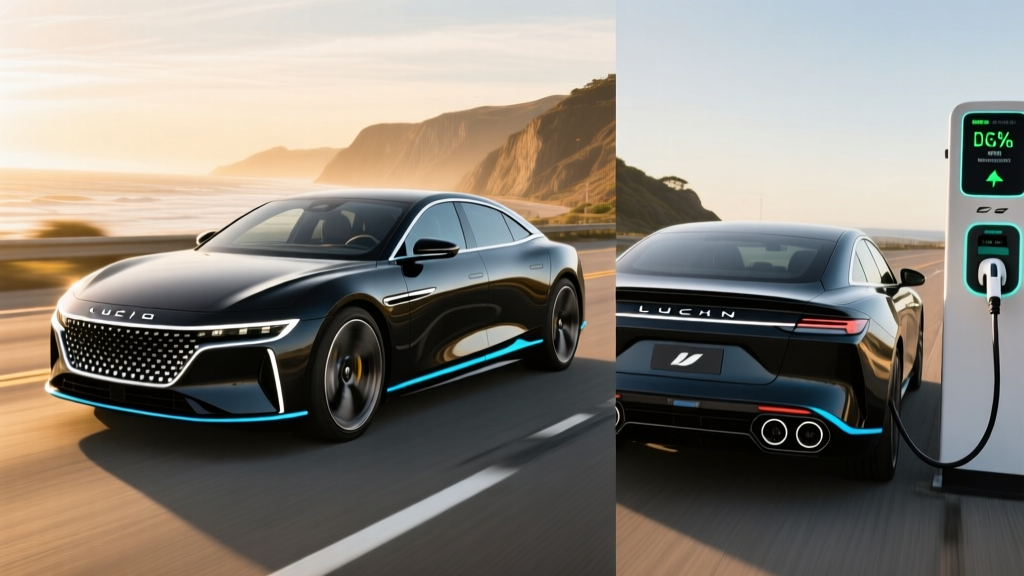
The Lucid Air remains one of the most technically ambitious sedans on the road, and its headline-grabbing acceleration is only part of the story. Buyers researching the Lucid Air 0-60 performance quickly discover a lineup that spans from a refined rear-wheel-drive grand tourer to a 1,234-horsepower tri-motor hypercar rival. But straight-line speed means little without context: how does that power translate to daily drivability, real-world range, charging practicality, and total ownership cost?
Below, we dissect every current Lucid Air trim with exact figures — EPA range, battery chemistry, DC fast-charge curves, efficiency, cargo dimensions, and 2026 pricing adjusted for the federal §30D tax credit. If you're cross-shopping the Air against the Tesla Model S, Mercedes EQS, or Porsche Taycan, this is the data-driven breakdown you need.
Lucid Air 0-60 Times and Performance by Trim
The Air's acceleration varies dramatically depending on the powertrain you choose. Lucid's in-house motor technology — compact, permanent-magnet units with integrated inverters — delivers exceptional power density. Here's how every current trim stacks up:
| Trim | Drivetrain | Horsepower | 0-60 mph | Top Speed | Base MSRP |
|---|---|---|---|---|---|
| Air Pure | RWD (single motor) | 430 hp | 5.0 sec | 145 mph | $69,900 |
| Air Touring | AWD (dual motor) | 620 hp | 3.4 sec | 149 mph | $87,400 |
| Air Grand Touring | AWD (dual motor) | 819 hp | 3.0 sec | 168 mph | $125,600 |
| Air Sapphire | AWD (tri-motor) | 1,234 hp | 1.89 sec | 205 mph | $249,000 |
Real-world note on the Sapphire's 1.89-second claim: This figure requires a prepped surface, drag-mode activation, and optimal battery temperature (above 85% SoC). On a typical public road with standard asphalt, expect 2.1–2.3 seconds — still astonishing, and quicker than a Bugatti Chron to 60 mph. The Grand Touring's 3.0-second run is far more repeatable in everyday conditions, requiring only Sport mode and adequate tire temperature.
For context, the EPA's official Lucid Air data confirms these powertrain configurations, and independent testing by outlets like Car and Driver has validated the Grand Touring's 3.0-second 0-60 on multiple occasions.
EPA Range vs. Real-World Driving
Lucid's efficiency engineering is arguably more impressive than its acceleration. The Air holds the record for the longest EPA-rated range of any production EV sold in the U.S. But EPA stickers don't tell the full story — highway speeds, cold temperatures, and elevation changes all pull the number down.
Range Reality Check: Lucid Air Grand Touring
EPA Estimated Range: 512 miles (19-inch wheels) / 446 miles (21-inch wheels)
Real-World Expectations:
- Mixed driving (city/highway, 65-75 mph): ~420–460 miles
- Sustained highway (75-80 mph, flat terrain): ~370–400 miles
- Cold weather (below 32°F, cabin heat): ~310–350 miles
- Mountain driving (significant elevation gain): ~340–380 miles (regain some on descent via regen)
Source: Manufacturer EPA filings via fueleconomy.gov
The Pure RWD, with its smaller 88-kWh usable battery, carries an EPA rating of 419 miles. Expect roughly 340–370 miles in mixed real-world driving and closer to 280–310 in deep winter conditions. The Air's standard heat pump mitigates cold-weather losses better than resistive-heater EVs, but physics still applies: lithium-ion cells lose roughly 15–25% usable capacity below freezing.
Battery Chemistry, Capacity, and Longevity
Lucid uses NMC (nickel manganese cobalt) lithium-ion cells across the Air lineup, sourced primarily from Samsung SDI and LG Energy Solution. NMC chemistry offers higher energy density than LFP (lithium iron phosphate), which is essential for fitting over 500 miles of range into a sedan platform. The trade-off: NMC degrades slightly faster than LFP over thousands of cycles and prefers not to sit at 100% SoC for extended periods.
| Trim | Usable Capacity | Chemistry | Cell Supplier | Battery Warranty |
|---|---|---|---|---|
| Air Pure | 88 kWh | NMC | Samsung SDI / LG | 8 yr / 100,000 mi |
| Air Touring | 112 kWh | NMC | Samsung SDI / LG | 8 yr / 100,000 mi |
| Air Grand Touring | 112 kWh | NMC | Samsung SDI / LG | 8 yr / 100,000 mi |
| Air Sapphire | 118 kWh | NMC | Samsung SDI | 8 yr / 100,000 mi |
The 8-year/100,000-mile battery warranty guarantees at least 70% capacity retention — in line with industry standards. Lucid's advanced thermal management system (liquid cooling with active heating and cooling circuits) helps preserve long-term State of Health. Early Air owners reporting 30,000+ miles show degradation in the 3–5% range, which is excellent for NMC packs of this size.
Charging Speed: DC Fast Charge and Home Level 2
The Air's 900-volt electrical architecture enables some of the fastest DC charging available in any production sedan. But peak kW numbers don't tell the full story — the charge curve taper above 80% SoC significantly affects total session time on road trips.
| Charging Level | Connector | Max Rate | Time / Miles Added |
|---|---|---|---|
| Level 1 (120V household) | NACS (native, 2025+ models) | ~1.4 kW | ~3–4 mi/hr |
| Level 2 (240V home, 48A) | NACS | 11.5 kW | ~33–38 mi/hr |
| Level 2 (240V home, 80A) | NACS | 19.2 kW | ~55–62 mi/hr |
| DC Fast Charge | NACS / CCS (adapter) | 300 kW peak | 10–80% in ~20 min (Grand Touring) |
Charging curve reality: The Grand Touring's 112-kWh pack peaks near 300 kW only between roughly 10–35% SoC on a capable 350-kW charger. From 35–60%, the rate tapers to approximately 200–220 kW. From 60–80%, it drops further to around 130–150 kW. The advertised 10–80% time of ~20 minutes assumes a 350-kW station and a preconditioned battery. On Electrify America's 150-kW stalls, expect 10–80% in roughly 35–40 minutes.
Starting with the 2025 model year, Lucid transitioned to the native NACS (North American Charging Standard) port, granting direct access to Tesla Supercharger V3 and V4 stalls (150–350 kW) without an adapter. For older CCS-equipped Air models, Lucid provides a NACS-to-CCS adapter.
Home charging tip: The Air's onboard charger supports up to 19.2 kW on Level 2 (80 amps), but this requires a hardwired wall connector and a 100-amp dedicated circuit. Most homes will need an electrical panel assessment — budget $500–$2,000 for potential panel upgrades on top of $600–$1,200 for the charger and installation. A 48-amp circuit (standard NEMA 14-50 or hardwired) delivers 11.5 kW, which adds roughly 35 miles of range per hour — sufficient for overnight replenishment for most drivers.
Efficiency: MPGe and kWh per 100 Miles
Lucid's efficiency numbers set the benchmark for luxury EVs. The Air's combination of a low drag coefficient (Cd 0.197), lightweight motor design, and sophisticated power electronics means more miles per kilowatt-hour than any competitor in its class.
| Trim | MPGe (Combined) | kWh/100 mi | Annual Fuel Cost* |
|---|---|---|---|
| Air Pure RWD | 146 MPGe | 23 kWh | ~$650 |
| Air Touring AWD | 134 MPGe | 25 kWh | ~$700 |
| Air Grand Touring AWD | 131 MPGe | 26 kWh | ~$750 |
| Air Sapphire AWD | 109 MPGe | 31 kWh | ~$900 |
*Based on $0.16/kWh national average electricity rate and 15,000 miles/year. Actual costs vary significantly by region and utility rate plan. Source: fueleconomy.gov
For comparison, the Tesla Model S Long Range achieves 120 MPGe combined, and the Mercedes EQS 580 sits at 97 MPGe. The Air Pure's 146 MPGe is exceptional for a 4,700-pound vehicle and directly translates to lower electricity costs and longer intervals between charges.
Pricing, Trims, and Federal Tax Credit Eligibility
The Lucid Air lineup spans from under $70,000 to a quarter-million dollars. Federal tax credit eligibility under IRS §30D is limited by MSRP caps, buyer income thresholds, and battery-component/critical-mineral sourcing requirements that tighten annually.
| Trim | Base MSRP | Sedan MSRP Cap (§30D) | Income Cap (MAGI) | Est. Credit |
|---|---|---|---|---|
| Air Pure | $69,900 | $55,000 | $150K single / $300K joint | Not eligible (MSRP exceeds cap) |
| Air Touring | $87,400 | $55,000 | $150K single / $300K joint | Not eligible |
| Air Grand Touring | $125,600 | $55,000 | $150K single / $300K joint | Not eligible |
| Air Sapphire | $249,000 | $55,000 | $150K single / $300K joint | Not eligible |
Critical note: Under §30D, new sedans must have an MSRP at or below $55,000 to qualify for the federal credit. Every Lucid Air trim exceeds this cap, meaning no new Air qualifies for the $7,500 federal EV tax credit as of 2026. Buyers may still benefit from state-level incentives (California's CVRP, for example, or utility-company rebates) — check your local jurisdiction. A used Air (2+ years old, under $25,000 sale price) may qualify for the up-to-$4,000 used EV credit under §25E, subject to income caps.
The point-of-sale transfer option (allowing the credit to be applied as an immediate discount rather than a tax-year refund) is available for qualifying vehicles — but again, the Air's MSRP disqualifies it from the new-vehicle credit entirely.
Interior, Cargo, Technology, and Driver Assists
The Air's cabin blends minimalist luxury with serious technology. A 34-inch curved glass cockpit display dominates the dash, running Lucid's proprietary Lucid UX software. Below it, a secondary retractable touchscreen handles climate, navigation, and media controls.
Cargo and passenger space:
- Rear trunk: 22.1 cu ft (class-leading for a sedan; Model S offers 28 cu ft with seats folded but less in standard config)
- Frunk (front trunk): 10.0 cu ft
- Rear legroom: 37.6 inches (surpasses the Model S and Taycan)
- Front headroom: 39.3 inches
- Rear headroom: 37.8 inches (the sloping roofline does cut into space for taller passengers)
Standout technology:
- DreamDrive Pro ADAS: 32 sensors including lidar (on Grand Touring and above), offering SAE Level 2 highway assist. This is not self-driving — the driver must remain engaged and hands on or near the wheel at all times.
- Over-the-air updates: Continuous feature rollouts including UI improvements, range optimizations, and new drive modes.
- Surreal Sound Pro: 21-speaker, 1,800-watt audio system (standard on Touring+, optional on Pure).
- Phone-as-key: Bluetooth Low Energy proximity unlock with NFC backup card.
- Range analytics: Real-time energy flow display with predictive range based on driving style, terrain, and temperature.
Notable drawbacks: The rear visibility is compromised by the thick C-pillars and small rear window — a backup camera is essential. The infotainment system, while visually impressive, lacks Apple CarPlay and Android Auto (Lucid's native system handles phone integration differently). Service center availability remains limited outside major metro areas, and mobile service coverage is still expanding.
Who Should Buy the Lucid Air?
Choose the Lucid Air If:
- You want the longest-range EV available without moving to an SUV
- Efficiency matters — you drive 20,000+ miles/year and want the lowest kWh/100mi in the luxury segment
- You value understated design over badge recognition
- You need genuine four-adult comfort with class-leading rear legroom
- Road trips are regular — 400+ real-world miles means fewer charging stops on 800-mile drives
Look Elsewhere If:
- You need a federal tax credit — no Air trim qualifies under current §30D MSRP caps
- Cargo versatility is paramount — an SUV like the Rivian R1S or Tesla Model X offers more utility
- You prefer Apple CarPlay/Android Auto integration
- You live far from a Lucid service center and need dealer-network convenience
- Budget is under $65,000 — the Pure starts at $69,900 before options
Lucid Air vs. Key Competitors
| Specification | Lucid Air GT | Tesla Model S LR | Mercedes EQS 580 | Porsche Taycan Turbo S |
|---|---|---|---|---|
| EPA Range | 512 mi | 402 mi | 371 mi | 283 mi |
| 0-60 mph | 3.0 sec | 3.1 sec | 4.1 sec | 2.4 sec |
| Peak DC Charge | 300 kW | 250 kW | 200 kW | 320 kW |
| Efficiency (MPGe) | 131 | 120 | 97 | 79 |
| Starting MSRP | $125,600 | $84,990 | $127,350 | $197,400 |
| Battery Warranty | 8yr/100K mi | 8yr/150K mi | 10yr/155K mi | 8yr/100K mi |
The Air Grand Touring wins on range and efficiency by a wide margin. The Model S counters with a lower price, broader Supercharger access (though the Air's NACS port now matches this), and a longer battery-warranty mileage limit. The Taycan Turbo S is the driver's choice for handling dynamics but sacrifices range heavily. The EQS offers the most opulent interior but trails in every performance metric.
Pros and Cons at a Glance
Pros
- Class-leading EPA range (512 mi on Grand Touring)
- Best-in-segment efficiency (131–146 MPGe depending on trim)
- 900V architecture enables 300-kW DC fast charging
- Spacious rear cabin with 37.6 inches of legroom
- Sapphire trim delivers hypercar-level 1.89-sec 0-60
- Native NACS port for direct Supercharger access (2025+)
- Standard heat pump for cold-climate efficiency
Cons
- No trim qualifies for the federal §30D new-vehicle credit
- Limited service center network outside major metros
- No Apple CarPlay or Android Auto
- Rear visibility hindered by thick C-pillars
- Premium pricing — Pure starts at $69,900
- DreamDrive Pro is Level 2 only (not autonomous)
- Brand is young — long-term resale value is less proven than Tesla or Porsche
Frequently Asked Questions
What is the real-world range of the Lucid Air?
The Grand Touring's EPA rating is 512 miles (19-inch wheels). In real-world mixed driving at highway speeds, expect 420–460 miles. In sustained cold weather (below freezing), plan for 310–350 miles. The Pure RWD delivers roughly 340–370 real-world miles from its 419-mile EPA rating.
How fast does the Lucid Air charge at home and on the road?
On a 48-amp Level 2 home charger, the Air adds roughly 35 miles of range per hour (11.5 kW). An 80-amp circuit pushes this to ~58 mi/hr (19.2 kW). On DC fast chargers, the Grand Touring peaks at 300 kW and achieves 10–80% in approximately 20 minutes on a 350-kW station — expect 35–40 minutes on a 150-kW charger.
Does the Lucid Air qualify for the federal EV tax credit?
No. Under IRS §30D rules, new sedans must have an MSRP at or below $55,000. Every Lucid Air trim exceeds this threshold, so none qualify for the up-to-$7,500 new-vehicle credit. State and utility incentives may still apply — check IRS.gov and your local programs.
Is the Lucid Air worth buying over a Tesla Model S?
If range and efficiency are your top priorities, the Air wins decisively (512 vs. 402 EPA miles, and significantly better MPGe). If you value a lower entry price, broader service infrastructure, and a proven Autopilot/FSD ecosystem, the Model S remains compelling. The Air is the efficiency champion; the Model S is the infrastructure and software champion.
What is the fastest Lucid Air 0-60 time?
The tri-motor Air Sapphire achieves a manufacturer-claimed 1.89 seconds on a prepped surface with drag mode engaged. In real-world conditions on standard pavement, expect 2.1–2.3 seconds — still among the quickest production cars ever built.
How long will the Lucid Air battery last?
Lucid warranties the battery for 8 years or 100,000 miles with at least 70% capacity retention. NMC chemistry typically retains 85–92% capacity after 100,000 miles based on early owner data and Lucid's thermal management design. Avoid routinely charging to 100% and leaving the car at full SoC for extended periods to maximize longevity.
Does the Lucid Air have self-driving capability?
No. Lucid's DreamDrive Pro is an SAE Level 2 driver-assistance system, meaning the driver must remain fully engaged, monitor the road, and be prepared to take over at any moment. It is not autonomous. Only Level 4 services like Waymo operate without a human driver in designated areas.