Quick Answer: Is an LSV Electric Car Right for You?
A Low-Speed Vehicle (LSV) is a federally regulated, street-legal electric cart capped at 20–25 mph, designed for roads with speed limits of 35 mph or less. Expect to pay $8,000–$18,000 for a new LSV electric car, get 30–60 miles of real-world range from a lead-acid or lithium battery, and recharge overnight on a standard 120V outlet. LSVs do not qualify for the federal §30D EV tax credit (they lack a 4-wheel highway-capable drivetrain and VIN classification). They are best suited for planned communities, campuses, and short errands — not highway commuting or cold-climate daily driving.
What Is an LSV Electric Car — and What It Isn't
The National Highway Traffic Safety Administration (NHTSA) defines an LSV under FMVSS No. 500. To be street-legal, an LSV must have:
- Headlamps, turn signals, stop lamps, tail lamps, and reflex reflectors
- Exterior mirrors (driver-side and passenger-side or interior)
- A parking brake
- A windshield (glazed, per AS-1 or AS-5 standards)
- A Vehicle Identification Number (VIN)
- A maximum speed of 20–25 mph (governed)
What an LSV does not have: airbags, crumple zones, electronic stability control, or any crash-test rating. These are not scaled-down cars — they are upgraded golf carts. That distinction drives everything about where you can legally operate one and how safe it is in mixed traffic.
Popular LSV electric car brands in 2026 include GEM (Polaris), Club Car Onward LSV, Tomberlin, and Aygo variants, plus a wave of Chinese-market imports rebranded for US neighborhoods. Pricing varies sharply by battery chemistry and build quality.
LSV Electric Car Specs: Range, Battery, and Charging
Unlike highway-capable BEVs, LSV specs are rarely EPA-rated. Manufacturers report range under ideal conditions (flat terrain, 165-lb driver, 15 mph average). Here's what typical 2026 models deliver:
| Spec | GEM e2 (Li-ion) | Club Car Onward LSV | Tomberlin E-Merge |
|---|---|---|---|
| Battery Chemistry | Lithium-ion (NMC) | Lithium-ion (LFP option) | Lead-Acid (AGM) |
| Battery Capacity | ~10 kWh usable | ~8–11 kWh usable | ~7.5 kWh usable |
| Claimed Range | Up to 60 mi | Up to 50 mi | Up to 40 mi |
| Real-World Range (hilly/wind) | 35–45 mi | 30–40 mi | 20–30 mi |
| Top Speed | 25 mph | 25 mph | 25 mph |
| Charge Time (120V) | 6–8 hours | 6–10 hours | 8–12 hours |
| Charge Time (240V option) | 3–4 hours | 3–5 hours | N/A |
| Base MSRP (2026) | $14,500–$16,500 | $12,000–$15,000 | $9,500–$12,000 |
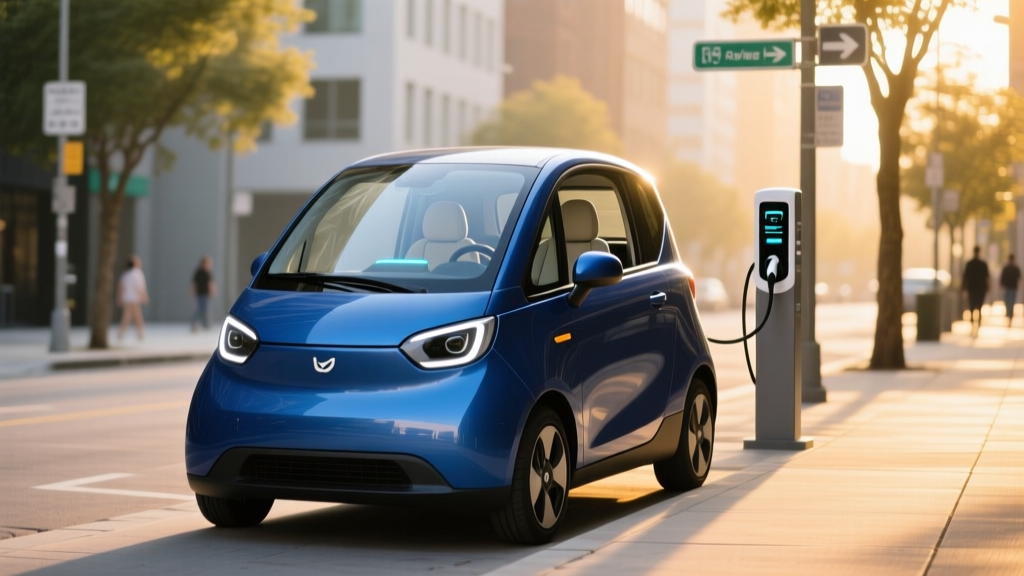
Charging an LSV is straightforward: plug into a standard 120V household outlet using the included cord. No Level 2 home charger installation is required, though 240V options cut charge time roughly in half. Energy consumption runs 150–250 Wh/mile depending on weight and terrain — roughly 4–7 miles per kWh.
LSV vs Gas Golf Cart vs Highway EV: Cost & Capability Comparison
Buyers cross-shopping an LSV electric car typically compare it against a gas-powered golf cart or a used highway-capable EV. Here's how those three options stack up over five years of neighborhood use (estimated 3,000 miles/year):
| Cost Factor | LSV Electric Car ($13,000) | Gas Golf Cart ($9,000) | Used Nissan LEAF ($14,000) |
|---|---|---|---|
| Purchase Price | $13,000 | $9,000 | $14,000 |
| Federal Tax Credit (§30D) | $0 (not eligible) | $0 | $4,000 (used EV credit, if eligible) |
| Fuel/Energy (5 yrs) | $550 (electricity) | $2,800 (gasoline) | $1,800 (electricity) |
| Maintenance (5 yrs) | $400 | $1,500 (oil, belts, plugs) | $1,200 |
| Insurance (5 yrs avg) | $1,500 | $600 (off-road only) / $2,000 (street) | $6,000 |
| Battery Replacement Risk | $2,500–$4,500 (year 6+) | N/A | $6,500+ if needed |
| 5-Year Total (est.) | $15,450 | $13,900 | $17,000 |
| Top Speed | 25 mph | 19 mph (stock) | 90+ mph |
| Highway Legal? | No (≤35 mph roads) | No | Yes |
| Crash Protection | Minimal | None | Full (airbags, structure) |
The LSV electric car wins on fuel and maintenance savings versus gas but loses to a used highway EV on capability and safety. The gas cart has the lowest upfront cost but the highest ongoing fuel and maintenance burden. Note that the §25E used EV credit (up to $4,000) applies only to highway-capable vehicles with a battery of at least 7 kWh — LSVs do not qualify.
Where LSVs Are Legal: State-by-State Reality
Federal law sets the equipment standard, but states and municipalities decide where LSVs can operate. Common patterns in 2026:
- Florida, Arizona, South Carolina, Georgia: LSV-friendly — allowed on roads up to 35 mph, many planned communities designed around them
- California, Texas: Permitted on ≤35 mph roads with local authority to restrict further; some cities ban LSVs on certain corridors
- Northeast/Midwest states: More restrictive — some states require additional equipment or limit LSVs to specific zones; winter practicality is poor regardless
Always verify with your state DMV and local ordinances before purchasing. Some HOAs and planned communities (The Villages, FL; Sun City, AZ) have their own LSV regulations that exceed state minimums.
Common LSV Misconceptions — Fact-Checked
| Myth | Fact |
|---|---|
| "LSVs qualify for the $7,500 federal EV tax credit" | False. The §30D credit requires a 4-wheeled vehicle with a GVWR under 14,000 lbs that is highway-capable and meets specific battery-sourcing rules. LSVs are classified separately under FMVSS 500 and do not meet highway-capable definitions. |
| "An LSV is as safe as a small car" | False. LSVs have no airbags, no crash-test ratings, and minimal structural protection. NHTSA data shows LSV occupants are significantly more vulnerable in collisions with full-size vehicles. |
| "I can drive an LSV on any road" | False. LSVs are restricted to roads with posted speed limits of 35 mph or less (varies by state). Crossing higher-speed roads is usually permitted at intersections, but traveling along them is not. |
| "LSV batteries last as long as highway EV batteries" | Misleading. Lead-acid LSV batteries typically need replacement every 3–5 years ($2,000–$3,000). Lithium-ion LSV batteries last 7–10 years but still cost $3,000–$4,500 to replace. Highway EV batteries carry 8-year/100,000-mile federal warranties. |
| "I don't need insurance for an LSV" | Usually false. Most states that allow street-legal LSV operation require minimum liability insurance, just like a car. Check your state requirements. |
Who Should (and Shouldn't) Buy an LSV Electric Car
Decision Framework: Should You Buy an LSV?
Choose an LSV electric car if:
- You live in a planned community, retirement village, or small town with ≤35 mph roads
- Your daily trips are under 20 miles round-trip (grocery, pharmacy, school drop-off)
- You have garage or covered parking with a 120V outlet for overnight charging
- You live in a mild climate (rarely below 32°F)
- You do not need to travel on roads posted above 35 mph
- You want near-zero maintenance and silent operation
Choose a highway-capable EV (Chevy Equinox EV, Nissan LEAF, Hyundai Kona Electric) if:
- You need to travel on roads posted 40+ mph
- Your daily round-trip exceeds 30 miles
- You live in a cold climate where LSV range collapses in winter
- You want crash protection, airbags, and safety technology
- You want to qualify for federal or state EV tax credits
- You need HVAC (heating and air conditioning) — most LSVs offer only basic heaters or no climate control
Choose a gas golf cart if:
- You need to operate primarily off-road or on private property
- You want the lowest possible purchase price and don't mind engine maintenance
- You need to tow moderate loads (gas carts typically have higher towing capacity)
Real-World Ownership: What LSV Buyers Overlook
Based on owner reports and fleet data, here are the practical realities of owning an LSV electric car that brochures don't mention:
Home charging is trivial but slow. A 120V outlet delivers roughly 1.2–1.4 kW to the LSV's onboard charger. A fully depleted 10 kWh battery takes 7–9 hours to recharge. Unlike highway EVs, there's no DC fast charging option — you cannot "top up" at a public station on the go.
Tires, brakes, and suspension are not car-grade. LSVs use small-diameter tires (often 12-inch) and basic drum or disc brakes. Expect tire replacement every 2–3 years and brake service every 3–4 years. Parts availability varies by brand — GEM and Club Car have established dealer networks; import brands may not.
Resale value is steep. LSVs depreciate 40–60% in the first three years, faster than most highway EVs. A $14,000 LSV may be worth $6,000–$8,000 after three years. Battery condition is the dominant factor — buyers will test range before purchasing used.
Insurance is available but limited. Specialty insurers (Progressive, Hagerty, and some regional carriers) offer LSV policies. Typical annual premiums run $250–$400 for liability-only, $400–$700 for comprehensive coverage. Not all insurers write LSV policies in all states.
LSV Electric Car FAQ
Can I drive an LSV electric car on a 45 mph road?
No, in most states. LSVs are federally limited to roads with posted speed limits of 35 mph or less. Some states allow crossing higher-speed roads at intersections, but sustained travel on a 45 mph road is illegal and dangerous given the 25 mph speed differential.
Do LSV electric cars qualify for any tax credits or incentives?
LSVs do not qualify for the federal §30D new vehicle credit or the §25E used vehicle credit because they are not classified as highway-capable motor vehicles. Some states or local utilities offer rebates for low-speed or neighborhood electric vehicles — check your state energy office and local utility programs.
How long do LSV batteries last before replacement?
Lead-acid batteries typically last 3–5 years (500–800 charge cycles) and cost $2,000–$3,000 to replace. Lithium-ion LSV batteries last 7–10 years (1,500–2,000+ cycles) and cost $3,000–$4,500 to replace. Deep discharges and extreme heat shorten lifespan for both chemistries.
Do I need a driver's license to operate an LSV?
Yes, in nearly all states. Because LSVs are street-legal motor vehicles, operators must hold a valid driver's license and carry insurance. Some states allow LSV operation with a learner's permit under supervision.
Can I add air conditioning or a heater to an LSV?
Some manufacturers offer optional cabin heaters (12V electric, drawing from the traction battery). Full HVAC systems are rare and expensive add-ons. In hot climates, open-air operation with a canopy is more common. Enclosed-cab LSVs (like the GEM eL XD) offer better weather protection but cost $2,000–$4,000 more.
What happens if my LSV battery dies mid-trip?
You'll need a tow — LSVs cannot accept a jump start from another vehicle in the traditional sense (the traction battery requires its specific charger). Some LSVs have a 12V auxiliary battery that powers lights and accessories; this can be jump-started, but it won't move the vehicle. Plan routes within your real-world range, especially in cold weather or hilly terrain.
Sources: NHTSA FMVSS No. 500 (ecfr.gov), IRS §30D and §25E credit guidance (irs.gov), GEM and Club Car 2026 model specifications.