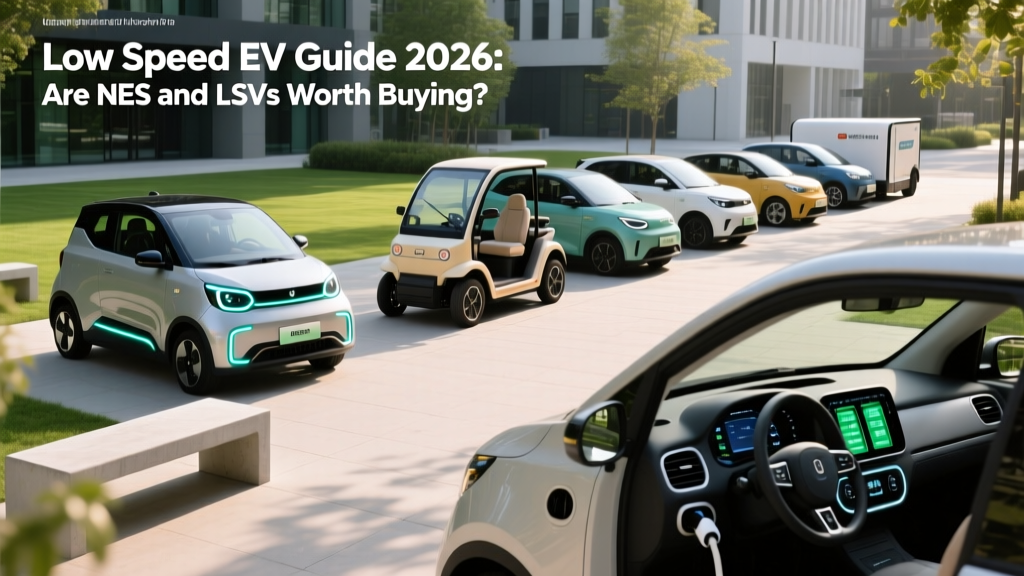
What Is a Low Speed EV and Who Should Buy One?
Short answer: A low speed EV — legally classified as a Low-Speed Vehicle (LSV) or Neighborhood Electric Vehicle (NEV) — is a street-legal electric vehicle federally limited to a top speed of 25 mph. These vehicles are best suited for short neighborhood commutes, retirement communities, college campuses, and planned developments where roads have speed limits of 35 mph or below. They typically offer 30–60 miles of range, cost $8,000–$20,000 new, and charge from a standard 120V outlet. They are not substitutes for a full-size EV or gas car if you need highway access, crash protection, or all-weather capability.
The market for low speed EVs has expanded considerably. What once meant a golf cart with a license plate now includes purpose-built commuter vehicles from companies like GEM (Polaris), Club Car, and a wave of newer entrants offering enclosed cabins, lithium batteries, and basic climate control. But before you swap your second car for a neighborhood runabout, the math, safety picture, and practical limitations deserve a hard look.
LSV vs. Full EV vs. Gas Cart: What's the Real Difference?
The core confusion around low speed EVs stems from overlapping categories. Here's how they actually break down in terms of federal regulation, capability, and cost:
| Attribute | Low Speed EV (LSV/NEV) | Full-Size BEV (e.g., Chevy Equinox EV) | Gas Golf Cart |
|---|---|---|---|
| Federal Classification | FMVSS 500 LSV | Full passenger vehicle (FMVSS all standards) | Off-road / not street-legal (unless converted) |
| Top Speed | 20–25 mph (federally capped) | 90–130+ mph | 12–19 mph (stock) |
| Street Legal? | Yes, on roads ≤35 mph (state rules vary) | Yes, all roads | No (unless LSV-converted) |
| Typical Range | 30–60 miles | 250–350+ miles (EPA) | 100–150 miles (fuel tank) |
| Battery / Fuel | 8–18 kWh, lead-acid or LFP | 60–100+ kWh, NMC or LFP | Gasoline (5–6 gal tank) |
| Charging / Fueling | 120V standard outlet, 6–10 hours | Level 2 / DC fast charge | Gas station |
| Base Price (2026) | $8,000–$20,000 | $33,000–$55,000+ | $6,000–$12,000 |
| Safety Equipment | Seatbelts, headlights, turn signals, VIN; no airbags or crash testing required | Airbags, crumple zones, ADAS, full crash testing | None (off-road vehicle) |
| Federal EV Tax Credit (§30D) | Not eligible (does not meet full FMVSS passenger vehicle standards) | Up to $7,500 (subject to MSRP, income, and sourcing rules) | Not eligible |
The safety gap is the single most important distinction. According to NHTSA, LSVs must meet FMVSS 500, which requires headlamps, turn signals, tail lamps, exterior mirrors, parking brakes, and a VIN — but not airbags, crumple zones, or any crash-test performance. You are trading significant occupant protection for a lower price and simpler operation.
Real Costs: Purchase, Charging, and Maintenance
The economic case for a low speed EV hinges on replacing short car trips with something cheaper to operate. Let's quantify that.
| Cost Category | Low Speed EV (LFP battery) | Gas Golf Cart | Full-Size BEV (as second car) |
|---|---|---|---|
| Purchase Price | $11,000–$16,000 | $8,000–$12,000 | $33,000–$45,000 |
| Federal Tax Credit | $0 | $0 | Up to $7,500 (if eligible) |
| Energy Cost per Mile | ~$0.03–$0.05 (at $0.14/kWh avg) | ~$0.12–$0.18 (gas at $3.30/gal, ~25 mpg) | ~$0.04–$0.06 |
| Annual Energy (5,000 mi/yr) | $150–$250 | $600–$900 | $200–$300 |
| Annual Maintenance | $100–$200 (minimal) | $300–$500 (engine, belts, oil) | $200–$400 |
| Insurance (annual) | $300–$700 | $150–$400 (off-road policies cheaper) | $1,200–$2,000+ |
| Battery Replacement (est.) | $2,500–$5,000 at 5–8 years (LFP); $1,500–$3,000 at 3–5 years (lead-acid) | N/A | Covered under 8 yr/100k mi warranty; $8,000–$18,000 out of warranty |
| 5-Year Total Cost (5k mi/yr) | $13,500–$21,500 | $13,000–$19,500 | $30,000–$42,000 (before credit) |
A few things jump out. First, the low speed EV is not dramatically cheaper than a gas golf cart over five years when you factor in battery replacement — the advantage is operating cost, silence, and zero tailpipe emissions. Second, the LSV is significantly cheaper than adding a full-size BEV as a second car, but it can't replace that car for highway trips, road trips, or bad weather.
The battery chemistry choice matters enormously. Older and budget LSVs still ship with lead-acid batteries, which are heavy, lose capacity faster, and need replacement every 3–5 years. Newer models with LFP (lithium iron phosphate) packs cost more upfront but deliver 2,000+ charge cycles with minimal degradation — realistically 8–10 years of daily use before meaningful capacity loss. Always confirm battery chemistry before purchasing.
Charging and Range: What the Specs Actually Mean
Low speed EVs don't use DC fast charging or public charging networks. They charge from a standard 120V household outlet using an onboard charger, typically rated between 1.0 and 1.8 kW. Here's what that translates to in practice:
| Battery Size | Onboard Charger | 0–100% Charge Time | Real-World Range (mixed use) |
|---|---|---|---|
| 8 kWh (lead-acid) | 1.2 kW | 7–9 hours | 20–30 miles |
| 12 kWh (LFP) | 1.5 kW | 8–10 hours | 35–45 miles |
| 18 kWh (LFP) | 1.8 kW | 10–12 hours | 50–65 miles |
Range reality check: manufacturers sometimes advertise ranges based on flat terrain, mild temperatures, and 15 mph speeds. Expect a 20–35% reduction in hilly areas, with the heater or A/C running, or in cold weather below 40°F. A 50-mile advertised range in a Florida retirement community might become 30–35 miles in a Midwestern winter.
The good news: for most LSV use cases — a 3-mile round trip to the grocery store, school drop-off, or community pool — even the smallest battery is more than sufficient. You're charging overnight from a regular outlet, and the cost is negligible. The key ownership rule is to never let a lead-acid pack sit below 50% state of charge for extended periods; LFP packs are far more tolerant of partial charges and storage.
Where Can You Actually Drive a Low Speed EV?
Federal law (FMVSS 500) permits LSVs on roads with posted speed limits of 35 mph or below. States can allow them on faster roads, but most do not. This means your practical driving area is determined entirely by local road infrastructure.
LSVs thrive in:
- Planned communities and retirement developments (The Villages, FL; Sun City, AZ; Peachtree City, GA) with extensive low-speed path networks
- College and corporate campuses with internal roads
- Small towns and barrier islands where most roads are 25–35 mph
- Gated communities with private roads (check HOA rules)
LSVs struggle in:
- Suburban areas where arterials are 40–45 mph and there are no parallel low-speed routes
- Rural areas with high-speed roads and no shoulders
- Any route requiring highway or interstate access — this is illegal and extremely dangerous
Check your state's specific LSV laws through your local DMV. Some states require registration, insurance, and a valid driver's license; others treat them more like off-road vehicles. A few states have created a middle tier — Medium-Speed Vehicles (MSVs) capped at 35 mph — with slightly enhanced safety requirements.
Safety: The Hard Truth Most Dealers Won't Lead With
This is where honest evaluation matters most. An LSV has no airbags, no crash-test ratings, no anti-lock brakes (in most cases), and minimal structural protection. In a collision with a full-size vehicle — even at 25 mph — the LSV occupant is at severe disadvantage.
The IIHS does not crash-test LSVs because they fall outside the federal passenger vehicle standards. There is no safety rating to reference. What we do know from physics:
- A 2,000-lb LSV hitting a 4,500-lb SUV at a combined 35 mph generates forces the LSV structure cannot manage
- Lack of three-point seatbelts (many LSVs use lap belts only) increases ejection and injury risk
- No electronic stability control means higher rollover risk in emergency maneuvers
- Night driving and rain reduce visibility and traction significantly with LSV-grade lighting and tires
This isn't to say LSVs are inherently dangerous in their intended environment — low-speed, low-traffic neighborhood roads. But they are categorically not equivalent to a car in protection, and buyers who use them on busier roads or in mixed traffic are accepting real risk.
Myths vs. Facts: Clearing Up Low Speed EV Confusion
| Myth | Fact |
|---|---|
| "LSVs qualify for the $7,500 federal EV tax credit" | They do not. IRS §30D applies only to vehicles meeting full FMVSS passenger vehicle standards. LSVs are classified under FMVSS 500 and are excluded. |
| "A low speed EV can replace my second car" | Only if every trip stays under ~30 miles on roads ≤35 mph, in fair weather. Highway access, winter driving, and longer commutes require a full vehicle. |
| "They're basically golf carts" | Street-legal LSVs have VINs, are registered with the DMV, require insurance, and must meet federal equipment standards. Golf carts are off-road vehicles with no such requirements. |
| "The battery will need replacing every 2 years" | Lead-acid packs last 3–5 years with proper care. LFP packs last 8–10+ years. Neither requires replacement on the schedule of early-generation NEVs. |
| "You don't need a license to drive one" | Most states require a valid driver's license, registration, and minimum insurance for street-legal LSV operation. Check your state DMV. |
| "They're completely safe at 25 mph" | At 25 mph, an LSV occupant in a collision with a larger vehicle faces serious injury risk due to lack of crash structure, airbags, and advanced restraints. |
Decision Framework: Should You Buy a Low Speed EV?
Buy a low speed EV if:
- You live in a planned community, retirement development, or small town where most roads are ≤35 mph
- Your daily trips are under 20 miles round-trip (grocery, school, pharmacy, community amenities)
- You already own or have access to a full-size vehicle for highway trips and longer commutes
- You have access to a standard 120V outlet for overnight charging (garage, carport, or driveway)
- You want to eliminate fuel and maintenance costs for short errands
- You understand and accept the safety limitations of an LSV vs. a full-size vehicle
Do NOT buy a low speed EV if:
- Your commute involves roads with speed limits above 35 mph and no safe low-speed alternative route
- You need a primary vehicle — an LSV cannot handle highway driving, road trips, or severe weather
- You're counting on the federal EV tax credit to make the math work (LSVs don't qualify)
- You live in an area with harsh winters and no covered low-speed routes
- You expect car-like crash protection — an LSV does not provide it
Consider a full-size BEV instead if:
- You need highway access, all-weather capability, or more than 60 miles of range
- You want federal tax credit eligibility (up to $7,500 under §30D, subject to income and MSRP caps)
- You want crash-tested safety with airbags, ADAS, and structural protection
- Your budget allows $30,000+ after incentives
Frequently Asked Questions
How fast does a low speed EV actually go?
Federal law caps LSVs at 25 mph. Most production models reach 20–25 mph on flat ground. Some "medium-speed" variants in certain states are governed to 35 mph, but these are less common and have enhanced equipment requirements.
Can I drive a low speed EV in the rain or winter?
Enclosed LSVs with heaters and wipers can handle rain and mild cold. However, battery range drops 20–35% in freezing temperatures, traction is limited with LSV-grade tires, and the vehicle's light weight makes it more susceptible to wind and slippery surfaces. Most LSV owners in cold climates treat them as fair-weather vehicles.
Do I need insurance for a low speed EV?
Yes, in most states. Street-legal LSVs require registration and minimum liability insurance, just like a car. Premiums are typically $300–$700 annually — much less than a full-size vehicle, but not zero. Check with your state DMV for specific requirements.
Can I charge a low speed EV at a public charging station?
No. LSVs use a standard 120V household plug (NEMA 5-15) and do not have CCS, NACS, or CHAdeMO charge ports. They are designed to charge overnight from a regular wall outlet at 1.0–1.8 kW. Public Level 2 and DC fast chargers are incompatible.
What happens when the battery wears out?
Lead-acid batteries typically need replacement every 3–5 years at a cost of $1,500–$3,000. LFP lithium batteries last 8–10+ years and cost $2,500–$5,000 to replace. Battery replacement is the single largest long-term ownership cost for an LSV, so buying a model with LFP chemistry is strongly recommended despite the higher upfront price.
Are there any tax incentives for buying a low speed EV?
The federal §30D clean vehicle credit does not apply to LSVs. However, some states and local utilities offer rebates for electric vehicles that may include LSVs — check with your state energy office and local utility. These are typically $200–$1,000, not the $7,500 available for full-size EVs.
What's the best low speed EV to buy in 2026?
Look for models with LFP battery chemistry, enclosed cabins, three-point seatbelts (not just lap belts), and adequate lighting for your area. Established manufacturers like GEM (by Polaris) and Club Car offer proven platforms with dealer support. Prioritize battery warranty length — a 5-year battery warranty is a strong signal of quality. Always verify the vehicle has a valid 17-digit VIN and meets FMVSS 500 before purchasing.