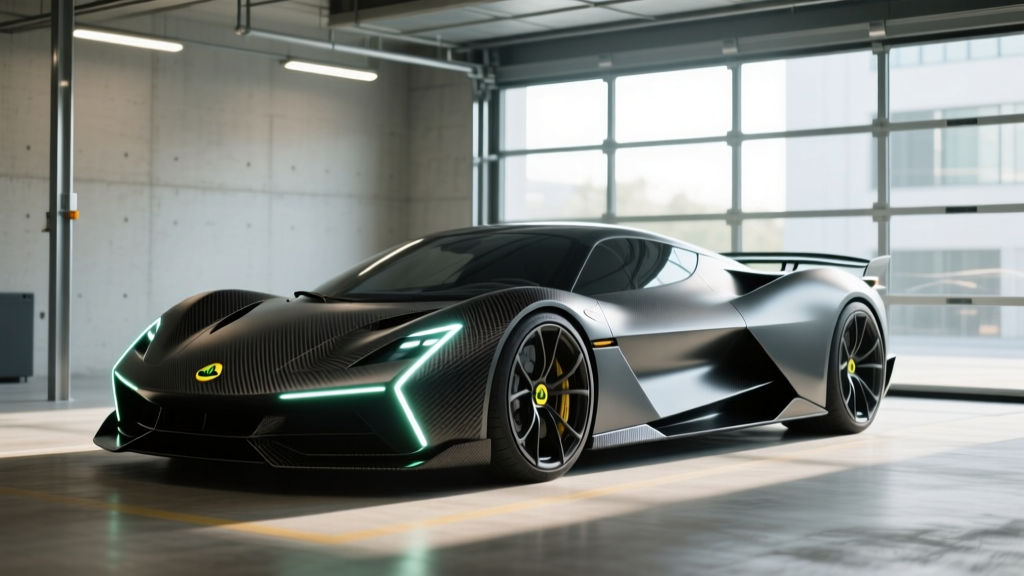
The Lotus Evija isn't trying to be a daily driver. It's a 1,972-horsepower, all-electric hypercar built in Hethel, England, with one purpose: to demonstrate what happens when you remove every compromise from an EV powertrain and bolt it to a carbon-fiber monocoque. With a production run limited to 130 units and a price tag north of $2 million, the Evija exists in a stratosphere occupied by the Rimac Nevera and Pininfarina Battista — not the Tesla Model S Plaid. But for the handful of buyers in this segment, and for anyone tracking the outer limits of electric propulsion, the Evija's specs demand serious examination.
This review breaks down the 2026 Lotus Evija's battery architecture, real-world range expectations, charging performance, and ownership economics with the same data-driven rigor we apply to every EV we cover. Hypercar or not, the physics of kWh, kW, and thermal management still apply.
Lotus Evija Quick Verdict
The Evija is the most powerful production car Lotus has ever built and one of the most powerful EVs on the planet. Its 70 kWh battery is modest by luxury-EV standards, but it's paired with a 2,000 kW (2 MW) discharge capability that enables acceleration figures rivaling top-fuel dragsters. Range is the trade-off: expect roughly 100–130 miles in mixed driving, with significantly less under track use. This is a hypercar, not a grand tourer. Buyers who need 300-mile road-trip capability should look elsewhere. Buyers who want to experience the absolute ceiling of electric performance — and can absorb the ownership costs — will find nothing quite like it.
| Spec | Value |
|---|---|
| Powertrain | Quad-motor AWD (one motor per wheel) |
| Horsepower | 1,972 hp (1,470 kW) combined |
| Torque | 1,254 lb-ft |
| 0–60 mph | < 3.0 seconds (0–186 mph in < 9.0 sec) |
| Top Speed | 217+ mph (electronically limited) |
| Battery Capacity | 70 kWh (usable), NMC lithium-ion |
| Battery Supplier | Williams Advanced Engineering |
| EPA Est. Range | Not EPA-rated (limited-production hypercar) |
| WLTP Est. Range | ~250 km / ~155 miles (manufacturer est.) |
| Max DC Fast Charge | 350 kW (800V architecture) |
| 10–80% DC Charge Time | ~12 minutes (est., 350 kW charger) |
| Level 2 AC Charge Rate | ~22 kW onboard charger |
| Curb Weight | ~4,160 lbs (1,887 kg) |
| Drivetrain | AWD, torque-vectoring (individual motor per wheel) |
| Base MSRP | ~$2,100,000 (before options/taxes) |
| Production Run | 130 units |
| Battery/Powertrain Warranty | 3 years / unlimited mileage (typical for hypercar segment) |
Range & Efficiency: The Hypercar Trade-Off
Let's address the obvious: the Evija's range is short by mainstream EV standards. Lotus estimates approximately 155 miles (250 km) under the WLTP cycle, which tends to run 10–15% higher than EPA methodology. Since the Evija is a limited-production vehicle (under 1,000 units annually), it is exempt from formal EPA testing, so no official EPA range sticker exists. Based on WLTP-to-EPA conversion factors and the Evija's power density, a realistic EPA-equivalent figure would land around 120–140 miles.
- WLTP estimate: ~155 miles (250 km)
- EPA-equivalent estimate: ~120–140 miles
- Highway (70 mph sustained): ~95–110 miles (aerodynamic drag dominates at hypercar speeds; the Evija's downforce-generating bodywork adds drag coefficient penalty)
- Track use (aggressive): 25–50 miles before requiring a charge — sustained 2 MW discharge depletes a 70 kWh pack rapidly
- Cold-weather (below 32°F / 0°C): Expect 15–25% range reduction, yielding ~90–115 miles in mixed driving
Note: The Evija is designed primarily for track and short-road use. Lotus expects most owners to trailer it to events or charge between track sessions.
Efficiency Numbers
Efficiency is not the Evija's mission, but for completeness: expect roughly 45–55 kWh/100 miles in mixed driving — roughly three times the consumption of an efficient sedan like the Hyundai Ioniq 6 (~24 kWh/100mi). This translates to an MPGe equivalent of approximately 60–75 MPGe. Again, context matters: the Rimac Nevera consumes at a similar rate. When you're producing 1,972 hp, electrons are fuel, and fuel is spent freely.
Battery Architecture & Chemistry
The Evija's battery pack is a mid-mounted, 70 kWh (usable capacity) unit developed by Williams Advanced Engineering — the same company that supplied battery packs for the FIA Formula E championship from 2014–2021. The chemistry is NMC (nickel manganese cobalt), chosen over LFP for its superior energy density. In a hypercar where every kilogram matters, NMC's higher Wh/kg ratio is essential.
Why 70 kWh and Not More?
The capacity decision reflects Lotus's engineering priorities. A larger pack (say, 120 kWh) would add 200–300 kg of mass, directly undermining the handling dynamics that define the Lotus brand. The 70 kWh pack, combined with the carbon-fiber monocoque chassis, keeps the Evija at approximately 4,160 lbs — heavy for a supercar, but remarkably light for a quad-motor EV producing nearly 2,000 hp. For comparison, the GMC Hummer EV packs a 212 kWh battery and weighs over 9,000 lbs.
The pack uses an 800-volt architecture, enabling the high discharge rates needed for the Evija's acceleration and the fast charge rates discussed below. Thermal management is liquid-cooled with dedicated cooling circuits for the battery, each of the four motors, and the inverters — critical when the car can dump the entire pack in under 7 minutes at full output.
Charging Performance: 350 kW DC & Home Charging
For a vehicle that will spend most of its life in a climate-controlled garage or on a track paddock, the Evija's charging specs are surprisingly practical.
| Charging Level | Power | Time / Rate | Notes |
|---|---|---|---|
| Level 1 (120V) | ~1.4 kW | ~50 hours (0–100%) | Emergency/trickle only; impractical for regular use |
| Level 2 (240V, 22 kW onboard) | 22 kW | ~3.5 hours (0–100%) | Adequate for overnight garage charging |
| DC Fast Charge (350 kW) | 350 kW peak | ~12 min (10–80%) | Requires 800V-capable charger (e.g., Electrify America 350 kW stations) |
| DC Fast Charge (150 kW) | 150 kW | ~22 min (10–80%) | More common public DC charger speed |
The Charging Curve Reality
As with all EVs, the Evija won't sustain its 350 kW peak rate for the entire session. Expect peak rates in the 10–50% state-of-charge window, with tapering above 60% as the battery management system protects cell health. The 12-minute 10–80% estimate assumes a properly preconditioned battery and a 350 kW-capable station. On a 150 kW charger (still the majority of public DC infrastructure), plan on roughly 22 minutes.
For home charging, the 22 kW onboard charger is a standout. Most EVs offer 11.5–19.2 kW Level 2 acceptance, meaning the Evija can replenish its 70 kWh pack faster on a high-amperage home circuit (requires a 100A dedicated circuit and hardwired EVSE). At 22 kW, a full charge takes roughly 3.5 hours — fast enough to arrive home after an evening drive and wake up fully charged.
Performance: Quad-Motor, 1,972 HP, Sub-3-Second 0–60
The Evija uses four independent electric motors — one at each wheel — each producing approximately 493 hp and controlled by its own inverter. This architecture enables true torque vectoring: the car can send positive torque to the outside wheels and negative (regenerative) torque to the inside wheels simultaneously through a corner, creating yaw moments no mechanical differential can match.
Lotus quotes a 0–60 mph time of under 3.0 seconds, with 0–186 mph (0–300 km/h) in under 9.0 seconds. The latter figure is where the Evija truly separates from performance sedans: the Model S Plaid hits 60 mph in 1.99 seconds but runs out of breath well before 186 mph. The Evija's powertrain is tuned for sustained high-speed delivery, not just launch.
Drive Modes
The Evija offers five drive modes — Range, City, Tour, Sport, and Track — each adjusting power delivery, regeneration intensity, suspension damping, and aerodynamic settings. Range mode limits output to roughly 1,000 hp and softens throttle response to extend the battery. Track mode unlocks full output, maximizes downforce from the active rear wing and underbody venturi tunnels, and enables the most aggressive regen settings for one-pedal-style deceleration into corners.
Interior, Tech & Practicality
The Evija's cabin reflects its track-first philosophy. The carbon-fiber monocoque is visible in places, and the seats are fixed-back racing buckets with manual fore/aft adjustment. There is no rear seat. Cargo space consists of a small front trunk (frunk) and a rear shelf behind the seats — combined, roughly 5–7 cubic feet of storage, enough for a helmet, a weekend bag, and little else.
Infotainment & Driver Assists
A digital instrument cluster and a slim center touchscreen handle infotainment duties, including navigation, telemetry logging, and drive-mode configuration. Lotus has integrated a smartphone companion app for remote preconditioning, charge monitoring, and vehicle location.
Driver-assistance features are minimal — this is a hypercar, not a commuter. Expect basic ABS, traction control, stability control, and a rear-view camera. There is no adaptive cruise control, no lane-keeping assist, and no Level 2 driver-assist system. The Evija demands full driver engagement at all times.
The Lotus Evija does not include any SAE Level 2 driver-assistance system (no adaptive cruise, no lane-centering, no automated parking). This is a deliberate engineering choice consistent with the hypercar segment. The driver is solely responsible for all vehicle control at all times.
Notable Drawbacks
- No frunk practicality: The mid-mounted battery and motors consume most of the chassis volume; cargo space is negligible
- Visibility: The low roofline and aggressive rear haunches limit rearward visibility; the camera-based "mirror" system helps but takes adjustment
- No public charging network integration: Lotus does not currently offer a branded charging network or plug-and-charge agreements with major providers; owners will rely on standard CCS adapters
- Ground clearance: Approximately 4.5 inches — speed bumps, steep driveways, and track curbing require caution
- Insurance: Expect annual premiums of $30,000–$50,000+ depending on jurisdiction and driver history
Pricing, Tax Credits & Ownership Economics
The Lotus Evija's base MSRP is approximately $2,100,000, with most examples delivered at $2.3–$2.7 million after bespoke customization through Lotus's Exclusive programme (custom paint, exposed carbon packages, personalized interior trim). All 130 build slots were allocated before production began, and the secondary market commands significant premiums.
Federal EV Tax Credit Eligibility
| Item | Amount |
|---|---|
| Base MSRP | ~$2,100,000 |
| As-tested (typical configured) | $2,300,000 – $2,700,000 |
| IRS §30D Federal Tax Credit | $0 — exceeds MSRP cap |
| Estimated total after credits | ~$2,100,000 – $2,700,000 |
The IRS §30D Clean Vehicle Credit has an MSRP cap of $80,000 for sedans and $85,000 for SUVs/pickups/vans. The Evija, classified as a sedan, is capped at $80,000 — roughly 3.8% of its actual price. It does not qualify for any portion of the $7,500 federal credit. Additionally, buyer income caps ($150,000 single / $300,000 joint AGI) and critical-mineral/battery-sourcing requirements further limit eligibility even for qualifying vehicles. At this price point, the tax credit is irrelevant to the purchase decision.
Total Cost of Ownership
For a vehicle in this segment, traditional TCO analysis is almost beside the point. But for completeness:
- Insurance: $30,000–$50,000/year (specialty hypercar insurers required)
- Charging cost: At $0.15/kWh (national average), a full 70 kWh charge costs ~$10.50. At 50 kWh/100mi, that's ~$7.50 per 100 miles of mixed driving — comparable to a 20 mpg gas car at $3.75/gallon
- Maintenance: Minimal routine maintenance (no oil, no spark plugs), but tire replacement is $2,000–$4,000 per set (Pirelli P Zero Trofeo R or equivalent), and brake system service on carbon-ceramic rotors is costly
- Depreciation: Hypercars of this exclusivity often hold or appreciate in value; the Evija's limited 130-unit run supports long-term collectibility
- Storage: Climate-controlled garage space is strongly recommended to preserve battery health and carbon-fiber bodywork
Warranty Coverage
Lotus provides a 3-year / unlimited-mileage limited vehicle warranty, consistent with the hypercar segment (Rimac offers a similar 3-year term). The battery and powertrain warranty covers defects for 3 years with no mileage cap, though capacity degradation thresholds typical of mainstream EVs (e.g., 70% retention over 8 years) do not apply here. Lotus expects Evija owners to accumulate very low annual mileage, and the Williams Advanced Engineering pack is built to motorsport-grade durability standards.
For a production run of 130 vehicles, Lotus offers a concierge-level service relationship: each owner is assigned a dedicated liaison for maintenance scheduling, track-day support, and parts sourcing. This is not a drop-off-at-the-dealer ownership experience.
Evija vs. Rimac Nevera vs. Pininfarina Battista
| Spec | Lotus Evija | Rimac Nevera | Pininfarina Battista |
|---|---|---|---|
| Horsepower | 1,972 hp | 1,914 hp | 1,900 hp |
| 0–60 mph | < 3.0 sec | 1.85 sec | ~2.0 sec |
| Battery (kWh) | 70 kWh (NMC) | 120 kWh (NMC) | 120 kWh (NMC) |
| WLTP Range | ~155 mi | ~340 mi | ~310 mi |
| Max DC Charge | 350 kW | 250 kW | 250 kW |
| Curb Weight | ~4,160 lbs | ~4,740 lbs | ~4,740 lbs |
| Base Price | ~$2.1M | ~$2.2M | ~$2.5M |
| Production Run | 130 | 150 | 150 |
The Nevera and Battista (which share the same Rimac powertrain architecture) offer roughly double the battery capacity and range, making them more viable for road use. The Evija trades range for a lighter chassis, higher peak power, and Lotus's legendary chassis tuning. If road-trip usability matters even in a hypercar, the Nevera wins. If track dynamics and Lotus heritage are the priority, the Evija has no equal among electric hypercars.
Who Should Buy the Lotus Evija?
- You want the most powerful Lotus ever built and value the brand's motorsport heritage
- Track-day performance and chassis dynamics matter more than range or daily usability
- You already own a practical daily driver and need a garage trophy that can also set lap records
- You value exclusivity — 130 units ensures you'll never see another one at a cars-and-coffee
- You need more than ~130 miles of real-world range
- You want a hypercar you can drive cross-country (the Rimac Nevera's 340-mile WLTP range is far more road-trip capable)
- You expect Level 2 driver assists, a comfortable ride, or practical cargo space
- Your budget is under $2 million
- 1,972 hp from four independent motors — class-leading power output
- Carbon-fiber monocoque keeps weight at ~4,160 lbs (lightest in its class)
- 350 kW DC fast-charging capability (fastest among electric hypercars)
- True torque vectoring with per-wheel motor control
- 22 kW onboard Level 2 charger (fastest home charging in segment)
- Lotus chassis engineering and motorsport pedigree
- 130-unit exclusivity supports long-term value retention
- ~120–140 miles real-world range — shortest in the electric hypercar class
- 70 kWh battery limits sustained track sessions before recharging
- $2.1M+ base price with no federal tax credit eligibility
- No driver-assistance features (no adaptive cruise, no lane-keeping)
- Negligible cargo space (~5–7 cu ft total)
- Insurance costs $30K–$50K+/year
- All 130 build slots allocated; secondary-market premiums apply
Frequently Asked Questions
What is the real-world range of the Lotus Evija?
The Evija's WLTP-estimated range is approximately 155 miles, but real-world mixed driving will yield roughly 120–140 miles. Highway driving at sustained speeds drops this to ~95–110 miles, and aggressive track use can deplete the 70 kWh battery in as few as 25–50 miles. Cold weather (below 32°F) reduces range by an additional 15–25%.
How fast does the Lotus Evija charge?
On a 350 kW DC fast charger, the Evija can go from 10% to 80% state of charge in approximately 12 minutes, assuming proper battery preconditioning. On a 150 kW public charger, expect ~22 minutes. At home on a 240V Level 2 circuit, the 22 kW onboard charger replenishes the full 70 kWh pack in about 3.5 hours.
Does the Lotus Evija qualify for the federal EV tax credit?
No. The IRS §30D Clean Vehicle Credit has an MSRP cap of $80,000 for sedans. The Evija's ~$2.1 million price far exceeds this limit, making it ineligible for any portion of the $7,500 credit. Buyer income caps and battery-sourcing requirements are moot at this price point.
Is the Lotus Evija worth buying vs. the Rimac Nevera?
It depends on your priorities. The Nevera offers roughly double the range (~340 mi WLTP), a quicker 0–60 time (1.85 sec), and a larger 120 kWh battery, making it more practical for road use. The Evija is lighter (~4,160 vs. ~4,740 lbs), more powerful (1,972 vs. 1,914 hp), charges faster (350 kW vs. 250 kW), and carries the Lotus motorsport legacy. For track-focused buyers, the Evija edges ahead. For road usability, the Nevera wins.
What battery chemistry does the Evija use?
The Evija uses an NMC (nickel manganese cobalt) lithium-ion battery developed by Williams Advanced Engineering. NMC was chosen for its high energy density (Wh/kg), which is critical in a hypercar where minimizing mass is paramount. LFP chemistry, while more durable and less expensive, is heavier per kWh and would add unacceptable weight.
How many Lotus Evijas are being made?
Lotus is producing exactly 130 units of the Evija. All build slots were allocated to buyers before production commenced. Prospective buyers must source one through the secondary market or private sale, typically at a premium over the original MSRP.
Can I daily-drive the Lotus Evija?
Technically yes, but practically no. The ~120–140 mile real-world range, negligible cargo space, absence of driver assists, 4.5-inch ground clearance, and $30K+ annual insurance make it unsuitable as a daily commuter. Most Evija owners keep it as a weekend/track vehicle alongside a practical daily driver.