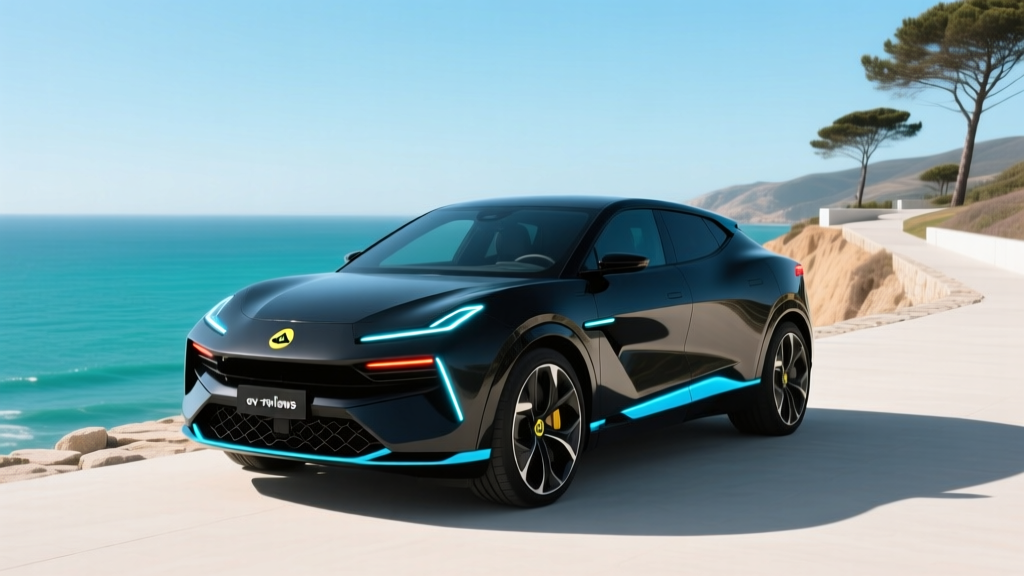
The Lotus Eletre is the brand's first all-electric vehicle and its first SUV — a machine that attempts to reconcile Lotus's sports-car DNA with the practicality American buyers demand. Built on Lotus's Electric Premium Architecture (EPA) at the Wuhan, China facility, the Eletre targets the high-performance luxury EV SUV segment occupied by the Tesla Model X, Porsche Cayenne EV, BMW iX, and Audi Q8 e-tron. After spending time with the specs, charging data, and real-world ownership reports, here is everything you need to know before committing to this six-figure electric SUV.
Quick Verdict: Who Should Buy the Lotus Eletre?
The Lotus Eletre is best for: Performance-focused luxury buyers who want exotic-car acceleration in a five-seat SUV, prioritize distinctive design over mainstream brand cachet, and have reliable home charging access. The R+ trim delivers hypercar-rivaling 905 hp, while the base model offers a strong blend of range and daily usability.
Look elsewhere if: You need maximum cargo space (the Cayenne EV and Model X offer more), require a proven dealer/service network (Lotus's US footprint is still expanding), or want to guarantee the full $7,500 federal tax credit — the Eletre's China-built battery sourcing likely disqualifies it under current §30D rules.
Lotus Eletre Specs at a Glance
| Specification | Eletre (Base) | Eletre R+ |
|---|---|---|
| EPA Range | 304 miles (est.) | 270 miles (est.) |
| Battery Capacity | 112 kWh usable (NMC) | 112 kWh usable (NMC) |
| Drivetrain | AWD, Dual-Motor | AWD, Dual-Motor |
| Horsepower | 603 hp | 905 hp |
| 0-60 mph | 4.5 seconds | 2.9 seconds |
| Max DC Fast Charge | 350 kW (peak) | 350 kW (peak) |
| 10-80% DC Time | ~20 minutes | ~20 minutes |
| Level 2 Charge Rate | 22 kW (AC) | 22 kW (AC) |
| MPGe (combined, est.) | 89 MPGe | 79 MPGe |
| Base MSRP | $107,400 | $147,400 |
Range and Efficiency: EPA Numbers vs. Real-World Reality
The Eletre carries a 112 kWh usable battery pack using NMC (nickel manganese cobalt) chemistry — chosen for its higher energy density compared to LFP, which matters in a performance-oriented vehicle where weight and packaging are at a premium. Lotus quotes WLTP range figures of up to 373 miles for the base model, but WLTP is a European testing cycle that tends to overstate range compared to the US EPA cycle.
Range Reality Check: The Eletre base model is estimated at 304 miles EPA. In real-world conditions, expect approximately 260-280 miles on highway-heavy trips at 70+ mph. In cold weather (below 32°F), range can drop by 15-25%, bringing effective range to roughly 225-255 miles. The R+ trim, with its stickier Pirelli P Zero tires and higher performance draw, will see an EPA estimate closer to 270 miles, with real-world highway driving yielding 230-250 miles.
Efficiency for the base Eletre lands around 34-36 kWh/100 miles, which is competitive with the BMW iX xDrive50 but trails the more efficiency-focused Tesla Model X. The Eletre's active aerodynamics — including deployable front grille shutters and a rear spoiler — help reduce drag at highway speeds, partially offsetting the vehicle's substantial 5,700+ lb curb weight.
Charging Speed: DC Fast Charging and Home Setup
The Eletre's 800-volt electrical architecture enables some of the fastest charging in the luxury SUV segment. Here is what that means at the charger and at home:
| Charge Level | Max Power | Miles Added/Hour | Notes |
|---|---|---|---|
| Level 1 (120V) | 1.4 kW | ~4 mi/hr | Emergency/top-up only; full charge takes 80+ hours |
| Level 2 (240V, home) | 22 kW (AC onboard) | ~62 mi/hr | Requires 100A circuit for max rate; most homes install 48A (11.5 kW, ~32 mi/hr) |
| DC Fast Charge | 350 kW (peak) | ~680 mi/hr (peak) | 10-80% in ~20 min; peak rate tapers significantly above 60% SoC |
Charging curve reality: While the Eletre peaks at 350 kW on compatible CCS chargers (and NACS via adapter as the industry transitions), that peak rate is sustained only between roughly 10-55% state of charge. Above 60%, the charge rate tapers to protect the NMC cells, dropping to approximately 150 kW by 70% and further to around 50 kW above 85%. The advertised 10-80% time of ~20 minutes assumes a 350 kW-capable station with battery preconditioning active. On a 150 kW Electrify America or EVgo station — still common in many US markets — expect 10-80% in roughly 35-40 minutes.
For home charging, the Eletre's 22 kW onboard AC charger is among the fastest available, but extracting that rate requires a hardwired wall connector on a dedicated 100-amp circuit. Most residential installations use a 60-amp circuit delivering 48 amps (11.5 kW), which adds about 32 miles of range per hour — sufficient to fully replenish the battery overnight in roughly 10 hours. Installation costs for a Level 2 home charger typically range from $800-$2,500 depending on panel capacity and conduit run; a panel upgrade to 200A service can add $1,500-$3,000 if your home has older 100A service.
Performance: 905 Horsepower in a 5,700-lb SUV
The Eletre R+ is the headline act: 905 horsepower from its dual-motor all-wheel-drive system launches this luxury SUV to 60 mph in a claimed 2.9 seconds. That puts it in the territory of a Lamborghini Huracán and comfortably ahead of the Tesla Model X Plaid's 2.5-second claim (though real-world Model X Plaid tests show variance). The base Eletre's 603 hp and 4.5-second 0-60 time are hardly slow — they match a BMW X5 M Competition for context.
Both trims feature Lotus's adaptive air suspension with continuous damping control, active rear steering (up to 3.5 degrees), and torque vectoring via the dual-motor setup. The R+ adds a Track mode that stiffens damping, sharpens throttle response, and adjusts the stability control thresholds. Lotus's Intelligent Adaptive Cruise Control (IACC) and lane-centering constitute an SAE Level 2 driver-assistance system — meaning the driver must remain fully engaged with hands on or near the wheel and eyes on the road at all times. This is not autonomous driving.
Braking duties on the R+ are handled by 10-piston front calipers clamping 412 mm carbon-ceramic rotors — hardware more commonly found on dedicated supercars. Regenerative braking offers adjustable levels but does not provide true one-pedal driving at the strongest setting, a choice Lotus made to preserve the natural coasting feel expected from a brand with sporting heritage.
Interior, Cargo, and Technology
The Eletre's cabin represents a sharp departure from Lotus's historically spartan interiors. A 15.1-inch OLED center touchscreen running Lotus's Hyper OS dominates the dashboard, flanked by a slim 12.6-inch driver display and an identical passenger screen. A 23-speaker KEF Reference audio system with Uni-Q driver technology is available — one of the most ambitious in-car audio setups on the market.
Cargo and passenger space:
- Front legroom: 41.2 inches
- Rear legroom: 37.8 inches
- Cargo behind rear seats: 24.1 cu ft
- Cargo with rear seats folded: 53.6 cu ft
- Frunk (front trunk): 2.7 cu ft (fits a charging cable bag, not much more)
The cargo volume trails the Tesla Model X (behind-second-row: 37.1 cu ft) and the BMW iX (35.5 cu ft) noticeably. If maximum hauling capacity is a priority, the Eletre is not the segment leader. The relatively small frunk also means you will want a dedicated trunk organizer for charging cables rather than relying on front-trunk storage.
Notable tech features include a deployable LIDAR sensor (roof-mounted, for future ADAS capability expansion), phone-as-key via Bluetooth/UWB, over-the-air software updates, and a 29-inch augmented-reality head-up display. Wireless Apple CarPlay and Android Auto are standard.
Pricing, Trims, and Federal Tax Credit Eligibility
| Trim | Base MSRP | As-Tested (typical options) | §30D Tax Credit |
|---|---|---|---|
| Eletre | $107,400 | ~$115,000-$122,000 | Likely $0 (see below) |
| Eletre R+ | $147,400 | ~$158,000-$170,000 | $0 (exceeds MSRP cap) |
Federal tax credit analysis (§30D): The Eletre faces significant hurdles for the $7,500 federal EV tax credit under current IRS rules, for two independent reasons:
- MSRP cap: SUVs must have an MSRP at or below $80,000 to qualify. Both the base Eletre ($107,400) and R+ ($147,400) exceed this threshold.
- Battery sourcing: The Eletre is manufactured in Wuhan, China, with battery cells and critical minerals sourced primarily through Chinese supply chains. Under §30D's critical-mineral and battery-component requirements (phased in through 2025-2026), vehicles with battery components from a "foreign entity of concern" (FEOC) are disqualified regardless of price.
- Buyer income caps: Even if the vehicle qualified, the credit phases out for buyers with modified AGI above $300,000 (married filing jointly), $225,000 (head of household), or $150,000 (single).
Consult a tax professional and review the latest guidance at IRS.gov's clean vehicle credits page for your specific situation. Some states offer additional incentives that are not subject to federal sourcing rules — check your state energy office for details.
Battery Warranty and Long-Term Ownership
Lotus covers the Eletre's battery and electric powertrain with an 8-year / 100,000-mile warranty, with a capacity retention threshold of 70% — meaning Lotus will repair or replace the battery if it degrades below 70% of original capacity within that period. This is industry-standard, matching Tesla, BMW, and Porsche, though Hyundai and Kia offer more generous 10-year/100,000-mile coverage.
The NMC chemistry in the Eletre typically shows 8-12% degradation over the first 100,000 miles based on industry-wide data from similar packs, though individual results vary based on charging habits, climate, and DC fast-charge frequency. Best practices for longevity include keeping state of charge between 20-80% for daily use, limiting DC fast charging to road trips, and using the vehicle's scheduled departure preconditioning to avoid charging to 100% and then sitting.
The vehicle limited warranty runs 4 years / 50,000 miles. Lotus's US dealer network remains relatively thin — approximately 20-25 locations nationwide as of 2026 — which is a practical consideration for service accessibility compared to BMW, Porsche, or Tesla's far larger footprints.
How the Eletre Compares to Key Rivals
| Metric | Lotus Eletre | Tesla Model X | BMW iX xDrive50 | Porsche Cayenne EV |
|---|---|---|---|---|
| EPA Range | ~304 mi | 335 mi | 324 mi | ~300 mi |
| Battery (kWh) | 112 NMC | 100 NMC | 111.5 NMC | 113 NMC |
| Peak DC Charge | 350 kW | 250 kW | 200 kW | 270 kW |
| 0-60 (top trim) | 2.9 sec | 2.5 sec (Plaid) | 4.4 sec | ~3.3 sec (Turbo) |
| Cargo (rear up) | 24.1 cu ft | 37.1 cu ft | 35.5 cu ft | ~28 cu ft |
| Base MSRP | $107,400 | $79,990 | $87,250 | $99,900 |
The Eletre's primary differentiator is its combination of 800V fast-charging architecture (matching or exceeding the Porsche Taycan and Hyundai Ioniq 5 benchmarks), supercar acceleration in the R+, and a design language that stands apart from the German establishment. Where it falls short: cargo space is the smallest in this group, the dealer network is the thinnest, and the price premium over the Model X is substantial without the Supercharger network advantage (though NACS adapter access is closing this gap industry-wide).
The Biggest Pros and Cons
Pros
- 350 kW DC fast charging — among the fastest in any SUV
- R+ delivers 905 hp / 2.9-sec 0-60 in a five-seat package
- 800V architecture future-proofs charging compatibility
- Distinctive design — nothing else on the road looks like it
- 22 kW AC onboard charger (fastest in class for home/public AC)
- Carbon-ceramic brakes on R+ with 10-piston front calipers
- KEF Reference audio system is audiophile-grade
Cons
- No federal tax credit eligibility (MSRP cap + FEOC sourcing)
- Cargo space trails all key competitors
- US dealer/service network still very limited (~20-25 locations)
- Real-world range drops significantly in cold weather and at highway speeds
- R+ pricing pushes into $160K+ territory with options
- Frunk is nearly useless (2.7 cu ft)
- Brand-new platform — long-term reliability data not yet established
- Regen braking doesn't offer true one-pedal driving
Frequently Asked Questions
What is the real-world range of the Lotus Eletre?
The base Eletre is estimated at ~304 miles EPA. Real-world highway driving at 70-75 mph typically yields 260-280 miles. In cold weather below freezing, expect 225-255 miles. The R+ trim sees roughly 230-250 miles in mixed real-world use due to its stickier tires and higher performance calibration.
How fast does the Eletre charge at home and on the road?
On a 350 kW DC fast charger, the Eletre achieves 10-80% in approximately 20 minutes (with preconditioning). At home on a typical 48-amp Level 2 setup (11.5 kW), expect about 32 miles of range per hour, or a full charge in roughly 10 hours. The 22 kW onboard AC charger can charge faster if you have a 100A dedicated circuit.
Does the Lotus Eletre qualify for the federal EV tax credit?
No, under current IRS §30D rules. The base Eletre's $107,400 MSRP exceeds the $80,000 SUV cap, and the China-manufactured battery components trigger the FEOC disqualification. Neither trim qualifies for the $7,500 credit. State-level incentives may still apply — check your state's energy office. Always verify current rules at IRS.gov.
Is the Lotus Eletre worth buying over a Tesla Model X or BMW iX?
Choose the Eletre if you prioritize exclusivity, maximum DC charging speed, and supercar-level acceleration (R+), and you can accept limited dealer support and no tax credit. Choose the Model X if you value the Supercharger network, more cargo space, a lower starting price, and available FSD (Supervised). Choose the iX if you want a more established service network, more cargo room, and a more conservative design. The Eletre is a compelling driver's SUV but requires accepting trade-offs that its German and American rivals have addressed.
What is the battery warranty on the Lotus Eletre?
Lotus covers the high-voltage battery and electric powertrain for 8 years or 100,000 miles, whichever comes first, with a minimum 70% capacity retention guarantee. The vehicle limited warranty is 4 years / 50,000 miles.
Can the Eletre use Tesla Superchargers?
The Eletre currently ships with a CCS1 charge port. As the industry transitions to NACS (Tesla's connector), Lotus has indicated adapter compatibility for Supercharger access, but confirm current adapter availability with your dealer at purchase. Third-party CCS-to-NACS adapters (such as those from A2Z EV) are also available for approximately $200-$300.
Sources: Lotus Cars USA official specifications; fueleconomy.gov (EPA); IRS §30D Clean Vehicle Credits. All specifications reflect 2026 model-year data available at time of publication and are subject to manufacturer revision.