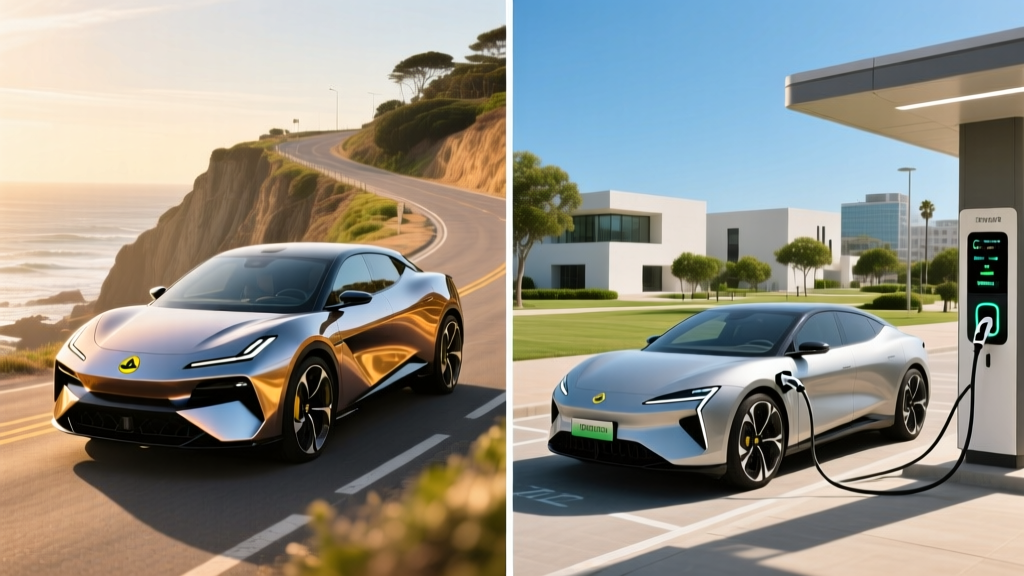
Lotus spent seven decades building featherweight, mid-engine sports cars. Its pivot to battery-electric luxury performance machines is one of the most dramatic brand transformations in the auto industry. For 2026, Lotus electric vehicles in the U.S. market mean two models: the Eletre performance SUV and the Emeya grand-touring sedan. Both ride on Lotus's Electric Premium Architecture (EPA), pack a 112-kWh NMC battery, and target Porsche, Tesla, and Lucid buyers who want British-engineered dynamics with serious kilowatt output.
This review breaks down exactly what you get for the money — EPA range versus real-world expectations, DC fast-charge curves, tax-credit math, and whether either model earns a spot in your garage over established rivals.
2026 Lotus Lineup at a Glance
| Spec | Eletre (Base / Eletre R) | Emeya (Base / Emeya R) |
|---|---|---|
| EPA Range | 304 mi (Base) / 266 mi (R) | 310 mi (Base) / 272 mi (R) |
| Battery (usable) | 112 kWh NMC (nickel-manganese-cobalt) | |
| Drivetrain | Dual-motor AWD | |
| Horsepower | 603 hp (Base) / 905 hp (R) | 611 hp (Base) / 905 hp (R) |
| 0-60 mph | 4.5 s (Base) / 2.9 s (R) | 4.15 s (Base) / 2.78 s (R) |
| Peak DC Fast Charge | 350 kW (800V architecture) | |
| 10-80% DC Time | ~20 minutes (peak conditions) | |
| Level 2 Home Charge | 22 kW onboard (~62 mi/hr added) | |
| Efficiency (combined) | 79 MPGe (Base) | 81 MPGe (Base) |
| Base MSRP | $109,900 / $145,900 | $98,900 / $142,900 |
| Battery Warranty | 8 yr / 100,000 mi (min 70% retention) | |
Range and Efficiency: Sticker vs. Reality
- EPA sticker (Eletre Base): 304 miles
- 70-mph highway loop: ~255-270 miles (NMC packs lose efficiency at sustained high speed)
- Winter (below 32°F): ~220-240 miles — expect 20-25% reduction without consistent preconditioning
- City/regen-heavy driving: Can match or slightly exceed EPA, up to ~315 miles
Source: fueleconomy.gov and independent EV road-test data.
The 112-kWh NMC pack is among the largest in any consumer EV sold in the U.S. That capacity gives the Eletre and Emeya a genuine 250+ mile highway buffer, but physics still applies: a 5,700-pound SUV pushing through air at 75 mph will consume electrons faster than the EPA's mixed-cycle test suggests.
The Emeya sedan, with a lower roofline and more aerodynamic drag coefficient, ekes out slightly better efficiency — roughly 81 MPGe combined versus the Eletre's 79 MPGe. In kWh/100-mi terms, that's approximately 42 kWh/100 mi for the Emeya and 43 kWh/100 mi for the Eletre. Neither is class-leading for efficiency (the Lucid Air achieves ~146 MPGe with a smaller, more optimized pack), but Lotus prioritized power delivery and charge speed over hypermiling.
Charging Speed: 800V Architecture Delivers
Both Lotus EVs use an 800-volt electrical architecture — the same voltage class as the Porsche Taycan, Hyundai Ioniq 5, and Kia EV6. This enables peak DC fast-charge rates up to 350 kW at compatible stations (Electrify America 350-kW stalls, for instance).
| Charging Level | Power (kW) | Rate / Time | Notes |
|---|---|---|---|
| Level 1 (120V household) | ~1.4 kW | ~4 mi/hr added | Emergency / trickle only |
| Level 2 (240V, 48A home) | 11.5 kW | ~32 mi/hr | Typical home wall connector |
| Level 2 (240V, max onboard) | 22 kW | ~62 mi/hr | Requires 90A+ circuit; rare home install |
| DC Fast (peak) | 350 kW | 10-80% in ~20 min | Requires 350-kW station + preconditioning |
| DC Fast (typical 150-kW stall) | ~150 kW | 10-80% in ~38 min | More common public infrastructure |
Charging-curve reality check: The 350-kW peak is not sustained across the entire session. Like all EVs, the Eletre and Emeya taper charge rate significantly above 80% State of Charge to protect battery longevity. Expect the curve to look roughly like this: 350 kW from 10-30%, stepping down to ~250 kW through 50%, ~150 kW through 70%, and below 80 kW past 85%. If you routinely charge to 100% at DC fast stations, budget an extra 15-20 minutes for that final 20%.
At home, the 22-kW onboard charger is a standout feature — most EVs cap at 11.5 kW (48 amps). If your home electrical panel supports a 100-amp dedicated circuit (consult a licensed electrician), you can replenish the 112-kWh pack from 10-90% overnight in about 5 hours. Most owners on a standard 48-amp Level 2 setup will need closer to 10 hours for a full charge, which still works fine for overnight top-ups.
Performance and Driving Dynamics
The Eletre R and Emeya R both produce 905 horsepower from their dual-motor AWD powertrain, launching to 60 mph in under 3 seconds. That's supercar territory in a 5,700-pound SUV or a 5,400-pound sedan. Even the base trims — 603 hp (Eletre) and 611 hp (Emeya) — deliver 4-second-range 0-60 times that outpace most V8 sports sedans.
Lotus tuned the EPA platform with an adaptive air suspension, rear-wheel steering (up to 3.5 degrees on the R trims), and active anti-roll bars. The result is genuinely impressive body control for vehicles of this mass. The steering is weighted and communicative by EV standards — a deliberate Lotus hallmark carried over from the Elise and Evija lineage.
Regenerative braking offers multiple levels selectable via the steering-wheel paddles, but Lotus does not offer true one-pedal driving to a full stop. You'll still use the friction brakes at low speeds. For EV veterans accustomed to Nissan Leaf or Tesla one-pedal modes, this takes adjustment.
Interior, Cargo, and Technology
Both models seat five. Interior materials are premium — Nappa leather, Alcantara headliners, and real carbon-fiber trim on R variants. The centerpiece is a 15.1-inch OLED infotainment display running Lotus's Hyper OS, plus a 12.6-inch digital instrument cluster and an available 29-inch AR head-up display.
Cargo capacity:
- Eletre: 21.4 cu ft behind rear seats; ~54 cu ft with seats folded. Front trunk (frunk): ~2.6 cu ft — enough for charging cables, not luggage.
- Emeya: 17.8 cu ft trunk; no frunk on U.S.-spec models.
- Rear legroom: ~39.4 inches (Eletre), ~37.8 inches (Emeya)
On the driver-assistance front, both models ship with Lotus's Intelligent Drive system — a Level 2 (SAE) suite including adaptive cruise, lane-centering, automated lane-change, and a 360-degree camera with lidar sensors (four lidar units are integrated into the body, deployable from the roof and fenders).
Pricing, Trims, and Federal Tax Credit Eligibility
| Trim | Base MSRP | As-Tested (typical options) | §30D Federal Credit |
|---|---|---|---|
| Emeya Base | $98,900 | $106,000-$112,000 | Not eligible (MSRP cap exceeded) |
| Emeya R | $142,900 | $155,000+ | Not eligible |
| Eletre Base | $109,900 | $118,000-$125,000 | Not eligible (MSRP cap exceeded) |
| Eletre R | $145,900 | $158,000+ | Not eligible |
Does a Lotus qualify for the $7,500 federal EV tax credit? No — not under current IRS §30D rules. The federal credit for new EVs has an MSRP cap: $80,000 for SUVs, pickups, and vans; $55,000 for sedans. Every 2026 Lotus EV exceeds these caps by a wide margin. Additionally, buyer income limits apply ($150K single / $300K joint for new EVs), and the credit requires specific battery-critical-mineral and component sourcing thresholds that are difficult for low-volume, globally sourced vehicles to meet.
For full eligibility rules, consult the IRS Clean Vehicle Credits page and speak with a tax professional before making purchase decisions based on incentive assumptions.
Some states offer their own EV rebates or HOV-lane access regardless of federal credit eligibility — check your state's energy or DMV website for specifics, as these vary by jurisdiction and change frequently.
Warranty and Ownership Costs
Lotus provides an 8-year / 100,000-mile battery and powertrain warranty, with a minimum 70% capacity retention guarantee over that period. The bumper-to-bumper limited warranty runs 4 years / 50,000 miles. These terms are competitive with Porsche and BMW, though Tesla's 8-year / 150,000-mile battery warranty (on Model S/X) remains more generous on mileage.
Insurance premiums for both models run high — expect $3,500-$5,500 annually depending on your profile and location. High-performance EVs from low-volume manufacturers typically carry elevated rates due to repair-cost uncertainty and parts availability.
Maintenance is lighter than a combustion equivalent (no oil changes, fewer moving parts), but Lotus's dealer and service network in the U.S. is still small — roughly 25-30 authorized locations as of early 2026. If you're far from a Lotus dealer, factor in potential travel time for warranty work.
Lotus Electric Vehicles vs. Key Competitors
At this price point, the Eletre and Emeya compete against formidable rivals:
- Porsche Taycan / Cayenne EV: The Taycan sedan matches Emeya on driving dynamics and charges at up to 320 kW (2025+ Taycan). The Cayenne EV (announced) targets Eletre directly. Porsche's U.S. dealer network is far more established.
- Tesla Model S Plaid: 1,020 hp, 396-mi EPA range, $89,990 — faster, longer-range, and cheaper, but interior quality and build consistency don't match Lotus.
- Lucid Air Grand Touring: 516-mi EPA range, 819 hp, ~$125,600. Dramatically more range and efficiency, but less aggressive styling and no SUV option.
- BMW i7 M70: 318-mi range, 650 hp, $168,000. More luxurious, less sporty. Significantly more expensive.
- 350-kW peak DC charging (10-80% in ~20 min)
- 905 hp R trims deliver sub-3-second 0-60
- 22-kW onboard Level 2 charger (class-leading)
- Lidar-equipped Level 2 ADAS suite
- Genuine sports-car handling tuning in a luxury EV
- Distinctive design — not a Tesla/Porsche clone
- No federal tax credit eligibility (MSRP too high)
- Real-world highway range ~255-270 mi (below EPA sticker)
- Limited U.S. dealer and service network (~25-30 locations)
- No one-pedal driving to a full stop
- Insurance premiums are steep ($3,500-$5,500/yr)
- Emeya has no frunk; Eletre frunk is tiny (2.6 cu ft)
Who Should Buy a Lotus EV?
- You want a performance SUV with sub-3-second 0-60 and 350-kW charging
- You have reliable home Level 2 charging (ideally 22-kW capable)
- You live within reasonable distance of a Lotus service center
- You prioritize driving dynamics over maximum range
- You want a grand-touring sedan that rivals the Taycan on handling but with more tech
- You value distinctive styling over brand cachet
- You primarily drive in moderate climates (cold-weather range loss hits the lower-EPA R trims harder)
- You need 400+ miles of real-world range (consider Lucid Air)
- Federal tax credit eligibility is essential to your purchase math
- You want the broadest possible service network (Tesla, BMW, Porsche)
- You need three-row seating or serious cargo volume
Frequently Asked Questions
What is the real-world range of Lotus electric vehicles?
The Eletre Base achieves an EPA-estimated 304 miles, but expect ~255-270 miles on sustained highway driving and ~220-240 miles in freezing temperatures. The Emeya Base rates at 310 miles EPA with similar real-world reductions. R trims, with their stickier tires and higher power output, drop to 266-272 miles EPA — plan for ~220-240 miles highway.
How fast do the Eletre and Emeya charge?
Both support up to 350 kW on DC fast chargers, achieving 10-80% in approximately 20 minutes at a compatible 350-kW station. At a more common 150-kW public charger, expect 10-80% in roughly 38 minutes. At home on Level 2, the 22-kW onboard charger can add ~62 miles of range per hour — among the fastest in any production EV.
Does a Lotus qualify for the federal EV tax credit?
No. Under current IRS §30D rules, the MSRP caps are $80,000 for SUVs and $55,000 for sedans. All 2026 Lotus models exceed these caps. Additionally, buyer income limits and battery-sourcing requirements further restrict eligibility. Consult IRS.gov and a tax professional for your specific situation.
Is the Lotus Eletre worth buying over a Porsche Cayenne EV or Tesla Model X?
The Eletre offers a compelling blend of 905-hp performance, 350-kW charging, and distinctive design. However, Porsche's dealer network is vastly larger, and the Tesla Model X offers more range (335-348 mi EPA) and a lower starting price (~$79,990). If exclusivity and driving dynamics are your top priorities, the Eletre is competitive. If service convenience and range matter more, the rivals have advantages.
What is the battery warranty on Lotus EVs?
Lotus covers the battery and powertrain for 8 years or 100,000 miles, whichever comes first, with a guaranteed minimum 70% capacity retention over that period. The bumper-to-bumper limited warranty is 4 years / 50,000 miles.
Can I charge a Lotus at Tesla Superchargers?
As of 2026, Lotus vehicles in the U.S. use the CCS1 connector. Tesla Superchargers have transitioned to NACS (North American Charging Standard). Lotus has not announced a native NACS port or an official CCS-to-NACS adapter program for U.S. models. You can charge at Electrify America, EVgo, ChargePoint, and other CCS-compatible networks. Check Lotus's official communications for any future adapter availability.
How does the Lotus Intelligent Drive system compare to Tesla Autopilot?
Both are SAE Level 2 systems requiring full driver supervision. Lotus uses four lidar units plus cameras and radar, giving it strong object-detection redundancy. Tesla relies on a camera-only (Tesla Vision) approach. Neither system is self-driving. Real-world performance varies by scenario — Lotus's lidar may perform better in low-visibility conditions, while Tesla benefits from a larger training-data fleet. Both require hands on wheel and eyes on road.
Editorial note: Pricing, tax-credit rules, and specifications reflect 2026 model-year data available at time of publication. Always verify current figures with Lotus Cars, the IRS, and your local dealer before purchasing.