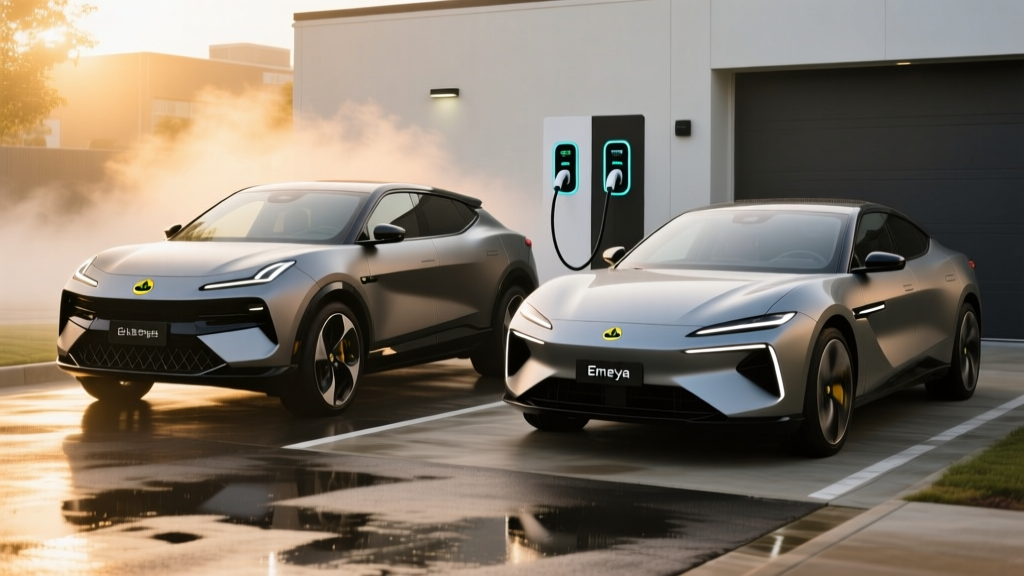
Lotus spent decades building featherweight, mid-engine sports cars. Now the Geely-owned brand sells two all-electric vehicles in the United States: the Eletre grand-touring SUV and the Emeya four-door GT sedan. Both ride on Lotus's Electric Premium Architecture (EPA), share an 800-volt electrical system, and target buyers who want Porsche Taycan–level performance with more interior space. This 2026 Lotus BEV guide breaks down the real-world range, charging behavior, pricing, and tax-credit reality for both models so you can decide if the Lotus badge is worth the premium.
2026 Lotus BEV Lineup at a Glance
| Spec | Eletre (Base / R) | Emeya (Base / R) |
|---|---|---|
| Body style | 5-seat SUV | 5-seat liftback sedan |
| Drivetrain | Dual-motor AWD | Dual-motor AWD |
| Battery (usable) | ~112 kWh NMC | ~102 kWh NMC |
| Horsepower | 603 hp / 905 hp | 611 hp / 905 hp |
| 0–60 mph | 4.5 s / 2.9 s | 4.1 s / 2.8 s |
| EPA range (est.) | 304 mi / 266 mi | 310 mi / 270 mi |
| Peak DC charge | 350 kW | 350 kW |
| 10–80% DC time | ~20 min | ~18 min |
| Level 2 (11.5 kW) | ~32 mi/hr | ~30 mi/hr |
| MPGe (combined) | 79 MPGe | 83 MPGe |
| Base MSRP | $109,900 | $96,900 |
| Warranty | 4 yr/50k basic, 8 yr/100k battery | 4 yr/50k basic, 8 yr/100k battery |
Real-World Range vs. EPA Estimates
Eletre R: EPA 266 mi — expect ~220–240 mi highway; under 200 mi in cold, high-speed driving.
Emeya Base: EPA 310 mi — expect ~260–280 mi highway; ~230–250 mi in cold weather.
Emeya R: EPA 270 mi — expect ~225–245 mi highway; ~195–215 mi in freezing temps.
Both Lotus BEVs use nickel-manganese-cobalt (NMC) lithium-ion packs supplied by CATL. NMC offers higher energy density than LFP, which is why a 112 kWh pack fits under the Eletre's floor, but it is more sensitive to repeated 100% charges. Lotus recommends daily charging to 80–90% and reserving 100% for road trips — a practice that extends long-term State of Health (SoH).
The range gap between the Base and R trims is almost entirely due to the R's higher-output rear motor, stickier Pirelli P Zero tires, and more aggressive default regen mapping that trades efficiency for response. If your commute is mostly highway, the Base trims are the range champions of the lineup.
800V Charging: How Fast Do Lotus BEVs Actually Charge?
| Level | Power | Miles added per hour | Notes |
|---|---|---|---|
| Level 1 (120V) | 1.4 kW | ~3–4 mi/hr | Emergency/trickle only |
| Level 2 (240V, 48A) | 11.5 kW | ~30–32 mi/hr | Full charge in ~10 hr |
| DC Fast (350 kW) | Up to 350 kW | ~850 mi/hr peak | 10–80% in ~18–20 min |
The 800V architecture is the headline. At a 350 kW Electrify America or IONITY stall, the Eletre peaks near 340 kW for roughly the first 10–15% of the session before tapering. Sustained power from 20–60% SoC hovers around 220–250 kW, then drops to ~140 kW through 80%. That curve yields a 10–80% time of about 20 minutes — competitive with the Hyundai Ioniq 5 N and slightly quicker than a Taycan Turbo GT on the same hardware.
Preconditioning matters. Use the Lotus app or in-car nav to route to a DC charger; the thermal system will warm the pack to the optimal 30–35°C window, which can shave 3–5 minutes off the session in cold weather. Skip preconditioning in winter and you may see peak power capped around 150 kW until the pack warms organically.
For home charging, a 48-amp Level 2 wallbox on a 60-amp circuit adds roughly 30 miles per hour of sleep — enough to fully replenish either car overnight. Lotus includes a NACS charge port on 2026 U.S. models, giving native access to Tesla Superchargers (V4 stalls deliver up to 250 kW, still enough for a quick 15-minute top-up).
Performance, Ride, and Daily Drivability
Lotus engineered the EPA platform around a dual-motor AWD layout with torque vectoring on the rear axle. The Base trims use a single-speed reduction gear; the R trims add a two-speed transmission on the rear motor, enabling the 2.8–2.9 second 0–60 times without sacrificing highway efficiency.
Standard adaptive air suspension with continuous damping control gives both cars a 55–65 mph comfort bias, but drop into Track mode and the Eletre R hunkers down 15 mm and sharpens throttle mapping noticeably. The Emeya, being lower and ~350 lb lighter, feels more like a sports sedan than a lifted hatch — steering is quicker and body roll is better contained.
Regen braking offers three levels plus a true one-pedal mode that brings the car to a full stop. Lotus's blending is smoother than early Taycan software but not quite as seamless as BMW's i5 adaptive regen.
Interior, Cargo, and Technology
Inside, the Eletre offers 21.4 cu ft behind the second row and 54.3 cu ft with the 40/20/40 split folded — roughly 3 cu ft more than a Cayenne E-Hybrid. Rear legroom measures 38.6 inches, enough for two adults on a long trip. The Emeya's liftback design yields 17.1 cu ft of cargo space, expandable to 42.8 cu ft with seats folded.
A 15.1-inch OLED center display runs Lotus's HyperOS infotainment with native Apple CarPlay, Android Auto, and over-the-air updates. A 12.6-inch passenger display is standard on R trims. Audio is a 23-speaker KEF Reference system — one of the best factory setups in any EV at this price.
Driver assistance falls under Lotus Pilot, a Level 2 SAE system bundling adaptive cruise, lane-centering, and automated lane changes. It is competent on highways but requires hands-on-wheel supervision and is not a hands-off system like GM's Super Cruise. A 3D surround-view camera with transparent chassis is standard and genuinely useful when parking the Eletre's 17-foot footprint.
Pricing, Trims, and Federal Tax Credit Reality
| Model / Trim | Base MSRP | As-tested (typical options) | §30D credit eligibility |
|---|---|---|---|
| Eletre Base | $109,900 | $118,500 | Not eligible — exceeds $80k SUV MSRP cap |
| Eletre R | $149,900 | $162,000 | Not eligible — exceeds $80k SUV MSRP cap |
| Emeya Base | $96,900 | $105,400 | Not eligible — exceeds $55k sedan MSRP cap |
| Emeya R | $139,900 | $151,200 | Not eligible — exceeds $55k sedan MSRP cap |
The IRS §30D rules cap eligible MSRP at $80,000 for SUVs/pickups/vans and $55,000 for sedans. Every 2026 Lotus BEV trim exceeds those limits, so no current Lotus BEV qualifies for the $7,500 federal tax credit. Buyer income caps ($300k joint / $150k single) and critical-mineral sourcing rules further restrict eligibility even on cheaper EVs.
Some buyers offset cost via state incentives — California's CVRP rebate, Colorado's $5,000 credit, and utility off-peak charging rebates can stack — but always verify current rules with your state energy office and a tax professional.
Lotus BEV vs. Porsche Taycan, BMW i7, and Lucid Air
The Eletre's most direct rival is the Porsche Cayenne EV (arriving late 2026) and the current Taycan Cross Turismo. The Eletre undercuts the Taycan on cargo space and rear-seat room but matches it on 800V charging speed. The Lucid Air Pure (~$75k) offers 419 mi of EPA range and is tax-credit eligible, but cannot match the Lotus on build quality or NACS Supercharger access.
The Emeya competes with the Taycan sedan, BMW i7, and Mercedes EQS. It is the performance-per-dollar leader in that set, undercutting a Taycan Turbo by $50k+ while delivering similar 0–60 times. The trade-off is a smaller dealer/service network and a brand still building U.S. credibility.
Pros
- 800V architecture delivers 10–80% in under 20 min on a 350 kW stall
- NACS port gives native Tesla Supercharger access
- Class-leading KEF Reference audio and OLED displays
- R trims hit sub-3.0s 0–60 — hypercar territory
- Air suspension balances comfort and sport well
Cons
- No federal §30D tax credit — MSRP exceeds caps
- U.S. dealer and service footprint still small
- R-trim range drops below 270 mi EPA
- Lotus Pilot ADAS is competent but not class-leading
- Heavy — 5,800+ lb curb weight hurts tire and brake wear
Who Should Buy a Lotus BEV?
The Eletre fits performance-SUV buyers who want Porsche dynamics, more cargo space than a Taycan Cross Turismo, and don't need the federal credit. The Emeya suits grand-touring sedan shoppers cross-shopping the Taycan and Lucid Air who value design and audio quality over maximum range.
Neither model is the right pick if your top priority is range-per-dollar (Lucid Air), hands-off highway driving (GM Super Cruise vehicles), or a robust dealer network (BMW/Porsche). But if you want a distinctive, fast-charging, driver-focused EV that stands apart from the Tesla-and-German crowd, the 2026 Lotus BEV lineup earns a serious test drive.
Frequently Asked Questions
What is the real-world range of the 2026 Lotus Eletre?
The Base Eletre is EPA-rated at 304 miles. Real-world highway driving at 70 mph yields 255–275 mi in mild weather and 220–240 mi in freezing temperatures. The hotter Eletre R drops to 266 mi EPA and roughly 220–240 mi highway.
How fast do Lotus BEVs charge at home and on the road?
On a 350 kW DC fast charger, both models hit 10–80% in 18–20 minutes thanks to their 800V architecture. At home on an 11.5 kW Level 2 wallbox, expect ~30–32 miles of range per hour, or a full overnight charge.
Does the 2026 Lotus Eletre or Emeya qualify for the $7,500 federal EV tax credit?
No. Under current IRS §30D rules, SUVs must have an MSRP at or below $80,000 and sedans at or below $55,000. All Lotus BEV trims exceed those caps.
Is Lotus a reliable EV brand in the U.S.?
Lotus is still expanding its U.S. service network. The EVA platform and CATL battery are proven in the Chinese and European markets, but long-term U.S. ownership data is limited. The 8-year/100,000-mile battery warranty provides a baseline of protection.
How does the Emeya compare to the Porsche Taycan?
The Emeya R matches the Taycan Turbo on 0–60 (~2.8s) and undercuts it by roughly $50,000. The Taycan offers a larger service network, slightly sharper steering feel, and a more mature ADAS suite. The Emeya wins on value and interior tech.
What is the battery warranty on Lotus BEVs?
Lotus provides an 8-year/100,000-mile warranty on the high-voltage battery and powertrain, with a capacity-retention threshold of 70%. The basic vehicle warranty is 4 years/50,000 miles.