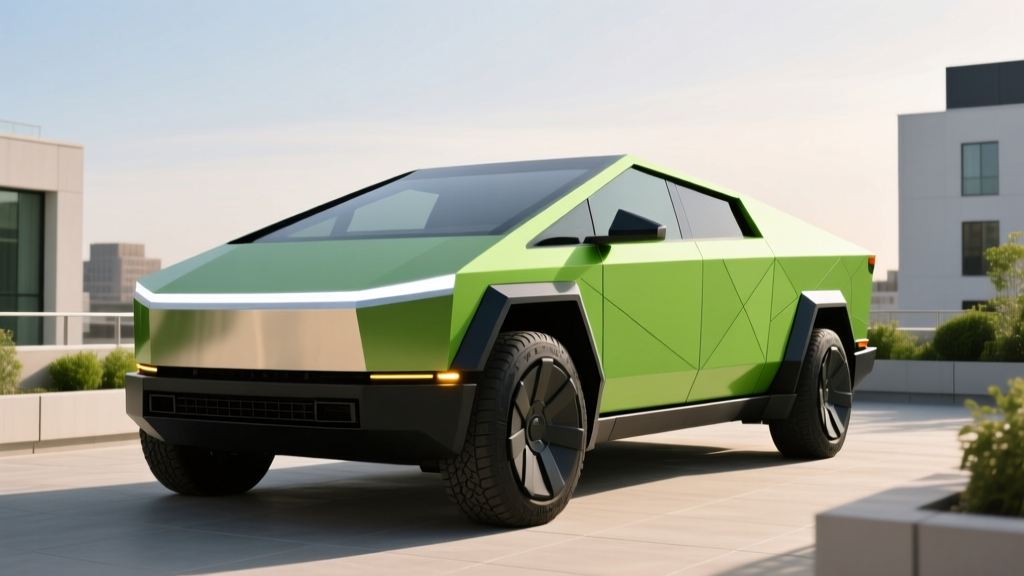
If you've spent any time on EV social media in the past year, you've seen it: a stainless-steel Tesla Cybertruck wrapped in eye-searing lime green, cutting through traffic like a neon blade. The "lime green Cybertruck" has become one of the most searched custom EV aesthetics in 2026, combining Tesla's polarizing angular truck with a vinyl wrap color that ranges from acid green to British Racing Green meets highlighter. But beneath the head-turning wrap sits a serious electric pickup with real capability, real limitations, and real ownership costs. This review covers what you're actually buying before you add the $3,000–$5,000 wrap on top.
2026 Tesla Cybertruck: Quick Verdict
The 2026 Cybertruck lineup continues with the Long Range AWD and Cyberbeast trims, following the discontinuation of the base RWD model after 2025. It remains one of the fastest-accelerating pickups ever built, offers competitive range, and delivers genuine utility — but its stainless-steel exoskeleton makes it a uniquely challenging (and expensive) vehicle to own, insure, and yes, wrap in lime green. For buyers who want an EV truck with performance credentials and don't mind the polarizing design, it's compelling. For those prioritizing comfort, quiet, and conventional truck practicality, the Ford F-150 Lightning or Rivian R1T may serve better.
Range, Battery, and Real-World Efficiency
| Spec | Long Range AWD | Cyberbeast (Tri-Motor) |
|---|---|---|
| EPA Range | 340 miles | 320 miles |
| Battery Capacity (usable) | ~123 kWh | ~123 kWh |
| Battery Chemistry | NMC (Nickel Manganese Cobalt) | NMC |
| Drivetrain | Dual-Motor AWD | Tri-Motor AWD |
| Horsepower | 600 hp | 845 hp |
| 0–60 mph | 3.9 seconds | 2.6 seconds |
| Max Towing | 11,000 lbs | 11,000 lbs |
| MPGe (Combined) | 67 MPGe | 64 MPGe |
| Efficiency (kWh/100 mi) | 50 kWh/100 mi | 53 kWh/100 mi |
| Base MSRP | $79,990 | $99,990 |
The EPA rates the Long Range AWD at 340 miles and the Cyberbeast at 320 miles. In practice, expect 270–300 miles on highway road trips at 70–75 mph, and significantly less — around 220–250 miles — in cold weather (below 32°F) due to battery resistance and cabin heating demands. The Cybertruck's angular, flat-panel design creates more aerodynamic drag than a curved body, which disproportionately hurts highway efficiency compared to crossovers. If your commute is mostly city driving under 50 mph, you'll get closer to the EPA sticker. Plan road trips with a 20–25% buffer below the EPA number.
The ~123 kWh usable battery pack uses NMC (nickel manganese cobalt) chemistry, chosen for its high energy density — necessary to push a 6,800+ pound vehicle to 340 miles. NMC offers better cold-weather performance and energy density than LFP, but Tesla recommends daily charging to 80–90% for longevity, reserving 100% for road trips. Over a typical ownership period, expect roughly 8–12% degradation over 100,000 miles based on Tesla's fleet data and third-party tracking from sources like fueleconomy.gov.
Charging Speed: DC Fast and Home Level 2
| Charging Level | Power (kW) | Speed (mi/hr added) | Notes |
|---|---|---|---|
| Level 1 (120V outlet) | ~1.4 kW | ~3–4 mi/hr | Emergency only; 80+ hours for full charge |
| Level 2 (240V, 48A) | 11.5 kW | ~29 mi/hr | Full charge in ~11 hours; standard home setup |
| DC Fast Charge (V4 Supercharger) | Peak 250 kW | ~140 mi/hr (peak) | 10–80% in ~22 minutes |
| DC Fast Charge (350 kW CCS station w/ adapter) | ~200–250 kW | ~120–140 mi/hr | Requires NACS-to-CCS adapter; varies by station |
The Cybertruck uses Tesla's NACS connector natively, giving it full access to the Supercharger network — the most reliable DC fast-charging ecosystem in North America. On a V4 Supercharger, the truck peaks at around 250 kW, though the massive 123 kWh battery means the charge curve tapers noticeably above 60% state of charge. The 10–80% charge takes approximately 22 minutes under ideal conditions (warm battery via preconditioning, uncrowded station). Above 80%, charging slows dramatically to protect cell health — plan to charge to 80% on road trips and move on rather than wait for 100%.
For home charging, the Cybertruck's onboard charger maxes at 11.5 kW on a 48-amp Level 2 circuit (60-amp breaker). That adds roughly 29 miles of range per hour, meaning a depleted battery takes about 11 hours to fill overnight. You'll need a NEMA 14-50 outlet or a hardwired Tesla Wall Connector. Budget $800–$2,500 for professional installation depending on your panel capacity and run length — and confirm your electrical panel has headroom for a 60-amp circuit before committing.
Performance and Driving Dynamics
The Cyberbeast's 2.6-second 0–60 mph time makes it one of the quickest production vehicles on the road, let alone a 6,800-pound pickup. The Long Range AWD's 3.9 seconds is equally absurd by truck standards. Both models feature adaptive air suspension with up to 16 inches of ground clearance in Off-Road mode, and the steer-by-wire system (no mechanical connection between the yoke and the wheels) provides variable steering ratios that make parking lot maneuvers surprisingly manageable despite the truck's 223.7-inch length.
The steer-by-wire system is the most polarizing feature. Some owners adapt within a week; others never trust the lack of physical feedback. There's no traditional steering column — just a yoke and electronics. Tesla has issued multiple software updates to refine the feel, but it remains a love-it-or-leave-it proposition. On highway drives, the Cybertruck is stable and planted, but the stainless-steel body and minimal sound insulation mean you hear more wind noise than in a Rivian R1T or F-150 Lightning at 75 mph.
Pricing, Tax Credits, and Ownership Costs
| Trim | Base MSRP | Federal §30D Credit | Effective Price (if eligible) |
|---|---|---|---|
| Long Range AWD | $79,990 | Up to $7,500 | ~$72,490 |
| Cyberbeast | $99,990 | Up to $7,500 | ~$92,490 |
Tax credit caveats — read carefully: Under IRS §30D rules, the Cybertruck qualifies as a light truck (MSRP cap: $80,000). The Long Range AWD at $79,990 squeaks under the cap, but the Cyberbeast at $99,990 does not qualify for the federal credit. Additionally, buyer income caps apply: modified AGI cannot exceed $150,000 (single), $225,000 (head of household), or $300,000 (joint). Battery component and critical mineral sourcing requirements must also be met — Tesla's supply chain has shifted over time, so verify current-year eligibility on IRS.gov's qualified vehicle list before purchasing. The credit can be transferred to the dealer at point of sale for an instant price reduction, or claimed on your tax return.
Insurance is a real cost factor. The Cybertruck's stainless-steel body panels, steer-by-wire system, and specialized repair requirements push premiums 30–50% higher than comparable trucks. Expect $2,500–$4,000 annually depending on your state, driving record, and coverage level. Get quotes before ordering.
Interior, Cargo, and Tech
The Cybertruck seats five (three-across front bench optional on some configs, but typically a two-row, five-seat layout). Rear legroom measures approximately 38.5 inches — adequate for adults on shorter trips but not class-leading. The 6.5-foot bed (74.3 inches long) offers 67 cubic feet of cargo volume, with an additional 15.3 cubic feet in the front trunk (frunk). The bed features a powered tonneau cover, 120V and 240V outlets (up to 11.5 kW continuous output via Powershare), and integrated tie-downs.
The 18.5-inch center touchscreen runs Tesla's latest software with navigation, streaming, and gaming capabilities. A rear 9.4-inch touchscreen serves second-row passengers. The truck includes Tesla's Autopilot (adaptive cruise + lane centering) standard, with Full Self-Driving (Supervised) available as a $8,000 option or $99/month subscription. Important: FSD is an SAE Level 2 driver-assist system — you must remain fully engaged, hands on the yoke, eyes on the road. It is not autonomous driving.
Notable drawbacks include the lack of Apple CarPlay/Android Auto (Tesla uses its proprietary system exclusively), the yoke's learning curve, limited rear visibility (reliance on cameras), and the fact that the stainless-steel body cannot be traditionally repaired — dents require panel replacement, and collision shops with Cybertruck certification remain scarce in many regions.
The Lime Green Wrap: What You Need to Know
Since the Cybertruck's stainless-steel exoskeleton cannot be painted through conventional means, vinyl wrapping is the only way to achieve a lime green (or any color) finish. A full-body wrap in a high-quality lime green vinyl (brands like 3M, Avery Dennison, or KPMF) typically costs $3,500–$6,000 installed, depending on finish (gloss, satin, chrome, color-shift). The Cybertruck's flat panels and sharp angles actually make it one of the more wrap-friendly vehicles — fewer complex curves — but the sheer surface area drives cost.
Key considerations for wrapping a Cybertruck:
- Paint protection film (PPF) underneath: Many owners apply PPF before the color wrap to protect the stainless steel from scratches during wrap removal. Adds $2,000–$4,000.
- Warranty and resale: Wraps don't void Tesla's vehicle warranty, but improper removal can scratch the steel. Document everything.
- Durability: Quality wraps last 3–5 years. Lime green, especially bright/neon shades, may fade faster in high-UV climates than darker colors.
- Insurance notification: Some insurers require notification of wraps; others don't cover wrap replacement after a collision. Check your policy.
How It Compares: Cybertruck vs. Key Rivals
| Spec | Cybertruck LR AWD | F-150 Lightning (Ext. Range) | Rivian R1T (Dual-Motor Max) |
|---|---|---|---|
| EPA Range | 340 mi | 320 mi | 352 mi |
| 0–60 mph | 3.9 sec | 4.0 sec | 4.5 sec |
| Max Tow | 11,000 lbs | 10,000 lbs | 11,000 lbs |
| Starting MSRP | $79,990 | $69,995 | $83,900 |
| Bed Length | 6.5 ft | 5.5 ft | 4.5 ft (+ Gear Tunnel) |
| §30D Credit Eligible | Yes (LR only) | Yes | Yes |
The F-150 Lightning wins on familiarity, dealer network, and lower entry price. The Rivian R1T wins on adventure capability, build quality, and the clever Gear Tunnel. The Cybertruck wins on raw performance, range efficiency per pound, and the Supercharger network. Your choice depends on whether you prioritize convention (Ford), exploration (Rivian), or performance and spectacle (Tesla).
- Class-leading acceleration (2.6s Cyberbeast)
- 340-mile EPA range; efficient for its weight
- 11,000-lb towing + 11.5 kW Powershare output
- Supercharger network access (NACS native)
- Stainless-steel body resists dents and corrosion
- Flat panels make vinyl wrapping (lime green!) straightforward
- Cyberbeast exceeds $80K MSRP cap — no tax credit
- Steer-by-wire yoke is polarizing and unfamiliar
- Insurance premiums 30–50% above peers
- Limited certified collision repair centers
- No Apple CarPlay/Android Auto
- Rear visibility relies heavily on cameras
- Highway range drops significantly due to aero drag
Who Should Buy the Cybertruck?
Choose the Cybertruck if: You want the fastest truck available, live near Superchargers, need 11,000-lb towing, and love the design enough to defend it daily. The lime green wrap crowd tends to be enthusiasts who want maximum attention — and the Cybertruck delivers that in spades.
Choose the F-150 Lightning if: You want a conventional truck experience, need a wider dealer/service network, prefer a lower MSRP, and value CarPlay integration.
Choose the Rivian R1T if: You prioritize off-road adventure, want the Gear Tunnel for gear-heavy lifestyles, and appreciate premium interior materials and build quality.
Frequently Asked Questions
What is the real-world range of the lime green Cybertruck?
The wrap doesn't affect range. The Long Range AWD is EPA-rated at 340 miles; expect 270–300 miles on highway trips and 220–250 miles in freezing weather. The Cyberbeast is rated at 320 miles with similar real-world reductions.
How fast does the Cybertruck charge at home and on the road?
On a 48-amp Level 2 home charger, it adds ~29 miles per hour (11.5 kW), filling the battery in about 11 hours. On a V4 Supercharger, it peaks at 250 kW and charges from 10–80% in roughly 22 minutes.
Does the Cybertruck qualify for the $7,500 federal EV tax credit?
The Long Range AWD at $79,990 MSRP qualifies under the §30D truck cap of $80,000, provided the buyer meets income limits ($150K single / $300K joint) and battery sourcing requirements are satisfied. The Cyberbeast at $99,990 does not qualify. Always verify on IRS.gov before purchasing.
How much does a lime green wrap cost on a Cybertruck?
Expect $3,500–$6,000 for a professional full-body vinyl wrap in lime green, depending on vinyl brand and finish type (gloss, satin, metallic). Add $2,000–$4,000 if you apply PPF underneath for steel protection.
Is the Cybertruck worth buying over the F-150 Lightning or Rivian R1T?
It depends on your priorities. The Cybertruck wins on acceleration, Supercharger access, and head-turning design. The Lightning wins on price and dealer service. The R1T wins on adventure utility and interior quality. All three are capable EV trucks — your use case decides.
What is the Cybertruck's battery warranty?
Tesla covers the battery and drive unit for 8 years or 120,000 miles (whichever comes first), with a minimum 70% capacity retention threshold during the warranty period. This is competitive with the industry standard of 8 years / 100,000 miles.