Quick Answer: Can an EV Actually Tow the Lightship?
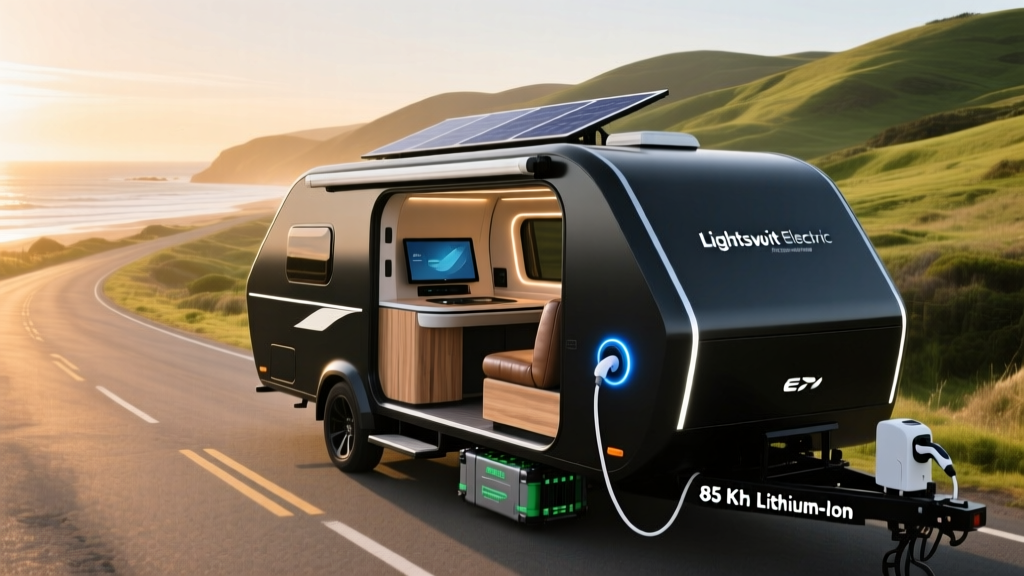
The Lightship L1 is an aerodynamic travel trailer with an integrated battery pack (up to 125 kWh) and electric motors on its axle, designed to offset the range loss EVs normally suffer when towing. With a base price of $107,000 and deliveries expected starting in 2025–2026, the L1 aims to make electric towing viable by essentially powering itself — so your EV's range stays closer to its unloaded EPA figure. The trade-off is a premium price and reliance on an emerging product category that has limited real-world track record.
Why the Lightship L1 Exists: The EV Towing Problem
Every EV owner who has tried towing a conventional travel trailer knows the math is brutal. Towing a 5,000-pound box with poor aerodynamics can cut an EV's range by 40–60%. A Rivian R1T with an EPA-estimated 352 miles of range might deliver just 150–170 miles while towing a standard 25-foot trailer at highway speeds. A Ford F-150 Lightning drops from 320 miles to roughly 130–150 miles under similar conditions.
The Lightship L1 addresses this with three engineering choices:
- Self-propulsion: Electric motors on the trailer's axle provide up to 80 kW of assist, pushing the trailer so the tow vehicle doesn't have to work as hard.
- Extreme aerodynamics: A low-profile, teardrop-inspired shape with an active rear diffuser targets a drag coefficient roughly 50% lower than a conventional boxy travel trailer.
- Massive onboard battery: A 125 kWh (usable) lithium-iron-phosphate (LFP) pack powers both the propulsion system and full off-grid living — solar panels on the roof add up to 3 kW of trickle charging.
The net result Lightship targets: near-zero range loss for the tow vehicle compared to driving unloaded. If your EV gets 300 miles solo, Lightship claims you should see roughly 280–300 miles while towing the L1 — a claim that, if validated in real-world highway testing, would fundamentally change the EV towing equation.
Lightship L1 Specs at a Glance
| Specification | Lightship L1 (Announced) | Typical 25' Travel Trailer |
|---|---|---|
| Base MSRP | $107,000 | $30,000–$55,000 |
| Battery Capacity | ~125 kWh (LFP) | None (or small 12V/48V auxiliary) |
| Propulsion | Dual electric motors, ~80 kW assist | None (passive) |
| Dry Weight (est.) | ~7,500 lbs | 4,500–6,500 lbs |
| Sleeping Capacity | Up to 6 | 4–8 |
| Solar Capacity | Up to 3 kW roof-integrated | Aftermarket add-on, 200–600W typical |
| EV Range Impact (claimed) | Near zero | 40–60% reduction |
| Off-Grid Duration (est.) | 7+ days (full amenities) | 1–3 days (with generator or small battery) |
Note: Lightship L1 specs are based on manufacturer announcements. Final production specifications may differ. Always confirm with Lightship directly before purchasing.
The Real Cost: Lightship vs. Conventional Trailer Ownership
The L1's $107,000 starting price places it in luxury RV territory — comparable to an Airstream Interstate touring coach or a fully loaded Oliver Legacy Elite II. Here's how the five-year cost picture compares to a conventional setup:
| Cost Category (5-Year) | Lightship L1 + EV Tow | Conventional Trailer + Gas Truck |
|---|---|---|
| Purchase Price | $107,000 (trailer) + $75,000–$100,000 (EV) | $40,000 (trailer) + $55,000–$70,000 (truck) |
| Fuel / Electricity (est. 30,000 mi towing) | ~$1,800–$2,500 (home charging + DC fast) | ~$7,500–$10,000 (gas at $3.50/gal, 8 MPG towing) |
| Maintenance | Lower (no trailer engine, EV drivetrain) | $3,000–$5,000 (truck oil, trans, brakes) |
| Insurance (est.) | $8,000–$12,000 | $6,000–$9,000 |
| Depreciation (est.) | Unknown (new category) | $20,000–$30,000 combined |
| Approx. 5-Year Total | $200,000–$230,000 | $130,000–$165,000 |
The fuel savings are real — potentially $5,000–$8,000 over five years — but they don't close the gap created by the L1's premium price. Buyers are paying for the experience (silent, emission-free camping, week-long off-grid stays without a generator) and the range preservation, not pure economics.
Towing Range: EV vs. Gas — The Data
Here's why the L1's self-propulsion concept matters in practice. These figures are based on published EPA ranges and real-world towing tests from fueleconomy.gov and independent EV testing outlets:
| Vehicle | EPA Range (Unloaded) | Est. Range Towing Conv. Trailer | Est. Range Towing L1 (Projected) |
|---|---|---|---|
| Rivian R1T (Dual Max, 2025) | 410 mi | 180–210 mi | 350–390 mi* |
| Ford F-150 Lightning (Ext. Range) | 320 mi | 130–160 mi | 280–310 mi* |
| Chevy Silverado EV (4WT) | 440 mi | 200–230 mi | 370–410 mi* |
| Tesla Cybertruck (AWD) | 340 mi | 150–180 mi | 290–320 mi* |
| Ford F-150 Gas (3.5L EcoBoost) | ~480 mi (26 gal tank) | ~220–260 mi | N/A |
| Ram 1500 Gas (5.7L HEMI) | ~460 mi (26 gal tank) | ~200–240 mi | N/A |
*Projected L1 figures are based on Lightship's claims of near-zero range impact. Independent third-party highway towing tests at sustained 65–70 mph speeds are needed for validation. Cold weather (below 32°F) will reduce all EV ranges by an additional 15–30%, even with the L1.
Charging the Lightship L1: What Owners Should Expect
The L1's 125 kWh battery is essentially a second EV battery sitting behind your truck. Here's what recharging looks like:
- Level 2 (240V, 48A / 11.5 kW): A full charge from 0–100% takes roughly 11 hours. This is practical for overnight charging at home or at a campground with a 50-amp RV pedestal.
- Solar (3 kW roof array): In ideal conditions, expect roughly 15–18 kWh per day of solar gain — enough to power interior amenities (lights, fridge, HVAC) indefinitely while parked off-grid, but not enough to meaningfully recharge the propulsion battery for travel.
- Regenerative braking while towing: The L1 recaptures energy on deceleration and downhill grades, adding incremental range back to the trailer battery during highway driving.
Critical note on charging infrastructure: Most public DC fast-charging stations (Tesla Superchargers, Electrify America, EVgo) are not designed for vehicles with trailers attached. You will likely need to unhitch to use a DCFC for the tow vehicle, and the L1's own DC fast-charging capability (if equipped) may require dedicated RV-capable charging sites. Lightship has indicated the L1 will support Level 2 charging from standard RV campground power, which is the practical charging path for most trips.
Real-World Ownership Considerations
Who Should Consider the Lightship L1?
The L1 makes the most sense for a specific buyer profile:
- You already own or plan to buy an electric truck or large SUV (Rivian R1T/R1S, F-150 Lightning, Silverado EV, Cybertruck, or similar).
- You camp frequently enough (10+ nights/year) to justify the investment.
- You value off-grid, generator-free camping — the L1's battery can power air conditioning, induction cooking, and lighting for a week without shore power.
- You take road trips where EV charging infrastructure exists along your route but conventional RV parks with full hookups don't.
Who Should Wait or Look Elsewhere?
- Budget-conscious campers: A $40,000 conventional trailer behind a gas truck remains dramatically cheaper over any time horizon.
- First-time RV buyers: The L1 is a first-generation product in a new category. Early-adopter risk (software bugs, service network gaps, production delays) is real.
- Cold-climate towers: LFP batteries perform well in longevity but lose more capacity than NMC in freezing temps. Expect the L1's propulsion assist to diminish by 15–25% in sustained sub-30°F conditions, which means more load falls back on your tow vehicle.
- Heavy-load towers: The L1's ~7,500 lb dry weight still requires a tow vehicle rated for at least 8,000–9,000 lbs of towing capacity. Smaller EVs (Tesla Model Y, Hyundai Ioniq 5) are not suitable.
Common Misconceptions — Myth vs. Fact
| Myth | Fact |
|---|---|
| "The L1 drives itself — it's a self-driving trailer." | The L1's motors provide propulsion assist synchronized with the tow vehicle via a brake controller and proprietary link. It does NOT steer, navigate, or operate autonomously. The driver is fully responsible for all vehicle control. |
| "I can tow it with any EV." | You need an EV rated for 8,000+ lbs towing. The L1 is not compatible with sedans, crossovers, or small SUVs regardless of their hitch rating. |
| "Solar panels will recharge the propulsion battery." | The 3 kW solar array adds ~15–18 kWh/day — roughly 12–15% of the 125 kWh pack in ideal sun. Solar sustains living amenities, not highway propulsion. |
| "It qualifies for the $7,500 EV tax credit." | The IRS §30D credit applies to new qualified plug-in electric motor vehicles for road use. RV trailers are generally not classified as eligible vehicles. Consult a tax professional and review IRS clean vehicle credit guidance before assuming eligibility. |
| "I'll never need a campground with hookups." | The L1's battery is large but finite. Week-long boondocking is feasible for living loads, but if you use electric heat or A/C heavily, you'll deplete faster than solar replenishes. Plan accordingly. |
Decision Framework: Is the Lightship L1 Right for You?
Choose the Lightship L1 if:
- You own an electric truck or large EV SUV and want to preserve 90%+ of its range while towing.
- You camp off-grid frequently and want to eliminate a gas generator entirely.
- You can absorb a $107,000+ trailer purchase and view it as a lifestyle investment, not a pure cost-saver.
- You're comfortable with first-generation product risk and a developing service network.
Stick with a conventional trailer if:
- Your total RV budget is under $60,000.
- You primarily camp at established RV parks with full hookups.
- You tow with a gas or diesel truck and don't plan to switch to an EV tow vehicle soon.
- You want a proven product with a nationwide dealer and service network.
Frequently Asked Questions
When can I actually buy the Lightship L1?
Lightship has taken reservations with deposits, and initial deliveries have been targeted for 2025–2026. Production volumes are limited in early years. Check Lightship's official site for current availability and delivery timelines, as startup production schedules frequently shift.
Does towing the Lightship L1 require a special license?
In most U.S. states, a standard driver's license covers towing a trailer under 10,000 lbs GVWR for non-commercial use. The L1 falls within this range, but verify your state's specific requirements — some states have additional endorsements for trailers above certain weight thresholds.
How does the L1's propulsion system interact with my EV's regenerative braking?
Lightship states the L1 syncs with the tow vehicle's brake controller to coordinate braking and regen. The trailer's motors apply regenerative braking on deceleration, reducing brake wear on both the tow vehicle and the trailer. The exact calibration and compatibility with specific EV models will become clearer as independent owners publish real-world data.
What happens if the L1's battery runs out while towing?
If the L1's propulsion battery is depleted, the trailer becomes a conventional (heavy) passive trailer, and your tow vehicle must handle the full load. This would result in the typical 40–60% range reduction. Lightship's system is designed to manage battery state-of-charge to prevent this scenario, but it's a risk on very long drives without charging stops.
Can I charge the L1 from my EV's battery while driving?
The L1 is not designed to draw propulsion power from the tow vehicle's battery while underway. It charges via Level 2 shore power, its own solar array, and regenerative braking. Attempting to charge it from your EV while driving would defeat the purpose and dramatically reduce your tow vehicle's range.
Is the Lightship L1 eligible for any federal or state EV incentives?
As of 2026, the federal §30D clean vehicle credit is designed for passenger vehicles, not trailers. Some states may offer incentives for energy storage or solar components, but the L1 as a whole is unlikely to qualify for standard EV purchase credits. Always consult the IRS guidance and a qualified tax professional for your specific situation.