The Tesla Model Y is America's best-selling electric vehicle, but a growing community of owners is taking the crossover where it was never designed to go: off the pavement. The lifted Tesla Model Y has emerged as a grassroots movement — part overlanding experiment, part aesthetic statement, and part practical solution for rural EV owners who face rutted driveways, snow berms, and washboard fire roads. But bolting a lift kit onto a unibody EV crossover fundamentally changes its aerodynamics, range, and handling. This review breaks down what the modification actually does to the Model Y's EPA-rated efficiency, charging behavior, and everyday usability, based on real-world builds, aftermarket data, and Tesla's official specs for the 2025–2026 model year.
What Is a Lifted Tesla Model Y?
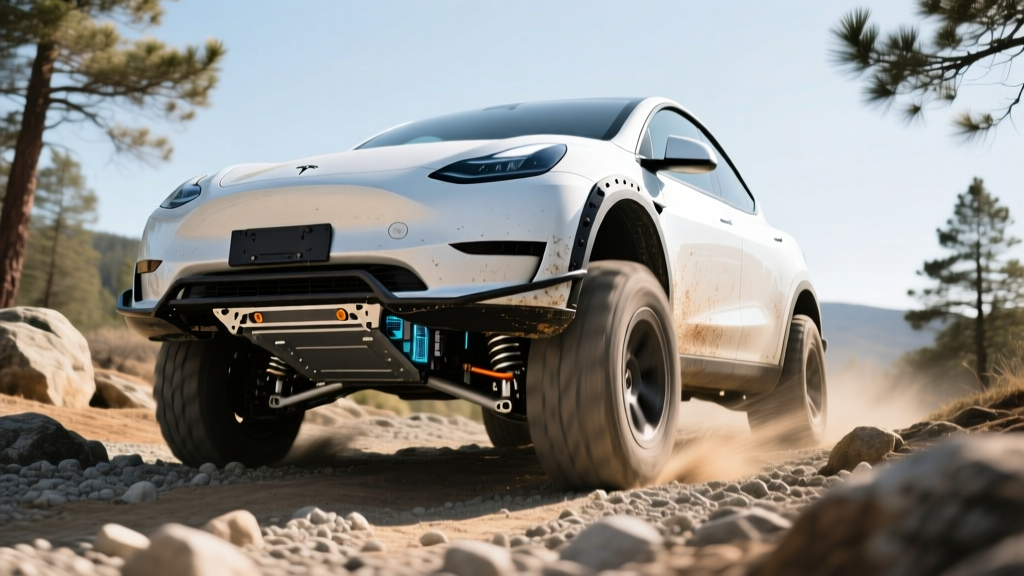
A lifted Model Y isn't a factory product — Tesla doesn't sell an off-road trim. Instead, owners install aftermarket suspension lift kits that raise the vehicle's ride height by 1.5 to 3 inches. Companies like Mountain Top Overland, EV-Lifts, and Unplugged Performance offer coil spacer kits, adjustable coilover systems, and complete subframe-drop packages specifically engineered for the Model Y's front and rear suspension geometry.
The typical build adds larger all-terrain tires (often 245/70R18 or 255/65R18) on reinforced wheels, skid plates for the battery enclosure, and sometimes roof racks and auxiliary lighting. The result looks like a mini electric SUV built for Bureau of Land Management roads — and it costs anywhere from $2,500 for a basic spacer kit to $12,000+ for a comprehensive overland setup with armor and wheels.
| Specification | Value |
|---|---|
| EPA Range | 310 miles (stock, 19" wheels) |
| Battery Capacity | ~75 kWh usable (NMC chemistry) |
| Drivetrain | Dual-Motor AWD |
| Horsepower | 384 hp combined |
| 0–60 mph | 4.8 seconds |
| MPGe (Combined) | 122 MPGe / 28 kWh/100 mi |
| Max DC Fast Charge | 250 kW peak |
| 10–80% DC Fast Charge | ~25 minutes |
| Level 2 Home Charging | 11.5 kW (~44 mi/hr) |
| Cargo Volume | 76 cu ft (rear seats folded) |
| Ground Clearance (Stock) | 6.6 inches |
| Base MSRP (Long Range AWD) | $44,990 |
| Battery Warranty | 8 years / 120,000 miles |
How a Lift Kit Changes Range and Efficiency
This is where the rubber meets the road — or rather, where the aero penalty begins. The Model Y's stock 310-mile EPA range (Long Range AWD with 19" Gemini wheels) is achieved through careful aerodynamic tuning: a 0.23 drag coefficient, flush door handles, and a smooth underbody. Lifting the vehicle 2 inches raises the frontal area, disrupts underbody airflow, and typically adds rolling resistance from heavier all-terrain tires.
Stock Model Y LR AWD: EPA 310 mi. Real-world highway (70 mph): ~270–285 mi. Cold weather (20°F): ~230–250 mi.
Lifted Model Y (2" lift + AT tires): Expect a 12–18% range reduction. Effective range: ~255–270 mi EPA-equivalent, ~220–240 mi highway, ~190–210 mi in cold weather. The energy consumption penalty typically shifts efficiency from 28 kWh/100 mi to roughly 33–35 kWh/100 mi at highway speeds.
The primary culprits are aerodynamic drag (which increases with the square of speed, so highway driving suffers most) and tire rolling resistance. All-terrain tires like the Falken Wildpeak A/T Trail or BFGoodrich All-Terrain T/A KO2 carry a higher rolling-resistance coefficient than the stock Michelin Primacy all-season tires. On back roads under 45 mph, the penalty shrinks to roughly 8–10%. On a 75-mph interstate, it's a full 15–18%.
Owners who've logged thousands of lifted miles on apps like TeslaFi consistently report energy consumption between 300–350 Wh/mi in mixed driving, compared to the stock car's 250–280 Wh/mi. That translates to roughly 40–55 fewer miles of usable range per charge cycle.
Charging Speed: Does the Lift Affect It?
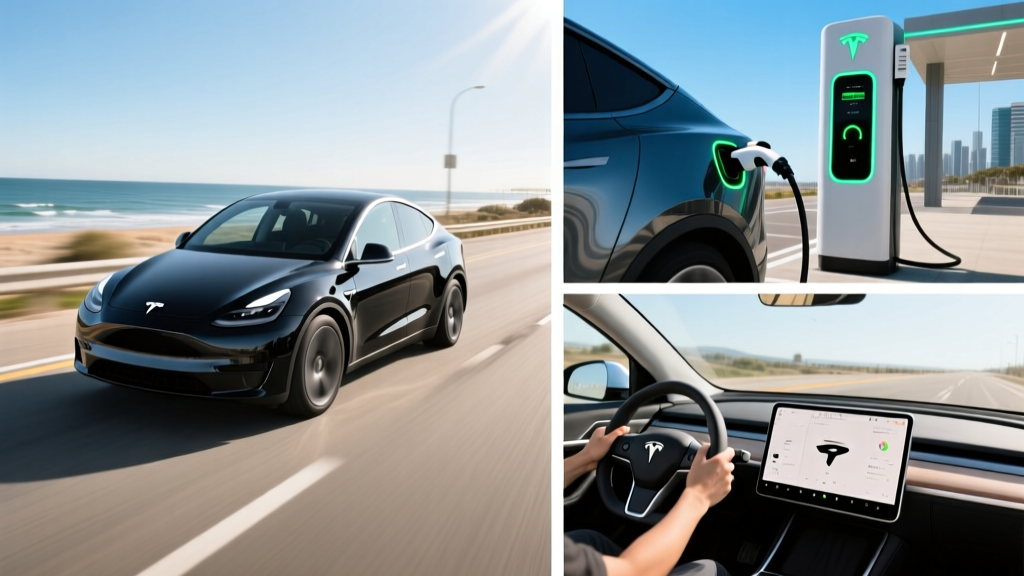
Good news: the lift kit has zero effect on the Model Y's charging hardware. The battery pack, charge controller, and thermal management system are unchanged. The 2025–2026 Model Y Long Range AWD still supports:
| Charging Level | Power / Rate | Speed | Notes |
|---|---|---|---|
| Level 1 (120V) | ~1.4 kW | ~3–5 mi/hr | Emergency/trickle only |
| Level 2 (240V, 48A) | 11.5 kW | ~44 mi/hr | Full charge in ~7 hours |
| DC Fast Charge (Supercharger) | 250 kW peak | 10–80% in ~25 min | Tapers above 80%; sustained avg ~150 kW |
One nuance: because a lifted Model Y consumes more energy per mile, you'll need to charge more kWh to cover the same distance. A 200-mile road trip that uses 56 kWh in a stock Model Y might use 66–70 kWh in a lifted build. That means slightly longer charging stops or slightly more frequent ones on long-distance trips. The Supercharger network itself is unaffected — the car still preconditions the battery when navigating to a charger, and peak charge rates remain the same.
Off-Road Capability: What It Can and Can't Do
The stock Model Y's 6.6 inches of ground clearance is modest — less than a Subaru Outback (8.7 in) or a Toyota RAV4 (8.4 in). A 2-inch lift kit brings it to roughly 8.6 inches, which is genuinely competitive with mainstream crossovers. Combined with the Model Y's dual-motor AWD system (which can vector torque front-to-rear in milliseconds), a lifted build handles fire roads, sandy washes, snow-covered passes, and moderate rock crawling surprisingly well.
However, this is not a body-on-frame truck. The Model Y's unibody construction, low-hanging battery pack, and exposed cooling lines underneath mean that serious rock crawling or deep-water fording is risky. Aftermarket skid plates (typically aluminum or UHMW polyethylene) protect the battery enclosure from punctures, but approach and departure angles remain limited by the front bumper and rear diffuser design.
- Deep water crossings (battery and electronics are sealed to IP67, but sustained submersion is not tested off-road)
- Severe rock crawling — ground clearance helps, but breakover angle and suspension articulation are limited
- Heavy towing — the Model Y is rated for 3,500 lbs max; a lift increases trailer sway risk
- High-speed desert running — the stock suspension damping isn't tuned for whoops and jumps
The dual-motor AWD system is the real secret weapon. Electric torque delivery is instant and precise — there's no torque converter lag, no driveline shock. In snow and mud, the traction control system reacts in milliseconds, far faster than any mechanical limited-slip differential. Owners report the lifted Model Y outperforms comparable gas crossovers in low-traction scenarios, provided ground clearance isn't the limiting factor.
Pricing, Tax Credits, and the True Cost of a Lifted Build
Let's break down the economics. A 2026 Tesla Model Y Long Range AWD starts at $44,990. The Performance trim is $48,990. A rear-wheel-drive base model (if available in your market) starts around $39,990.
| Trim | MSRP | §30D Credit Potential | Effective Price |
|---|---|---|---|
| Long Range AWD | $44,990 | Up to $7,500* | ~$37,490 |
| Performance AWD | $48,990 | Up to $7,500* | ~$41,490 |
*Per IRS §30D rules: subject to buyer income caps ($150K single / $300K joint AGI), MSRP cap ($80K for SUVs — Model Y qualifies), and critical-mineral/battery-component sourcing requirements that change annually. Point-of-sale transfer available at participating dealers. Always verify eligibility with a tax professional before purchase.
Now add the lift. A comprehensive build typically runs:
- Basic 2" spacer lift kit: $1,500–$2,500 (parts only)
- Coilover suspension system: $3,000–$5,000
- All-terrain tire set (4) + wheels: $2,000–$3,500
- Battery skid plate: $400–$800
- Professional installation: $800–$2,000
- Total typical build: $5,000–$12,000 on top of vehicle MSRP
Critically, aftermarket suspension modifications will void Tesla's suspension and potentially powertrain warranty coverage for any related failures. The 8-year/120,000-mile battery and drive unit warranty remains intact for unrelated issues, but if a lifted suspension causes a half-shaft failure or alignment-related tire wear, Tesla service centers will likely deny the claim. Document everything, and consider a third-party extended warranty that covers modified vehicles.
Pros and Cons of the Lifted Model Y Build
- Ground clearance increases to ~8.5–9.5 in, rivaling Subaru Outback
- Instant electric AWD torque excels in snow, mud, and sand
- Access to Supercharger network for adventure travel
- Zero tailpipe emissions on remote trails (quiet, no exhaust fumes)
- Unique aesthetic — stands out at trailheads and in neighborhoods
- Low center of gravity (battery pack) reduces rollover risk vs. lifted gas trucks
- 12–18% range reduction from aero and tire penalties
- Voids Tesla suspension warranty; may complicate drive-unit claims
- Higher tire wear from alignment challenges at lifted geometry
- Reduced high-speed stability and increased wind noise
- No factory support — all risk is on the owner
- Resale value impact is uncertain; niche appeal only
Who Should Build a Lifted Model Y?
This modification isn't for everyone. The lifted Model Y makes the most sense for:
- Rural EV owners who need extra ground clearance for snow ruts, gravel driveways, and unmaintained roads but want electric efficiency for daily commuting.
- Overlanding enthusiasts who value silent, emission-free travel on BLM and forest service roads and can plan around the reduced range.
- Ski-town residents who face steep, icy driveways and want the traction of electric AWD with clearance for accumulated snow.
It's a poor choice for anyone who regularly drives 300+ miles between charges, prioritizes maximum efficiency, or needs the full factory warranty intact. If you're primarily a highway commuter, the lift works against you every single mile.
Competitor Comparison: What Else Gets You Off-Road?
If you want off-road EV capability without aftermarket surgery, consider these alternatives:
- Ford F-150 Lightning: 8.9 inches of ground clearance, 320-mile range, available from factory. More capable off-road but far larger and less efficient.
- Rivian R1S: 14.9 inches of ground clearance (max air suspension), quad-motor AWD, genuine off-road engineering. Starts at ~$79,900 — nearly double the Model Y.
- Subaru Solterra: 8.3 inches stock, but only 222 miles EPA range and 100 kW max DC charging. Less practical for adventure travel.
- Hyundai Ioniq 5 (with aftermarket lift): Similar unibody crossover platform; less aftermarket support than Tesla currently.
The Model Y's advantage is the Supercharger network, the lowest cost of entry, and the most mature aftermarket ecosystem. Its disadvantage is that it was never engineered for this use case — you're working against the vehicle's design intent.
Frequently Asked Questions
What is the real-world range of a lifted Tesla Model Y?
A stock Model Y Long Range AWD is EPA-rated at 310 miles. With a 2-inch lift and all-terrain tires, expect 255–270 miles in mixed driving, 220–240 miles on the highway at 70+ mph, and 190–210 miles in sub-freezing temperatures. Energy consumption rises from ~28 kWh/100 mi to approximately 33–35 kWh/100 mi.
How fast does a lifted Model Y charge?
Charging hardware is unchanged. DC fast charging peaks at 250 kW, with a 10–80% session taking roughly 25 minutes at a V3 or V4 Supercharger. Level 2 home charging at 11.5 kW adds about 44 miles of range per hour. However, because the car uses more energy per mile, you'll need to charge slightly more often to cover the same distances.
How much does a lifted Model Y cost after tax credits?
A 2026 Model Y Long Range AWD starts at $44,990. If you qualify for the full $7,500 federal §30D credit (income, MSRP, and battery-sourcing requirements apply), the effective vehicle price drops to ~$37,490. Add $5,000–$12,000 for a quality lift kit, tires, skid plates, and professional installation for a total all-in cost of roughly $42,500–$49,500.
Does a lifted Model Y qualify for the federal EV tax credit?
The lift kit itself has no impact on tax credit eligibility — the credit is based on the vehicle as manufactured. The Model Y qualifies for up to $7,500 under IRS §30D, subject to buyer income caps ($150K single / $300K joint), the $80K SUV MSRP cap (easily met), and critical-mineral/battery-component sourcing thresholds that tighten annually. The credit can be transferred at the point of sale as a purchase discount at participating dealers. Consult a tax professional for your specific situation.
Will lifting my Model Y void the warranty?
Under the Magnuson-Moss Warranty Act, a dealer must prove that the modification caused the failure to deny a warranty claim. In practice, Tesla service centers have denied suspension, alignment, and drivetrain claims on lifted vehicles. The battery and drive unit warranty (8 years / 120,000 miles) generally remains intact for unrelated failures, but expect scrutiny. Keep detailed records and receipts for all modifications.
Is a lifted Model Y worth it vs. buying a Rivian or F-150 Lightning?
If your budget is under $55,000 and you want a compact, efficient EV with light off-road capability, the lifted Model Y is the most affordable path — especially with access to the Supercharger network. If you need serious off-road capability (deep rocks, water crossings, high-articulation terrain), the Rivian R1S or even a used Rivian R1T is a far more capable platform, albeit at roughly double the cost. The F-150 Lightning offers factory ground clearance and towing capacity but sacrifices efficiency and parking practicality.
What size tires fit a lifted Model Y?
Most 2-inch lift kits accommodate up to 255/65R18 or 245/70R18 all-terrain tires without rubbing. Some 2.5–3 inch kits allow 265/70R17 with minor trimming. Always verify fitment with your specific kit manufacturer and have the alignment checked with a shop experienced in EV suspension geometry — the Model Y's camber and toe specs are sensitive to ride-height changes.