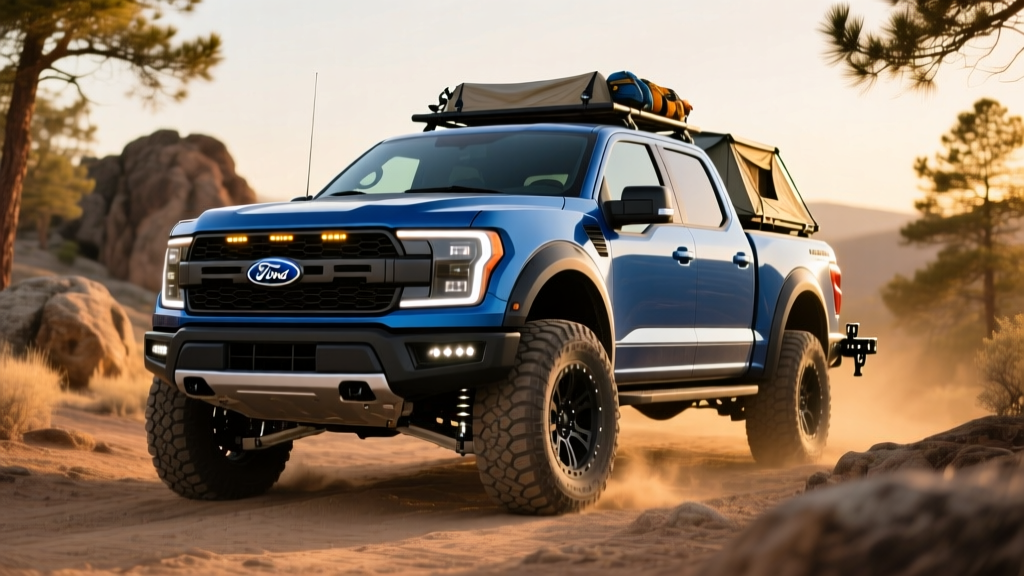
The Ford F-150 Lightning already proved that a full-size electric pickup can handle job-site duty, family hauling, and 300+ miles of range. But a growing community of owners wants more ground clearance, bigger tires, and genuine trail capability. Enter the lifted F-150 Lightning — a modified electric truck that trades a small slice of range for serious off-road credibility.
In this review, we break down what lifting the Lightning actually does to its EPA range, charging speed, warranty coverage, and everyday usability. We'll also cover the 2026 model-year specs, pricing after federal tax credits, and whether a lifted Lightning makes sense compared to the Rivian R1T or a lifted gas F-150.
2026 F-150 Lightning: Baseline Specs Before the Lift
Before analyzing the mods, let's anchor to the stock 2026 F-150 Lightning. Ford offers two battery packs across multiple trims, and the larger Extended Range pack is what most lift-kit buyers start with.
| Spec | Value |
|---|---|
| EPA Range | 320 miles |
| Battery Capacity (usable) | 131 kWh (NMC chemistry) |
| Horsepower / Torque | 580 hp / 775 lb-ft |
| Drivetrain | Dual-motor AWD |
| 0-60 mph | 3.8 seconds |
| Max DC Fast Charge | 150 kW |
| 10-80% DC Fast Charge | ~41 minutes |
| Level 2 Home Charging | 19.2 kW (80A) / ~30 mi/hr |
| Efficiency (combined) | 70 MPGe / 48 kWh/100mi |
| Max Towing Capacity | 10,000 lbs |
| Max Payload | 2,235 lbs |
| Bed Volume | 52.8 cu ft (5.5-ft bed) |
| Frunk Volume | 14.1 cu ft |
| Rear Legroom | 43.6 inches |
| Base MSRP (Lariat Ext. Range) | $69,995 |
| Battery Warranty | 8 years / 100,000 miles (≥70% capacity) |
Source: EPA Fuel Economy and Ford F-150 Lightning Specs.
What Lifting the Lightning Actually Involves
A typical lifted F-150 Lightning build includes a 2- to 4-inch suspension lift (often from BDS Suspension, Rough Country, or ReadyLIFT), 35-inch all-terrain or mud-terrain tires replacing the stock 22-inch or 20-inch wheels, and upgraded upper control arms to correct ball-joint angles. Some owners add aftermarket skid plates, rock sliders, and auxiliary lighting.
The Lightning's independent rear suspension and heavy battery pack (roughly 1,800 lbs slung under the floor) make it a unique lift candidate. The truck's low center of gravity is an off-road advantage — it resists rollover far better than a solid-axle gas truck at the same ride height. But the added weight of 35-inch tires (each roughly 15-20 lbs heavier than stock) and the increased frontal area of a lifted body both hit efficiency hard.
Real-World Range: EPA Sticker vs. Lifted Reality
EPA Estimate (stock): 320 miles
Real-world (stock, mixed driving): ~270-290 miles
Real-world (stock, 75 mph highway): ~240-260 miles
Real-world (stock, 30°F cold weather): ~220-240 miles
Real-world (lifted + 35" AT tires, mixed): ~210-240 miles
Real-world (lifted + 35" AT tires, 70 mph highway): ~180-210 miles
Real-world (lifted, cold + highway): ~160-190 miles
The range penalty from a lift kit and larger tires typically runs 15-25% depending on tire choice, driving speed, and terrain. All-terrain tires like the BFGoodrich KO2 or Falken Wildpeak AT3W are the most popular compromise — aggressive enough for trails but not as punishing on the highway as mud-terrains. The increased rolling resistance and aerodynamic drag from a 3-inch lift are both significant at highway speeds, where the Lightning is already working harder than a sedan due to its truck shape.
For context, a stock Lightning Lariat Extended Range at 70 mph on a flat interstate in 65°F weather typically delivers 240-260 miles before needing a charge. Add the lift and 35s, and that same run drops to roughly 180-210 miles. That's still enough for most day-trips and trail runs, but it demands more planning on longer road trips.
Charging Speed: Does the Lift Change Anything?
The good news: a suspension lift and larger tires don't change the Lightning's charging hardware. The truck still peaks at 150 kW on DC fast chargers and accepts up to 19.2 kW on a hardwired Level 2 home charger.
| Charging Level | Power | Miles Added per Hour | Notes |
|---|---|---|---|
| Level 1 (120V outlet) | 1.4 kW | ~2-3 mi/hr | Emergency/trickle only |
| Level 2 (240V, 48A) | 11.5 kW | ~18 mi/hr | Common home setup |
| Level 2 (240V, 80A) | 19.2 kW | ~30 mi/hr | Requires 100A circuit, Ford Charge Station Pro |
| DC Fast Charge | 150 kW peak | ~120 mi in 20 min | 10-80% in ~41 min; tapers sharply above 80% |
One important note for lifted owners: because your real-world range is lower, each charging session effectively covers fewer miles. A 10-80% charge that gives a stock Lightning roughly 224 miles of range will only net a lifted truck about 160-180 real-world miles. Plan your charging stops accordingly on road trips.
The Lightning's charge curve is relatively flat between 10-60% SoC, sustaining close to 150 kW, then tapering to roughly 80 kW by 70% and 40 kW by 85%. This is typical for NMC chemistry in a large pack. Preconditioning the battery via the FordPass app before arriving at a DC charger is critical — without it, peak rates can drop to 80-100 kW in cold weather.
Off-Road Capability: Where the Lifted Lightning Shines
This is where the modification pays off. A 3-inch lift with 35-inch tires transforms the Lightning from a capable light-trail truck into something that can genuinely tackle moderate rock crawling, deep sand, and rutted forest roads.
Ground clearance increases from the stock 8.9 inches to roughly 11.5-12.5 inches, putting it in the territory of a Ford Raptor. The Lightning's flat battery floor is a massive advantage here — there are no differentials, exhaust components, or transfer cases hanging below to snag on rocks.
Approach, departure, and breakover angles all improve meaningfully with the lift. Stock approach angle is approximately 24.4°; with a 3-inch lift and 35s, expect roughly 28-30°. That's enough to clear most trail obstacles without scraping the front air dam (which most owners remove anyway).
Torque delivery is the Lightning's secret off-road weapon. With 775 lb-ft available instantly from zero RPM through dual electric motors, the truck can crawl over obstacles with precise throttle control — no need to build revs or worry about stalling. The electronic locking rear differential (standard on Lariat and above) further enhances traction.
Weight distribution is favorable. The 6,800-lb curb weight (stock) is heavy, but it's distributed nearly 50/50 front-to-rear thanks to the dual motors and battery placement. On loose surfaces like sand or snow, that weight becomes an advantage for traction. On technical rock crawls, the weight is a liability — expect more body roll and slower recovery if you get stuck.
Warranty Implications: What Mods Void and What They Don't
This is the question every prospective lifted Lightning owner asks. The short answer: Ford's 8-year/100,000-mile battery and powertrain warranty is not automatically voided by a suspension lift, but the Magnuson-Moss Warranty Act only protects you if the modification didn't cause the failure.
In practice:
- Battery pack: A lift kit doesn't affect battery chemistry or degradation. If a cell fails, Ford should still honor the warranty unless they can prove the lift caused physical damage to the pack (unlikely with a quality kit).
- Electric motors and inverters: Unaffected by suspension mods. Warranty intact.
- Suspension components: Ball joints, control arms, and CV axles see increased stress with a lift and larger tires. Ford may deny warranty claims on these specific parts if the lift is deemed the cause of premature wear.
- Steering rack and wheel bearings: Higher stress from heavier tires. Similar gray area — document everything.
Our recommendation: use a reputable lift kit manufacturer that provides its own warranty on components (BDS offers a lifetime warranty on its kits), keep all receipts, and have the installation done by a qualified shop that documents alignment specs before and after.
Pricing, Trims, and Federal Tax Credit Eligibility
Here's what the 2026 F-150 Lightning lineup costs before modifications, and how the federal EV tax credit factors in.
| Trim | Battery | MSRP | §30D Credit Eligible? |
|---|---|---|---|
| Pro (Standard Range) | 98 kWh | $54,995 | Yes — if income & sourcing rules met |
| XLT (Standard Range) | 98 kWh | $59,995 | Yes — if income & sourcing rules met |
| Lariat (Extended Range) | 131 kWh | $69,995 | Yes — under $80K truck cap |
| Platinum (Extended Range) | 131 kWh | $84,995 | NO — exceeds $80K MSRP cap for trucks |
Under IRS §30D rules (see IRS Clean Vehicle Credits), the F-150 Lightning qualifies as a truck, meaning the MSRP cap is $80,000. The Pro, XLT, and Lariat trims clear that bar. The Platinum at $84,995 does not.
Buyer income caps also apply: modified adjusted gross income must not exceed $300,000 (joint filers), $225,000 (head of household), or $150,000 (single). Battery component and critical mineral sourcing requirements must also be met — Ford has worked to localize sourcing, but always verify current-year eligibility on the IRS website or with your tax professional before relying on the credit.
The credit can be transferred to the dealer at point of sale as of 2024+, reducing your purchase price directly rather than waiting for a tax refund.
Expect to spend $2,500-$4,500 on a quality 3-inch lift kit (BDS, Rough Country, or ReadyLIFT), $1,200-$2,000 on a set of 35-inch all-terrain tires, $600-$1,200 on upper control arms and alignment, and $500-$1,500 on installation labor. Total build cost: $4,800-$9,200 on top of the truck's purchase price.
Tech, Interior, and Daily-Driving a Lifted Lightning
The Lightning's cabin and tech carry over regardless of suspension mods. The 15.5-inch portrait touchscreen (SYNC 4A on Lariat and above) is one of the best infotainment systems in any truck, with native EV route planning that factors in charging stops. The 12-inch digital instrument cluster displays real-time range, energy flow, and battery temperature — all useful data when you're wheeling.
Ford BlueCruise (SAE Level 2 hands-free driving on pre-mapped divided highways) works identically on a lifted truck, though the forward-facing camera's angle changes slightly with the lift. Most owners report no issues, but recalibration at a dealer is recommended after any suspension modification.
BlueCruise is an SAE Level 2 driver-assistance system. You must keep your eyes on the road and remain ready to take over at any time. The driver-monitoring camera ensures compliance. This is fundamentally different from Level 4 robotaxi services like Waymo.
Pro Power Onboard (up to 9.6 kW of 240V/120V outlet power from the bed and frunk) is arguably the Lightning's most underrated feature. For overlanding and trail use, it eliminates the need for a portable generator — plug in a fridge, power tools, camp lights, or an air compressor directly from the truck's battery. A lifted Lightning with Pro Power Onboard is an exceptionally capable base camp vehicle.
Daily driving trade-offs with a lift are real: the taller step-in height requires a running board or power-deploy step, the stiffer aftermarket suspension can degrade on-road ride quality (especially with heavier-duty kits), and fuel economy — er, efficiency — drops noticeably. Parking garages with low clearances become a concern if your build exceeds 7 feet in height (stock Lightning is about 78.7 inches tall; a 3-inch lift pushes it to ~81.7 inches).
Lifted F-150 Lightning vs. Key Competitors
| Spec | Lifted F-150 Lightning (Ext. Range) | Rivian R1T Dual-Motor (Max Pack) | Lifted Gas F-150 Raptor |
|---|---|---|---|
| Approx. Real-World Range | ~210-240 mi (lifted) | ~320 mi (stock), ~260 mi (lifted) | ~350 mi (17 gal × ~21 mpg hwy) |
| Horsepower | 580 hp | 665 hp | 450 hp |
| 0-60 mph | ~4.5 sec (est. with tires/lift) | ~3.5 sec | ~5.5 sec |
| Ground Clearance (lifted) | ~12 inches | ~14.9 inches (stock) | ~13.1 inches |
| Towing Capacity | 10,000 lbs | 11,000 lbs | 8,700 lbs |
| Starting Cost (before lift) | $69,995 | $87,600 | $79,775 |
| Federal EV Tax Credit | Up to $7,500 (Lariat) | Up to $7,500 | None |
| Off-Road Factory Warranty | Voided by aftermarket lift | Factory warranty intact (stock) | Factory warranty intact |
The Rivian R1T is the purpose-built off-road EV truck — if trail capability is your primary goal and budget allows, it's hard to beat. But the R1T costs $18,000+ more than a Lightning Lariat, doesn't have a frunk as large, and lacks Pro Power Onboard. The lifted Lightning offers 80% of the R1T's trail capability at 60% of the price, plus the versatility of Ford's dealer network and parts availability.
Compared to a lifted gas F-150 Raptor, the Lightning wins on instant torque, lower running costs (electricity vs. premium fuel), Pro Power Onboard, and a near-silent trail experience. The Raptor wins on range, refueling speed, lighter weight, and established aftermarket support with no warranty gray areas.
Choose the lifted Lightning if: You want electric torque on trails, need Pro Power Onboard for overlanding, primarily drive within 200 miles of home, and value lower per-mile energy costs.
Choose the Rivian R1T if: You want factory-engineered off-road capability without aftermarket warranty risk, need maximum ground clearance, and budget is flexible.
Choose the gas Raptor if: You tow heavy loads over long distances, frequently travel in charging-desert regions, or want a fully warrantied off-road truck with zero range compromises.
Pros and Cons of a Lifted F-150 Lightning
- Instant 775 lb-ft torque for precise trail crawling
- Flat battery floor = excellent underbody clearance when lifted
- Pro Power Onboard eliminates generator for camping/job-site
- Low center of gravity resists rollover better than solid-axle trucks
- Lower per-mile energy cost vs. gas (even with reduced efficiency)
- Frunk + bed = unmatched cargo versatility
- Near-silent trail operation (leave-no-trace ethic)
- 15-25% range reduction from lift + larger tires
- Real-world range drops to ~180-210 mi highway with mods
- Suspension/steering warranty claims may be denied
- 150 kW peak DC charging is slower than some competitors
- Heavy curb weight (~7,000+ lbs lifted) hurts technical trail performance
- Higher step-in height; running boards recommended
- Charging-desert road trips require more planning with reduced range
Frequently Asked Questions
What is the real-world range of a lifted F-150 Lightning?
A stock F-150 Lightning Extended Range delivers an EPA-estimated 320 miles, but real-world mixed driving typically yields 270-290 miles. With a 3-inch lift and 35-inch all-terrain tires, expect roughly 210-240 miles in mixed driving and 180-210 miles at sustained highway speeds. Cold weather (below 30°F) further reduces range by 15-25%, potentially dropping a lifted Lightning to 160-190 miles on winter highway drives.
How fast does the F-150 Lightning charge at home and on the road?
On a DC fast charger, the Lightning peaks at 150 kW and charges from 10-80% in approximately 41 minutes. At home, a hardwired Level 2 Ford Charge Station Pro delivers 19.2 kW (80 amps), adding roughly 30 miles of range per hour. A more common 48-amp Level 2 setup adds about 18 miles per hour. The lift kit does not change charging hardware or speeds — only your effective miles per charge session.
How much does a lifted F-150 Lightning cost after tax credits?
A 2026 F-150 Lightning Lariat Extended Range starts at $69,995 MSRP. If you meet IRS §30D requirements (income under $300K joint/$150K single, battery sourcing compliance), you can apply up to $7,500 as a point-of-sale discount, bringing the effective price to ~$62,495. Add $5,000-$9,000 for a quality lift kit, 35-inch tires, and professional installation, and you're looking at roughly $67,500-$71,500 out the door for a fully built truck. The Platinum trim ($84,995) exceeds the $80K MSRP cap for trucks and does not qualify for the federal credit.
Does lifting the F-150 Lightning void the warranty?
Under the Magnuson-Moss Warranty Act, Ford cannot void your entire warranty simply because you installed aftermarket parts. However, if a suspension lift or larger tires directly cause a component failure (ball joints, CV axles, steering rack), Ford may deny the warranty claim for that specific part. The battery pack and electric motors are generally unaffected by suspension modifications and should remain covered under the 8-year/100,000-mile warranty. Always use quality components and keep installation records.
Is a lifted F-150 Lightning worth buying vs. the Rivian R1T?
It depends on your priorities and budget. The lifted Lightning costs roughly $20,000-$25,000 less than a comparable R1T and offers Pro Power Onboard, a larger frunk, and Ford's extensive dealer network. The R1T delivers superior ground clearance (14.9 inches stock), a factory-engineered off-road setup with no warranty concerns, and roughly 80 more miles of real-world range. If budget is the primary driver and you mainly stay within 200 miles of home, the lifted Lightning is excellent value. If you want a no-compromise off-road EV with full factory warranty coverage, the R1T is the better choice.
Can I still tow with a lifted F-150 Lightning?
Yes, but expect reduced range while towing. The stock Lightning Extended Range is rated for 10,000 lbs of towing capacity. A lift kit and larger tires don't change that mechanical rating, but towing any significant load already cuts EV range by 30-50%. Combined with the lift's 15-25% range penalty, towing 7,000+ lbs with a lifted Lightning might yield only 100-130 miles between charges. For frequent heavy towing over long distances, a gas or diesel truck remains more practical.