Quick Answer: Should You Wait for the Lexus TZ?
The Lexus TZ electric three-row SUV has been spied testing globally in heavy camouflage, signaling a production launch likely in late 2026 or early 2027. If you need a three-row family EV now, competitors like the Kia EV9 (EPA 304 mi, ~$54,900) and Rivian R1S (EPA 410 mi, ~$79,900) are already on sale. If you're a loyal Lexus buyer willing to wait 12–18 months, the TZ could deliver Toyota's proven reliability ethos with premium cabin quality and competitive 300+ mile range — but expect a starting MSRP around $65,000–$75,000, putting it above the federal §30D tax credit's $80,000 SUV cap but in a competitive luxury segment.
What the Spy Shots Tell Us About the Lexus TZ
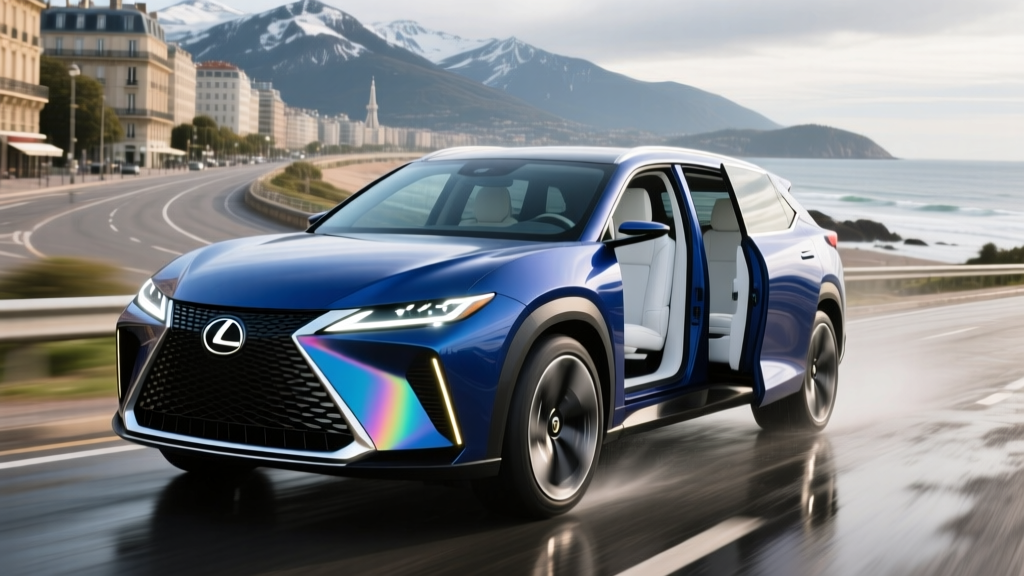
Recent prototype sightings across Europe, North America, and Japan show a boxy, upright SUV with a long wheelbase, short overhangs, and a flat floor — hallmarks of a dedicated EV platform. The test mules wear Lexus's signature spindle-grille silhouette (sealed, as expected for a BEV) and accommodate three rows of seating. Industry sources suggest the TZ will ride on a stretched version of Toyota's e-TNGA platform, the same architecture underpinning the bZ4X and Subaru Solterra, but significantly enlarged for three-row duty.
What we can reasonably project based on platform physics, competitive positioning, and Toyota's stated EV roadmap:
| Attribute | Estimated / Projected | Notes |
|---|---|---|
| Platform | e-TNGA (stretched) | Dedicated BEV skateboard |
| Battery Capacity | ~100–110 kWh usable | Likely NMC chemistry for energy density |
| EPA Range (est.) | 300–340 miles | Real-world highway: ~260–290 mi |
| Peak DC Fast Charge | ~150–180 kW | 10–80% in ~28–32 minutes (est.) |
| Level 2 AC Charging | 11 kW onboard charger | ~10 hours 0–100% on 240V/48A |
| Drivetrain | Dual-motor AWD (likely standard) | ~400–450 HP projected |
| 0–60 mph (est.) | ~5.0–5.5 seconds | Premium-family tuning, not performance |
| Seating | 6- or 7-passenger (3 rows) | Captain's chairs likely on higher trims |
| Starting MSRP (est.) | $65,000–$75,000 | Before options/destination |
| Battery Warranty | 8 years / 100,000 miles | Toyota standard; capacity retention TBD |
Important caveat: These figures are projections based on platform analysis, competitive benchmarking, and Toyota's published battery-roadmap data. Final EPA-certified numbers will not be available until closer to launch. Always verify with fueleconomy.gov once the TZ is officially rated.
How the Lexus TZ Compares to Gas and Hybrid Three-Row SUVs
Many three-row SUV shoppers are cross-shopping between battery-electric, plug-in hybrid, and conventional hybrid options. Here's how the projected TZ stacks up against segment benchmarks on the metrics that matter for family hauling:
| Metric | Lexus TZ (BEV, est.) | Kia EV9 (BEV) | Toyota Grand Highlander Hybrid | Lexus TX 500h (PHEV-adjacent hybrid) |
|---|---|---|---|---|
| Powertrain | Dual-motor BEV | Dual-motor BEV | 2.5L HEV | 2.4L Turbo Hybrid |
| EPA Range / Efficiency | ~300–340 mi / ~90 MPGe | 304 mi / 83 MPGe | ~36 MPG combined | ~27 MPG combined |
| Fuel/Energy Cost per Year | ~$650–$900 | ~$750–$1,000 | ~$1,800–$2,200 | ~$2,400–$2,800 |
| Base MSRP | ~$65,000–$75,000 | $54,900 | $40,120 | $63,400 |
| Annual Maintenance | ~$300–$500 | ~$300–$500 | ~$600–$900 | ~$700–$1,000 |
| 5-Year Fuel + Maint. | ~$4,750–$7,000 | ~$5,250–$7,500 | ~$12,000–$15,500 | ~$15,500–$19,000 |
The numbers tell a clear story: BEVs like the TZ and EV9 dramatically reduce per-mile energy and maintenance costs, but demand a significantly higher upfront investment. The break-even point against a Grand Highlander Hybrid, assuming 15,000 miles/year and national-average electricity rates (~$0.16/kWh), lands around year 5–6 depending on your local utility rates and whether you charge primarily at home or on expensive public DC fast chargers ($0.35–$0.55/kWh in many markets).
Real Costs of Owning the Lexus TZ: A 5-Year Projection
Speculative as it is, we can model ownership costs using competitive BEV data and Toyota/Lexus historical patterns. This projection assumes a $70,000 purchase price (mid-range estimate), 15,000 miles/year, home Level 2 charging 80% of the time, and DC fast charging 20% of the time.
| Cost Category | Lexus TZ (BEV, est.) | Lexus TX 350 AWD (Gas) |
|---|---|---|
| Purchase Price (MSRP) | $70,000 | $58,000 |
| Federal Tax Credit (§30D) | Up to $7,500* | $0 |
| Net Purchase | $62,500 | $58,000 |
| Energy/Fuel (5 yrs) | $3,750–$4,500 | $11,000–$13,000 |
| Maintenance (5 yrs) | $1,500–$2,500 | $3,500–$5,000 |
| Insurance (5 yrs) | $10,500–$13,000 | $8,000–$10,000 |
| Depreciation (5 yrs, est.) | $28,000–$35,000 | $22,000–$28,000 |
| Estimated 5-Yr Total | $106,750–$117,500 | $102,500–$114,000 |
*§30D tax credit eligibility depends on MSRP caps (currently $80,000 for SUVs), buyer income limits ($300K MFJ / $150K single), battery component sourcing, and critical-mineral requirements. The point-of-sale transfer option lets you apply the credit at the dealer. Verify current rules at IRS.gov and consult a tax professional.
The insurance premium gap is real. EVs cost 15–25% more to insure on average than comparable gas vehicles due to higher repair costs, specialized parts, and battery-replacement exposure. Get quotes before committing — don't assume Lexus's luxury-insurance rates will match the TX's.
Charging Reality: Home Setup and Public Network Considerations
The TZ's projected 11 kW onboard AC charger means a full charge from empty on a 240V/48A Level 2 home circuit takes roughly 10 hours — perfectly suited for overnight replenishment. But that assumes you can install Level 2 at home.
Common Three-Row EV Charging Misconceptions
| Myth | Fact |
|---|---|
| "I can charge on any standard outlet." | Level 1 (120V) adds ~3–4 miles/hour. For a 100+ kWh battery, a full charge takes 30+ hours. Level 2 (240V) is practically essential for daily three-row SUV use. |
| "DC fast charging is always 30 minutes." | Peak kW is not sustained kW. A 180 kW peak rate typically drops to 80–100 kW above 60% SoC. Expect 10–80% in ~28–32 minutes, but 80–100% can add another 20+ minutes due to the charge-curve taper. |
| "I'll never need gas, so I save instantly." | Public DC fast charging at $0.40–$0.55/kWh can cost more per mile than a 30 MPG hybrid on $3.50/gallon gas. Savings materialize primarily with home charging at $0.12–$0.18/kWh. |
| "Cold weather doesn't affect EVs much." | At 20°F, expect 20–35% range reduction due to battery chemistry limitations and cabin heating demands. A projected 320-mile EPA range becomes ~210–255 real-world miles in deep winter. A heat pump (expected on the TZ) mitigates but doesn't eliminate this loss. |
If you lack home charging access — common for apartment dwellers and street-parkers — a large-battery three-row BEV becomes significantly less practical. Public charging infrastructure is improving but remains inconsistent in many regions. Before ordering any three-row EV, map your realistic weekly charging options and run the math on your local utility's time-of-use rates.
Federal Tax Credit Eligibility: What TZ Buyers Need to Know
The §30D clean vehicle credit offers up to $7,500, but qualification is a multi-factor checklist that changes with supply-chain sourcing. Here's the current framework:
- MSRP Cap: SUVs must have an MSRP at or below $80,000. If the TZ starts above $75K and options push it over $80K, higher trims may lose eligibility.
- Buyer Income Limits: Adjusted gross income cannot exceed $300,000 (married filing jointly), $225,000 (head of household), or $150,000 (single).
- Battery Component Sourcing: A percentage of battery components must be manufactured or assembled in North America. This threshold increases annually — for 2026, it's stringent enough that many Asian-sourced batteries face partial or full disqualification.
- Critical Mineral Sourcing: A percentage of critical minerals must be sourced from the U.S. or free-trade-agreement partners. Toyota's supply chain is heavily Japan- and Australia-based, which may or may not satisfy current thresholds.
- Point-of-Sale Transfer: You can transfer the credit to the dealer at purchase, reducing your out-of-pocket cost immediately rather than waiting for a tax refund.
- FEOC Restriction: Vehicles with battery components from a "foreign entity of concern" (primarily Chinese suppliers) are disqualified entirely.
Given Toyota's historically conservative, Japan-centric supply chain, there is genuine uncertainty about whether the TZ will qualify for the full $7,500 at launch. Monitor fueleconomy.gov's credit listings once the TZ receives official EPA certification.
Decision Framework: Is the Lexus TZ the Right Three-Row EV for You?
Choose the Lexus TZ (when available) if:
- You're a current Lexus owner who values dealer service experience, long-term reliability reputation, and premium cabin materials
- You have reliable home Level 2 charging and drive mostly in moderate climates
- Your daily driving is under 80 miles round-trip with occasional 250–300 mile road trips
- You're willing to wait 12–18 months for production and delivery
- You prioritize ride comfort and low NVH over sporty handling or maximum range
Buy now instead (Kia EV9, Rivian R1S, or Hyundai Ioniq 9) if:
- You need a three-row EV within the next 6 months
- You want verified EPA range and charging data before spending $55K–$80K+
- You need maximum towing capacity (Rivian R1S: 7,700 lbs)
- Your budget is under $60,000 (Kia EV9 starts at ~$54,900)
- You live in a cold climate and want proven cold-weather range data from real owners
Consider a hybrid (Toyota Grand Highlander Hybrid, Lexus TX 500h) if:
- You lack home charging access and rely on street or apartment parking
- You regularly tow heavy loads or drive in remote areas with sparse charging infrastructure
- You want lower upfront cost and don't mind higher per-mile fuel expenses
- You live in extreme cold where BEV range loss would be a daily burden
What First-Time EV Buyers Should Know Before Committing
If the Lexus TZ is your first electric vehicle, several ownership realities deserve your attention before you place a deposit:
kWh vs. kW — the most common confusion. Think of kWh (kilowatt-hours) as the size of your "fuel tank" — the TZ's projected ~100–110 kWh battery holds the energy. kW (kilowatts) is the rate at which energy flows — a 180 kW DC fast charger fills that tank at a certain speed. Never confuse the two: a 100 kWh battery charging at 100 kW takes roughly one hour from empty (in simplified terms; the real charge curve tapers significantly above 80% SoC).
Tire costs are higher. Heavy three-row EVs (projected TZ curb weight: ~5,200–5,600 lbs) wear through tires 20–30% faster than lighter gas SUVs due to instant torque and mass. Budget $1,200–$1,800 for a set of premium all-season or EV-optimized tires every 30,000–40,000 miles.
Regenerative braking changes your driving. One-pedal driving — where lifting the accelerator slows the vehicle significantly — takes 1–2 weeks to internalize but reduces brake wear dramatically. Expect brake pads to last 80,000+ miles on a BEV.
Preconditioning matters for fast charging. The TZ will likely include battery preconditioning — warming the battery pack before you arrive at a DC fast charger. This is critical in cool weather: a cold battery may accept only 50 kW instead of the rated 180 kW peak, doubling your charge time. Always navigate to a charger using the built-in nav to trigger preconditioning automatically.
Frequently Asked Questions
When will the Lexus TZ electric three-row SUV go on sale?
Based on the global spy-shot testing cadence and typical Toyota/Lexus development timelines, a late-2026 reveal with early-2027 U.S. deliveries is the most likely scenario. Toyota has not confirmed an official date. Treat any specific launch date as rumor until Lexus issues a press release.
Will the Lexus TZ qualify for the $7,500 federal EV tax credit?
Uncertain at this stage. Eligibility depends on final MSRP (must be ≤$80,000 for SUVs), your income, and whether Toyota's battery supply chain meets North American component-sourcing and critical-mineral thresholds under current IRS §30D rules. Toyota's Japan-heavy supply chain creates real risk of partial or full disqualification. Check fueleconomy.gov once the TZ is EPA-certified.
How does the Lexus TZ compare to the Kia EV9 for families?
The EV9 is on sale now with verified EPA range (304 miles for the Long Range RWD), a starting price around $54,900, and available NACS charging (access to Tesla Superchargers). The TZ will likely offer a more premium interior, Lexus dealer experience, and potentially slightly more range — but at a $10,000–$20,000 price premium and a 12–18 month wait. If you need a car now, the EV9 is the pragmatic choice.
Can I charge the Lexus TZ at Tesla Superchargers?
Toyota has committed to adopting the NACS (North American Charging Standard) connector for future EVs. If the TZ launches with a native NACS port, it will access Tesla's Supercharger network (17,000+ stalls in the U.S.) without an adapter. If it launches with CCS1, a NACS adapter will likely be available. Toyota's official connector specification has not been confirmed for the TZ.
What will battery replacement cost if the TZ battery degrades?
Out-of-warranty battery replacement for a 100+ kWh pack currently runs $15,000–$25,000 at dealerships, though prices are declining as battery manufacturing scales. Toyota's standard hybrid/EV battery warranty covers 8 years/100,000 miles against defects and excessive capacity loss (typically below 70% State of Health). Real-world data from Toyota's bZ4X suggests modest degradation — roughly 5–10% over the first 100,000 miles under normal use — but the TZ's larger pack and different thermal management may yield different results.
Is a three-row EV practical for road trips?
Yes, with planning. A 300+ mile EPA range covers most interstate segments between charging stops, and DC fast charging adds ~150–200 miles in 20 minutes. However, road-tripping with three rows occupied means more cargo compromise, and charging stops take 25–35 minutes versus 5 minutes for gas. Families who road-trip 4+ times per year should test-drive a three-row EV on a representative route before committing.
The Lexus TZ electric three-row SUV remains in pre-production testing as of this writing. All specifications, pricing, and tax-credit projections in this article are estimates based on platform analysis, competitive benchmarking, and Toyota's published roadmap. Verify all figures with official Lexus communications and fueleconomy.gov before making a purchase decision.