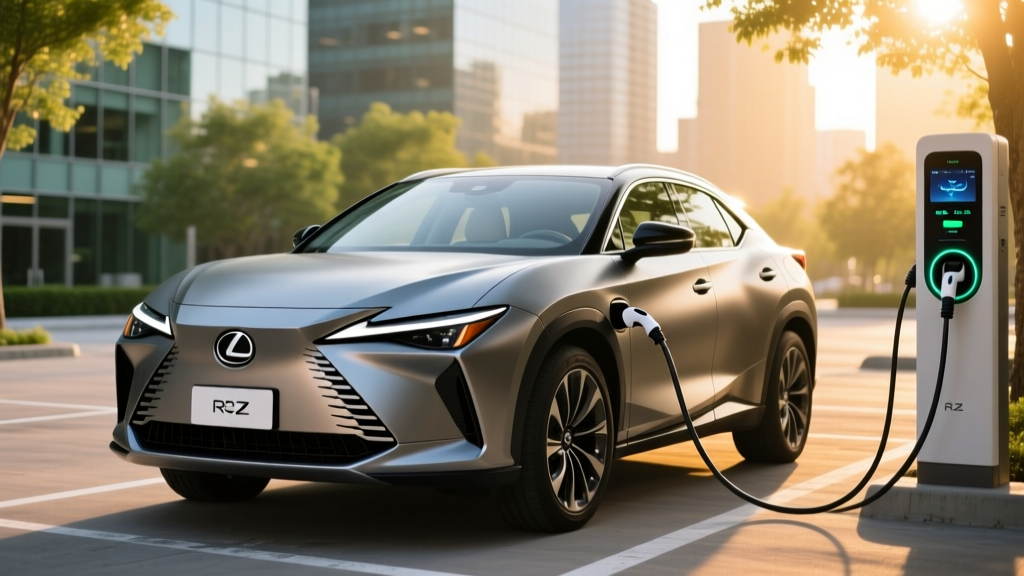
Quick Answer: The 2026 Lexus RZ 450e delivers an EPA-estimated 220 miles of range (RZ 550e F Sport: 196 miles), with a 71.4 kWh NMC battery, peak DC fast charging at 150 kW (10–80% in ~30 minutes), and a starting MSRP around $55,850. Compared to the gas Lexus RX 350, RZ owners who charge at home save roughly $800–$1,200 annually on fuel, but face a higher purchase price and limited fast-charging speed relative to rivals like the Hyundai Ioniq 5 or BMW iX. The RZ makes sense if you value Lexus build quality, have reliable home Level 2 charging, and drive mostly under 180 miles per day.
2026 Lexus RZ: Specs, Range, and Charging at a Glance
| Specification | RZ 450e (AWD) | RZ 550e F Sport (AWD) |
|---|---|---|
| EPA Range | 220 miles | 196 miles |
| Real-World Range (highway, 70 mph) | ~185–200 miles | ~165–180 miles |
| Real-World Range (cold weather, 30°F) | ~160–180 miles | ~140–160 miles |
| Battery Capacity | 71.4 kWh (usable) | 71.4 kWh (usable) |
| Battery Chemistry | NMC (Nickel Manganese Cobalt) | NMC |
| Max DC Fast Charge | 150 kW (peak) | 150 kW (peak) |
| 10–80% DC Fast Charge Time | ~30 minutes | ~30 minutes |
| Level 2 Charge Rate (240V) | ~11 kW (~9.5 hours 0–100%) | ~11 kW |
| Combined MPGe | 102 MPGe | 89 MPGe |
| Horsepower | 308 hp | 408 hp |
| 0–60 mph | 5.0 seconds | 4.4 seconds |
| Starting MSRP | $55,850 | $66,350 |
| Battery/Powertrain Warranty | 8 yr / 100,000 mi | 8 yr / 100,000 mi |
Real-World Range Reality Check: The EPA sticker says 220 miles for the RZ 450e, but in sustained highway driving at 70+ mph, expect 185–200 miles. In freezing temperatures, that drops to roughly 160–180 miles due to battery resistance and cabin heating loads. The RZ uses a heat pump on most trims, which helps, but cold weather still exacts a 15–25% toll. If your daily commute is under 80 miles round-trip, this is a non-issue. If you regularly drive 200+ miles between charges, the RZ's range will feel tight compared to the Hyundai Ioniq 5 Long Range (318 mi EPA) or Tesla Model Y (308 mi EPA).
Lexus RZ vs. Gas Lexus RX 350: Cost and Efficiency Compared
The most common cross-shop for RZ buyers is the gas-powered Lexus RX 350 — Lexus's best-selling SUV. Here's how they compare on the metrics that matter over a 5-year ownership period, assuming 12,000 miles per year and a $4.00/gallon national gas average.
| Factor | Lexus RZ 450e | Lexus RX 350 (Gas AWD) |
|---|---|---|
| Base MSRP | $55,850 | $51,450 |
| Federal Tax Credit (§30D) | Up to $7,500 (if eligible) | $0 |
| Effective Price After Credit | ~$48,350 | $51,450 |
| Energy/Fuel Cost Per Mile | ~$0.04–$0.06 (home charging) | ~$0.16 (at $4.00/gal, 25 MPG combined) |
| Annual Fuel/Energy Cost (12k mi) | ~$480–$720 | ~$1,920 |
| 5-Year Fuel/Energy Cost | ~$2,400–$3,600 | ~$9,600 |
| Estimated 5-Year Maintenance | ~$1,800 | ~$3,200 |
| 5-Year Total Energy + Maintenance | ~$4,200–$5,400 | ~$12,800 |
Key takeaway: If you qualify for the full §30D credit, the RZ 450e effectively costs less than the RX 350 at purchase and saves $7,400–$8,600 in energy and maintenance over five years. However, the credit has income caps ($300k joint / $150k single), MSRP caps ($80k for SUVs), and battery sourcing requirements that change annually. Always verify your eligibility on IRS.gov's clean vehicle credit page before counting on the savings.
Charging the RZ: What You Actually Need to Know
The RZ's charging profile is its most debated specification. At 150 kW peak DC fast charging, it trails competitors — the Hyundai Ioniq 5 peaks at 240 kW, and the BMW iX xDrive50 at 195 kW. In practice, the RZ's charge curve holds around 100–130 kW from 10–50% SoC, then tapers significantly above 80%, adding roughly 15–20 minutes for that final 20%.
| Charging Level | Power | Miles Added Per Hour | Use Case |
|---|---|---|---|
| Level 1 (120V household) | ~1.4 kW | ~4–5 miles/hr | Emergency/overnight trickle |
| Level 2 (240V, 48A home charger) | ~11 kW | ~32–36 miles/hr | Daily overnight charging (full in ~9.5 hrs) |
| DC Fast Charge (public) | Up to 150 kW peak | ~150–180 miles in 30 min | Road trips; 10–80% in ~30 min |
Home charging is non-negotiable for RZ ownership. Relying solely on public DC fast charging at 150 kW means 30-minute stops every 180 miles or so on road trips, and consistent public charging costs $0.30–$0.48/kWh — erasing much of the cost advantage over gas. A Level 2 home charger installation (240V, 48A circuit) typically costs $800–$2,000 total (charger unit plus licensed electrician), with the job potentially requiring a $1,500–$3,000 panel upgrade if your home has an older 100A service. Budget $1,000–$4,000 total for a proper home charging setup.
The RZ uses the J1772 connector for Level 2 and CCS1 for DC fast charging as standard. Lexus has announced NACS (Tesla Supercharger) compatibility via adapter for current models, with native NACS ports expected on upcoming model-year refreshes. Verify your adapter or port configuration before planning Supercharger-based road trips.
Ownership Realities: Insurance, Depreciation, and Maintenance
Beyond the sticker price and fuel savings, RZ ownership carries some costs that surprise first-time EV buyers:
- Insurance: EV insurance premiums run 15–25% higher than equivalent gas vehicles due to battery replacement costs and specialized repair networks. Expect $1,800–$2,600/year for the RZ 450e depending on your state, driving record, and coverage level. Get quotes before purchasing.
- Depreciation: The Lexus RZ experienced steeper-than-average initial depreciation in its first model years (2023–2024), partly due to range criticism and competitive pressure. Lexus has responded with price adjustments and lease incentives on newer model years. Plan for roughly 45–55% value retention over 3 years, which is below the segment-leading Tesla Model Y but typical for luxury EV SUVs from legacy brands.
- Maintenance savings: No oil changes, no transmission fluid, no spark plugs, and significantly reduced brake wear (regenerative braking handles most deceleration). Expect to spend primarily on tire rotation/replacement (EVs are heavier and use tires faster), cabin air filters, and wiper fluid. Budget ~$350–$500/year in routine maintenance.
- Battery longevity: The NMC battery is warranted for 8 years / 100,000 miles against dropping below 70% capacity. Real-world degradation data from similar Toyota/Lexus hybrid platforms suggests 10–15% capacity loss over 8–10 years with normal use. Full battery replacement (rare) would cost $12,000–$18,000 out of warranty.
Common Lexus RZ Misconceptions — Corrected
| Myth | Fact |
|---|---|
| "220 miles of range is enough for any road trip." | Real-world highway range is ~185–200 miles, and in cold weather ~160–180 miles. Road trips require planning around DC fast chargers every 150–180 miles. |
| "The RZ charges as fast as other EVs." | At 150 kW peak, the RZ charges roughly 35–40% slower than an Ioniq 5 (240 kW) or Tesla Model Y (250 kW). A 10–80% session takes ~30 minutes vs. ~18 minutes in faster-charging rivals. |
| "Every RZ buyer gets a $7,500 tax credit." | The §30D credit has buyer income caps, MSRP caps ($80k for SUVs), and battery critical-mineral sourcing requirements that phase in annually. Many RZ trims qualify, but eligibility is not automatic — confirm on IRS.gov. |
| "I don't need a home charger — public charging is fine." | Public DC fast charging at $0.35–$0.48/kWh costs nearly as much per mile as a fuel-efficient gas car. Home Level 2 charging at $0.12–$0.18/kWh is where the real savings live. |
| "The RZ battery will need replacement in 5 years." | NMC batteries in modern EVs are warrantied for 8 years/100,000 miles at 70% capacity. Data from Toyota/Lexus hybrid platforms shows 85–90% capacity retention at 10 years with normal use. |
Decision Framework: Is the Lexus RZ the Right EV for You?
Choose the Lexus RZ 450e if:
- You have reliable Level 2 home charging (garage or driveway with 240V access)
- Your daily driving is under 180 miles round-trip
- You value Lexus build quality, dealer service experience, and cabin refinement over maximum range
- You qualify for the §30D federal tax credit, bringing the effective price near or below the RX 350
- You prioritize a smooth, quiet ride over sporty performance or cutting-edge tech
Look elsewhere if:
- You frequently drive 200+ miles without overnight stops (consider the Ioniq 5 Long Range, Tesla Model Y, or Rivian R1S for range)
- You need the fastest possible road-trip charging (Ioniq 5, Model Y, or Porsche Macan Electric charge significantly faster)
- You lack home charging access and would rely entirely on public infrastructure
- You need 3-row seating or maximum cargo space (the RZ offers 34.9 cu ft behind the rear seats — less than the 3-row RX or Rivian R1S)
- Your household income exceeds the §30D caps ($300k joint / $150k single) and the credit is essential to the value equation
What First-Time EV Buyers Should Know Before Choosing the RZ
If the RZ is your first EV, prepare for these ownership realities:
- Preconditioning matters. Use the Lexus app to precondition the battery while plugged in before a DC fast-charge session. A warm battery charges faster — preconditioning can shave 5–10 minutes off a 10–80% session in cold weather.
- Charge to 80% daily, 100% for trips. NMC batteries last longest when held between 20–80% SoC for routine use. Charge to 100% only when you need the full range for a long drive, and avoid leaving the car at 100% SoC for extended periods.
- Plan road trips around chargers, not range. Use apps like PlugShare or A Better Routeplanner to map DC fast chargers along your route. Assume 170 miles of usable range per charge leg in the RZ 450e to build in a safety margin.
- Test your home electrical panel first. Before ordering the RZ, have a licensed electrician evaluate your panel capacity. A 48A Level 2 charger requires a 60A dedicated circuit. Homes with 100A service may need a $1,500–$3,000 panel upgrade to 200A.
- Factor in total cost, not just monthly payment. Higher insurance, potential home electrical work, and tire replacement costs partially offset the fuel savings. Use a DOE fuel cost calculator with your local electricity rate for accurate projections.
Frequently Asked Questions
Does the Lexus RZ qualify for the $7,500 federal EV tax credit?
The RZ 450e and RZ 550e have been eligible for up to $7,500 under §30D in recent model years, but eligibility depends on battery sourcing requirements, your income (capped at $300,000 joint / $150,000 single AGI), and the vehicle's MSRP staying under the $80,000 SUV cap. The credit can be applied as a point-of-sale reduction at the dealer. Verify current-year eligibility at IRS.gov and with your tax professional.
How does the RZ compare to the Tesla Model Y?
The Model Y Long Range offers significantly more EPA range (308 miles vs. 220), faster DC charging (250 kW vs. 150 kW), and access to the Supercharger network natively. The RZ counters with a more traditional luxury interior, quieter cabin, Lexus dealer service network, and available Lexus Safety System+ 3.0 ADAS. If range and charging speed are top priorities, the Model Y wins. If build quality and dealer experience matter more, the RZ has an edge.
Can I charge the Lexus RZ at Tesla Superchargers?
Lexus has provided a NACS adapter for CCS-equipped RZ models, enabling access to Tesla's Supercharger network (which now supports non-Tesla vehicles via adapter). Confirm adapter availability and compatibility with your specific model year before relying on Superchargers for road trips. Native NACS ports are expected on future model-year refreshes.
What is the real cost to charge the RZ at home?
At the US average residential electricity rate of ~$0.16/kWh, a full 71.4 kWh charge costs roughly $11.42, delivering 185–220 miles of range — about $0.05–$0.06 per mile. Compare that to the gas RX 350 at 25 MPG combined and $4.00/gallon: $0.16 per mile. Home charging saves approximately $0.10 per mile, or $1,200/year at 12,000 miles.
Is the Lexus RZ a good EV for cold climates?
The RZ includes a heat pump on most trims, which improves cold-weather efficiency compared to resistive heating. However, expect 15–25% range reduction in sustained sub-freezing temperatures, dropping real-world range to approximately 160–180 miles. If you live in a cold climate and drive long distances, plan around this reduced range and always precondition while plugged in.