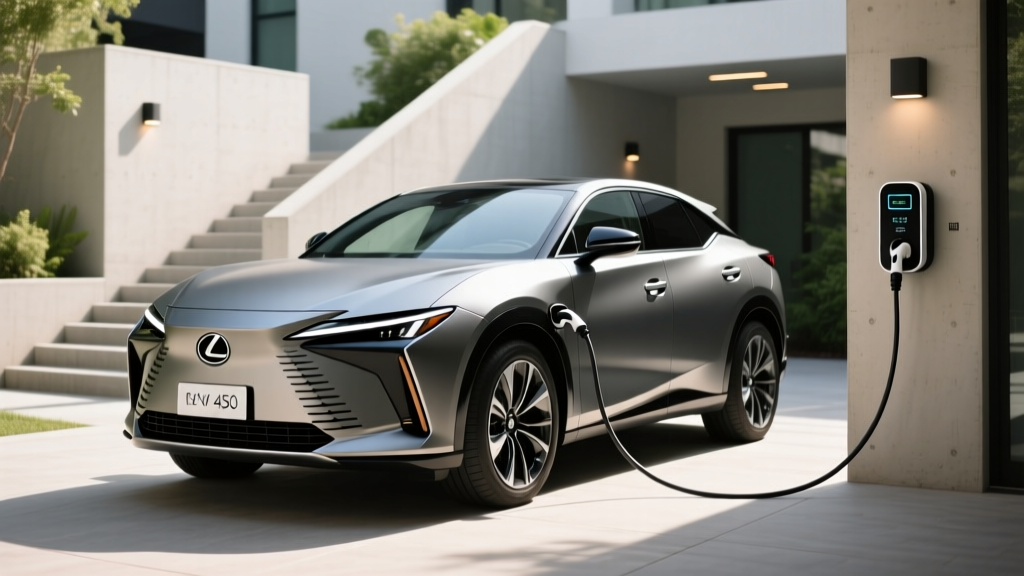
The short answer: Lexus currently offers one fully electric vehicle in the U.S. — the RZ 450e, a compact luxury crossover SUV. For 2026, the RZ 450e starts at approximately $55,175 (including destination), delivers an EPA-estimated 220 miles of range (Premium trim with 18-inch wheels), and charges at a peak of 150 kW on DC fast chargers. It qualifies for a portion of the federal §30D tax credit depending on your income, the vehicle's battery sourcing, and MSRP caps — but its range and charging speed trail rivals like the Genesis GV60 and BMW iX. If you want Lexus luxury with electrification but need more range, the plug-in hybrid NX 450h+ (37 miles electric-only) is worth a serious look.
The 2026 Lexus RZ 450e: What You're Actually Buying
Lexus entered the EV market with the RZ 450e, built on Toyota's e-TNGA platform shared with the Subaru Solterra and Toyota bZ4X. But Lexus differentiates with a more refined interior, standard Lexus Safety System+ 3.0, and a tuned suspension that prioritizes ride comfort over sporty edge. For 2026, the RZ 450e is available in three trims: Premium, Luxury, and the newly added F Sport Handling.
| Spec | Premium (18" wheels) | Luxury / F Sport (20" wheels) |
|---|---|---|
| EPA Range | 220 miles | 196 miles |
| Battery (usable) | 71.4 kWh (NMC lithium-ion) | 71.4 kWh (NMC lithium-ion) |
| Drivetrain | DIRECT4 AWD (dual motor) | DIRECT4 AWD (dual motor) |
| Horsepower | 308 hp combined | 308 hp combined |
| 0–60 mph | 5.0 seconds | 5.0 seconds |
| MPGe (combined) | 102 MPGe | 89 MPGe |
| Peak DC Fast Charge | 150 kW | 150 kW |
| 10–80% DC Charge Time | ~30 minutes | ~30 minutes |
| Level 2 (240V) Charge Rate | 7.2 kW (~9.5 hrs, 0–100%) | 7.2 kW (~9.5 hrs, 0–100%) |
| Base MSRP (incl. destination) | $55,175 | $60,675 / $59,175 |
| Battery Warranty | 8 years / 100,000 miles | |
Real-world range reality check: The EPA rates the RZ 450e Premium at 220 miles, but expect 180–200 miles on sustained highway driving at 70+ mph, and as low as 155–175 miles in freezing temperatures (below 32°F). The 20-inch wheel trims lose 24 miles of EPA range due to higher rolling resistance and weight. If your daily commute is under 60 miles round-trip and you charge at home, this range is manageable — but road-trippers will need to plan stops carefully.
Charging the RZ 450e: Speeds, Networks, and Home Setup
The RZ 450e uses a CCS1 (Combined Charging System) connector for DC fast charging and a J1772 connector for Level 1 and Level 2 AC charging. Lexus does not currently offer a NACS (Tesla-style) port, though CCS-to-NACS adapters are available for accessing Tesla Supercharger V3 stations that support CCS via Magic Dock.
| Level | Power | Connector | Speed (approx.) | Best Use Case |
|---|---|---|---|---|
| Level 1 (120V) | ~1.4 kW | J1772 / NEMA 5-15 | ~4 miles per hour | Emergency / overnight trickle |
| Level 2 (240V) | 7.2 kW | J1772 / NEMA 14-50 or hardwired | ~23 miles per hour | Daily home charging |
| DC Fast Charge | Up to 150 kW peak | CCS1 | ~115 miles in 30 min (10–80%) | Road trips |
Charging curve reality: The RZ 450e peaks at 150 kW only between roughly 10–30% state of charge. It tapers to around 80–100 kW by 50% SoC and drops further to under 40 kW above 80%. This means the advertised 10–80% time of ~30 minutes is accurate, but charging from 80–100% can add another 40+ minutes. Plan your road-trip stops to charge to 80% and move on — don't wait for a full battery.
Home charging cost: Installing a dedicated 240V Level 2 circuit typically costs $800–$2,500 depending on your electrical panel capacity and the distance from panel to garage. If your panel is at or near capacity (common in older homes with 100A service), a panel upgrade to 200A can add $1,500–$3,500. A quality Level 2 charger (ChargePoint Home Flex, Emporia V2, or similar) runs $350–$700. Budget a total of $1,500–$4,000 for a complete home setup.
RZ 450e vs. Gas Lexus NX vs. NX 450h+ Plug-In Hybrid
Many Lexus shoppers cross-shop the RZ 450e against the gasoline NX 350 and the plug-in hybrid NX 450h+. Here's how they stack up on the metrics that matter for ownership decisions.
| Metric | RZ 450e (EV) | NX 350 (Gas AWD) | NX 450h+ (PHEV) |
|---|---|---|---|
| Starting MSRP | $55,175 | $43,815 | $59,925 |
| EPA Range / Efficiency | 220 mi / 102 MPGe | ~380 mi / 25 MPG combined | 37 mi electric + 380 mi gas / 84 MPGe (charge-sustaining: 36 MPG) |
| Fuel/Energy Cost (5 yr, 15k mi/yr) | ~$3,750 (at $0.14/kWh) | ~$10,500 (at $3.50/gal) | ~$6,800 (mixed electric + gas) |
| Estimated 5-yr Maintenance | ~$1,800 | ~$3,600 | ~$3,200 |
| Federal Tax Credit (§30D) | Up to $3,750* | $0 | Up to $3,750* |
| 0–60 mph | 5.0 sec | 6.6 sec | 6.0 sec |
*Tax credit amounts depend on battery critical-mineral and component sourcing requirements under current IRS §30D rules. Check IRS.gov for current-year eligibility. Credit is nonrefundable and subject to buyer income caps ($150K single / $300K joint MAGI) and MSRP caps ($80K for SUVs).
5-Year Total Cost of Ownership Estimate (75,000 miles):
| Cost Category | RZ 450e | NX 350 Gas | NX 450h+ PHEV |
|---|---|---|---|
| Purchase (after est. credit) | $51,425 | $43,815 | $56,175 |
| Energy / Fuel | $3,750 | $10,500 | $6,800 |
| Maintenance | $1,800 | $3,600 | $3,200 |
| Insurance (est. avg) | $9,500 | $7,800 | $8,600 |
| Home Charger Install | $2,500 | $0 | $2,500 |
| Estimated Depreciation | $22,000 | $18,500 | $21,000 |
| 5-Year Total | ~$90,975 | ~$84,215 | ~$98,275 |
Depreciation estimates based on current EV resale trends; EV depreciation has been steeper than ICE. Insurance premiums for EVs tend to run 15–25% higher due to repair costs. Source: fueleconomy.gov for efficiency data.
Federal Tax Credit: Does the RZ 450e Qualify?
The Lexus RZ 450e is assembled in Japan (at Toyota's Motomachi plant), which affects its eligibility for the full $7,500 federal clean vehicle credit under IRS §30D. Under current rules, the credit is split into two halves:
- $3,750 — Battery Components: Requires a percentage of battery components to be manufactured or assembled in North America. The RZ 450e's Japan-built battery pack may not meet this threshold.
- $3,750 — Critical Minerals: Requires a percentage of critical minerals to be sourced from the U.S. or free-trade-agreement partners. This half is more likely to apply.
- Buyer Income Cap: MAGI must not exceed $150,000 (single), $225,000 (head of household), or $300,000 (joint filing).
- MSRP Cap: Vehicle MSRP must not exceed $80,000 for SUVs — all RZ 450e trims clear this.
- Point-of-Sale Transfer: You can transfer the credit to the dealer at purchase for an upfront price reduction, rather than waiting to claim it on your tax return.
Bottom line: Expect the RZ 450e to qualify for approximately $3,750 (the critical-minerals half) for most eligible buyers, not the full $7,500. Confirm current eligibility with your dealer and a tax professional before purchasing — sourcing rules tighten annually.
Common Misconceptions About Lexus Electric Vehicles
| Myth | Fact |
|---|---|
| "Lexus EVs are just rebadged Toyotas." | The RZ 450e shares the e-TNGA platform with the bZ4X/Solterra, but Lexus uses unique suspension tuning, interior materials, sound insulation, and the DIRECT4 torque-vectoring AWD system not found on the Toyota. |
| "220 miles of range is unusable." | The average American drives 37 miles per day (FHWA data). For home-charging owners, 220 miles is more than adequate for daily use. It only becomes limiting on road trips exceeding 180 miles between stops. |
| "EV batteries need replacing every few years." | Lexus warranties the RZ battery for 8 years / 100,000 miles against capacity loss below 70%. Industry data shows NMC batteries typically retain 85–90% capacity at 100,000 miles. Full replacement (if ever needed) runs approximately $15,000–$20,000, but is rare within the first decade. |
| "I can charge at any Tesla Supercharger." | Only Tesla Supercharger V3 stations equipped with the Magic Dock CCS adapter are accessible to non-Tesla EVs. Coverage is growing but still limited. Plan around Electrify America, EVgo, and ChargePoint networks for CCS charging. |
| "The RZ 450e is self-driving with Lexus Safety System+." | Lexus Safety System+ 3.0 is a SAE Level 2 driver-assistance system. It includes adaptive cruise, lane-centering, and automatic emergency braking — but you must keep your hands on the wheel and eyes on the road at all times. It is not autonomous driving. |
SAE Level 2 — not self-driving: Lexus Safety System+ 3.0 and the available Advanced Park feature are SAE Level 2 systems. The vehicle can manage steering and acceleration/deceleration under specific conditions, but the driver is fully responsible for monitoring the environment and intervening immediately. No current Lexus vehicle offers Level 3 or higher autonomy.
Decision Framework: Is a Lexus Electric Right for You?
Choose the Lexus RZ 450e (EV) if:
- You have reliable Level 2 home charging (garage or driveway with 240V access)
- Your daily driving is under 80 miles round-trip
- You rarely take road trips longer than 200 miles without a planned stop
- You prioritize cabin quietness, ride comfort, and Lexus dealer service
- You live in a mild-to-moderate climate (extreme cold further reduces the 220-mi range)
Choose the Lexus NX 450h+ (PHEV) if:
- You lack home charging access or live in an apartment without EV infrastructure
- You frequently drive 300+ miles and don't want to plan charging stops
- You want electric-only commuting (37 miles covers most daily trips) with gas-engine flexibility
- You live in a region with harsh winters where EV range loss is a concern
Choose the Lexus NX 350 (Gas) if:
- Upfront purchase price is your primary concern ($11,000+ less than the RZ)
- You drive fewer than 10,000 miles per year (fuel savings from EV won't offset the price premium)
- You plan to keep the vehicle 3 years or less (depreciation risk is lower on gas models currently)
What First-Time Lexus EV Buyers Should Know
If you're transitioning from a gas Lexus to the RZ 450e, here's what will change in your ownership experience:
1. Preconditioning matters. Use the Lexus app to precondition the battery while plugged in before a DC fast-charge stop. A cold battery charges significantly slower — preconditioning warms it to optimal temperature and can cut your 10–80% charge time by 5–10 minutes.
2. Regenerative braking replaces most brake use. The RZ 450e offers adjustable regen levels via paddle shifters. In daily driving, you'll use the friction brakes rarely — they're mainly there for hard stops. Expect brake pad life to extend well beyond 80,000 miles.
3. Insurance will cost more. EV insurance premiums run 15–25% higher than equivalent gas vehicles, driven by higher repair costs and battery replacement risk. Get quotes from your insurer before purchasing — some companies (like State Farm and Progressive) have narrowed the gap, but it varies by state.
4. Tire wear is accelerated. EVs are heavier (the RZ 450e weighs ~4,665 lbs) and deliver instant torque. Expect to replace tires every 25,000–35,000 miles rather than the 40,000–50,000 miles typical on a gas NX. Budget for EV-rated tires (Michelin Pilot Sport EV, Hankook iON) at ~$250–$350 per tire.
5. Software updates are OTA but limited. Lexus pushes over-the-air updates for infotainment and some vehicle systems, but don't expect Tesla-style feature additions. Updates are primarily bug fixes and minor improvements.
Frequently Asked Questions
Will Lexus release more electric vehicles after the RZ?
Lexus has announced plans for a full EV lineup by 2035, including a next-generation electric sedan and a larger electric SUV. However, as of 2026, the RZ 450e remains the only battery-electric Lexus available in the U.S. A redesigned RZ with improved range and faster charging is expected around 2027–2028, but specs are preliminary.
How does the RZ 450e compare to the Tesla Model Y or Genesis GV60?
The RZ 450e trails on range and charging speed. The Tesla Model Y Long Range offers 310+ miles EPA and 250 kW peak charging. The Genesis GV60 delivers 248 miles and 233 kW peak charging. Where the RZ wins is interior material quality, dealership experience, and Lexus reliability reputation. If range is your top priority, the RZ is not the segment leader.
Can I use the HOV lane with the RZ 450e?
HOV lane access for EVs varies by state. California's Clean Air Vehicle decal program has specific income and vehicle price requirements that change annually. Check your state's DMV for current rules — eligibility is not guaranteed simply because the vehicle is electric.
What happens if the RZ 450e battery degrades significantly?
Lexus warranties the high-voltage battery for 8 years or 100,000 miles, guaranteeing it will retain at least 70% of original capacity. If degradation exceeds this threshold within the warranty period, Lexus will repair or replace the battery at no cost. Outside warranty, a full replacement is estimated at $15,000–$20,000, though real-world NMC battery data suggests most packs retain 80%+ capacity at 150,000 miles.
Does the RZ 450e have a frunk (front trunk)?
No. Unlike some EV competitors, the RZ 450e does not offer a front trunk. Cargo space is limited to the rear area: 34.9 cubic feet behind the second row and approximately 56.9 cubic feet with seats folded. This is competitive for the segment but less than a Model Y's combined frunk + trunk volume.