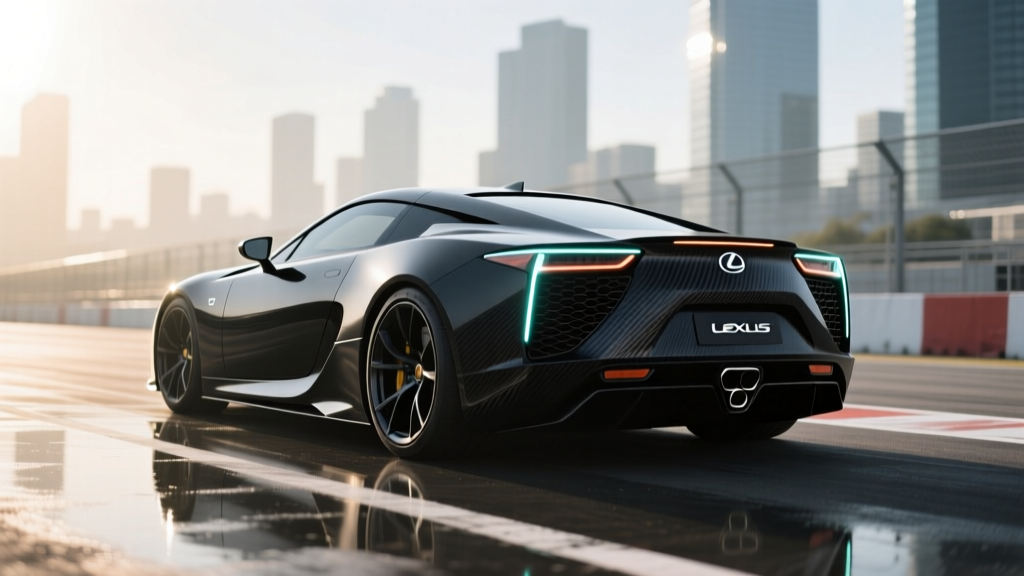
The original Lexus LFA was a V10 halo car that burned through its 500-unit production run between 2010 and 2012, leaving behind one of the most revered exhaust notes in automotive history. Now, Toyota has confirmed that the Lexus LFA BEV return is in active development — a fully electric successor that aims to translate that analog soul into a battery-electric flagship. First previewed as a concept in December 2021 and reiterated at Japan Mobility Show events through 2024–2025, the production version is expected to arrive for the 2027 model year.
This is not a vehicle you can order today. Toyota has released preliminary details, teaser imagery, and engineering direction — but final EPA certification, pricing, and delivery timelines remain unconfirmed. What follows is a synthesis of every official statement, credible report, and engineering data point available as of early 2026, interpreted through the lens of real EV ownership and performance benchmarking.
Announced Status: What Lexus Has Confirmed
Toyota's electrification roadmap, updated most recently in official corporate briefings, lists the next-generation LFA among its "halo" BEV projects alongside an electric MR2 and a Celica successor. Key confirmed points:
- Powertrain: Fully electric (BEV), multi-motor configuration
- Target production: 2027 model year (calendar-year deliveries likely late 2026 or early 2027)
- Battery technology: Toyota has indicated solid-state battery integration, though whether the LFA launches with solid-state cells or an advanced lithium-ion pack remains unconfirmed
- Production volume: Expected to be extremely limited — likely under 500 units, mirroring the original LFA's exclusivity strategy
- Platform: Dedicated BEV sports-car architecture, not a rebadged existing Toyota EV platform
Estimated Performance and Powertrain Specs
The original LFA produced 552 hp from its 4.8-liter Yamaha-tuned V10 and hit 60 mph in approximately 3.6 seconds. The BEV successor is targeting a substantial leap in both metrics, consistent with the performance envelope of contemporary electric hypercars and Toyota's stated ambition to compete at the highest tier.
| Attribute | Estimated / Target | Notes |
|---|---|---|
| Powertrain | Tri-motor AWD | Likely 2 rear + 1 front, torque-vectoring |
| Horsepower | ~700–1,000+ hp | Toyota's BEV sports concept targeted >1,000 hp |
| 0–60 mph | ~2.0–2.5 seconds (est.) | Consistent with tri-motor EV hypercar benchmarks |
| Battery Chemistry | Solid-state (target) or advanced NMC | Toyota holds 1,000+ solid-state patents; production readiness TBD |
| Battery Capacity | ~80–100 kWh usable (est.) | Weight-constrained sports car; likely prioritizes power density over capacity |
| EPA Range | ~200–260 miles (est.) | Sports-car aero + high power output limit efficiency |
| Drivetrain | AWD with active torque vectoring | Independent rear motors enable yaw control |
| Base MSRP | $200,000–$400,000+ (est.) | Original LFA was $375,000; EV halo pricing likely comparable or higher |
Range and Efficiency: The Sports-Car EV Tradeoff
Electric supercars face a fundamental physics problem: high power output and aggressive aerodynamic profiles (low, wide, heavy cooling demands) work against range efficiency. For context, the Lotus Evija (2,011 hp, ~2,000 kWh-class pack) manages roughly 250 miles on the WLTP cycle, and the Rimac Nevera achieves about 340 miles WLTP with a 120 kWh pack — but WLTP is roughly 20–25% more generous than the EPA test cycle used in the US.
Estimated EPA range: ~200–260 miles
Real-world highway (75 mph): Expect 160–210 miles — aggressive aero drag at speed erodes efficiency significantly in low-slung sports cars
Cold-weather impact (below 32°F): 15–25% range reduction typical for performance EVs without aggressive heat-pump preconditioning
Track use: Under sustained high-load driving, range will drop to well under 100 miles per charge — consistent with every EV in track conditions
If Toyota successfully integrates solid-state cells, the energy density advantage (potentially 2× current NMC at the cell level) could allow a smaller, lighter pack to deliver comparable range — or enable a larger pack without the weight penalty that destroys a sports car's handling balance. This is the single most consequential variable in the LFA BEV's engineering outcome.
Charging: Solid-State's Potential Advantage
Toyota has claimed that its solid-state battery technology could enable a 10–80% charge in approximately 10 minutes under optimal DC fast-charging conditions. This would represent a generational leap over current lithium-ion charging curves, where most performance EVs (Porsche Taycan, Tesla Model S Plaid) require 18–25 minutes for the same 10–80% window.
| Charging Level | Power / Rate | Estimated Time / Recovery |
|---|---|---|
| Level 1 (120V household) | ~1.4 kW | ~3–5 miles per hour — emergency only for a ~90 kWh pack |
| Level 2 (240V home) | ~11–19.2 kW | Full charge in 5–9 hours; ~25–40 miles per hour of charging |
| DC Fast Charge (CCS/NACS) | ~250–350 kW peak (est.) | 10–80% in ~10 min (solid-state) or ~18–22 min (advanced NMC) |
The critical caveat: DC fast-charging speeds depend on both the vehicle's charge acceptance and the station's output. Even if the LFA BEV can accept 350 kW, only a small fraction of public chargers in the US currently deliver sustained power above 250 kW. The Alternative Fuels Data Center maintains a live map of high-power charging stations.
For a halo sports car that will spend most of its life on a home Level 2 charger or at the track, DC fast-charging speed matters less than it does for a daily commuter — but it will define the car's road-trip viability for owners who want to drive it beyond their garage radius.
Design, Interior, and Technology
Toyota's design teasers show an extremely low, wide silhouette with a cab-rearward proportion that echoes the original LFA's long-hood stance — translated into a form with no engine bay to fill. Key technology expectations include:
- Steer-by-wire: Toyota has been developing steer-by-wire systems that eliminate the mechanical column, enabling variable steering ratios and a yoke-style wheel — confirmed for Toyota's next-gen BEV sports platforms
- Active aerodynamics: Expected deployable elements (rear wing, front splitter, underbody diffusers) managed by vehicle-speed and driving-mode algorithms
- Synthetic sound profile: The original LFA's V10 exhaust note was central to its identity. Toyota has experimented with both synthetic acoustic profiles and what it calls a "sound that resonates with the driver's body" — potentially using haptic and structural vibration rather than speaker-based simulation
- Driver-assist: Expect SAE Level 2 driver assistance (adaptive cruise, lane-keeping, automated emergency braking) via Toyota's latest Safety Sense suite. This is not autonomous driving — the driver must remain fully engaged at all times
- Infotainment: Likely a next-generation Lexus Interface system with a large central touchscreen, wireless CarPlay/Android Auto, and over-the-air update capability
Cargo and Practicality
Supercar practicality is inherently limited. The original LFA offered roughly 6.5 cubic feet of cargo space behind the seats. Expect the BEV successor to be similar — potentially with a small front trunk (frunk) enabled by the absence of an engine, adding 2–4 cubic feet. Total usable storage will likely be 8–12 cubic feet, enough for a weekend bag for two but nothing more.
Passenger space will be strictly for two occupants in fixed-back or limited-adjustment sport seats. Legroom and headroom will be snug by any standard other than the supercar segment.
Pricing, Tax Credits, and Ownership Economics
The original Lexus LFA carried an MSRP of $375,000 at launch (2010–2012), and values have since appreciated to $800,000–$1,000,000+ on the collector market. The BEV successor will occupy a similar or higher price tier.
| Item | Estimate / Status |
|---|---|
| Estimated Base MSRP | $200,000 – $400,000+ |
| Federal EV Tax Credit (§30D) | Not eligible — MSRP cap for passenger cars is $55,000 (per IRS §30D rules). The LFA BEV will exceed this cap by a factor of 4–7×. |
| Buyer Income Cap | Irrelevant — MSRP disqualification applies regardless of buyer AGI |
| State Incentives | Varies by jurisdiction; most state rebates also have MSRP caps ($60K–$80K typical). Check your state's energy office. |
| Estimated Insurance (annual) | $8,000–$15,000+ — consistent with limited-production supercars |
To be explicit: the Lexus LFA BEV will not qualify for the $7,500 federal EV tax credit. The §30D new clean vehicle credit has a hard MSRP cap of $55,000 for sedans, coupes, and wagons (and $80,000 for SUVs, trucks, and vans). The LFA BEV, at any plausible price point, is categorically excluded. Buyers should also consult a tax professional regarding potential state-level incentives, luxury vehicle tax implications, and alternative energy credits.
Warranty Expectations
Lexus currently provides a 8-year/100,000-mile hybrid battery warranty on its electrified models and a standard 4-year/50,000-mile basic warranty. For a limited-production halo car, expect:
- Basic warranty: 4 years / 50,000 miles (standard Lexus)
- Battery/powertrain: 8 years / 100,000 miles minimum — potentially extended given the limited production volume and Toyota's confidence signaling around solid-state longevity
- Concierge/white-glove service: Likely included, consistent with the original LFA's ownership experience (dedicated service liaison, flatbed transport, etc.)
Competitive Landscape: What the LFA BEV Is Up Against
The electric hypercar and supercar segment is small but growing. Here is how the announced LFA BEV stacks up against confirmed competitors:
| Vehicle | Power | 0–60 mph | Est. Range | Price |
|---|---|---|---|---|
| Lexus LFA BEV (est.) | 700–1,000+ hp | ~2.0–2.5s | ~200–260 mi | $200K–$400K+ |
| Rimac Nevera | 1,914 hp | 1.85s | ~287 mi (EPA) | ~$2.2M |
| Lotus Evija | 2,011 hp | ~2.0s (claimed) | ~250 mi (WLTP) | ~$2.3M |
| Porsche Taycan Turbo GT | 1,019 hp | 2.1s | 269 mi (EPA) | ~$240K |
| Tesla Model S Plaid | 1,020 hp | 1.99s | 396 mi (EPA) | ~$90K |
The LFA BEV's competitive positioning is unusual: it likely won't match the Nevera or Evija on raw power, and it won't approach the Model S Plaid on range or value. Its lane is brand heritage, exclusivity, and build quality — the same qualities that made the original LFA appreciate in value while other supercars depreciated. The question is whether an electric LFA can command collector-grade desirability without a screaming V10.
Who Should Consider the Lexus LFA BEV?
- You owned or admired the original LFA and want the spiritual successor
- You value exclusivity and limited production over raw spec-sheet dominance
- You want a Toyota/Lexus ownership and service experience at the supercar tier
- You see the car as a potential future collector asset (limited production + brand cachet)
- You have home Level 2 charging and primarily drive within 150 miles of home
- You want maximum range — the Model S Plaid offers nearly 400 EPA miles at a fraction of the price
- You need daily-driver practicality (cargo, rear seats, ground clearance)
- You want confirmed, EPA-certified specs before committing — these are still estimates
- You expect federal or state EV tax incentives — the MSRP disqualifies this vehicle entirely
- You prioritize proven charging infrastructure compatibility over cutting-edge battery tech
The Solid-State Battery Question
Toyota holds more solid-state battery patents than any other automaker, and the company has repeatedly stated that its first commercial solid-state EVs will debut in the 2027–2028 timeframe. The LFA BEV is a logical launch vehicle for this technology: limited production volume reduces manufacturing risk, the high price absorbs the premium cell cost, and the halo effect generates maximum brand value from the technological statement.
Solid-state batteries promise several advantages over current NMC lithium-ion cells:
- Energy density: Potentially 2× at the cell level, enabling smaller, lighter packs for the same range — critical for a sports car where weight distribution defines handling
- Charge speed: Toyota has targeted 10-minute 10–80% charging, enabled by the solid electrolyte's resistance to lithium plating at high charge rates
- Safety: Solid electrolytes are non-flammable, eliminating the thermal runaway risk inherent in liquid-electrolyte lithium-ion cells
- Longevity: Potentially longer cycle life, though degradation data at production scale does not yet exist
The risk: solid-state manufacturing at any scale remains unproven. Toyota has pushed back its solid-state timeline multiple times. If production readiness isn't achieved by the LFA BEV's launch window, the car may debut with an advanced NMC pack and receive a solid-state upgrade in a subsequent model year — a pattern we've seen with other Toyota technology rollouts.
Frequently Asked Questions
When can I buy the Lexus LFA BEV?
Toyota has not opened orders. The production target is the 2027 model year, which typically means calendar deliveries in late 2026 or early 2027. Given the extremely limited production volume (likely under 500 units), allocation will probably be by invitation or dealer relationship, similar to the original LFA's application-based purchase process.
What is the real-world range of the Lexus LFA BEV?
There is no EPA-certified figure yet. Based on comparable electric sports cars and Toyota's engineering disclosures, we estimate 200–260 EPA miles. Real-world highway driving at 75 mph will likely reduce that to 160–210 miles. Cold weather (below freezing) could further reduce range by 15–25%. Track driving will consume range dramatically faster than any road scenario.
How fast does the Lexus LFA BEV charge?
If equipped with solid-state batteries, Toyota has targeted a 10-minute 10–80% DC fast charge — roughly half the time of today's best lithium-ion EVs. With a conventional advanced NMC pack, expect 18–22 minutes for the same window at a 250–350 kW charger. Home Level 2 charging (240V, 11–19.2 kW) would fully replenish the pack in 5–9 hours overnight.
Does the Lexus LFA BEV qualify for the federal EV tax credit?
No. Under current IRS §30D rules, the federal new clean vehicle credit has an MSRP cap of $55,000 for passenger cars (sedans, coupes, wagons). The LFA BEV's estimated $200,000–$400,000+ price exceeds this cap by a wide margin. Income limits and battery-sourcing requirements are irrelevant in this case — the MSRP alone disqualifies the vehicle.
Is the Lexus LFA BEV worth waiting for vs. buying a Rimac Nevera or Porsche Taycan Turbo GT?
These are fundamentally different propositions. The Nevera ($2.2M) offers unmatched power and proven performance but at a price 5–10× higher. The Taycan Turbo GT (~$240K) is a proven, EPA-certified, daily-drivable performance EV with 269 miles of range and access to Porsche's dealer network — but it's a four-door sedan, not a limited-production two-seat halo car. The LFA BEV's value proposition is exclusivity, brand heritage, and potential collector appreciation — not spec-sheet dominance. If you want a car to drive hard every day, the Taycan Turbo GT is the pragmatic choice. If you want a future collectible that happens to be electric, the LFA BEV may be worth the wait.
Will the Lexus LFA BEV have a manual transmission or simulated gears?
Toyota has filed patents for simulated manual transmissions in EVs (including a system with a physical clutch pedal and gear lever that modulates torque delivery to mimic gear shifts). Whether this reaches the LFA BEV is unconfirmed, but Toyota's GR division has publicly stated that driver engagement — not just straight-line speed — is central to its EV sports car philosophy. Expect at minimum a selectable "gear-shift" simulation mode, and possibly a more immersive haptic system.
What about the LFA's legendary sound?
This is the most emotionally charged question among LFA enthusiasts. The original car's Yamaha-tuned V10 with its equal-length exhaust headers produced a sound widely considered the best in automotive history. Toyota has acknowledged this challenge and has explored multiple approaches: synthetic audio profiles played through the cabin, structural vibration systems that transmit drivetrain frequencies through the chassis, and even external acoustic signatures. No solution will replicate a 9,000-RPM V10, but Toyota appears aware that silence is not an acceptable outcome for an LFA successor.