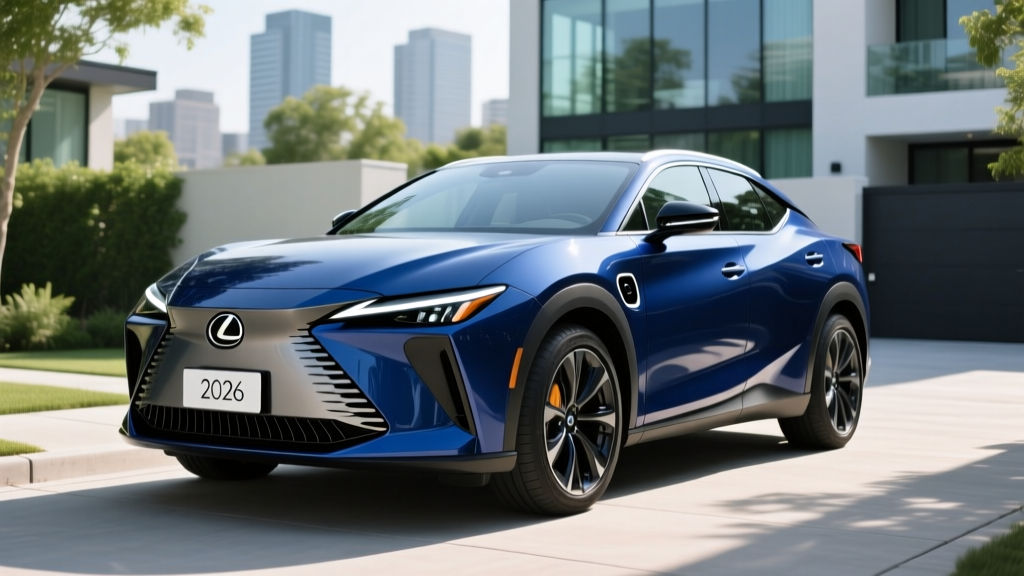
For luxury buyers eyeing the electric transition, Lexus has positioned the RZ lineup as a comfort-first entry into the BEV space. But when you're browsing Lexus EV lease deals, the sticker price is only the beginning of the math. Between shifting federal tax credit rules, higher-than-average EV insurance premiums, and the reality of DC fast charging speeds, the true cost of a Lexus RZ 450e or RZ 300e requires a deeper look.
As of 2026, the Lexus RZ remains the brand's dedicated electric platform offering. While it doesn't chase the 0-60 times of a Tesla Model Y Performance or the 350+ mile range of a Lucid Air, it delivers the refinement, build quality, and dealer network that Lexus buyers expect. The real question is whether the lease economics — especially the federal tax credit passthrough — make it a smarter financial move than buying or choosing a German rival.
2026 Lexus RZ Lineup: Specs, Pricing, and Lease Baseline
Before we run the ownership numbers, here's what you're actually leasing. The 2026 Lexus RZ comes in two main configurations: the dual-motor RZ 450e (AWD) and the single-motor RZ 300e (FWD). Both share the same 72.8 kWh battery pack (NMC chemistry), but efficiency and range differ meaningfully.
| Spec | 2026 RZ 300e (FWD) | 2026 RZ 450e (AWD) |
|---|---|---|
| Battery (usable) | 72.8 kWh (NMC) | 72.8 kWh (NMC) |
| EPA Range | 266 miles | 220 miles (Luxury) / 196 miles (Premium w/ 20" wheels) |
| Efficiency | 114 MPGe combined | 102 MPGe combined |
| DC Fast Charge (peak) | 150 kW (10-80% in ~30 min) | 150 kW (10-80% in ~30 min) |
| Level 2 Charge Rate | 7.7 kW (~25 mi/hr) | 7.7 kW (~25 mi/hr) |
| Horsepower | 201 hp | 308 hp |
| 0-60 mph | 7.4 sec | 5.0 sec |
| Base MSRP | $54,000 | $59,850 |
| Battery Warranty | 8 yr / 100,000 mi | 8 yr / 100,000 mi |
Why Lease Deals Matter: The $7,500 Tax Credit Passthrough
The single biggest factor in 2026 Lexus EV lease deals is the federal tax credit loophole — and it's a legitimate advantage of leasing over buying.
Under IRS §30D rules, the federal clean vehicle credit has strict requirements: buyer income caps ($150K single / $300K joint), vehicle MSRP caps ($80K for SUVs like the RZ), and battery component/critical mineral sourcing thresholds that eliminate many vehicles assembled with Chinese-sourced materials. The Lexus RZ, assembled in Japan with a Toyota/Prime Planet battery supply chain, has faced eligibility challenges under the strictest sourcing rules for outright purchases.
However, when you lease, the credit goes to the lessor (the finance company), not to you. The lessor can then pass that $7,500 savings to you as a capitalized cost reduction — effectively lowering your monthly payment — regardless of your personal income or the vehicle's battery sourcing. This is the "lease loophole" that makes Lexus EV lease deals particularly attractive in 2026.
- Income Caps (purchase only): AGI ≤ $150K single, $225K head of household, $300K joint
- MSRP Cap: ≤ $80,000 for SUVs (RZ qualifies at all trims)
- Battery Sourcing: Must meet escalating critical mineral and battery component thresholds (varies by model year — check fueleconomy.gov)
- Point-of-Sale Transfer: Eligible buyers can apply credit at purchase to reduce down payment
- Lease Passthrough: Lessor claims credit; passes savings via lower lease payments (no income/sourcing restrictions on lessee)
5-Year Total Cost of Ownership: Lexus RZ vs. Gas Lexus NX
To understand whether a Lexus EV lease makes financial sense, we need to compare it against what most cross-shoppers are considering: a gas-powered Lexus NX 350. Here's a 5-year/75,000-mile total cost of ownership (TCO) breakdown.
| Cost Category | RZ 450e (Leased) | NX 350 AWD (Purchased) |
|---|---|---|
| Effective Vehicle Cost (5yr) | $28,500 (lease payments w/ $7.5K credit applied) | $31,200 (depreciation on $49K purchase) |
| Fuel/Energy (75K miles) | $4,875 (home charging at $0.16/kWh avg) | $9,375 (gas at $3.75/gal, 25 MPG combined) |
| Insurance (5yr) | $12,500 (~$2,500/yr EV premium) | $9,500 (~$1,900/yr) |
| Maintenance (5yr) | $1,800 (cabin filter, wipers, tire rotation) | $4,200 (oil, filters, brakes, fluids) |
| Depreciation/Disposition | $0 (return at lease end or buy at residual) | Included in vehicle cost above |
| Total 5-Year Cost | $47,675 | $54,275 |
| Cost Per Mile | $0.64 | $0.72 |
The RZ 450e lease saves roughly $6,600 over five years compared to purchasing a gas NX 350, driven primarily by the tax credit passthrough and fuel savings. But note where the EV costs more: insurance is approximately $3,000 higher over five years. This is the trade-off many lease calculators miss.
Charging Cost vs. Gas: The Per-Mile Math
Let's get specific about energy costs, because this is where EV ownership delivers its most consistent savings — if you can charge at home.
| Scenario | Cost per Mile | Annual Cost (15K mi) |
|---|---|---|
| RZ 450e — Home Level 2 ($0.16/kWh, 2.8 mi/kWh) | $0.057 | $857 |
| RZ 450e — Public DC Fast ($0.45/kWh avg) | $0.161 | $2,411 |
| NX 350 Gas ($3.75/gal, 25 MPG combined) | $0.150 | $2,250 |
| RZ 450e — 80% home / 20% public blend | $0.078 | $1,168 |
The takeaway: if you charge at home 80% of the time, you'll spend roughly $1,168 per year on electricity vs. $2,250 on gas — a $1,082 annual savings. But if you rely entirely on public DC fast charging (at $0.40-$0.50/kWh rates from networks like Electrify America or EVgo), your per-mile cost actually exceeds gasoline. Home charging access is non-negotiable for EV economics.
Maintenance Savings: Where EVs Quietly Win
EV maintenance savings are real but modest on a year-to-year basis. The Lexus RZ eliminates oil changes, transmission fluid, spark plugs, and exhaust system repairs. Regenerative braking significantly extends brake pad life — many EV owners report original brake pads lasting 80,000-100,000 miles.
| Maintenance Item | RZ 450e (5yr/75K mi) | NX 350 Gas (5yr/75K mi) |
|---|---|---|
| Oil Changes | $0 | $750 (10 changes @ $75) |
| Brake Pads/Rotors | $0 (regen preserves) | $800 (1-2 replacements) |
| Cabin Air Filter | $200 | $200 |
| Tire Rotation/Replacement | $1,200 (EVs wear tires faster due to weight/torque) | $900 |
| Coolant/Fluid Service | $200 | $400 |
| Wipers/Misc | $200 | $200 |
| Total | $1,800 | $3,250 |
The net savings is approximately $1,450 over five years. Important caveat: EVs tend to wear through tires faster than gas cars due to heavier curb weight and instant torque. Budget for premium tire replacements (the RZ uses 18- or 20-inch all-seasons costing $200-$300 per corner).
The Insurance Reality: Why EVs Cost More to Insure
Here's where the honest math gets uncomfortable. EV insurance premiums run 15-30% higher than comparable gas vehicles, and the Lexus RZ is no exception. Expect to pay $2,300-$2,700 per year for full coverage on an RZ 450e, versus $1,700-$2,100 for an NX 350.
The reasons are structural: EV repair costs are higher (specialized high-voltage training required for body shops), battery replacement after even minor collision damage can total a vehicle, and parts availability for EV-specific components remains limited compared to decades-old gas car supply chains. According to IIHS data, EVs also show slightly higher collision claim frequencies, possibly due to their instant torque and heavier weight affecting braking distances.
Shop insurance quotes before signing a lease. Companies like Geico, Progressive, and Tesla Insurance (in some states) have started offering more competitive EV-specific rates, and bundling with home insurance can narrow the gap.
Depreciation and Resale: The EV Wild Card
EV depreciation has been volatile. In 2023-2024, used EV values dropped sharply as Tesla cut new-vehicle prices and battery technology evolved quickly. By 2026, the market has stabilized somewhat, but EVs still depreciate faster than gas equivalents in most segments.
For a lessee, this is actually an advantage: you're insulated from resale risk. If the RZ's residual value tanks by lease-end, you simply hand the keys back. If it holds value well, you can exercise the purchase option at the pre-set residual price and potentially flip it.
Current 36-month residual estimates for the Lexus RZ 450e hover around 48-52% of MSRP — below the Lexus brand average (which typically leads the industry in retention) but comparable to other luxury EVs. The Lexus badge and dealer network provide some floor, but the rapid pace of EV tech advancement (faster-charging competitors, larger batteries) pressures used values.
Decision Framework: Is a Lexus RZ Lease Right for You?
- You have reliable home Level 2 charging access (garage or driveway with 240V outlet)
- You want the $7,500 tax credit benefit but your income exceeds §30D caps or the vehicle's battery sourcing disqualifies a purchase
- Your daily commute is under 100 miles round-trip (the RZ's real-world range handles this easily)
- You value Lexus dealer service experience and plan to stay in the brand ecosystem
- You want to hedge against EV depreciation risk in a rapidly evolving market
- You need 300+ miles of real-world range for frequent road trips (consider Tesla Model Y Long Range or Hyundai Ioniq 5)
- You rely exclusively on apartment/curbside parking with no home charging (public DC charging will erase your fuel savings)
- You drive more than 15,000 miles annually (lease mileage penalties of $0.20-$0.30/mile add up fast)
- You want the fastest DC charging in the segment — the RZ's 150 kW peak and ~30-minute 10-80% time trails the Ioniq 5's 240 kW / 18-minute capability
Frequently Asked Questions
How much does a 2026 Lexus RZ lease cost per month?
With the $7,500 federal tax credit applied as a cap cost reduction, a 36-month RZ 450e lease with 10,000 miles/year typically runs $650-$800/month depending on your credit tier, down payment, and regional dealer incentives. Without the credit passthrough, expect $850-$1,000/month. Always negotiate the capitalized cost (sale price) before discussing monthly payments.
Can I claim the $7,500 tax credit if I lease the RZ?
Not directly. Under a lease, the lessor (finance company) claims the credit because they technically purchase the vehicle. However, most Lexus dealers and Toyota Financial Services pass the full $7,500 to you as a capitalized cost reduction, lowering your monthly payment. Confirm this passthrough explicitly in your lease agreement — it should appear as a "credit applied" line item reducing the cap cost.
What happens if I exceed my lease mileage on the RZ?
Most Lexus EV leases set excess mileage penalties at $0.20-$0.25 per mile. If you sign a 10,000-mile/year lease (30,000 total) and drive 42,000 miles over three years, you'd owe $2,400-$3,000 at lease-end. If you're uncertain about mileage, negotiate a 12,000 or 15,000-mile/year lease upfront — it's cheaper than paying penalties later.
Does the Lexus RZ qualify for HOV lane access?
Yes, in most states that offer clean vehicle HOV stickers. California's Clean Air Vehicle decal program grants solo carpool lane access to qualifying ZEVs, though the program has income caps and application wait times. Check your state's DMV for current rules — these perks can add 15-20 minutes of daily commute savings in congested metros.
How does the RZ's charging speed compare to competitors?
The RZ peaks at 150 kW on DC fast chargers, achieving a 10-80% charge in approximately 30 minutes. This trails the Hyundai Ioniq 5 (240 kW, ~18 min), Kia EV6 (240 kW, ~18 min), and Tesla Model Y (~250 kW peak, ~15 min on V3 Superchargers). For road trippers who prioritize minimal charging stops, the RZ is adequate but not class-leading. Precondition the battery via the Lexus app before arriving at a DC charger to maximize charge speed.