Quick Answer: Are Lexus Electric Vehicles Worth It in 2026?
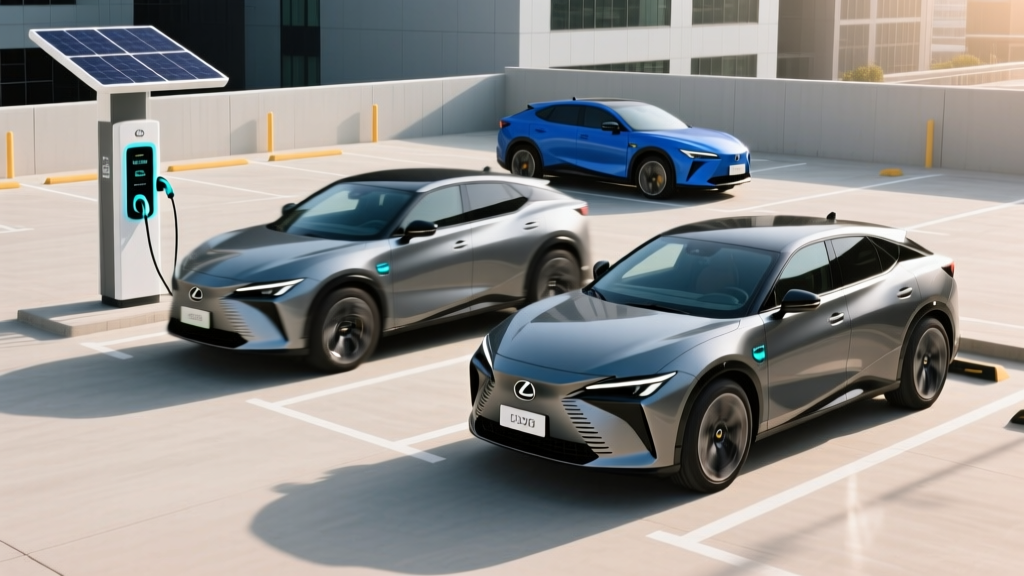
Lexus currently offers two fully electric models in the U.S.: the RZ 450e (dual-motor AWD, 220-mile EPA range, starting ~$53,000) and the RZ 300e (single-motor FWD, 266-mile EPA range, starting ~$47,000). Both use a 72.8 kWh NMC battery and peak DC fast-charge at roughly 150 kW (10–80% in ~30 minutes). The RZ qualifies for partial or full §30D federal tax credits depending on battery-sourcing compliance and your income — check current IRS rules before purchasing. For existing Lexus hybrid owners, the RZ delivers a smoother, quieter ride with lower per-mile fueling costs, but its range trails competitors like the Hyundai Ioniq 5 and Tesla Model Y. The RZ makes the most sense for buyers who prioritize Lexus build quality, dealership service, and daily commutes under 150 miles with reliable home Level 2 charging.
The 2026 Lexus EV Lineup: RZ 450e and RZ 300e at a Glance
Lexus entered the battery-electric market cautiously, and the RZ series reflects the brand's methodical approach. Rather than chasing maximum range or blistering acceleration, Lexus engineered the RZ around ride refinement, cabin quietness, and the kind of panel-gap precision that has defined the brand for decades. Here are the hard numbers for both models currently on sale:
| Specification | 2026 RZ 450e (AWD) | 2026 RZ 300e (FWD) |
|---|---|---|
| EPA Range | 220 miles (18" wheels) / 196 miles (20" wheels) | 266 miles (18" wheels) |
| Real-World Highway Range | ~175–190 miles | ~215–230 miles |
| Battery Capacity (usable) | 72.8 kWh (NMC) | 72.8 kWh (NMC) |
| Horsepower | 308 hp | 201 hp |
| 0–60 mph | 5.0 seconds | 7.4 seconds |
| Peak DC Fast Charge | ~150 kW | ~150 kW |
| 10–80% DC Charge Time | ~30 minutes | ~30 minutes |
| Level 2 (240V) Charge Rate | ~11 kW (~7 hours 0–100%) | ~11 kW (~7 hours 0–100%) |
| MPGe (combined) | 102 MPGe | 115 MPGe |
| Starting MSRP | ~$53,500 | ~$47,000 |
| Battery/Powertrain Warranty | 8 years / 100,000 miles | 8 years / 100,000 miles |
Real-World Range Reality: The EPA sticker on the RZ 450e says 220 miles, but that's with 18-inch wheels. Choose the available 20-inch wheels and the EPA number drops to 196 miles. In real-world highway driving at 70–75 mph, expect roughly 175–190 miles from the AWD model before you need to plug in. In cold weather (below 32°F), plan for a further 20–30% reduction — meaning a worst-case winter highway range of around 130–150 miles. The RZ 300e, with its more efficient single-motor setup, stretches to roughly 215–230 miles on the highway in mild conditions.
Lexus RZ vs. Gas Lexus NX: Cost and Efficiency Comparison
Many RZ shoppers cross-shop the Lexus NX, particularly the NX 350h hybrid. Here's how the numbers stack up when you compare the RZ 450e against the gas-powered NX 350 (non-hybrid) over a typical ownership period:
| Metric | 2026 RZ 450e (AWD) | 2026 NX 350 (AWD Gas) |
|---|---|---|
| Starting MSRP | ~$53,500 | ~$43,500 |
| Federal Tax Credit (§30D) | Up to $7,500 (eligibility varies) | $0 |
| Effective Starting Price | ~$46,000 (if full credit applies) | ~$43,500 |
| EPA Efficiency | 102 MPGe | 25 MPG combined |
| Cost per Mile (fuel/energy) | ~$0.04–$0.06 (home charging) | ~$0.13–$0.15 ($3.40/gal gas) |
| Annual Fuel/Energy Cost (12k mi) | ~$480–$720 | ~$1,560–$1,800 |
| Estimated Annual Maintenance | ~$300–$400 | ~$600–$900 |
| 5-Year Fuel/Energy Cost | ~$2,400–$3,600 | ~$7,800–$9,000 |
The RZ's effective purchase price can undercut the gas NX when the full §30D credit applies, and annual fueling savings run roughly $900–$1,200 per year if you charge primarily at home. Over five years, that's $4,500–$6,000 in energy savings alone, plus reduced maintenance (no oil changes, fewer brake replacements thanks to regenerative braking).
Real Ownership Costs: Charging, Insurance, and Maintenance
Beyond the sticker price, here's what Lexus EV ownership actually costs in practice:
| Cost Category | RZ 450e (Annual) | Notes |
|---|---|---|
| Home Charging (Level 2) | $480–$720 | Based on $0.13–$0.18/kWh national avg, 12,000 mi/yr |
| Public DC Fast Charging | $900–$1,400 | If relying primarily on public chargers at $0.35–$0.50/kWh |
| Insurance | $1,800–$2,600 | EV premiums run 15–25% higher than gas equivalents |
| Maintenance | $300–$400 | Tire rotation, cabin filter, wiper fluid — no oil or spark plugs |
| Tire Replacement | $800–$1,400 (every 25–35k mi) | EVs wear tires faster due to weight and instant torque |
Home charging installation is a critical variable. A Level 2 home charger (240V, 40–48 amp circuit) typically costs $500–$800 for the hardware and $800–$2,500 for electrician installation, depending on whether your electrical panel needs an upgrade. If you need a 200-amp panel upgrade, add $1,500–$3,000. This is a one-time cost that pays for itself within 1–3 years versus public charging or gas.
Federal Tax Credit Eligibility for the Lexus RZ
The §30D federal tax credit can reduce the effective cost of a new RZ by up to $7,500, but eligibility is not automatic. Under current IRS rules, several requirements must be met simultaneously:
- MSRP Cap: SUVs (which the RZ is classified as) must have an MSRP at or below $80,000. The RZ clears this easily.
- Buyer Income Cap: Modified adjusted gross income must not exceed $300,000 (joint filers), $225,000 (head of household), or $150,000 (individual).
- Battery Sourcing: The credit splits into two halves — $3,750 for critical-minerals sourcing and $3,750 for battery-component assembly. The RZ's battery supply chain compliance determines how much of the $7,500 is available. Lexus has updated sourcing for 2026, but always verify the current eligible amount on fueleconomy.gov before purchasing.
- Point-of-Sale Transfer: You can now transfer the credit to the dealer at purchase, reducing your out-of-pocket cost immediately rather than waiting for a tax refund.
Critical caveat: Battery-sourcing rules tighten periodically. A vehicle that qualifies for the full $7,500 today may drop to $3,750 or $0 in a future model-year batch. Always confirm the exact credit amount for the specific VIN you're purchasing.
Charging the Lexus RZ: What to Expect at Home and on the Road
The RZ uses a CCS1 connector for DC fast charging (with a NACS adapter available or forthcoming for Tesla Supercharger access). Here's a practical breakdown of charging scenarios:
| Charging Level | Power (kW) | Miles Added per Hour | Typical Use Case |
|---|---|---|---|
| Level 1 (120V standard outlet) | ~1.4 kW | ~4–5 miles | Emergency / overnight trickle |
| Level 2 (240V home charger) | ~11 kW | ~35–40 miles | Daily home charging — full charge in ~7 hours |
| DC Fast Charge (public) | Up to ~150 kW peak | ~150+ miles in 30 min (10–80%) | Road trips; tapers significantly above 80% |
Charging curve reality: The RZ peaks at roughly 150 kW, but that peak is sustained only briefly — typically between 10–30% State of Charge. By 50%, the rate drops to around 100 kW, and above 80%, it slows to under 50 kW to protect the battery. This means a 10–80% session takes about 30 minutes, but charging from 80–100% can add another 25–30 minutes. For road-trip planning, plan stops around the 10–80% window and move on.
The RZ's 150 kW peak charge rate trails competitors like the Hyundai Ioniq 5 (which peaks at ~240 kW on 800V architecture and charges 10–80% in roughly 18 minutes). If you take frequent long road trips, this is a meaningful difference.
Common Misconceptions About Lexus Electric Vehicles
| Myth | Fact |
|---|---|
| "The RZ is just a rebadged Toyota bZ4X." | While they share the e-TNGA platform and 72.8 kWh battery, the RZ has distinct suspension tuning, sound insulation, interior materials, and available steer-by-wire. The driving experience is notably more refined. |
| "EV batteries need replacing every few years." | The RZ's NMC battery carries an 8-year/100,000-mile warranty guaranteeing at least 70% capacity retention. Industry data shows most modern EV batteries retain 85–90% capacity after 100,000 miles. Full replacement (if ever needed) runs $10,000–$15,000, but is rare. |
| "I can't take a Lexus EV on road trips." | You can, but plan carefully. With 175–190 real-world highway miles (RZ 450e), you'll stop every 2.5–3 hours. DC fast-charging adds ~150 miles in 30 minutes. The CCS network (Electrify America, EVgo) covers most interstate corridors, though reliability varies. |
| "All Lexus EVs qualify for the full $7,500 tax credit." | Credit eligibility depends on battery-sourcing compliance, your income, and the specific model year/batch. Always verify on fueleconomy.gov for the exact VIN. |
| "Level 2 driver-assist means the car drives itself." | Lexus Safety System+ 3.0 is a SAE Level 2 system — it provides lane-centering and adaptive cruise, but you must remain fully engaged, hands on or near the wheel, at all times. It is not autonomous driving. |
Decision Framework: Is a Lexus RZ Right for You?
Choose the Lexus RZ 300e if:
- Your daily commute is under 80 miles round-trip
- You have reliable home Level 2 charging
- You want the lowest entry price (~$47,000 before credits) and maximum range (266 miles EPA)
- You rarely take road trips over 250 miles
- You value Lexus dealership service and brand loyalty over cutting-edge EV tech
Choose the Lexus RZ 450e if:
- You need AWD for snow, rain, or mountain driving
- You want stronger acceleration (5.0 sec 0–60) and 308 hp
- Your daily driving stays under 70 miles, keeping you well within range even in cold weather
- You qualify for the §30D credit, bringing the effective price close to the RZ 300e
Consider a competitor instead if:
- You regularly drive 300+ miles between charges — the Hyundai Ioniq 5 (303 mi EPA, ~240 kW charging) or Tesla Model Y (310+ mi EPA, 250 kW Supercharger access) are better fits
- You want the fastest possible DC charging for frequent road trips
- You lack home charging access and rely entirely on public infrastructure — the RZ's 150 kW peak and 30-minute charge sessions are less convenient than 800V competitors
- Maximum cargo space is a priority — the RZ offers 34.9 cu ft behind the rear seats, which is competitive but not class-leading
First-Time EV Buyer Checklist for the Lexus RZ
If this is your first electric vehicle, here's what you need to sort out before taking delivery:
- Home charging assessment: Have a licensed electrician evaluate your panel. You'll need a dedicated 40–50 amp, 240V circuit. Budget $1,500–$3,500 total for equipment and installation.
- Understand kW vs. kWh: kWh is battery capacity (the RZ holds 72.8 kWh of usable energy). kW is charge rate (the RZ accepts up to 150 kW on a DC fast charger). These are not interchangeable.
- Download charging apps: PlugShare, Electrify America, EVgo, and ChargePoint are essential for finding public chargers on road trips.
- Learn preconditioning: The RZ can precondition its battery before a DC fast-charge stop (set a charger as your navigation destination). This warms the battery and enables faster charging — especially important in cold weather.
- Plan for cold weather: If you live where winters drop below freezing, budget 20–30% range loss. The RZ's heat pump (standard on most trims) helps, but physics is physics.
- Verify tax credit eligibility: Check IRS §30D guidelines and fueleconomy.gov for the specific model year and trim you're buying.
- Insurance quotes: Get EV-specific insurance quotes before purchasing. Expect 15–25% higher premiums than a gas NX, though some insurers offer EV discounts.
Frequently Asked Questions
Does Lexus make any fully electric vehicles?
Yes. As of 2026, Lexus sells two battery-electric vehicles in the U.S.: the RZ 450e (AWD, 308 hp, 220-mile EPA range) and the RZ 300e (FWD, 201 hp, 266-mile EPA range). Lexus also offers several hybrids (HEV) and plug-in hybrids (PHEV), but the RZ models are the only full EVs.
How long does it take to charge a Lexus RZ at home?
On a Level 2 home charger (240V, ~11 kW), a full 0–100% charge takes approximately 7 hours. Most owners plug in overnight and wake up to a full battery. On a standard 120V outlet (Level 1), a full charge would take over 50 hours — practical only for emergency trickle-charging.
Is the Lexus RZ reliable compared to other EVs?
Lexus consistently ranks at or near the top of J.D. Power and Consumer Reports reliability surveys. While the RZ is relatively new, it benefits from Toyota/Lexus's conservative engineering approach and shares its e-TNGA platform with the Toyota bZ4X, which has been on the road since 2023. The 8-year/100,000-mile battery and powertrain warranty provides additional peace of mind.
Can the Lexus RZ use Tesla Superchargers?
Lexus has announced NACS (Tesla connector) adoption, and adapters or native NACS ports are expected for newer model years. Check with your dealer for the latest compatibility. In the meantime, the RZ charges natively via CCS1 at Electrify America, EVgo, and other networks.
What happens if the RZ battery degrades?
Lexus warranties the battery for 8 years or 100,000 miles against capacity loss below 70%. Real-world data from similar NMC batteries suggests most retain 85–90% capacity at 100,000 miles. If a replacement is ever needed out of warranty, expect $10,000–$15,000 — though prices continue to decline as battery manufacturing scales.
How does the RZ compare to the Lexus NX hybrid?
The NX 350h hybrid offers 37 MPG combined and ~550 miles of total range with no charging needed, making it ideal for drivers without home charging or frequent long-distance travelers. The RZ offers a smoother, quieter ride, lower per-mile fueling costs (with home charging), and zero tailpipe emissions, but with a shorter range and higher upfront cost offset partially by tax credits. If you can charge at home and your daily driving is under 100 miles, the RZ is the more refined experience. If you regularly exceed 300 miles between stops or lack home charging, the NX 350h remains the pragmatic choice.