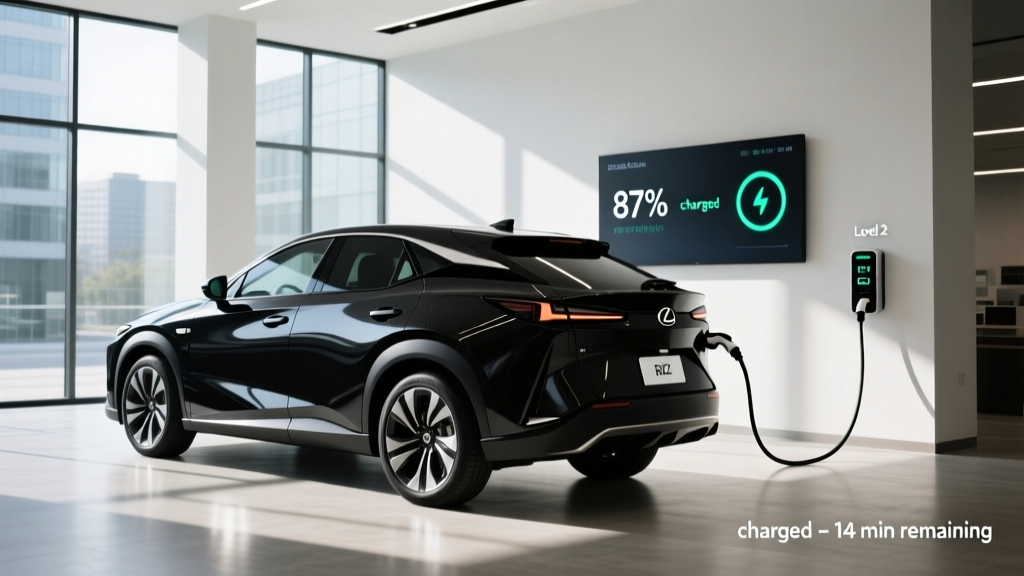
Leasing a Lexus RZ 450e or RZ 300e in 2026 looks attractive on paper: a luxury electric SUV with a refined cabin, strong reliability reputation, and monthly payments softened by federal tax credits. But the math behind a Lexus electric vehicle lease involves more than the sticker monthly payment. You need to account for whether the dealer passes the §30D credit through as a capital cost reduction, how insurance premiums compare to gas alternatives, what you actually save on fuel in your state, and how Lexus EVs hold value at lease-end.
This guide breaks down the real ownership economics of the 2026 Lexus RZ lineup — the numbers Lexus marketing won't lead with — so you can decide if an EV lease from Toyota's luxury brand fits your budget.
The 2026 Lexus RZ Lineup: What You're Leasing
For 2026, Lexus offers two battery-electric models built on the e-TNGA platform shared with the Toyota bZ4X and Subaru Solterra:
| Spec | RZ 300e (FWD) | RZ 450e (AWD) |
|---|---|---|
| EPA Range | 266 miles | 220 miles (Premium) / 196 miles (Luxury w/ 20" wheels) |
| Battery (usable) | 72.8 kWh, NMC | 72.8 kWh, NMC |
| Horsepower | 201 hp | 308 hp |
| 0-60 mph | 7.4 sec | 5.0 sec |
| Peak DC Charge Rate | 150 kW | 150 kW |
| 10-80% DC Fast Charge | ~30 min | ~30 min |
| Level 2 Charge Rate | 7.2 kW | 7.2 kW |
| Efficiency (MPGe) | 114 MPGe combined | 102 MPGe combined |
| Base MSRP | $44,900 | $54,900 |
| Battery Warranty | 8 yr / 100,000 mi | 8 yr / 100,000 mi |
Federal Tax Credit & Lease Pass-Through: The §30D Details
The single most important number in any Lexus electric vehicle lease is whether the $7,500 federal tax credit applies — and whether you actually benefit from it. Here's where leasing gets complicated.
Under IRS §30D rules, when you purchase an EV, the credit applies against your personal tax liability (subject to income caps, MSRP limits, and battery sourcing rules). But when you lease, the credit technically goes to the lessor (Lexus/Toyota Financial Services) because they own the vehicle. The critical question: does the lessor pass it through to reduce your lease cost?
For 2026, Lexus Financial Services has generally applied the credit as a capital cost reduction on qualifying RZ leases — effectively lowering your monthly payment by roughly $150-$200/month over a 36-month term. But this is not guaranteed by law. Always confirm the credit is reflected in your lease agreement's "capitalized cost" line before signing.
Federal §30D Eligibility Checklist (2026 Rules)
- Income caps: AGI ≤ $150,000 (single), $225,000 (head of household), $300,000 (joint)
- MSRP caps: ≤ $80,000 for SUVs/pickups/vans; ≤ $55,000 for sedans — the RZ qualifies as an SUV
- Battery sourcing: Critical minerals and battery components must meet escalating domestic/free-trade-partner thresholds (phased in through 2029)
- Point-of-sale transfer: For purchases, the credit can transfer to the dealer at sale; for leases, it reduces the capitalized cost
- Assembly: Vehicle must undergo final assembly in North America — the RZ is built in Japan, which creates a §30D complication (see below)
State, Local & Utility Incentives
- California (CVRP): Up to $2,000 for income-qualified buyers; some utilities (PG&E, SCE, SDG&E) offer $500-$1,500 rebates
- Colorado: State tax credit up to $5,000 for EVs under $80,000 MSRP
- New York: Drive Clean Rebate up to $2,000 (point-of-sale)
- Utility rebates: Many utilities offer $250-$1,000 for home Level 2 charger installation — check with your provider
5-Year Total Cost of Ownership: RZ 450e vs. Gas Alternative
Lease terms typically run 36 months, but understanding 5-year TCO helps you evaluate whether to buy out the lease, lease again, or switch vehicles. Below we compare the RZ 450e AWD against a similarly priced gas luxury SUV — the 2026 Lexus NX 350 AWD ($46,000 MSRP, 24 MPG combined) — over 5 years and 60,000 miles.
| Cost Category (5 yr / 60k mi) | Lexus RZ 450e AWD | Lexus NX 350 AWD (Gas) |
|---|---|---|
| Effective Purchase Price (after incentives) | $47,400 (est. after lease credit pass-through) | $46,000 |
| Energy / Fuel Cost | $3,780 (at $0.14/kWh, 33 kWh/100mi) | $8,750 (at $3.50/gal, 24 MPG) |
| Maintenance | $1,800 (cabin filter, fluid top-offs, tire rotation) | $4,200 (oil changes, filters, brakes, spark plugs) |
| Insurance (5-yr total) | $12,500 (~$2,500/yr avg) | $10,000 (~$2,000/yr avg) |
| Depreciation (est.) | $22,000 (~46% over 5 yr) | $16,500 (~36% over 5 yr) |
| Total 5-Year Cost | $87,480 | $85,450 |
The RZ 450e's energy and maintenance savings of roughly $7,370 over five years are substantial. But those savings are largely consumed by higher insurance premiums (~$2,500 more) and steeper depreciation (~$5,500 more). The net result: the RZ costs about $2,000 more over five years than its gas counterpart in this scenario — before factoring in the subjective value of a smoother, quieter, more responsive drive.
Charging Cost Per Mile vs. Gas: The Math
| Metric | RZ 450e (Home L2) | RZ 450e (Public DCFC) | NX 350 (Gas) |
|---|---|---|---|
| Energy Cost per Unit | $0.14/kWh | $0.40/kWh | $3.50/gallon |
| Consumption | 33 kWh/100 mi | 33 kWh/100 mi | 4.17 gal/100 mi (24 MPG) |
| Cost per Mile | $0.046 | $0.132 | $0.146 |
At home on Level 2, the RZ costs roughly a third of the gas NX per mile. But if you rely primarily on public DC fast charging at $0.35-$0.48/kWh (typical Electrify America or EVgo rates), the cost advantage nearly disappears. Home charging access is the single biggest variable in EV operating cost. If you can install a Level 2 charger at home, the fuel savings are real and compounding. If you can't, leasing an EV becomes harder to justify purely on economics.
Maintenance Savings: Where EVs Genuinely Win
This is where the Lexus RZ delivers unambiguous savings over gas vehicles:
| Maintenance Item | Gas Vehicle (NX 350) | EV (RZ 450e) |
|---|---|---|
| Oil Changes | $50-$80 every 5,000-10,000 mi | Not required |
| Transmission Fluid | $150-$300 at 60,000 mi | Not applicable (single-speed reduction gear) |
| Brake Pads | $300-$600 every 30,000-50,000 mi | $300-$600 at 80,000-100,000+ mi (regen braking saves pads) |
| Spark Plugs | $200-$400 at 60,000 mi | Not required |
| Air/Engine Filters | $50-$100 every 15,000-30,000 mi | Cabin filter only (~$50 every 15,000 mi) |
| Coolant Flush | $100-$200 at 60,000 mi | Battery thermal coolant at longer intervals |
| Estimated 60k-mi Total | $3,500-$4,500 | $1,200-$2,000 |
Regenerative braking is the unsung hero here. By using the electric motors to decelerate, the RZ dramatically reduces friction brake wear. Many EV owners report original brake pads lasting 80,000-120,000 miles. Combined with no oil changes, no spark plugs, and fewer fluid services, the RZ's maintenance cost runs roughly 50-60% less than a comparable gas Lexus over the same period.
Insurance Reality: The Cost EV Buyers Underestimate
Here's the number that catches most new EV lessees off guard: insurance premiums for the Lexus RZ 450e typically run 15-25% higher than for the gas NX 350, even though both carry the Lexus badge and similar safety ratings.
Why? Several factors drive EV insurance costs up:
- Higher repair costs: EV-specific components (battery pack, power electronics, electric motors) are expensive to replace after collision damage. Even minor rear-end collisions can trigger battery inspection protocols costing thousands.
- Specialized labor: High-voltage system repairs require certified technicians, and fewer shops have this capability, driving up labor rates.
- Total-loss thresholds: Insurers may total an EV for battery damage that a gas vehicle would survive, because battery replacement on the RZ costs an estimated $15,000-$20,000 out of warranty.
- Vehicle MSRP: The RZ 450e starts at $54,900 — higher base prices mean higher comprehensive and collision premiums.
National average annual premiums for the RZ 450e range from $2,200-$2,800 depending on your state, driving record, and coverage levels. Before signing a lease, get a firm insurance quote — don't rely on online estimates. Some insurers (Geico, Progressive, State Farm) offer EV-specific discounts of 5-10%, but these don't fully offset the base premium increase.
Depreciation & Resale Value: The EV Weak Spot
Lexus has historically been a depreciation champion — the gas NX retains roughly 60-64% of its value after five years. But the RZ tells a different story, and this is critical for lease math.
The RZ 450e has experienced steeper depreciation than gas Lexus models for three reasons:
- Market correction: Used EV prices spiked in 2022-2023 and corrected sharply in 2024-2025, dragging residual values down across the segment.
- Tesla price cuts: Aggressive Tesla pricing reset consumer expectations for what a used EV should cost, compressing values for all competitors.
- Range competitiveness: The RZ's 196-266 mile EPA range, while adequate for most daily driving, trails newer competitors offering 300+ miles, making it less desirable on the used market.
Current projections put 5-year RZ depreciation at approximately 44-50%, compared to 34-38% for the gas NX. On a $54,900 RZ 450e, that's roughly $24,000-$27,500 in value lost vs. $15,600-$17,500 for the NX.
Why this matters for leasing: Lease payments are largely determined by the vehicle's residual value (what it's worth at lease-end). Lower projected residuals mean higher monthly payments. Lexus Financial Services sets the residual — and if they set it conservatively (reflecting EV depreciation trends), your lease payment absorbs that gap. On the flip side, if the used EV market stabilizes and the RZ holds value better than projected, you could have positive equity at lease-end that you can apply to your next vehicle.
One advantage of leasing: you transfer the depreciation risk to the lessor. If EV values continue to soften, you simply return the car at lease-end. If you had purchased, you'd absorb that loss directly.
Is a Lexus Electric Vehicle Lease Right for You?
Choose a Lexus RZ Lease If:
- You have home Level 2 charging access (the economics depend on it)
- Your daily driving stays under 150 miles round-trip
- You want to transfer depreciation risk to the lessor in an uncertain used-EV market
- You can confirm the §30D credit pass-through in writing before signing
- You value refinement, cabin quality, and dealership experience over maximum range per dollar
- You want to "try" EV ownership for 36 months without a long-term commitment
Consider a Gas or Hybrid Lexus Instead If:
- You lack reliable home or workplace charging
- You regularly drive 200+ miles between charges (the RZ's range is a real constraint)
- You plan to keep the vehicle 8+ years (the NX hybrid offers better long-term value retention)
- Your insurance quote comes back more than 30% above your current premium
- You want the simplicity of one fuel type with no charging logistics
Frequently Asked Questions
How much does a 2026 Lexus RZ lease cost per month?
Typical 36-month leases for the RZ 450e AWD with 10,000 miles/year range from $550-$750/month depending on trim, down payment, money factor, and whether the $7,500 federal credit is applied as a cap-cost reduction. The RZ 300e FWD typically leases for $450-$600/month under similar terms. Always compare the total lease cost (monthly × term + down payment + disposition fee) rather than just the monthly figure.
Do I qualify for the federal EV tax credit on a Lexus RZ lease?
The RZ is assembled in Japan, which disqualifies it from the §30D purchase credit. However, under the §45W commercial clean vehicle credit, the leasing company (Lexus Financial Services) can claim the credit and pass savings to you as a cap-cost reduction. This is not automatic — confirm with your dealer that the credit is reflected in the lease terms. Income caps ($150K single / $300K joint) still apply to the lessee. Consult a tax professional and verify current rules at IRS.gov.
How much will I save on fuel leasing the RZ vs. a gas Lexus?
If you charge primarily at home at $0.14/kWh, expect to spend roughly $0.046/mile on electricity vs. $0.146/mile on gas for the NX 350. Over 12,000 miles/year, that's $756/year for electricity vs. $1,752/year for gas — a savings of about $996/year or $4,980 over five years. If you rely on public DC fast charging at $0.40/kWh, your cost rises to $0.132/mile ($1,584/year), nearly eliminating the savings.
Are EVs more expensive to insure than gas cars?
Yes, typically 15-25% more. The RZ 450e's average annual premium of $2,200-$2,800 exceeds the NX 350's $1,800-$2,200 range. Higher repair costs, specialized labor requirements, expensive battery components, and elevated MSRP all contribute. Get a firm quote from your insurer before signing a lease — the difference can be $300-$600/year.
How well do Lexus EVs hold their value compared to gas models?
Less well, currently. The RZ is projected to retain approximately 50-56% of its value after five years, compared to 62-66% for the gas NX. This gap reflects broader EV market corrections, competitive pressure from longer-range rivals, and consumer uncertainty about used battery health. Leasing protects you from this depreciation risk — you return the vehicle at term regardless of its market value.
What happens if I exceed my lease mileage on the RZ?
Lexus Financial Services typically charges $0.15-$0.25 per excess mile at lease-end. If you drive 15,000 miles/year on a 10,000-mile lease, you'd owe $7,500-$12,500 in excess mileage fees over three years. If your commute or lifestyle demands higher mileage, negotiate a 12,000 or 15,000-mile lease upfront — the monthly increase is far less than the end-of-term penalty.
Should I buy or lease the Lexus RZ?
For the RZ specifically, leasing often makes more financial sense in 2026 because: (1) the §45W commercial credit loophole may make the $7,500 available on leases but not purchases (due to Japan assembly), (2) you transfer depreciation risk in a volatile used-EV market, and (3) you can upgrade to a potentially longer-range successor model in three years. Purchasing makes more sense if you drive very low annual miles, plan to keep the car 8+ years, or can confirm §30D eligibility for purchase in your situation.