The Quick Answer: Does Lexus Make a 3-Row Electric SUV?
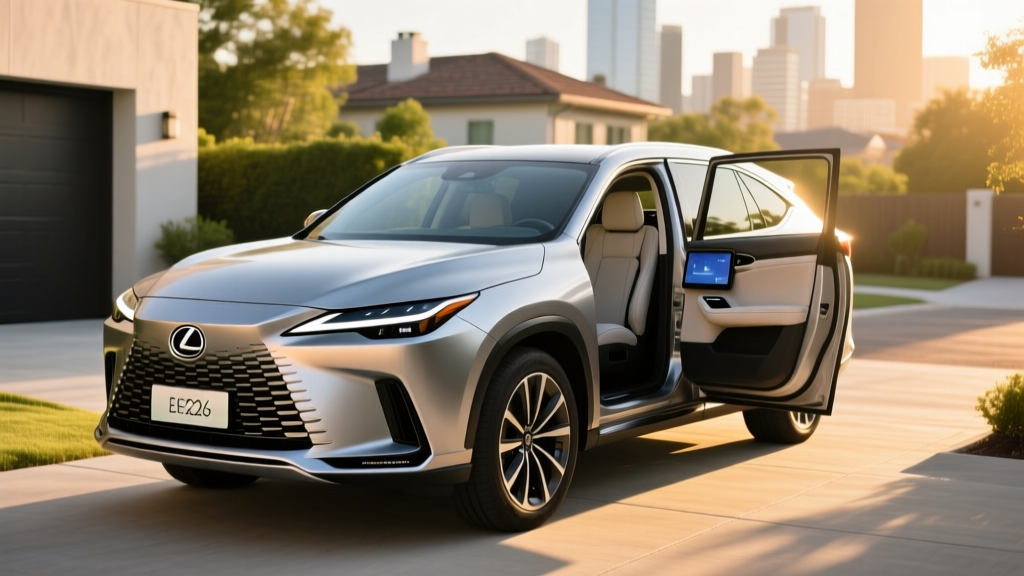
As of 2026, Lexus does not sell a fully electric (BEV) 3-row SUV. The closest offering is the Lexus TX — a 3-row luxury SUV available as the TX 350 (turbo gas), TX 500h (hybrid), and TX 550h+ (plug-in hybrid). If you need a battery-electric 3-row SUV with a Lexus badge today, you'll need to wait for an announced BEV variant or cross-shop competitors like the Kia EV9, Rivian R1S, or Mercedes EQB.
Below, we break down what the TX lineup actually delivers, how it compares to fully electric alternatives, and whether a PHEV or a rival BEV makes more financial sense for your family in 2026.
Lexus TX Lineup: Specs, Range, and Pricing at a Glance
The Lexus TX arrived as the brand's answer to the 3-row luxury SUV segment, filling a gap left by the discontinued RX L. For 2026, the TX comes in three powertrain flavors. Here's how they stack up with hard numbers:
| Spec | TX 350 (Gas) | TX 500h (Hybrid) | TX 550h+ (PHEV) |
|---|---|---|---|
| Powertrain | 2.4L Turbo I-4 | 2.4L Turbo Hybrid | 2.4L Turbo PHEV |
| Horsepower | 275 hp | 366 hp | 406 hp |
| 0–60 mph | ~7.6 sec | ~5.9 sec | ~5.6 sec |
| EPA Combined MPG / MPGe | 23 MPG | 27 MPG | 64 MPGe (electric) / 27 MPG (gas-only) |
| Electric-Only Range (PHEV) | N/A | N/A | ~33 miles (EPA est.) |
| Battery Capacity | N/A | ~1.4 kWh (NiMH) | ~18.1 kWh (Lithium-ion) |
| Drivetrain | FWD / AWD | AWD (DIRECT4) | AWD (DIRECT4) |
| Base MSRP (2026) | ~$56,000 | ~$62,000 | ~$72,000 |
| §30D Federal Tax Credit | Not eligible | Not eligible | Up to $7,500 (subject to sourcing/income rules) |
| Battery Warranty | N/A | 10 yr / 150,000 mi | 10 yr / 150,000 mi |
Sources: fueleconomy.gov, Lexus USA. Specs reflect 2025–2026 model year data. Verify trim pricing with your dealer as MSRPs shift annually.
TX 550h+ vs. Fully Electric 3-Row SUVs: The Real Comparison
Since Lexus doesn't yet offer a BEV 3-row SUV, the practical question is: should you buy the TX 550h+ PHEV or jump to a fully electric competitor? Let's put the TX 550h+ against the two most relevant BEV alternatives in the segment.
| Attribute | Lexus TX 550h+ (PHEV) | Kia EV9 (BEV) | Rivian R1S Dual-Motor (BEV) |
|---|---|---|---|
| EPA Range (Electric) | 33 mi (PHEV) + gas tank | 279 mi (Long Range AWD) | ~352 mi (Max Pack) |
| Battery Chemistry | NMC (18.1 kWh) | NMC (99.8 kWh usable) | NMC / LFP options |
| Peak DC Fast Charge | No DCFC (Level 2 only) | 236 kW (10–80% in ~24 min) | ~200 kW (10–80% in ~29 min) |
| Level 2 Charge Time (0–100%) | ~3 hours at 7.2 kW | ~9 hours at 11 kW | ~10 hours at 11.5 kW |
| Seats | 6 or 7 | 6 or 7 | 7 |
| Base MSRP | ~$72,000 | ~$60,000 | ~$80,000 |
| §30D Federal Tax Credit | Up to $7,500* | Up to $7,500* | Up to $7,500* |
| Real-World Highway Range | 33 mi EV + ~370 mi gas | ~230–250 mi | ~290–310 mi |
| Cold-Weather Range Loss | Minimal (gas backup) | ~20–30% reduction | ~20–30% (heat pump helps) |
*§30D credit eligibility depends on battery critical-mineral sourcing, buyer income caps ($150K single / $300K joint), and MSRP caps ($80K for SUVs). Rules are current for 2026 but subject to legislative change. See IRS §30D guidelines and consult a tax professional.
Real Costs: 5-Year Ownership Breakdown
Sticker price tells only part of the story. Here's a realistic 5-year / 75,000-mile cost comparison for a family driving 15,000 miles annually. We've modeled the TX 550h+ against the Kia EV9 Long Range AWD, assuming the PHEV owner charges nightly at home and drives ~30 electric miles daily.
| Cost Category | Lexus TX 550h+ (PHEV) | Kia EV9 LR AWD (BEV) | Lexus TX 350 (Gas) |
|---|---|---|---|
| Purchase Price (base MSRP) | $72,000 | $60,000 | $56,000 |
| Est. §30D Tax Credit | −$7,500* | −$7,500* | $0 |
| Effective Purchase | $64,500 | $52,500 | $56,000 |
| Home Charger Install (Level 2) | $0 (included w/ PHEV) | −$1,200 (240V/48A) | $0 |
| Fuel / Electricity (5 yr) | ~$4,800 | ~$3,600 | ~$9,400 |
| Maintenance (5 yr) | ~$2,800 | ~$1,500 | ~$3,200 |
| Insurance (5 yr avg.) | ~$11,500 | ~$12,000 | ~$10,800 |
| Est. Depreciation (5 yr) | ~$28,000 | ~$25,000 | ~$24,000 |
| 5-Year Total Cost | ~$111,600 | ~$93,400 | ~$103,400 |
Key takeaways:
- The EV9 wins on 5-year total cost by roughly $18,000, driven by a lower effective purchase price (after credit), cheaper fueling, and reduced maintenance (no oil changes, fewer brake replacements thanks to regen).
- The TX 550h+ costs more upfront than the gas TX 350, but the PHEV's tax credit and lower fuel spend narrow the gap over five years.
- Insurance for BEVs tends to run 5–10% higher due to repair-cost premiums on battery packs and specialized bodywork.
Real-world charging caveat: The TX 550h+ has no DC fast charging capability. Its 18.1 kWh battery tops up exclusively via Level 1 (120V, ~8 hours) or Level 2 (240V, ~3 hours). For daily commutes under 30 miles, this is fine — plug in overnight. But on road trips, you'll run on gas after the first 33 electric miles. This is by design for a PHEV, but it means you won't experience the 20-minute DCFC pit stops that BEV owners rely on.
Common Misconceptions About the Lexus TX and Electrified 3-Row SUVs
| Myth | Fact |
|---|---|
| "The Lexus TX is available as a full electric SUV." | False. The TX is gas, hybrid, or plug-in hybrid only. Lexus has not announced a TX BEV variant as of early 2026. |
| "PHEVs don't qualify for the federal tax credit." | Incorrect. The TX 550h+ qualifies for up to $7,500 under §30D if battery sourcing and buyer income requirements are met. The credit can be transferred at point of sale. |
| "A 33-mile electric range is useless." | For many families, it covers the daily school run, commute, and errands entirely on electricity. The average American drives ~37 miles/day (FHWA data), so most daily driving stays electric with nightly charging. |
| "BEVs are always cheaper to own." | Not always. In regions with high electricity rates ($0.25+/kWh) and no home charging, a PHEV like the TX 550h+ can be more economical than paying DCFC prices of $0.35–$0.50/kWh on a BEV. |
| "Lexus hybrids need expensive battery replacements." | Lexus covers hybrid and PHEV batteries for 10 years / 150,000 miles. Real-world data from Toyota/Lexus hybrids shows most packs retain 85%+ capacity at 150K miles. Replacement, if needed out of warranty, runs $3,000–$6,000 — not the $20,000+ some fear. |
Real-World Ownership Considerations
Home Charging Access
Both the TX 550h+ and any BEV competitor require a 240V Level 2 home circuit for practical daily use. If you have a garage or dedicated parking spot with access to a 240V outlet (NEMA 14-50) or can install one, electrified ownership works smoothly. Budget $800–$2,000 for a licensed electrician to install a 48A hardwired Level 2 charger — more if your panel needs a 200A upgrade ($2,000–$4,000 additional).
If you lack home charging — apartment dwellers, street parkers — the TX 550h+ PHEV is more forgiving. You can still drive it as a highly efficient hybrid (27 MPG combined) without ever plugging in. A BEV like the EV9 or R1S becomes significantly less convenient without reliable home charging, forcing dependence on public DCFC networks at higher per-kWh costs.
Climate and Cold-Weather Reality
BEVs lose 20–30% of their EPA range in sustained sub-freezing temperatures due to battery chemistry limitations and cabin heating demands. The EV9's 279-mile EPA range could drop to ~200 miles in a Minnesota January. The TX 550h+ sidesteps this entirely: its gas engine provides heat and unlimited range regardless of temperature. For buyers in cold-climate states, this is a genuine advantage of the PHEV configuration.
Driving Patterns
Your daily mileage determines which powertrain pays off:
- Under 30 miles/day: The TX 550h+ operates almost entirely on electricity. Your "fuel" cost drops to ~$0.04–$0.06/mile on home charging.
- 30–80 miles/day: You'll use a mix of electric and gas. The hybrid system still delivers 27 MPG combined when the battery depletes.
- Frequent road trips (300+ miles): The TX 550h+ shines — no charging stops needed, just gas fill-ups. A BEV will require 1–2 DCFC stops per trip, adding 30–60 minutes total.
Decision Framework: Which 3-Row SUV Should You Buy?
Choose the Lexus TX 550h+ (PHEV) if:
- You want Lexus luxury, reliability reputation, and dealer support
- Your daily driving is under 35 miles and you can charge at home
- You take regular road trips and don't want to plan around charging stations
- You live in a cold climate where BEV range loss is a real concern
- You value the gas-engine safety net for towing (TX 550h+ is rated at 5,000 lbs)
Choose a BEV alternative (Kia EV9, Rivian R1S) if:
- You want to fully eliminate gasoline and tailpipe emissions
- Your daily driving is predictable and within the vehicle's real-world range
- You have reliable home Level 2 charging
- Lower 5-year total cost of ownership is a priority
- You want access to HOV lanes (varies by state — BEVs often qualify where PHEVs may not)
Choose the Lexus TX 350 (Gas) if:
- Your budget is tighter and you want the lowest upfront price
- You cannot install home charging
- You drive high annual miles in rural areas with sparse charging infrastructure
- You plan to keep the vehicle 10+ years and want simplicity
What Should a First-Time EV or PHEV Buyer Know?
If you're considering the TX 550h+ or any electrified 3-row SUV as your first step away from a conventional gas car, keep these practical points in mind:
- kW vs. kWh matters. kW (kilowatts) measures power — how fast you charge. kWh (kilowatt-hours) measures energy — how big the battery is. The TX 550h+ has an 18.1 kWh battery and charges at up to 7.2 kW on Level 2. A BEV like the EV9 has a 99.8 kWh battery and charges at up to 236 kW DC. These numbers directly affect your daily experience.
- The charge curve is real. BEVs charge fastest between 10–50% SoC, then taper significantly above 80% to protect battery chemistry. Advertised "peak" kW rates are sustained for only a portion of the session. Plan road-trip stops to 80%, not 100%.
- Tax credits aren't guaranteed. The §30D credit has income caps ($150K single, $300K joint), MSRP caps ($80K for SUVs/vans), and battery-sourcing requirements that disqualify some models. Always verify current eligibility on IRS.gov before committing.
- Preconditioning matters for BEVs. If you cross-shop a BEV, learn to use preconditioning — warming the battery before a DCFC stop. This can cut your 10–80% charge time by 5–10 minutes in cold weather.
- Your electrical panel may need an upgrade. A 200A panel is generally required for a 48A Level 2 charger alongside other household loads. Homes with 100A or 150A panels may need an upgrade, adding $2,000–$4,000 to your installation cost.
Frequently Asked Questions
Will Lexus release a fully electric 3-row SUV?
Lexus has committed to a full BEV lineup by 2035 and has shown concepts like the LF-Z Electrified, but no production 3-row BEV has been officially announced as of early 2026. The TX PHEV serves as the brand's electrified bridge for families needing three rows today.
Does the Lexus TX 550h+ qualify for the $7,500 federal tax credit?
It can qualify for up to $7,500 under IRS §30D, but eligibility depends on your adjusted gross income, the vehicle's battery critical-mineral sourcing, and the MSRP staying under the $80,000 SUV cap. The credit can be applied as a point-of-sale discount through a registered dealer. Confirm current eligibility at IRS.gov and with your tax professional.
How much does it cost to charge the TX 550h+ at home?
Charging the 18.1 kWh battery from empty to full at the US average electricity rate of ~$0.16/kWh costs approximately $2.90. Over a month of daily charging, that's roughly $87 — significantly less than the ~$180+ you'd spend on gasoline for the same 900 miles in the gas-only TX 350.
Is the Lexus TX 550h+ better than the gas TX 350?
For most buyers, yes — if you can charge at home. The 550h+ delivers 406 hp (vs. 275 hp), 33 miles of electric daily driving, 5,000-lb towing, and potential tax credit savings. The trade-off is a ~$16,000 higher MSRP. The break-even point vs. the TX 350 typically arrives around year 4–5 through fuel savings and the tax credit.
What's the real-world electric range of the TX 550h+?
The EPA rates it at ~33 miles electric. In real-world mixed driving (suburban, moderate climate, no heavy HVAC use), expect 28–35 miles. In cold weather with cabin heat, that drops to ~22–26 miles. Highway speeds above 70 mph also reduce electric range due to aerodynamic drag — plan for ~22–25 electric miles at sustained interstate speeds.
Can I tow with the Lexus TX 550h+?
Yes. The TX 550h+ is rated to tow up to 5,000 lbs when properly equipped, matching the gas TX 350 AWD. Towing will deplete the electric range faster and reduce gas-mode MPG to roughly 18–20 MPG combined, but the capability is there for boat trailers, small campers, and utility trailers.