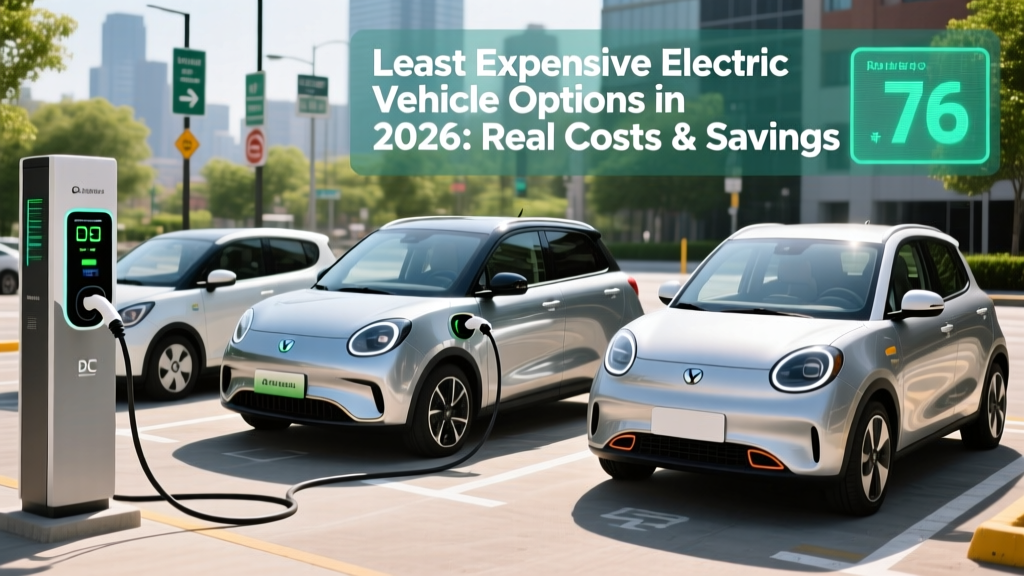
The Least Expensive Electric Vehicle in 2026: Quick Answer
The least expensive electric vehicle currently on sale in the US is the 2026 Nissan LEAF S, starting at an MSRP of approximately $28,140 before any incentives. After the federal §30D point-of-sale credit (up to $3,750 for vehicles with US-assembled batteries meeting sourcing rules), the effective price can drop to around $24,390. The LEAF S offers an EPA-estimated 149 miles of range from its 40 kWh battery. For buyers needing more range, the Chevrolet Equinox EV LT starts around $33,000 with an EPA 319-mile range, making it the least expensive long-range EV in 2026.
Choosing the least expensive electric vehicle isn't just about the sticker price. Total ownership costs — including charging, maintenance, insurance, and applicable tax credits — determine whether a budget EV actually saves you money over a comparable gas or hybrid car. This guide breaks down the cheapest new EVs available in 2026 with exact specs, real-world ownership data, and a practical decision framework.
Cheapest New EVs for 2026: Spec Comparison
| Model / Trim | Base MSRP | EPA Range | Battery (kWh) | Max DC Charge (kW) | 10–80% Time | 0–60 mph | HP |
|---|---|---|---|---|---|---|---|
| Nissan LEAF S | $28,140 | 149 mi | 40 kWh (NMC) | 50 kW | ~60 min | 7.9 sec | 147 |
| Nissan LEAF SV Plus | $36,190 | 212 mi | 60 kWh (NMC) | 100 kW | ~40 min | 6.5 sec | 214 |
| Hyundai Kona Electric SE | $32,975 | 261 mi | 65 kWh (NMC) | 100 kW | ~43 min | 7.3 sec | 201 |
| Chevy Equinox EV LT (FWD) | $33,000 | 319 mi | 85 kWh (NMC) | 150 kW | ~30 min | 8.0 sec | 213 |
| Volvo EX30 Single Motor | $34,950 | 275 mi | 69 kWh (NMC) | 153 kW | ~27 min | 6.1 sec | 272 |
Sources: fueleconomy.gov, manufacturer 2026 spec sheets. All MSRPs exclude destination charges. Federal §30D credit eligibility varies — see tax credit section below.
Real-World Range vs. EPA Sticker
EPA range estimates are calculated under controlled conditions. In real-world driving, expect:
- Highway driving (70+ mph): 10–15% range reduction vs. EPA combined
- Cold weather (below 32°F): 20–30% range loss due to battery resistance and cabin heating
- LEAF S 149-mi EPA → expect ~120–130 mi highway, ~100–115 mi in freezing temps
- Equinox EV 319-mi EPA → expect ~270–290 mi highway, ~220–250 mi in freezing temps
If your daily round-trip commute exceeds 80 miles in a cold climate, the LEAF S's 149-mile range leaves little buffer. The Equinox EV or Kona Electric provide far more margin.
5-Year Cost Breakdown: Budget EV vs. Gas Car
To understand whether the least expensive electric vehicle actually saves money, let's compare the 2026 Nissan LEAF SV Plus ($36,190 MSRP, eligible for up to $3,750 federal credit) against a popular gas alternative, the 2026 Honda Civic LX ($24,950 MSRP), over 5 years and 75,000 miles.
| Cost Category | Nissan LEAF SV Plus | Honda Civic LX (Gas) |
|---|---|---|
| Purchase Price (after credits) | $32,440 | $24,950 |
| Fuel / Electricity (75k mi) | $2,925 (home L2, $0.15/kWh avg) | $7,500 (30 MPG avg, $3.00/gal) |
| Maintenance (5 yr) | $1,200 (tire rotations, cabin filter, brake fluid) | $3,500 (oil changes, filters, brakes, spark plugs) |
| Insurance (5 yr avg) | $7,500 | $6,000 |
| Estimated Depreciation | -$14,000 | -$10,500 |
| 5-Year Total Cost of Ownership | $30,065 | $31,450 |
Assumptions: 15,000 mi/yr, home Level 2 charging at national avg electricity rate, gas at $3.00/gal national avg. Insurance averages based on national EV vs. ICE data. Depreciation estimates based on historical EV and compact sedan resale trends. Individual results vary by state, utility rate, and driving pattern.
The LEAF SV Plus edges ahead on total cost over 5 years, primarily due to fuel and maintenance savings. However, the upfront price premium of ~$7,500 means you need at least 3–4 years to break even. If you can't install a home Level 2 charger and rely on public DC fast charging (typically $0.35–$0.50/kWh), your fuel costs rise to roughly $5,500–$7,000, narrowing or eliminating the advantage.
Federal Tax Credit: What You Actually Qualify For
The IRS §30D federal EV tax credit offers up to $7,500 for new EVs, but eligibility for 2026 depends on multiple overlapping rules. As of 2026, the credit can be transferred to the dealer at point of sale, reducing your purchase price directly.
§30D Credit Requirements (2026)
- MSRP cap: ≤$55,000 for sedans/hatchbacks; ≤$80,000 for SUVs/trucks/vans
- Buyer income cap: Modified AGI ≤$150,000 (single), ≤$225,000 (head of household), ≤$300,000 (married filing jointly)
- Battery sourcing: Critical minerals and battery components must meet phased-in US/free-trade-agreement thresholds (percentages increase annually)
- Final assembly: Vehicle must be assembled in North America
- Foreign entity of concern (FEOC): Battery components and critical minerals cannot be sourced from designated foreign entities
Not all budget EVs qualify for the full $7,500. Many qualify for $3,750 (meeting one of the two sourcing thresholds) or $0 if sourcing rules aren't satisfied. Always verify eligibility on IRS.gov and confirm the specific VIN with your dealer before purchasing.
Common Misconceptions About Cheap EVs
| Myth | Fact |
|---|---|
| "Cheap EVs have terrible range." | The Equinox EV at $33,000 delivers 319 EPA miles — more than many $50,000+ EVs from just two years ago. |
| "EV batteries need replacing after a few years." | All models listed carry 8-year/100,000-mile battery warranties (federally mandated minimum). Most NMC batteries retain 85–90% capacity at 100k miles based on industry degradation data. |
| "I need a special charger at home." | A standard 120V outlet (Level 1) adds ~3–5 miles per hour of charging — sufficient for a LEAF S owner driving under 40 miles/day. A 240V Level 2 home charger ($500–$1,500 installed) adds 20–30 miles per hour. |
| "EVs cost way more to insure." | EV insurance averages 15–25% higher than equivalent gas cars, but the gap is narrowing. Shop quotes from multiple carriers — some now offer EV-specific discounts. |
| "The cheapest EV is always the best deal." | A $28,140 LEAF S with 149 miles of range and 50 kW DC charging may cost more in time and frustration on road trips than a $33,000 Equinox EV with 319 miles and 150 kW charging. |
Charging Reality for Budget EV Buyers
| Level | Power (kW) | Miles Added Per Hour | Typical Use Case | Cost to Install |
|---|---|---|---|---|
| Level 1 (120V) | 1.2–1.8 kW | 3–5 mi/hr | Overnight top-up for short commutes | $0 (standard outlet) |
| Level 2 (240V) | 7.2–11.5 kW | 20–35 mi/hr | Daily home charging, full overnight charge | $500–$2,500 (panel-dependent) |
| DC Fast Charge | 50–350 kW | 100–300+ mi in 20–30 min | Road trips, quick top-ups | Pay-per-use ($0.30–$0.50/kWh public) |
Critical note on the LEAF S: Its 50 kW max DC charge rate is the slowest among 2026 EVs. A 10–80% charge takes roughly 60 minutes, compared to 30 minutes for the Equinox EV at 150 kW. If you take road trips more than a few times per year, this matters significantly. The LEAF also uses the CHAdeMO connector for DC charging, while the industry (including Tesla Superchargers opening to non-Tesla EVs) has standardized on NACS and CCS. CHAdeMO infrastructure is shrinking, limiting your fast-charging options.
Decision Framework: Which Budget EV Is Right for You?
Choose based on your actual driving life, not the sticker price alone.
Choose the Nissan LEAF S ($28,140) if:
- Your daily round-trip commute is under 60 miles
- You live in a mild climate (minimal cold-weather range loss)
- You have reliable home Level 1 or Level 2 charging
- You rarely take road trips over 120 miles one-way
- You want the absolute lowest purchase price and accept the range/charging trade-offs
Choose the Hyundai Kona Electric ($32,975) if:
- You need 250+ miles of EPA range for flexibility
- You want CCS connector compatibility for broader public charging access
- You value a more modern interior and infotainment system
- You take occasional road trips and want 100 kW DC charging
Choose the Chevrolet Equinox EV ($33,000) if:
- Range is your top priority (319 EPA miles — the most per dollar in 2026)
- You drive in cold climates and need a large battery buffer
- You want 150 kW DC fast charging for practical road trips
- You need SUV cargo space and higher seating position
- You prefer NACS compatibility for Tesla Supercharger network access
Consider a PHEV instead if:
- You have no home charging access (apartment/street parking)
- You regularly drive 300+ miles without overnight stops
- You live in an area with sparse public charging infrastructure
- Look at the Toyota Prius Prime (~$33,000, 44 mi electric-only, 52 MPG combined gas) or Hyundai Tucson PHEV
First-Time EV Buyer Checklist
If this is your first electric vehicle, these practical steps will prevent costly surprises:
- Audit your daily mileage: Track your actual driving for two weeks. If 95% of your days fall under 80 miles round-trip, even the LEAF S works with home charging.
- Confirm home charging feasibility: Check if you have a dedicated 240V outlet (like a dryer outlet) near your parking spot. If not, get a quote from a licensed electrician for a Level 2 install — costs range from $500 (simple outlet near panel) to $2,500+ (panel upgrade or long conduit runs).
- Map your road-trip routes: Use apps like PlugShare or A Better Routeplanner to see if DC fast chargers exist along your most common long-distance routes. CHAdeMO-only vehicles (LEAF S) will have fewer options than CCS or NACS vehicles.
- Get insurance quotes before buying: EV insurance varies dramatically by carrier and model. Some budget EVs cost 20%+ more to insure than their gas equivalents; others are nearly identical.
- Verify §30D credit eligibility: Check the IRS official credit page for the specific model and VIN. Don't rely on dealer verbal assurances.
- Understand your utility rate: Time-of-use (TOU) plans can cut your charging cost to $0.08–$0.10/kWh overnight vs. $0.20+ during peak hours. Contact your utility about EV-specific rate plans.
Frequently Asked Questions
Is the Nissan LEAF being discontinued?
As of early 2026, Nissan continues to sell the LEAF in the US, though the next-generation LEAF (expected 2027–2028) is being redesigned for global markets with NACS/CCS charging. The current LEAF remains the least expensive new EV available, but its CHAdeMO connector and modest DC charge rate make it increasingly dated. If you buy one, understand that CHAdeMO public chargers are declining in number.
Can I really live with 149 miles of range?
Yes — if your daily driving is under 60 miles and you charge at home every night. The average American drives ~37 miles per day according to FHWA data. But if you live in a cold climate, regularly carry heavy loads, or take highway trips, your usable range drops to ~100–115 miles, which may feel restrictive. Range is deeply personal — match it to your worst-case driving day, not your average.
Are used EVs a better deal than the cheapest new EV?
Often, yes. A 2–3-year-old Chevrolet Bolt EV (259 EPA miles) can be found for $15,000–$20,000 and may qualify for the used EV tax credit (up to $4,000 or 30% of sale price, with income caps). However, used EVs carry unknown battery health risk — always request a State of Health (SoH) reading before purchasing. New EVs offer full battery warranties and the latest charging tech.
What happens if the battery fails out of warranty?
Out-of-warranty EV battery replacement costs range from $6,000 to $15,000+ depending on the model and battery size. For the LEAF's 40 kWh pack, expect ~$6,500–$8,000. For the Equinox EV's 85 kWh pack, $12,000–$15,000. That said, catastrophic battery failure is rare — most degradation is gradual, and batteries typically retain 80–90% capacity at 150,000+ miles based on fleet data from sources like Geotab.
Do budget EVs qualify for state incentives too?
Many states offer additional rebates or tax credits on top of the federal §30D credit. For example, some states provide $1,000–$5,000 in additional rebates, often with their own income and vehicle-price caps. These vary by jurisdiction and change frequently — check your state energy office or the Alternative Fuels Data Center for current state-level incentives.
What's the cheapest EV that can road-trip comfortably?
The Chevrolet Equinox EV LT at $33,000 is the least expensive EV that handles road trips without major compromise. Its 319-mile EPA range means realistic 270+ highway miles between charges, and its 150 kW DC charging adds ~150 miles in 20 minutes. Combined with NACS compatibility for Tesla Supercharger access, it's the budget EV least likely to frustrate you on longer drives.
Prices, tax credit rules, and model availability current as of 2026 model year. Always verify final pricing with your dealer and tax credit eligibility with a qualified tax professional or IRS.gov before purchasing.