Why the VW ID.4 Keeps Showing Up on Lease Deal Lists
If you've been scanning EV lease offers, the Volkswagen ID.4 likely keeps surfacing — and for good reason. VW's compact electric SUV undercuts most rivals on monthly payments, qualifies for a $7,500 federal incentive when leased (regardless of the battery-sourcing rules that complicate purchases), and delivers a practical 291 miles of EPA-estimated range in its most popular configuration. For 2026, VW has streamlined the ID.4 lineup, improved infotainment responsiveness, and maintained aggressive lease subsidies that make this one of the most accessible electric SUVs on the market.
But a low monthly payment doesn't tell the whole story. This review breaks down the real-world range you can expect, the charging curve behavior at DC fast chargers, the total cost math of leasing versus buying, and whether the ID.4's tech and driving experience justify a three-year commitment.
Specs at a Glance: 2026 VW ID.4
| Specification | Standard Range (RWD) | Pro S / Pro S Plus (RWD) | AWD Pro S |
|---|---|---|---|
| EPA Range | 206 mi | 291 mi | 263 mi |
| Battery (usable) | 62 kWh (NMC) | 82 kWh (NMC) | 82 kWh (NMC) |
| Horsepower | 201 hp | 282 hp | 335 hp |
| 0–60 mph | 7.7 sec | 6.7 sec | 5.4 sec |
| Peak DC Charge Rate | 140 kW | 175 kW | 175 kW |
| 10–80% DC Fast Charge | ~30 min | ~28 min | ~28 min |
| Level 2 Home Charge (11 kW) | ~7 hr full | ~8.5 hr full | ~8.5 hr full |
| MPGe (combined) | 104 MPGe | 107 MPGe | 98 MPGe |
| Starting MSRP | $38,995 | $43,995 | $47,795 |
| Cargo (rear seats up) | 30.3 cu ft | ||
| Cargo (rear seats folded) | 64.2 cu ft | ||
| Drivetrain | RWD | RWD | Dual-motor AWD |
Source: fueleconomy.gov, Volkswagen of America
Real-World Range: What the EPA Number Doesn't Tell You
EPA Estimate: 291 miles
Real-world highway (70–75 mph, mild weather): ~240–260 miles
Real-world mixed driving (city + highway): ~260–280 miles
Cold weather (below 32°F, cabin heat on): ~195–230 miles
Worst case (75 mph + 20°F + headwind): ~180–200 miles
The ID.4 Pro S with the 82 kWh battery delivers 291 miles on the EPA cycle, which is a combined city/highway figure weighted toward city driving where regenerative braking recovers energy. In practice, highway-heavy trips at sustained 70+ mph speeds will see that number drop to roughly 240–260 miles. The ID.4 is a relatively boxy SUV with a higher drag coefficient than a sedan, and aerodynamic losses compound at speed.
Cold weather is the bigger concern for northern-climate lessees. Lithium-ion batteries lose efficiency in freezing temperatures, and cabin heating draws significant power. Expect a 20–30% range reduction in sustained sub-freezing conditions. VW equips the ID.4 Pro S trims with a heat pump, which helps — but it doesn't eliminate cold-weather losses. If your daily commute is 80+ miles round-trip and you live in Minnesota or New England winters, the Standard Range 206-mile model will feel tight.
For most suburban commuters driving 30–50 miles daily with home charging, the 291-mile EPA figure provides a comfortable buffer. You'll charge to 80% overnight and rarely think about range on weekdays.
Charging Speed: DC Fast, Level 2, and the Curve That Matters
Charging speed is where the ID.4's value proposition gets nuanced. It's not the fastest-charging SUV in its class, but it's competent enough for most use cases.
| Charging Method | Power | Rate | Time |
|---|---|---|---|
| Level 1 (120V household) | 1.4 kW | ~4 mi/hr | Not practical for full charge |
| Level 2 (240V home, 48A) | 11 kW | ~33 mi/hr | 8.5 hr (0–100%, 82 kWh) |
| DC Fast Charge (peak) | 175 kW | Up to ~190 mi/hr at peak | 10–80% in ~28 min |
| DC Fast Charge (sustained avg) | ~110 kW avg | ~120 mi/hr avg | 10–80% realistic |
The 175 kW peak charge rate applies to the 82 kWh battery models. Here's the important context: that peak only holds roughly between 10–30% state of charge. The charge curve then tapers progressively — dropping to around 120 kW by 50%, roughly 80 kW by 70%, and below 50 kW past 80%. This is normal lithium-ion behavior managed by the battery management system to protect cell longevity, but it means your average charging speed across a 10–80% session is closer to 110 kW, not 175 kW.
For road trips, plan for 28–32 minute stops at Electrify America or other 150+ kW chargers. The ID.4's navigation system can precondition the battery when you navigate to a DC fast charger — warming the cells to optimal temperature for faster charging. Always use this feature in cold weather; skipping preconditioning can add 10+ minutes to your stop.
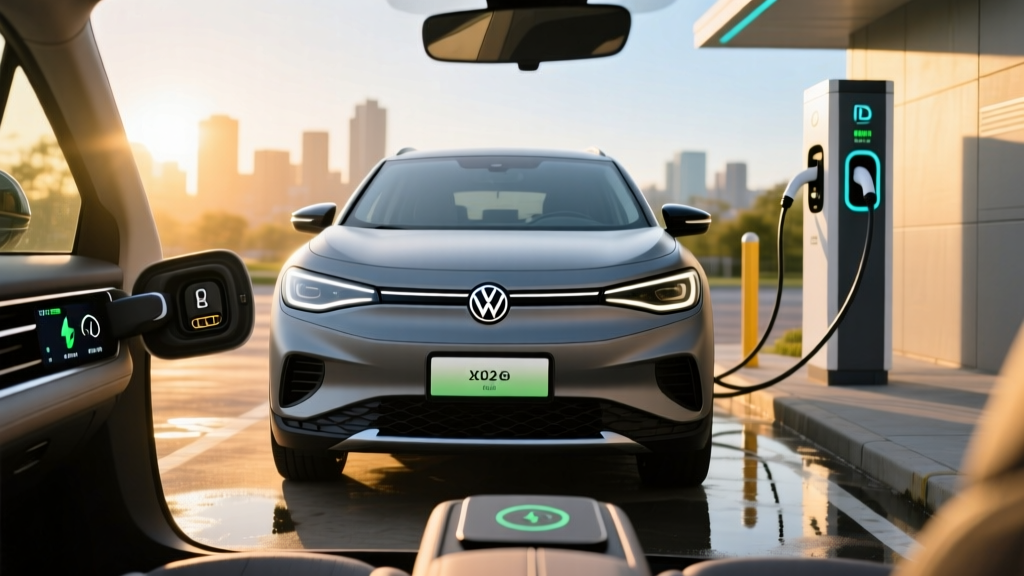
At home on a Level 2 charger (240V, 48-amp circuit), the 11 kW onboard charger replenishes the 82 kWh battery in about 8.5 hours. Most owners plug in when they get home and wake up to a full battery. A Level 2 home charger installation typically runs $500–$1,500 depending on your electrical panel's capacity and the distance from panel to charger location.
Performance and Driving Experience
The ID.4 is tuned for comfort, not sportiness. The rear-wheel-drive Pro S delivers 282 horsepower and a 6.7-second 0–60 mph time — brisk enough for confident highway merging but not thrilling. The dual-motor AWD variant bumps output to 335 hp and drops the 0–60 to 5.4 seconds, which genuinely feels quick in daily driving.
Ride quality is where the ID.4 earns its keep. VW's MEB platform places the battery pack low, giving the SUV a planted, composed feel over bumps. The steering is light and precise, the turning radius is impressively tight (31.5 feet — tighter than a Honda CR-V), and the cabin is well-insulated from wind and road noise. This is a family cruiser, not a canyon carver, and that's exactly what most lessees want.
Regenerative braking deserves a note: the ID.4 offers adjustable regen via steering-wheel paddles (D, B modes), but it does not offer true one-pedal driving that brings the car to a complete stop. You'll still use the brake pedal at stoplights. Some EV veterans find this annoying; new-to-EV drivers often prefer it because it feels more natural.
Pricing, Lease Deals, and the $7,500 Tax Credit Question
This is where leasing the ID.4 gets interesting — and where the math diverges sharply from buying.
| Cost Factor | Details |
|---|---|
| Base MSRP (Standard Range) | $38,995 |
| Base MSRP (Pro S RWD) | $43,995 |
| Base MSRP (AWD Pro S) | $47,795 |
| Federal Credit — Purchase (§30D) | Up to $7,500 — subject to income caps ($150K single / $300K joint), MSRP cap ($80K SUV), and critical-mineral/battery-component sourcing rules |
| Federal Credit — Lease (§25W commercial) | $7,500 passed through as lease cash — no income cap, no sourcing restrictions for the lessee |
| Typical Lease (Pro S, 36 mo, 10K mi/yr) | ~$249–$349/mo depending on region and incentives |
| Destination charge | $1,595 |
Source: IRS.gov — Clean Vehicle Credits
The lease loophole explained: When you purchase an ID.4, the §30D federal tax credit requires that the vehicle's battery components and critical minerals meet specific North American sourcing thresholds — and those thresholds tighten each year. By 2026, many EVs that previously qualified for the full $7,500 purchase credit have seen their eligibility reduced or eliminated due to these escalating sourcing rules.
However, when you lease an ID.4, the vehicle is technically purchased by the leasing company (VW Credit, Inc.). The $7,500 credit flows to the lessor under the §25W commercial clean vehicle credit, and VW has consistently passed this savings directly to lessees as "lease cash" — reducing the capitalized cost and lowering your monthly payment. Crucially, this lease pathway has no buyer income cap and no battery-sourcing restriction that applies to you as the lessee. High-income earners who are phased out of the purchase credit can still capture the full $7,500 benefit through a lease.
A typical 2026 ID.4 Pro S lease might look like this: $43,995 MSRP, minus $7,500 lease cash, minus any dealer discount or VW loyalty bonus, resulting in a capitalized cost around $34,000–$36,000. Over 36 months at 10,000 miles per year with a reasonable money factor, monthly payments in the $250–$350 range are achievable in many markets. Compare that to buying the same vehicle with no purchase credit eligibility, and leasing becomes the obvious financial choice for many shoppers.
Interior, Tech, and Cargo: Practical Family SUV Territory
The ID.4's cabin is spacious and functional. Rear legroom measures 37.6 inches — generous for the compact SUV segment — and the flat floor (no transmission tunnel) makes the middle seat usable for a child seat or a third passenger on shorter trips. Cargo volume is 30.3 cubic feet behind the rear seats and 64.2 cubic feet with the 60/40 split seats folded. That's competitive with the Toyota RAV4 and slightly behind the Hyundai Ioniq 5's 27.2/59.3 cu ft (though the ID.4 edges it on total volume).
Infotainment has historically been the ID.4's weakest link. The 2026 model continues with VW's ID. Software 4.0, which brought meaningful improvements over the laggy, frustrating ID. Software 2.x that plagued 2021–2023 models. The 12.9-inch touchscreen is now responsive, menus are logical, and wireless Apple CarPlay and Android Auto work reliably. The capacitive touch sliders for volume and temperature remain a complaint — they're unlit at night and too easy to bump accidentally — but they're a minor irritation rather than a dealbreaker.
Driver assistance comes via VW's IQ.DRIVE suite, which includes adaptive cruise control with stop-and-go, lane centering, automatic emergency braking, and blind-spot monitoring. This is a solid SAE Level 2 system — it assists with steering and speed but requires your hands on the wheel and eyes on the road at all times. It's not autonomous driving. The lane centering is competent on highways but not class-leading compared to GM's Super Cruise or Ford's BlueCruise, which offer hands-free operation on mapped roads.
Warranty and Long-Term Battery Outlook
VW covers the ID.4 with the following warranty structure:
- Bumper-to-bumper: 4 years / 50,000 miles
- Battery & powertrain: 8 years / 100,000 miles
- Battery capacity guarantee: Minimum 70% state of health retained over 8 years / 100,000 miles
- Roadside assistance: 4 years / 50,000 miles
The 8-year/100,000-mile battery warranty with a 70% capacity retention floor is standard for the industry. The ID.4 uses NMC (nickel manganese cobalt) lithium-ion cells, which offer high energy density but are more sensitive to sustained high-state-of-charge storage and extreme heat than LFP (lithium iron phosphate) chemistry used in some competitors like the base Tesla Model Y.
For a 36-month lease, battery degradation is a non-issue. You'll return the vehicle long before any meaningful capacity loss occurs, and you're fully covered under warranty for the entire lease term. This is actually one of the strongest arguments for leasing an EV: you never own the battery risk.
ID.4 vs. the Competition: Where It Fits
- Aggressive lease pricing with $7,500 federal lease cash
- Comfortable ride quality and tight turning radius
- Spacious rear seat and cargo area
- Heat pump standard on Pro S trims
- 3 years of complimentary Electrify America charging (30-min sessions, up to 500 kWh)
- No battery degradation risk on a 36-month lease
- DC charging speed (175 kW) trails Hyundai Ioniq 5 (240 kW) and Kia EV6 (239 kW)
- Capacitive touch sliders are frustrating, especially at night
- No one-pedal driving / no complete stop from regen alone
- Infotainment improved but still behind Hyundai/Kia and Tesla UX
- Real-world highway range falls notably short of EPA estimate
- AWD variant's range penalty is significant (263 vs. 291 mi)
The ID.4's closest competitors are the Hyundai Ioniq 5, Kia EV6, Ford Mustang Mach-E, and Tesla Model Y. The Ioniq 5 and EV6 charge significantly faster on DC (10–80% in ~18 minutes on a 350 kW charger) and offer more engaging infotainment. The Model Y has the Supercharger network advantage and better efficiency. The Mach-E offers sportier driving dynamics.
Where the ID.4 wins is the lease deal. VW's combination of aggressive pricing, the $7,500 lease cash pass-through, and complimentary Electrify America charging often results in monthly payments $50–$100 lower than equivalently equipped rivals. If your priority is the lowest cost per month for a practical electric SUV, the ID.4 is hard to beat.
Who Should Lease the ID.4?
- Suburban commuters driving 30–60 miles daily with home Level 2 charging access
- Families who prioritize rear-seat space and cargo room over sporty handling
- Cost-conscious EV shoppers who want the lowest monthly payment and plan to return the vehicle at lease end
- High-income earners ($150K+ single / $300K+ joint) who are phased out of the purchase tax credit but can capture the full $7,500 through leasing
- EV-curious buyers who want to try electric without committing to long-term battery ownership
Look elsewhere if: You regularly drive 300+ mile highway trips (the Ioniq 5 charges faster), you want hands-free highway driving (consider GM's Super Cruise vehicles), or you live in a region with sparse Electrify America coverage and no home charging.
Frequently Asked Questions
Does the VW ID.4 qualify for the $7,500 federal EV tax credit?
When purchased, ID.4 eligibility for the §30D credit depends on your income (capped at $150K single / $300K joint AGI), the vehicle's MSRP (under the $80K SUV cap — the ID.4 qualifies), and whether the battery meets critical-mineral and component sourcing thresholds that tighten annually. When leased, the $7,500 credit passes to the lessor under §25W and is applied as lease cash — no income cap or sourcing restriction applies to you. Check current rules at IRS.gov before signing.
What is the real-world range of the ID.4?
The Pro S RWD with the 82 kWh battery carries a 291-mile EPA estimate. Expect roughly 240–260 miles on sustained highway driving at 70+ mph, and 195–230 miles in freezing temperatures. The Standard Range model (62 kWh) rates at 206 miles EPA and delivers roughly 165–180 miles highway.
How fast does the ID.4 charge at home and on the road?
On a Level 2 home charger (240V, 48A), the ID.4 charges at up to 11 kW, adding roughly 33 miles of range per hour — a full overnight charge. On DC fast chargers, the 82 kWh models peak at 175 kW and achieve a 10–80% charge in approximately 28 minutes, with the charging curve tapering significantly above 80%.
Is it better to buy or lease the VW ID.4?
For most buyers in 2026, leasing is the stronger financial move. The $7,500 lease cash is available regardless of income or battery-sourcing rules, monthly payments are heavily subsidized by VW, and you avoid battery depreciation risk. Buying makes sense only if you drive very high annual mileage (lease penalties apply above 10K–12K mi/yr), you plan to keep the vehicle 8+ years, and you qualify for the full purchase credit.
Does the ID.4 have one-pedal driving?
No. The ID.4's regenerative braking system slows the car significantly in "B" mode but does not bring it to a complete stop. You will still use the brake pedal at intersections. This is a deliberate VW design choice, though it frustrates drivers accustomed to one-pedal driving in Teslas, Hyundais, or Nissans.
What happens at the end of an ID.4 lease?
You return the vehicle to a VW dealer, pay any excess wear-and-tear or mileage overage charges, and walk away. VW does not currently require you to purchase the vehicle at lease end (some manufacturers do). If you've stayed within your mileage allowance and kept the vehicle in reasonable condition, end-of-lease costs are minimal. You can then lease or purchase a new vehicle.