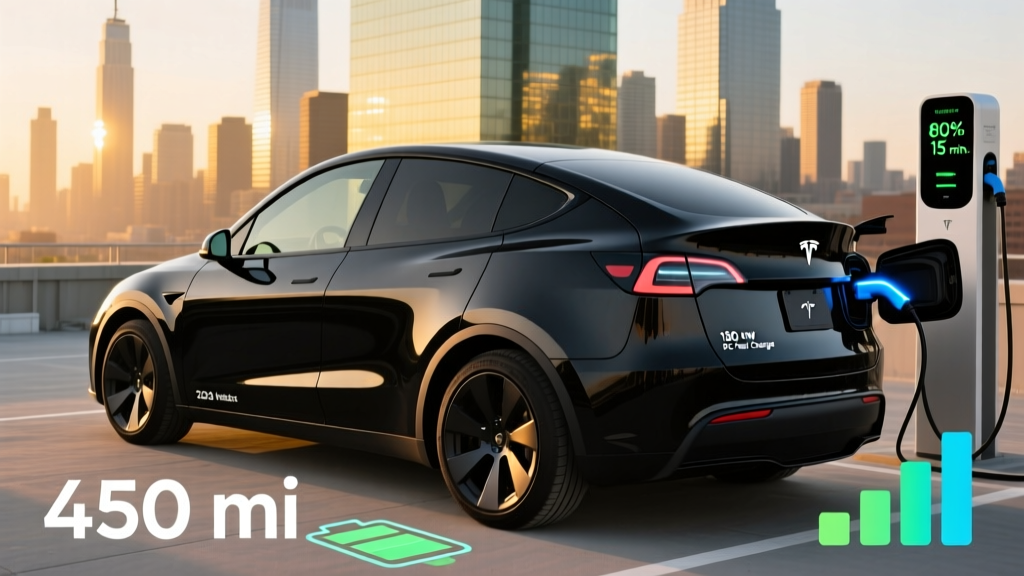
If you've been watching Tesla's pricing rollercoaster, the idea of leasing a Tesla Model Y probably feels like the safer bet. And you're not wrong. Leasing insulates you from Tesla's unpredictable depreciation, locks in a monthly payment, and — thanks to a little-known quirk in the federal tax credit rules — can unlock savings that outright buyers might not qualify for. But before you sign, you need the real numbers: what the Model Y actually delivers in range, how fast it charges when you're on a road trip, and whether the 2026 lease math beats buying.
We've driven, charged, and tracked ownership costs on the Model Y across multiple model years. Here's everything you need to make the lease decision with eyes wide open.
2026 Tesla Model Y at a Glance: The Specs That Matter
| Specification | Long Range AWD | Performance AWD | Rear-Wheel Drive |
|---|---|---|---|
| EPA Range | 320 miles | 295 miles | 295 miles |
| Battery Capacity (usable) | ~75 kWh (NMC) | ~75 kWh (NMC) | ~60 kWh (LFP) |
| Peak DC Fast Charge | 250 kW | 250 kW | 170 kW |
| 10–80% DC Charge Time | ~25 min | ~25 min | ~30 min |
| Level 2 Home Charging | 11.5 kW (~44 mi/hr) | 11.5 kW (~44 mi/hr) | 11.5 kW (~44 mi/hr) |
| 0–60 mph | 4.8 sec | 3.5 sec | 6.6 sec |
| Horsepower | 384 hp | 510 hp | 295 hp |
| Drivetrain | Dual-Motor AWD | Dual-Motor AWD | RWD (single motor) |
| EPA Efficiency | 120 MPGe (28 kWh/100mi) | 111 MPGe (30 kWh/100mi) | 127 MPGe (26 kWh/100mi) |
| Base MSRP (2026) | $48,990 | $53,990 | $44,990 |
| Battery/Powertrain Warranty | 8 yr / 120,000 mi | 8 yr / 120,000 mi | 8 yr / 100,000 mi |
Sources: fueleconomy.gov, Tesla official specifications. Pricing and specs reflect 2026 model year. Always confirm current figures at Tesla.com.
Real-World Range: What the EPA Sticker Doesn't Tell You
EPA Estimated: 320 miles
Real-World Highway (70–75 mph, moderate temps): ~265–285 miles
Real-World City / Mixed Commuting: ~290–310 miles
Cold Weather (below 32°F, highway): ~210–245 miles (25–35% reduction)
Heat Pump Equipped: Yes — reduces cold-weather cabin energy draw
The Model Y Long Range's 320-mile EPA figure is competitive among midsize electric SUVs, but EPA testing cycles don't replicate sustained highway speeds or freezing temperatures. In our experience and consistent with third-party testing, expect about 85% of the EPA number on a warm-weather highway drive and closer to 65–75% in deep winter conditions.
The RWD model uses a lithium iron phosphate (LFP) battery, which trades some energy density for exceptional cycle life and the ability to charge to 100% regularly without degradation concerns. Tesla actually recommends periodic 100% charges for LFP packs to keep the battery management system calibrated. The Long Range and Performance trims use nickel-manganese-cobalt (NMC) chemistry, which delivers more range per kilogram but should ideally be charged to 80–90% for daily use to maximize longevity.
Charging Speed: DC Fast, Level 2, and the Curve You Should Know
| Charging Level | Power / Rate | Miles Added Per Hour | Best For |
|---|---|---|---|
| Level 1 (120V standard outlet) | ~1.4 kW | ~5 miles/hr | Overnight top-off, emergencies |
| Level 2 (240V, 48A home charger) | 11.5 kW | ~44 miles/hr | Daily home charging (full overnight) |
| DC Fast Charge (Long Range/Perf) | Peak 250 kW | ~1,000 mi/hr at peak | Road trips, Superchargers |
| DC Fast Charge (RWD) | Peak 170 kW | ~680 mi/hr at peak | Road trips (slower taper) |
Here's where the nuance matters: peak kW is not sustained kW. The Long Range and Performance Model Y can hit 250 kW at a V3 or V4 Tesla Supercharger, but that rate only holds roughly between 10–30% state of charge (SoC). By 50% SoC, you'll see the rate taper to around 120–150 kW, and above 80% it drops sharply to under 50 kW. That's why the 10–80% time (~25 minutes) is the meaningful metric — not the peak number.
For home charging, a Level 2 Tesla Wall Connector on a 60-amp circuit (48 amps continuous) delivers 11.5 kW, adding roughly 44 miles of range per hour. A full charge from 10% takes about 7–8 hours, which fits neatly into an overnight window. If your home has a 200-amp electrical panel with sufficient spare capacity, installation typically runs $800–$2,000 depending on run length and local permitting. Homes needing a panel upgrade to 200A should budget an additional $1,500–$3,000.
One advantage of the Tesla ecosystem: access to the Supercharger network, which remains the most reliable public DC fast-charging network in the U.S. by uptime metrics. The 2026 Model Y ships with the native NACS (North American Charging Standard) port, meaning no adapter is needed at Tesla Superchargers. For Electrify America, EVgo, and other CCS networks, you'll need a NACS-to-CCS adapter (sold separately, ~$200–$250).
Leasing vs. Buying the Model Y: The Tax Credit Loophole Explained
This is where leasing a Tesla Model Y gets genuinely interesting — and where most comparison articles miss the details.
Under IRS §30D rules, the federal EV tax credit for purchased vehicles has strict requirements: buyer income caps ($150,000 single / $300,000 joint modified AGI), vehicle MSRP caps ($80,000 for SUVs), and battery component and critical mineral sourcing requirements that have tightened significantly since 2024. As of 2026, the Model Y Long Range AWD qualifies for the full $7,500 credit at point of sale for eligible buyers, but the RWD variant's battery sourcing may limit eligibility — always verify current status on IRS.gov before committing.
| Scenario | Upfront Cost | Monthly (est.) | Tax Credit Path |
|---|---|---|---|
| Buy outright (eligible buyer) | $48,990 − $7,500 = $41,490 | $680/mo (60-mo loan, 5.5% APR) | §30D point-of-sale transfer |
| Buy (income exceeds cap) | $48,990 | $810/mo (60-mo loan, 5.5% APR) | Not eligible |
| Lease (any income level) | ~$4,500 due at signing | $499–$599/mo (36-mo, 10k mi/yr) | Lease credit passed through by lessor |
The lease loophole: When a vehicle is leased, the $7,500 federal credit goes to the leasing company (technically the vehicle's owner), not the lessee. However, most leasing companies — Tesla Financial included — pass some or all of this credit through as a capitalized cost reduction, which lowers your monthly payment. Crucially, this pathway does not require the lessee to meet the §30D income caps. If your household income exceeds $300,000 AGI and you're locked out of the purchase credit, leasing preserves access to that $7,500 discount.
The trade-off: you don't build equity, you're limited to the contracted mileage (typically 10,000–15,000 miles/year, with $0.20–$0.25/mile overage penalties), and you'll face disposition fees at lease-end if you don't purchase or lease another Tesla. For a 36-month lease with 10,000 miles/year, expect roughly $499–$599/month depending on current money factor and residual value. Tesla's lease terms and rates fluctuate frequently — check Tesla.com/inventory for live numbers.
Interior, Cargo, and Tech: What Daily Ownership Actually Feels Like
The refreshed Model Y (often referred to as the "Juniper" update that rolled out through 2025–2026) addressed many of the previous generation's complaints. Interior materials have improved noticeably — softer-touch surfaces, ventilated front seats, ambient lighting, and a rear-seat touchscreen for climate and entertainment controls.
Dimensions that matter:
- Cargo volume (rear seats up): 30.2 cu ft
- Cargo volume (rear seats folded): 72.1 cu ft
- Front trunk (frunk): 4.1 cu ft
- Rear legroom: 41.6 inches
- Front headroom: 41.0 inches
That cargo space is competitive with the Hyundai Ioniq 5 (27.2/59.3 cu ft) and slightly behind the Ford Mustang Mach-E (29.7/59.7 cu ft) in rear-seat-up mode, though the Model Y's frunk is smaller than the Mach-E's 4.7 cu ft front trunk. For families hauling strollers, groceries, and luggage for four, the Model Y's tall hatchback profile makes it genuinely practical.
Tech highlights:
- 15.4-inch center touchscreen with Tesla's latest UI (fast, responsive, integrated navigation with Supercharger routing)
- 8.0-inch rear passenger touchscreen
- Tesla Autopilot (SAE Level 2 driver assistance) — includes Traffic-Aware Cruise Control and Autosteer
- Full Self-Driving (Supervised) available as a $8,000 add-on or $99/month subscription — still Level 2, requires active driver supervision at all times
- Over-the-air updates that regularly add features and refinements
- Ventilated front seats, heated rear seats, and heated steering wheel (now standard)
Performance and Efficiency: Quick When You Need It, Thrifty When You Don't
The Long Range AWD's 4.8-second 0–60 mph time is brisk enough to merge confidently onto any freeway and overtake without drama. The Performance trim's 3.5-second sprint is sports-car territory and genuinely startling the first time you floor it from a stoplight. But the real story for most lessees is efficiency.
At 120 MPGe combined (28 kWh per 100 miles), the Long Range AWD is one of the most efficient all-wheel-drive electric SUVs on the market. At the U.S. average electricity rate of ~$0.17/kWh, that works out to roughly $4.76 per 100 miles — compared to approximately $12–$14 per 100 miles for a comparable gas-powered SUV getting 25 MPG at $3.50/gallon. Over a 12,000-mile driving year, the fuel savings alone are approximately $900–$1,100.
The RWD model is even more efficient at 127 MPGe (26 kWh/100mi), making it the value pick for commuters in mild climates who don't need all-wheel drive.
Pros, Cons, and the Lease Verdict
- Access to Supercharger network — still the gold standard for road-trip charging reliability
- Excellent efficiency — among the best kWh/100mi in the segment
- Strong cargo capacity with practical hatchback layout
- Lease pathway unlocks $7,500 credit even above income caps
- OTA updates continuously improve the vehicle
- Competitive 250 kW peak charging speed (Long Range/Performance)
- No Apple CarPlay or Android Auto — Tesla's native infotainment only
- Ride quality firm on rough pavement (improved with Juniper refresh but still sporty)
- FSD subscription ($99/mo) adds cost for a Level 2 system
- Tesla service center availability varies by region — mobile service helps but isn't universal
- Lease mileage penalties ($0.20–$0.25/mile) sting if you exceed limits
- Price and terms fluctuate frequently — timing matters
Who Should Lease the Model Y — and Who Should Look Elsewhere?
- Your household AGI exceeds §30D income caps and you still want the $7,500 credit benefit
- You drive 10,000–12,000 miles/year (fits standard lease mileage)
- You want a 3-year commitment with the option to walk away from depreciation risk
- You have home Level 2 charging access and value Supercharger road-trip convenience
- You prefer not to worry about long-term battery degradation or resale value
- You drive 15,000+ miles/year (lease overage penalties will add up fast)
- You need Apple CarPlay/Android Auto (check the Hyundai Ioniq 5 or Kia EV6)
- You want a softer ride and more traditional interior (Ford Mustang Mach-E or Volkswagen ID.4)
- You plan to keep the vehicle 7+ years (buying and holding is cheaper long-term)
Frequently Asked Questions
What is the real-world range of the Tesla Model Y?
The EPA rates the Long Range AWD at 320 miles. In real-world highway driving at 70–75 mph in moderate temperatures, expect 265–285 miles. In sub-freezing winter conditions, that drops to 210–245 miles. City driving with regenerative braking recovers energy and gets closer to the EPA figure, typically 290–310 miles.
How fast does the Model Y charge at home and on the road?
At home on a Level 2 charger (240V, 48A), the Model Y charges at 11.5 kW, adding about 44 miles of range per hour — enough for a full overnight charge. On DC fast chargers, the Long Range and Performance trims peak at 250 kW (10–80% in ~25 minutes at a V3/V4 Supercharger). The RWD model peaks at 170 kW with a 10–80% time around 30 minutes. Remember that peak rates only hold at low states of charge; the charge curve tapers significantly above 50%.
Does the Tesla Model Y qualify for the $7,500 federal EV tax credit?
For eligible buyers purchasing outright, the Model Y Long Range AWD currently qualifies for the full $7,500 §30D credit at point of sale, subject to buyer income caps ($150K single / $300K joint AGI), the $80,000 SUV MSRP cap, and battery sourcing requirements. Eligibility can change as Tesla adjusts supply chains — always verify on IRS.gov. When leasing, the credit goes to the lessor (Tesla Financial) and is typically passed through as a capitalized cost reduction, which benefits lessees regardless of income level.
Is it better to lease or buy the Tesla Model Y in 2026?
Leasing makes the most sense if you want to avoid depreciation risk (Tesla's resale values have been volatile), if your income disqualifies you from the purchase credit, or if you prefer upgrading every 3 years. Buying wins if you drive high annual mileage (15K+), plan to keep the vehicle long-term, or want to build equity. Run the numbers on Tesla.com with current money factor and residual values — the math shifts frequently.
Is Tesla Autopilot or FSD self-driving?
No. Both Tesla Autopilot and Full Self-Driving (Supervised) are SAE Level 2 driver-assistance systems. They can steer, accelerate, and brake within a lane under your supervision, but you must remain fully attentive with hands on or near the wheel and eyes on the road at all times. True self-driving (Level 4) is only available in limited robotaxi services like Waymo in specific geofenced cities.
What happens at the end of a Model Y lease?
At lease-end, you can return the vehicle (subject to excess mileage and wear charges), purchase it at the predetermined residual value, or lease a new Tesla. Tesla typically charges a disposition fee (~$395–$495) if you return the vehicle and don't lease or purchase another. Excess mileage is billed at $0.20–$0.25 per mile over the contracted limit.