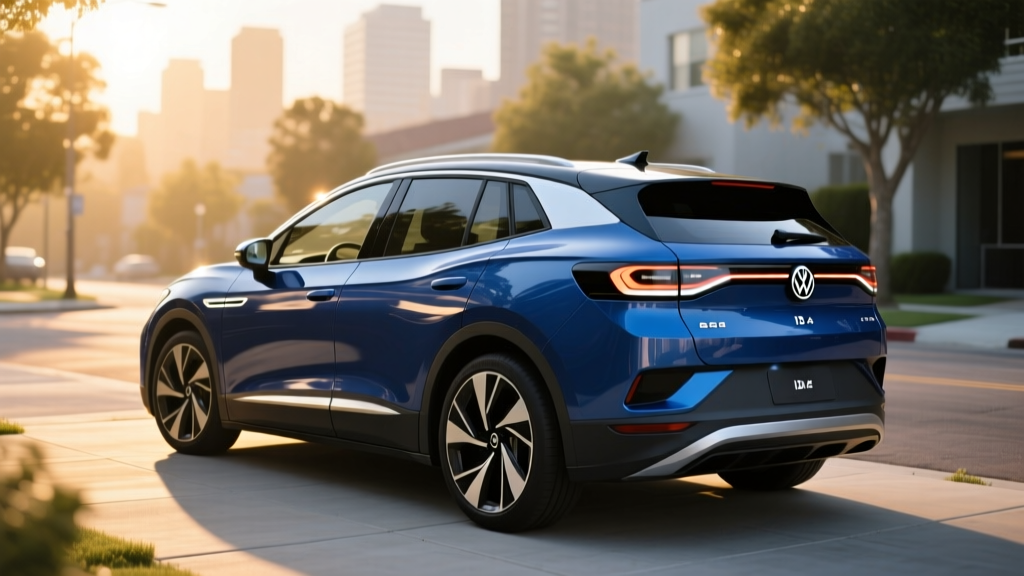
The Volkswagen ID.4 occupies a specific niche in the compact electric SUV segment: it's not the longest-range option, nor the quickest to charge, but it consistently undercuts rivals on monthly lease payments while offering a practical, roomy cabin. For 2026, the ID.4 continues with the 82 kWh (usable) battery pack across most trims, updated software, and pricing that starts under $40,000 before incentives. If you've been searching whether to lease the Volkswagen ID.4 or buy outright, this review covers the exact numbers — range, charging curves, real-world efficiency, and tax-credit math — you need to make the call.
2026 Volkswagen ID.4: Quick Spec Overview
| Spec | ID.4 Pro (RWD) | ID.4 Pro S AWD |
|---|---|---|
| EPA Range | 291 miles | 263 miles |
| Battery (usable) | 82 kWh, NMC | 82 kWh, NMC |
| Peak DC Fast Charge | 170 kW | 170 kW |
| 10–80% DCFC Time | ~30 minutes | ~30 minutes |
| Level 2 Home Charge | 11 kW (~37 mi/hr) | 11 kW (~37 mi/hr) |
| Motor / Drivetrain | 282 hp / RWD | 335 hp / AWD (dual-motor) |
| 0–60 mph | 7.7 sec | 5.4 sec |
| Combined MPGe | 107 MPGe | 101 MPGe |
| Efficiency | 31 kWh/100 mi | 33 kWh/100 mi |
| Cargo (rear seats up) | 30.3 cu ft | 30.3 cu ft |
| Cargo (seats folded) | 64.2 cu ft | 64.2 cu ft |
| Base MSRP | $39,735 | $47,735 |
| Battery Warranty | 8 yr / 100,000 mi | 8 yr / 100,000 mi |
Source: fueleconomy.gov and Volkswagen of America press specifications. MSRP excludes destination charge ($1,350).
Real-World Range: What the EPA Sticker Doesn't Tell You
EPA Estimated: 291 miles
Real-World Highway (70 mph, mild weather): ~245–260 miles
Real-World City/Mixed Commute: ~270–285 miles
Cold-Weather Estimate (below 30°F): ~200–230 miles (15–30% reduction)
The ID.4's heat pump (standard on 2026 models) mitigates some cold-weather loss, but NMC chemistry still loses efficiency in freezing temps. Plan road trips around ~230 miles of usable range to keep a safety buffer.
The rear-wheel-drive ID.4 Pro's 291-mile EPA figure is competitive with the base Hyundai Ioniq 5 (303 mi) and slightly behind the Tesla Model Y Long Range (310+ mi). In mixed driving around 55–65 mph, owners consistently report 260–275 miles before hitting 10% State of Charge. Push highway speeds to 75 mph and that drops closer to 240 miles — a function of the ID.4's boxy aerodynamic profile (0.28 Cd) compared to sleeker rivals.
The AWD Pro S sacrifices range for traction and power: 263 miles EPA, translating to roughly 220–240 miles on a real-world highway run. If you live in snow-belt states, the trade-off is usually worth it — but budget-conscious lessees who commute in mild climates should stick with RWD for maximum range per dollar.
Charging Speed: 170 kW Peak, but Watch the Curve
| Charging Level | Power / Rate | Time (10–80%) | Miles Added per Hour |
|---|---|---|---|
| Level 1 (120V outlet) | ~1.2 kW | N/A (days) | ~4 mi/hr |
| Level 2 (240V, 48A home charger) | 11 kW | ~7.5 hours (0–100%) | ~37 mi/hr |
| DC Fast Charge (peak) | 170 kW | ~30 min (10–80%) | N/A |
| DC Fast Charge (sustained avg) | ~110–125 kW avg | — | ~250 mi/hr at peak |
The ID.4's 170 kW peak DC fast-charge rate is the single biggest criticism leveled against it. Rivals like the Hyundai Ioniq 5 and Kia EV6 (both 800V architecture) peak at 230–250 kW and complete a 10–80% session in roughly 18 minutes. The ID.4, running a 400V architecture, takes about 30 minutes for the same session.
Here's what that charge curve actually looks like: the ID.4 ramps to ~170 kW between roughly 10% and 30% State of Charge, then tapers progressively. By 60% SoC you're seeing ~100 kW, and above 80% it drops to ~50 kW or less. This is normal for NMC packs on 400V systems, but it means you should plan DC fast stops to get you from 10% to 80% and then move on — don't sit at a charger trying to fill from 80% to 100%.
For home charging, the 11 kW onboard charger is a genuine strength. With a properly installed Level 2 wallbox (240V / 48A circuit), you'll add roughly 37 miles of range per hour, easily replenishing a full day's driving overnight. Most ID.4 lessees will never need public charging for daily use if they have Level 2 access at home.
Lease Pricing, Trims, and the Federal Tax Credit Question
| Trim | Drivetrain | MSRP | Est. Monthly Lease* |
|---|---|---|---|
| Standard Range S | RWD | $39,735 | $249–$329 |
| Pro | RWD | $41,735 | $279–$359 |
| Pro S | RWD | $45,235 | $319–$399 |
| Pro S Plus | AWD | $51,235 | $379–$459 |
| GTX (performance) | AWD | $52,735 | $399–$489 |
*Estimated lease ranges based on 36-month / 30,000-mile terms with tier-1 credit and typical VW Credit promotional support. Actual payments vary by dealer, region, and down payment. VW frequently offers lease cash incentives of $5,000–$7,500 that dramatically reduce monthly payments.
Does the ID.4 Qualify for the $7,500 Federal Tax Credit?
This is where leasing vs. buying gets nuanced. Under current IRS §30D rules, the Volkswagen ID.4 qualifies for up to $7,500 in federal tax credits when purchased, subject to:
- MSRP cap: SUVs must be under $80,000 — all ID.4 trims qualify
- Buyer income cap: Modified AGI ≤ $150,000 (single) or ≤ $300,000 (joint filing)
- Battery sourcing: Critical minerals and battery component requirements must be met (VW has confirmed North American battery sourcing for 2026 ID.4 models assembled in Chattanooga, TN)
- Point-of-sale transfer: You can apply the credit at the dealer to reduce the purchase price directly
However, leasing is different. When you lease, the tax credit technically goes to the lessor (VW Credit), not to you. In practice, Volkswagen typically passes this benefit through as "lease cash" — a dealer incentive that reduces your capitalized cost and therefore your monthly payment. This means even lessees who exceed the income cap for §30D can benefit, because the commercial lessor claims the credit (under §45W) and passes savings to you. This is a significant advantage of leasing the ID.4 over buying if your household income exceeds the §30D thresholds.
Leasing the ID.4 often nets you a $5,000–$7,500 incentive baked into the deal, regardless of your income level. Combined with VW's aggressive lease cash promotions (which have reached $7,500+ in recent quarters), monthly payments on a Pro RWD can dip below $300/month with modest money down. For many shoppers, this makes the ID.4 one of the most affordable ways to get into a new EV.
Interior, Tech, and Daily Livability
The ID.4's cabin prioritizes space and simplicity over flash. Front legroom is generous at 41.1 inches, and rear-seat passengers get 37.6 inches — enough for adults on longer trips. Cargo volume (30.3 cu ft behind the rear seats) beats the Tesla Model Y's rear cargo area and is on par with the Hyundai Ioniq 5.
The 12.9-inch infotainment touchscreen (upgraded from earlier 12-inch units) runs VW's ID. Software 4.0, which addresses many of the lag and menu-complexity complaints from 2021–2023 models. Wireless Apple CarPlay and Android Auto are standard. The digital cockpit cluster is compact but legible, and the available head-up display with augmented-reality navigation is a genuinely useful feature for highway driving.
Driver assistance: The ID.4 comes standard with Travel Assist (adaptive cruise + lane centering), which operates as an SAE Level 2 system. It handles highway cruising competently but requires hands-on-wheel engagement. This is not an autonomous driving system — it's comparable to Toyota Safety Sense or Honda Sensing in capability, though VW's lane-centering calibration is slightly more confident on gentle curves.
Notable drawbacks:
- Rear drum brakes (standard) feel unusual at this price point, though they aid efficiency through reduced drag and enhanced regen blending
- No front trunk (frunk) — the space under the hood houses electronics
- Capacitive touch sliders for climate and volume remain a frustration for some users; physical buttons would be preferable
- Regenerative braking is relatively mild — the ID.4 does not offer true one-pedal driving in most modes (B-mode provides stronger regen but won't bring you to a full stop)
How the ID.4 Stacks Up Against Key Competitors
| Metric | VW ID.4 Pro RWD | Hyundai Ioniq 5 SE RWD | Tesla Model Y LR AWD | Ford Mustang Mach-E Select RWD |
|---|---|---|---|---|
| EPA Range | 291 mi | 303 mi | 310+ mi | 250 mi (std) / 320 mi (ext) |
| Battery | 82 kWh NMC | 77.4 kWh NMC | ~75 kWh NMC | 70 kWh LFP / 91 kWh NMC |
| Peak DC Charge | 170 kW | 233 kW (800V) | 250 kW | 150 kW |
| 10–80% DCFC | ~30 min | ~18 min | ~20 min | ~36 min |
| 0–60 mph | 7.7 sec | 7.0 sec | 4.8 sec | 6.1 sec |
| Starting MSRP | $39,735 | $42,600 | $44,990 | $39,995 |
| Cargo (seats up) | 30.3 cu ft | 27.2 cu ft | 30.2 cu ft (+ frunk) | 29.7 cu ft (+ frunk) |
The ID.4's competitive advantage is lease pricing, not raw specs. Hyundai's Ioniq 5 charges dramatically faster thanks to its 800V architecture. The Tesla Model Y offers more range, quicker acceleration, and a Supercharger network advantage. But when VW layers $5,000–$7,500 in lease cash on top of the federal credit passthrough, the ID.4's monthly payment often undercuts all three rivals by $50–$150/month.
If charging speed is your top priority (frequent road trippers), the Ioniq 5 or Model Y are better choices. If you want the lowest monthly cost to commute in a practical electric SUV and charge mostly at home, the ID.4 is difficult to beat on value.
Who Should Lease the Volkswagen ID.4?
- You want the lowest monthly payment in the compact EV SUV segment
- You charge primarily at home (Level 2) and drive under 60 miles/day
- You value cabin space and a quiet, comfortable ride over sporty acceleration
- Your household income exceeds the §30D cap — leasing bypasses the income restriction
- You prefer a traditional dealership experience over Tesla's direct-sales model
- You road-trip frequently and need the fastest DC charging (consider Ioniq 5 or Model Y)
- You want one-pedal driving and aggressive regenerative braking
- You need a frunk for additional storage
- You want the longest possible EPA range in this class
Pros and Cons at a Glance
👍 Pros
- Aggressive lease pricing with stacked incentives
- Spacious cabin with adult-friendly rear seats
- 11 kW Level 2 onboard charger (faster than many rivals)
- Comfortable, quiet ride quality
- Standard heat pump for cold-weather efficiency
- Built in USA (Chattanooga, TN) — supports tax credit sourcing
- 8-year / 100,000-mile battery warranty
👎 Cons
- 170 kW DC fast charge is slower than 800V rivals
- No frunk
- Capacitive touch controls frustrate some drivers
- Mild regen — no true one-pedal driving
- Rear drum brakes (efficiency-driven, but perception issue)
- Infotainment still slightly behind Hyundai/Kia in responsiveness
Frequently Asked Questions
What is the real-world range of the Volkswagen ID.4?
The RWD ID.4 Pro is EPA-rated at 291 miles. In real-world mixed driving at moderate speeds, expect 260–275 miles. Highway driving at 70+ mph drops that to roughly 240–255 miles, and freezing temperatures can reduce range by 15–30%, putting winter range around 200–230 miles. The AWD Pro S rates at 263 miles EPA with proportionally lower real-world figures.
How fast does the ID.4 charge at home and on DC fast chargers?
At home on a Level 2 (240V / 48A) charger, the ID.4 accepts up to 11 kW, adding roughly 37 miles of range per hour — a full charge takes about 7.5 hours. On DC fast chargers, it peaks at 170 kW (10–30% SoC) and completes a 10–80% session in approximately 30 minutes. Average sustained DC charging is around 110–125 kW due to the 400V architecture's taper curve.
How much does the ID.4 cost after incentives when leasing?
Lease pricing varies by dealer and region, but VW frequently offers $5,000–$7,500 in lease cash that stacks with the federal credit passthrough. On a Pro RWD (MSRP ~$41,735 + destination), lessees have reported monthly payments in the $279–$359 range on 36-month terms with $2,000–$4,000 due at signing. Total effective discount from MSRP can exceed $12,000 when all incentives are applied.
Does the Volkswagen ID.4 qualify for the $7,500 federal EV tax credit?
When purchased, yes — the 2026 ID.4 (built in Chattanooga, TN with North American battery sourcing) qualifies for up to $7,500 under IRS §30D, subject to buyer income caps ($150K single / $300K joint) and the $80,000 SUV MSRP ceiling. When leased, the credit goes to VW Credit as lessor, but VW typically passes the savings through as reduced lease payments — and importantly, the lessee's personal income does not need to meet §30D caps in a lease arrangement.
Is the ID.4 worth leasing over the Tesla Model Y or Hyundai Ioniq 5?
It depends on your priorities. If lowest monthly payment and a comfortable, spacious commuter SUV are your goals, the ID.4 is arguably the best value in the segment when lease incentives are stacked. If you need faster DC charging for road trips, the Ioniq 5's 800V architecture (18-minute 10–80%) is meaningfully better. If you want maximum range, performance, and Supercharger access, the Model Y wins on specs — but typically at a higher monthly cost. The ID.4 is the pragmatic, budget-first choice.
What is the ID.4's battery warranty?
Volkswagen covers the ID.4's high-voltage battery for 8 years or 100,000 miles (whichever comes first), warranting it against capacity loss below 70% of original usable capacity. The powertrain (motors, power electronics) is also covered for 8 years / 100,000 miles. The basic vehicle warranty is 4 years / 50,000 miles, with 2 years of complimentary scheduled maintenance included.