Quick Verdict: Is Leasing the Tesla Model X the Smart Move?
The Tesla Model X remains one of the most capable three-row electric SUVs on the market, and for 2026, leasing may be the most financially rational way to get into one. With a starting MSRP pushing past $79,990 and depreciation curves that penalize early adopters, a lease shields you from residual-value risk while still granting access to the Supercharger network, over-the-air updates, and a vehicle that hits 0-60 mph in as little as 3.8 seconds (Dual Motor) or an absurd 2.5 seconds (Plaid).
But leasing an EV introduces its own calculus — particularly around the federal §30D tax credit, which Tesla structures through a lease pass-through. Below, we dissect the 2026 Model X across every metric that matters to real buyers: actual range when you're running highway speeds in January, charging speeds at a 250 kW Supercharger versus your garage Level 2, cargo flexibility with those iconic falcon-wing doors, and whether the numbers pencil out against the Rivian R1S, BMW iX, or Mercedes EQS SUV.
Range, Battery & Real-World Efficiency
Long Range (Dual Motor AWD): 348 miles EPA. Expect ~290-310 miles in mixed highway driving; ~230-260 miles in sustained sub-30°F cold weather with cabin heating.
Plaid (Tri-Motor AWD): 326 miles EPA. Expect ~270-290 miles highway; ~215-245 miles in cold conditions.
The 2026 Model X uses a ~100 kWh usable battery pack (approximately 95-100 kWh net capacity depending on trim). Tesla does not publicly disclose cell chemistry by model year, but the Model X has historically used NMC (nickel manganese cobalt) or NCA (nickel cobalt aluminum) cylindrical cells — optimized for energy density and performance rather than the LFP chemistry found in the base Model 3/Y RWD. This means you'll want to follow the 80% daily charge recommendation to maximize long-term battery health, reserving 100% charges for road trips.
Efficiency on the Long Range trim clocks in at roughly 100 MPGe combined (approximately 33-35 kWh/100 miles) per EPA data on fueleconomy.gov. The Plaid's tri-motor setup and performance tuning drop that to around 95-98 MPGe. In real-world driving, efficiency varies significantly: aggressive acceleration, roof-rack cargo, and towing (up to 5,000 lbs rated) will push consumption well past 40 kWh/100 mi.
| Spec | Long Range (AWD) | Plaid (AWD) |
|---|---|---|
| EPA Range | 348 miles | 326 miles |
| Battery (usable) | ~100 kWh (NMC/NCA) | ~100 kWh (NMC/NCA) |
| 0-60 mph | 3.8 seconds | 2.5 seconds |
| Horsepower | 670 hp | 1,020 hp |
| Drivetrain | Dual-Motor AWD | Tri-Motor AWD |
| Top Speed | 149 mph | 163 mph |
| Efficiency (combined) | ~100 MPGe | ~96 MPGe |
| Towing Capacity | 5,000 lbs | 5,000 lbs |
| Base MSRP | $79,990 | $94,990 |
Charging Speed: Supercharger, DC Fast & Home Level 2
Charging infrastructure access is where the Model X retains a tangible advantage. Tesla's NACS (North American Charging Standard) connector natively accesses the Supercharger network — over 50,000+ stalls globally — without adapters. As other automakers adopt NACS through 2025-2026, Tesla's network advantage narrows, but the seamless plug-and-charge experience and stall density still lead the industry.
| Charging Method | Power (kW) | Speed / Time |
|---|---|---|
| DC Fast Charge (V3 Supercharger / CCS adapter) | Peak 250 kW | 10-80% in ~30 minutes; adds ~175 miles in 15 min |
| DC Fast Charge (V4 Supercharger) | Peak 250 kW (vehicle-limited) | Same as V3 — Model X architecture caps at 250 kW |
| Level 2 Home (Tesla Wall Connector, 48A / 11.5 kW) | 11.5 kW | ~34 miles per hour of charging; 0-100% in ~10 hours |
| Level 2 (Standard 240V / 32A mobile connector) | 7.7 kW | ~23 miles per hour; 0-100% in ~14 hours |
| Level 1 (120V household outlet) | ~1.4 kW | ~3-4 miles per hour; emergency/trickle only |
Charging curve reality: The Model X peaks at 250 kW only at a low state of charge (roughly 10-25% SoC) and with battery preconditioning active (the car navigates to a Supercharger and heats the pack automatically). Above 50% SoC, the rate tapers significantly — expect ~120-150 kW through the 60-80% range, and a slow trickle above 90%. This is standard lithium-ion behavior, but it means the advertised "175 miles in 15 minutes" requires arriving at a near-depleted battery and a V3 or better stall.
For home charging, the Tesla Wall Connector at 48 amps (requiring a 60-amp dedicated circuit) delivers roughly 34 miles of range per hour — enough to fully replenish overnight. Installation costs for a 240V/60A circuit typically range from $800-$2,500 depending on panel proximity and whether a service upgrade is needed. Always consult a licensed electrician for final specs.
Interior Space, Tech & the Falcon-Wing Reality
The Model X seats up to seven in a 2-3-2 configuration (five- and six-seat layouts are also available). The second row in the six-seat config features individual captain's chairs with a center pass-through. Cargo volume behind the third row measures approximately 43 cubic feet, expanding to ~88 cu ft with the third row folded, and a maximum of ~92 cu ft with both rear rows down. The front trunk (frunk) adds roughly 6.5 cu ft — useful for charging cables or a small bag.
Third-row legroom is approximately 32.7 inches — adequate for children on longer trips but tight for adults beyond 30 minutes. The panoramic windshield (the largest glass roof in any production vehicle) creates an airy cabin but can increase solar heat gain in summer; Tesla includes a UV/IR-blocking tint, though some owners add aftermarket shades.
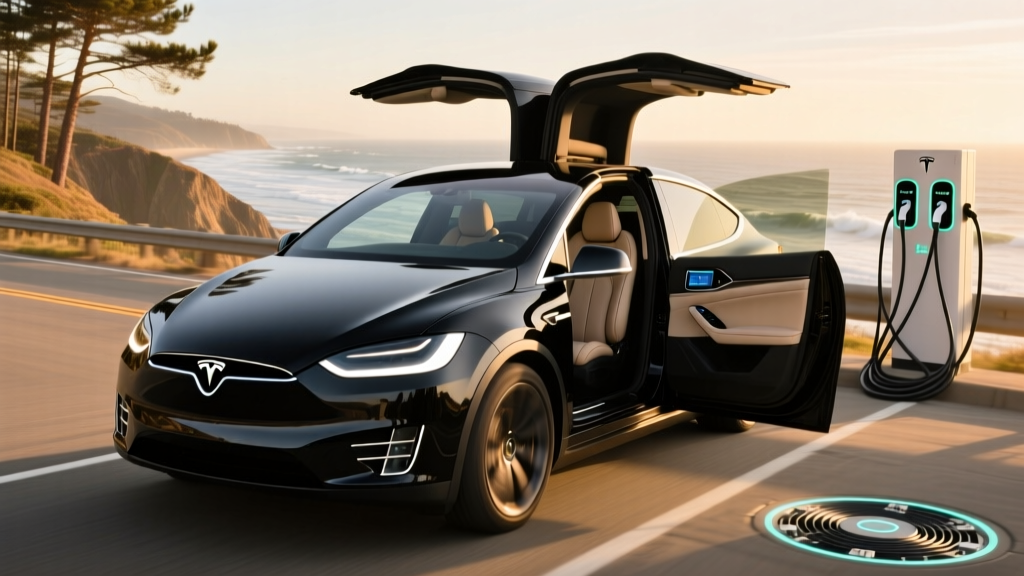
The falcon-wing rear doors are the Model X's signature feature and its most polarizing. They open upward, requiring less lateral clearance than conventional doors — genuinely useful in tight parking spaces. However, they add mechanical complexity, can be slower to open/close than standard doors, and have historically been a source of rattles and seal issues. Low garages (under ~7 feet of clearance) can trigger sensor-based partial opening, which takes practice.
Tech highlights:
- 17-inch center touchscreen (tilting, 2200x1300 resolution) with Netflix, YouTube, and gaming
- Second-row 8-inch touchscreen for rear passengers (climate, media, gaming)
- Tesla Autopilot (SAE Level 2) standard — adaptive cruise + lane centering
- Full Self-Driving (Supervised) available as a $8,000 add-on or $99/month subscription — still Level 2, requires active driver supervision at all times
- 22-speaker audio system with active noise cancellation
- HEPA air filtration with Bioweapon Defense Mode
- Power-folding second- and third-row seats
Pricing, Lease Economics & Federal Tax Credit
For 2026, the Model X lineup is straightforward:
- Long Range (Dual Motor AWD): $79,990 MSRP (before destination)
- Plaid (Tri-Motor AWD): $94,990 MSRP (before destination)
Common options that push the as-tested price higher include the six-seat interior (+$6,500), 22-inch turbine wheels (+$5,500), FSD subscription or purchase, and premium paint colors ($1,500-$2,500). A well-equipped Long Range typically lands between $88,000-$95,000 before incentives.
| Trim | Base MSRP | Est. As-Tested | Est. Monthly Lease (36 mo, $5k down)* |
|---|---|---|---|
| Long Range | $79,990 | $87,000-$95,000 | $1,050-$1,300/mo |
| Plaid | $94,990 | $102,000-$115,000 | $1,350-$1,650/mo |
*Lease estimates vary by region, credit score, money factor, residual value, and whether Tesla's lease pass-through applies the $7,500 federal credit. Confirm with Tesla or a leasing specialist.
Does the Model X Qualify for the $7,500 Federal EV Tax Credit?
This is where leasing becomes strategically important. Under current IRS §30D rules, the Model X faces the federal tax credit's MSRP cap: SUVs must have an MSRP at or below $80,000 to qualify. The Long Range trim at $79,990 technically clears this threshold — but only at base price. Adding virtually any option pushes the transaction above $80,000, eliminating purchase-based credit eligibility.
Additionally, §30D imposes buyer income caps (modified AGI of $150,000 single / $300,000 joint for purchases), critical-mineral and battery-component sourcing requirements that shift annually, and the vehicle must undergo final assembly in North America (the Model X is built in Fremont, CA — this requirement is met).
The lease loophole: Under IRC §45W (the commercial clean vehicle credit), a lessor can claim the $7,500 credit regardless of MSRP caps, buyer income limits, or battery-sourcing rules, and pass the savings to the lessee as a capitalized-cost reduction. Tesla has historically offered this pass-through on leases. If available, this effectively makes a $7,500 dent in your lease regardless of trim or income — but Tesla's policy on passing through this credit can change, and you should confirm in writing before signing.
- ✅ MSRP at or below $80,000 SUV cap (base Long Range only — options may disqualify)
- ✅ North American final assembly (Fremont, CA)
- ⚠️ Buyer MAGI ≤ $150K single / $300K joint filing
- ⚠️ Battery critical-mineral and component sourcing thresholds (verify current-year % on IRS.gov)
- ✅ Point-of-sale transfer available at time of purchase (dealer must be registered)
- ✅ No MSRP cap
- ✅ No buyer income cap
- ✅ No battery-sourcing requirement
- ⚠️ Lessor must claim and pass through the credit — confirm with Tesla
How the Model X Stacks Up Against Key Competitors
The three-row luxury EV SUV segment has matured considerably. Here's how the Model X compares on the metrics that matter:
| Metric | Tesla Model X LR | Rivian R1S (Dual Max) | BMW iX xDrive50 | Mercedes EQS 580 SUV |
|---|---|---|---|---|
| EPA Range | 348 mi | ~410 mi (Max Pack) | ~324 mi | ~305 mi |
| Starting MSRP | $79,990 | $84,900 | $87,250 | $105,550 |
| 0-60 mph | 3.8 sec | ~4.5 sec | 4.4 sec | 4.1 sec |
| Max DC Charge | 250 kW | 220 kW (est.) | 200 kW | 200 kW |
| Third Row | Yes (std) | Yes (std) | No | Yes (optional) |
| Towing | 5,000 lbs | 7,700 lbs | 3,500 lbs | 3,500 lbs |
| NACS Native | Yes | Yes (2025+) | CCS (adapter req.) | CCS (adapter req.) |
| Frunk | Yes | Yes (large) | No | No |
The Rivian R1S is the closest functional rival — it offers more range with the Max Pack, substantially better towing, genuine off-road capability, and a more conventional (if less dramatic) design. The BMW iX is a five-seater, eliminating it from three-row consideration. The Mercedes EQS SUV is more luxurious and quieter but starts $25,000+ higher and offers less range.
The Model X wins on charging network seamlessness, raw performance (especially Plaid), and tech-forward features. It loses on third-row comfort (the Rivian is roomier back there), build-quality consistency (panel gaps remain a Tesla talking point), and overall luxury refinement compared to German rivals.
Pros, Cons & Who Should Lease the Model X
- Best-in-class Supercharger network access (native NACS)
- Class-leading performance — Plaid is supercar-fast in an SUV body
- Over-the-air updates continuously add features
- Genuine three-row seating + frunk + strong cargo flexibility
- Lease pass-through can unlock $7,500 credit regardless of income/MSRP
- Low running costs vs. gas three-row SUVs (~$0.04-$0.06/mi on home charging)
- 5,000-lb towing capacity (adequate for small trailers/boats)
- Falcon-wing doors add complexity and potential maintenance cost
- Third-row space tight for adults on long trips
- Build quality inconsistency (panel gaps, interior trim)
- No Apple CarPlay / Android Auto — Tesla-only infotainment
- Insurance premiums are among the highest in the EV segment
- Depreciation risk if purchased (lease mitigates this)
- FSD remains Level 2 despite the "Full Self-Driving" name
- Choose the Model X if: you want a three-row EV with Supercharger access, value acceleration and tech, plan to keep the vehicle 2-3 years (lease term), and can confirm the §45W lease credit pass-through.
- Choose the Rivian R1S if: you need serious towing, off-road capability, a more usable third row, or prefer a more adventure-oriented vehicle.
- Choose the Mercedes EQS SUV if: luxury refinement, ride comfort, and dealership service experience matter more than range or performance.
- Buy instead of lease if: you plan to keep the vehicle 6+ years, drive under 12,000 miles/year, and qualify for the purchase credit at base Long Range pricing.
Warranty & Long-Term Ownership
Tesla covers the Model X with the following warranties:
- Basic Vehicle: 4 years / 50,000 miles
- Battery & Drive Unit: 8 years / 150,000 miles (whichever comes first), with a minimum 70% capacity retention guarantee over the warranty period
The 8-year/150,000-mile battery warranty is competitive and provides meaningful protection through a typical lease term and beyond. NMC/NCA batteries in Tesla vehicles have demonstrated strong longevity — Tesla's impact reports indicate average degradation of approximately 12-15% after 150,000 miles across their fleet. For a 36-month lease putting on 36,000-45,000 miles, battery degradation is a negligible concern.
Out-of-warranty battery replacement for a 100 kWh pack currently ranges from $15,000-$22,000 depending on labor and sourcing — another reason leasing through the warranty period is a rational hedge.
Frequently Asked Questions
What is the real-world range of the Tesla Model X?
The EPA rates the Long Range at 348 miles and the Plaid at 326 miles. In real-world highway driving at 70-75 mph, expect approximately 290-310 miles (Long Range) and 270-290 miles (Plaid). In sustained cold weather (below 30°F), range drops 20-30%, landing around 230-260 miles for the Long Range. Preconditioning the battery and using seat heaters instead of cabin heat can recover some of that loss.
How fast does the Model X charge at home and on the road?
On a DC fast charger (V3 Supercharger or equivalent), the Model X peaks at 250 kW and charges from 10-80% in approximately 30 minutes with preconditioning. At home on a Level 2 Tesla Wall Connector (48A/11.5 kW), it adds about 34 miles of range per hour — a full overnight charge. On a standard 240V/32A outlet, expect about 23 miles per hour.
Does the Tesla Model X qualify for the $7,500 federal tax credit?
For outright purchase, the base Long Range at $79,990 technically meets the §30D SUV MSRP cap — but adding options pushes it over $80,000 and eliminates eligibility. Buyer income caps and battery-sourcing rules also apply. For leases, the lessor can claim the $7,500 credit under §45W (no MSRP or income cap) and pass it to you as a cap-cost reduction. Confirm Tesla's current lease pass-through policy before signing.
Is leasing the Model X better than buying?
Leasing makes sense if you want to avoid depreciation risk (luxury EVs can lose 40-50% of value in 3 years), want the latest tech via trade-in, and can access the §45W lease credit. Buying makes sense if you drive under 12,000 miles/year, plan to keep the car 5+ years, and want to avoid perpetual payments. Run the numbers on both scenarios using Tesla's website calculator and a third-party lease estimator.
How does the Model X compare to the Rivian R1S?
The Rivian R1S offers more range (up to ~410 mi with Max Pack), significantly better towing (7,700 lbs vs. 5,000 lbs), a more usable third row, and genuine off-road capability. The Model X counters with faster DC charging, Supercharger network seamlessness, more raw performance (Plaid), and OTA software updates. If you tow or go off-pavement, the R1S wins. If you prioritize speed, tech, and charging ease, the Model X holds the edge.
What are the biggest drawbacks of the Model X?
The falcon-wing doors add mechanical complexity and potential repair costs. Third-row space is tight for adults. Build quality (panel gaps, trim alignment) remains inconsistent compared to German rivals. There's no Apple CarPlay or Android Auto — you're locked into Tesla's ecosystem. Insurance premiums are high relative to the segment. And despite the "Full Self-Driving" name, the driver-assist system is SAE Level 2 and requires your full attention.