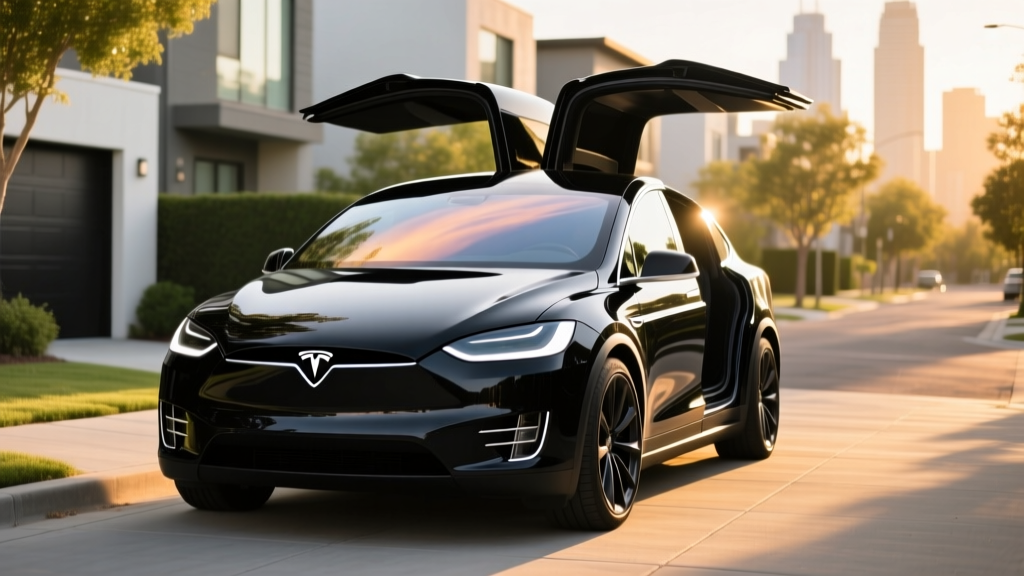
The Tesla Model X remains one of the most distinctive electric SUVs on the road, thanks to its falcon-wing rear doors, massive panoramic windshield, and access to the Supercharger network. But at a starting price that pushes well past $80,000, many buyers are asking whether it makes more sense to lease the Model X rather than buy outright. This review covers the 2026 Model X lineup with exact specs, real-world range expectations, charging performance, tax-credit eligibility, and a clear-eyed look at who should — and shouldn't — pull the trigger.
Quick Verdict: Who Should Lease the Model X?
The Model X is a niche vehicle that excels at a specific job: hauling up to seven passengers in a premium electric package with class-leading acceleration and the best public-charging network available. If you need three rows, want access to Tesla's Supercharger network, and plan to trade in within 36 months, leasing can shield you from the steep depreciation that luxury EVs typically suffer. If you don't need the third row or falcon-wing novelty, competitors like the BMW iX or Rivian R1S may offer better value.
Buy (or look elsewhere) if: You drive over 15,000 miles/year (lease penalties add up), want maximum cargo space (Rivian R1S), or need proven off-road capability.
2026 Tesla Model X: Core Specifications
| Spec | Model X Long Range | Model X Plaid |
|---|---|---|
| EPA Range | 348 miles | 320 miles |
| Battery (usable) | ~100 kWh, NMC | ~100 kWh, NMC |
| Drivetrain | Dual-Motor AWD | Tri-Motor AWD |
| Horsepower | 670 hp | 1,020 hp |
| 0–60 mph | 3.8 seconds | 2.5 seconds |
| Top Speed | 149 mph | 163 mph |
| Max DC Fast Charge | 250 kW | 250 kW |
| 10–80% DC Time | ~30 minutes | ~30 minutes |
| Level 2 Home Charge | 11.5 kW (~34 mi/hr) | 11.5 kW (~34 mi/hr) |
| MPGe (combined) | 102 MPGe | 98 MPGe |
| Efficiency | 33 kWh/100 mi | 34 kWh/100 mi |
| Towing Capacity | 5,000 lbs | 5,000 lbs |
| Seating | 5, 6, or 7 | 5 or 6 |
| Cargo (behind 3rd row) | ~15 cu ft | ~15 cu ft |
| Cargo (max, seats folded) | ~85 cu ft | ~85 cu ft |
| Front Legroom | 41.2 in | 41.2 in |
| Second-Row Legroom | 41.0 in | 41.0 in |
| Base MSRP | $81,630 | $96,630 |
| Battery/Drive Unit Warranty | 8 yr / 150,000 mi | 8 yr / 150,000 mi |
| Limited Vehicle Warranty | 4 yr / 50,000 mi | 4 yr / 50,000 mi |
Source: EPA / fueleconomy.gov, Tesla.com specifications (2025/2026 model year). Real-world figures may vary.
Real-World Range: What the EPA Number Doesn't Tell You
Real-World Highway (70–75 mph): ~270–295 miles
Cold-Weather (below 32°F): ~220–260 miles depending on cabin heating use
Mixed Commute (city + suburban): ~310–330 miles (regen braking helps in stop-and-go)
The Model X's 100 kWh battery pack uses NMC (nickel-manganese-cobalt) chemistry, which offers high energy density but is more sensitive to extreme temperatures than LFP. In our experience and consistent with third-party testing, highway driving at sustained speeds of 70–75 mph reduces range by roughly 15–20% compared to the EPA combined figure. The Model X's large frontal area and weight (~5,100 lbs) work against it at highway speeds.
Cold weather compounds the issue. Without preconditioning the battery and cabin while still plugged in, expect a 25–35% range reduction in sub-freezing conditions. The Model X does include a heat pump, which is significantly more efficient than resistive heating, but physics still wins in deep cold. If your daily commute is under 80 miles round-trip, the range buffer is generous. If you regularly drive 250+ miles between charges in winter, plan your stops carefully.
Charging Performance: DC Fast, Level 2, and the Supercharger Advantage
| Charging Level | Power | Miles Added per Hour | Typical Use Case |
|---|---|---|---|
| Level 1 (120V) | ~1.4 kW | ~4 mi/hr | Emergency / overnight trickle |
| Level 2 (240V, 48A) | 11.5 kW | ~34 mi/hr | Home daily charging |
| DC Fast (V3 Supercharger) | 250 kW peak | ~200 mi in 15 min | Road trips |
| DC Fast (V4 Supercharger) | Up to 250 kW | Similar to V3 for Model X | Newer station locations |
The Model X peaks at 250 kW on Tesla's V3 and V4 Superchargers, but — and this is critical — that peak only holds for a narrow portion of the charge curve, roughly between 10% and 30% state of charge. Above 50%, the charge rate tapers significantly, dropping below 100 kW past 70% SoC. This is why Tesla quotes a 10–80% time of approximately 30 minutes rather than a linear calculation from peak power.
For home charging, a Wall Connector on a 60-amp circuit delivers 11.5 kW, adding roughly 34 miles of range per hour. A full charge from 10% takes about 9–10 hours, making overnight charging practical for most owners. Installation of a 240V/60A circuit typically costs $800–$2,000 depending on your electrical panel's proximity to the garage and whether a panel upgrade (200A service) is needed.
The Supercharger network remains Tesla's strongest competitive moat. With over 6,000 V3/V4 stalls across the U.S. (as of early 2026), route planning via the car's built-in navigation is seamless. Non-Tesla EVs now have limited Supercharger access via NACS adapters, but Tesla owners still get priority pricing and native integration.
Pricing, Lease Costs, and Federal Tax Credit Eligibility
| Trim | Base MSRP | Typical As-Tested | §30D Credit Eligible? | Effective Price (if eligible) |
|---|---|---|---|---|
| Model X Long Range | $81,630 | $86,000–$92,000 | No (exceeds MSRP cap) | N/A |
| Model X Plaid | $96,630 | $102,000–$115,000 | No (exceeds MSRP cap) | N/A |
Here's the critical point for anyone researching a Model X lease: the federal §30D EV tax credit has an MSRP cap of $80,000 for SUVs, vans, and pickup trucks (per IRS guidelines). The 2026 Model X Long Range starts at $81,630, which means it does not qualify for the $7,500 federal credit — even before considering buyer income limits ($300K joint / $150K single) and battery-sourcing requirements.
However, leasing changes the equation. Under IRS rules, the §30D credit technically goes to the lessor (the financing entity), not the lessee. Many Tesla leasing partners pass some or all of the credit's value into the lease as a capitalized-cost reduction, effectively lowering your monthly payment. This "lease loophole" means you may indirectly benefit from the credit even though the vehicle's MSRP exceeds the purchase cap — but this is dealer- and lessor-dependent. Always confirm with Tesla's finance team or your leasing partner whether the credit is being applied to your specific lease agreement.
- MSRP cap: $80,000 for SUVs/trucks/vans (Model X exceeds this)
- Buyer income cap: $300,000 joint / $225,000 HOH / $150,000 single (modified AGI)
- Battery critical-mineral and component sourcing requirements apply
- Point-of-sale transfer available for eligible purchases (not leases)
- Leased vehicles: credit goes to lessor; pass-through to lessee varies
- Consult a tax professional — rules are subject to change. See IRS.gov
Typical Model X lease terms in 2026 run 36 months with 10,000–15,000 miles per year. Expect monthly payments in the range of $1,200–$1,800 depending on trim, down payment, money factor, and residual value. Tesla does not always offer traditional leases directly; many buyers lease through third-party financing partners or BMW Financial-style programs. Check Tesla's current offers at your local delivery center.
Performance and Driving Dynamics
The Model X Long Range delivers 670 horsepower from its dual-motor all-wheel-drive powertrain, launching to 60 mph in 3.8 seconds — a figure that would have been supercar territory a decade ago. The Plaid variant's tri-motor setup produces 1,020 hp and a 2.5-second 0–60 time, making it one of the quickest production SUVs ever built.
But straight-line speed isn't the whole story. The Model X's air suspension provides a comfortable, adaptive ride that adjusts based on speed and terrain. Steering is precise but light, and the low center of gravity (battery pack under the floor) keeps body roll controlled through corners. That said, at 5,100+ pounds, you feel the mass during hard braking and quick direction changes. This is a grand-touring SUV, not a canyon carver.
Regenerative braking is strong and adjustable, enabling near one-pedal driving in most conditions. The Model X does not offer a dedicated "one-pedal" toggle like some competitors; instead, regen strength varies with the selected driving mode and stop mode settings.
Interior, Technology, and Standout Features
The Model X cabin centers around a 17-inch landscape touchscreen running Tesla's proprietary infotainment software. The interface is fast, responsive, and receives regular over-the-air updates. There is no Apple CarPlay or Android Auto — Tesla's ecosystem is self-contained, with built-in navigation, Spotify, Netflix (while parked), and a surprisingly capable gaming suite.
The yoke steering wheel is standard on Plaid and optional on Long Range. It offers an unobstructed view of the instrument cluster but requires adaptation for low-speed maneuvering and parking. A conventional round wheel remains available.
Standout features:
- Falcon-wing rear doors with ultrasonic sensors for obstacle avoidance — dramatic and practical in tight parking spots
- Panoramic windshield extending over the front seats — unmatched visibility and sense of openness
- HEPA air filtration with Bioweapon Defense Mode — legitimately excellent air quality
- Available 22-speaker audio system with active noise cancellation
- Second-row captain's chairs (6-seat config) or bench (5/7-seat)
Notable drawbacks:
- Panel gap inconsistency remains a known concern across Tesla's Fremont-built vehicles
- No physical buttons for climate or volume — everything routes through the screen
- Third-row space is tight for adults; best suited for children on longer trips
- Falcon-wing doors can be slow to open/close and have historically had higher maintenance rates than conventional doors
- Turn-signal stalks removed on newer builds (haptic buttons on the yoke/wheel) — a polarizing change
Driver Assistance: Autopilot and FSD (Supervised)
Tesla Autopilot and Full Self-Driving (Supervised) are driver-assistance systems, not autonomous driving. The driver must remain fully engaged, hands on the wheel (or applying torque), and eyes on the road at all times. Only Level 4 systems (e.g., Waymo robotaxis in geofenced areas) operate without a human driver.
Every Model X ships with Tesla's Basic Autopilot, which includes adaptive cruise control and lane-keeping assist. The Enhanced Autopilot package ($6,000) adds automatic lane changes, Navigate on Autopilot, and Smart Summon. Full Self-Driving (Supervised), priced at $8,000 (or $99/month subscription), adds traffic-light and stop-sign recognition, and city-street autosteer.
In practice, FSD (Supervised) handles many scenarios competently but still requires regular intervention for construction zones, unprotected left turns, and ambiguous lane markings. It's a capable highway companion and increasingly confident on surface streets, but it is not a replacement for an attentive driver. Tesla's safety data reports fewer crashes per million miles with Autopilot engaged, but the NHTSA continues to investigate multiple incidents involving Tesla driver-assist systems.
- Drive without a licensed, attentive operator in the driver's seat
- Navigate all construction zones, detours, or unmapped roads reliably
- Replace your insurance liability — you are the responsible driver
- Operate as a Level 3+ system — there is no "eyes-off" mode
Model X vs. Key Competitors: Is It Worth It?
| Attribute | Tesla Model X LR | BMW iX xDrive50 | Rivian R1S (Dual) |
|---|---|---|---|
| EPA Range | 348 mi | 324 mi | 352 mi |
| Starting MSRP | $81,630 | $87,250 | $75,900 |
| Seating | 5/6/7 | 5 only | 7 |
| 0–60 mph | 3.8 sec | 4.4 sec | 4.5 sec |
| Max DC Charge | 250 kW | 195 kW | 200 kW (NACS) |
| Cargo (max) | 85 cu ft | 78 cu ft | 105 cu ft |
| Towing | 5,000 lbs | 3,500 lbs | 7,700 lbs |
| Charging Network | Supercharger (native) | CCS / NACS adapter | Supercharger (NACS) |
The Model X wins on acceleration and charging-network convenience but trails the Rivian R1S on cargo volume, towing capacity, and starting price. The BMW iX offers a more traditional luxury interior with superior build quality but sacrifices the third row entirely. If you need seven seats and want the fastest public-charging experience, the Model X has no direct equal. If you prioritize off-road capability or maximum utility, the R1S is the stronger pick.
Pros and Cons
- Class-leading acceleration (especially Plaid)
- Native Supercharger network access — best road-trip EV experience
- Falcon-wing doors are genuinely useful in tight parking
- Heat pump and strong cold-weather preconditioning
- Over-the-air updates continuously add features
- Spacious second row with excellent legroom
- 8-year/150,000-mile battery and drive unit warranty
- Exceeds $80K MSRP cap — no direct §30D purchase credit
- Build quality inconsistency (panel gaps, interior trim)
- Third row is cramped for adults
- Falcon-wing doors add complexity and potential maintenance cost
- No Apple CarPlay / Android Auto
- High insurance premiums relative to competitors
- Steep depreciation curve — leasing mitigates this
Frequently Asked Questions
What is the real-world range of the Tesla Model X?
The EPA rates the Model X Long Range at 348 miles and the Plaid at 320 miles. In real-world highway driving at 70–75 mph, expect roughly 270–295 miles. In cold weather (below freezing), that drops to approximately 220–260 miles without preconditioning. City driving with regenerative braking can get you closer to the EPA figure.
How fast does the Model X charge at home and on the road?
At home on a 240V Level 2 Wall Connector (11.5 kW), the Model X adds about 34 miles of range per hour, with a full charge taking roughly 9–10 hours. On a V3 Supercharger, it peaks at 250 kW and can add up to 200 miles in about 15 minutes. A 10–80% DC fast charge takes approximately 30 minutes, with significant tapering above 80% SoC.
Does the Tesla Model X qualify for the federal EV tax credit?
For purchase, no. The §30D credit caps SUV MSRP at $80,000, and the Model X starts at $81,630. However, when you lease the Model X, the credit may be claimed by the lessor and partially passed through as a reduced monthly payment. This is not guaranteed — confirm with your leasing partner. Always verify current rules at IRS.gov.
Is it better to buy or lease the Model X?
Leasing makes sense if you drive under 15,000 miles per year, want to avoid long-term depreciation risk on a $80K+ EV, and plan to upgrade within 36 months. Buying is preferable if you drive high annual miles, want to build equity, or plan to keep the vehicle beyond 4–5 years. The battery warranty (8 years / 150,000 miles) provides long-term peace of mind for buyers.
How does the Model X compare to the Rivian R1S and BMW iX?
The Model X leads in acceleration and Supercharger convenience. The Rivian R1S offers more cargo space (105 vs. 85 cu ft), higher towing capacity (7,700 vs. 5,000 lbs), and a lower starting price. The BMW iX delivers superior interior build quality but seats only five and has slower DC charging (195 kW vs. 250 kW). Your priority — performance, utility, or luxury refinement — should drive the decision.
What is the battery warranty on the Model X?
Tesla covers the Model X battery and drive unit for 8 years or 150,000 miles, whichever comes first, with a minimum 70% capacity retention guarantee. The limited vehicle warranty covers 4 years or 50,000 miles. NMC chemistry degrades gradually; most owners report 5–10% capacity loss over the first 100,000 miles based on fleet data.
Can the Model X tow, and how does that affect range?
The Model X is rated to tow 5,000 pounds. Towing significantly impacts range — expect a 30–50% reduction depending on trailer weight, aerodynamics, and terrain. Plan for charging stops every 120–180 miles when towing near max capacity.