Quick Verdict: Why Buyers Consider Leasing a Tesla Model 3
Leasing a Tesla Model 3 in 2026 remains one of the most accessible pathways into the EV market. With a base MSRP starting around $38,990 for the Standard Range RWD trim, aggressive lease money factors from Tesla Finance, and the ability to capture the §30D federal clean vehicle credit as a lease bonus (passed through as a capitalized cost reduction), the monthly math often beats buying outright — especially for drivers who upgrade every 36 months and want to sidestep long-term battery degradation concerns.
The refreshed "Highland" Model 3 (introduced for the 2024 model year and carried into 2026) brought meaningful upgrades: a quieter cabin, ventilated front seats, rear touchscreen, improved suspension tuning, and ambient lighting. But the core appeal is unchanged — best-in-class efficiency, access to the Supercharger network, and over-the-air updates that keep the car feeling current.
| Spec | Standard Range RWD | Long Range AWD | Performance AWD |
|---|---|---|---|
| EPA Range | 272 mi | 363 mi | 315 mi |
| Battery (usable) | ~57 kWh (LFP) | ~75 kWh (NMC) | ~75 kWh (NMC) |
| 0–60 mph | 5.8 sec | 4.2 sec | 2.9 sec |
| Horsepower | 271 hp | 346 hp | 510 hp |
| Drivetrain | Rear-Wheel Drive | Dual-Motor AWD | Dual-Motor AWD |
| Peak DC Charge | 170 kW | 250 kW | 250 kW |
| 10–80% DC Time | ~25 min | ~27 min | ~27 min |
| Level 2 Rate | 11.5 kW (~44 mi/hr) | 11.5 kW (~44 mi/hr) | 11.5 kW (~44 mi/hr) |
| MPGe (combined) | 132 MPGe | 125 MPGe | 113 MPGe |
| kWh/100 mi | 25 | 27 | 30 |
| Base MSRP | $38,990 | $45,990 | $52,990 |
Real-World Range: What the EPA Sticker Doesn't Tell You
The EPA posts 272 miles for the Standard Range RWD and 363 miles for the Long Range AWD. Those numbers are among the best in the segment per fueleconomy.gov. But your daily experience will differ based on driving style, terrain, and climate.
- EPA Sticker: 363 miles
- Highway (70 mph, mild weather): ~300–320 miles
- City/Suburban mixed: ~330–350 miles (regen recovers energy)
- Cold weather (30°F, highway): ~240–270 miles (25–30% loss without preconditioning)
- Cold weather with preconditioning + heat pump: ~280–300 miles
The Model 3's standard heat pump significantly mitigates cold-weather loss compared to older EVs without one. Preconditioning the battery while plugged in before departure preserves range and dramatically improves DC fast-charge speeds in cold conditions.
The Standard Range RWD uses an LFP (lithium iron phosphate) battery, which sacrifices some energy density for exceptional cycle life and the ability to charge to 100% daily without degradation concerns. The Long Range and Performance trims use NMC (nickel manganese cobalt) chemistry for higher energy density — Tesla recommends charging to 80% for daily use and 100% only before long trips.
Charging Speed: DC Fast, Level 2, and the Supercharger Advantage
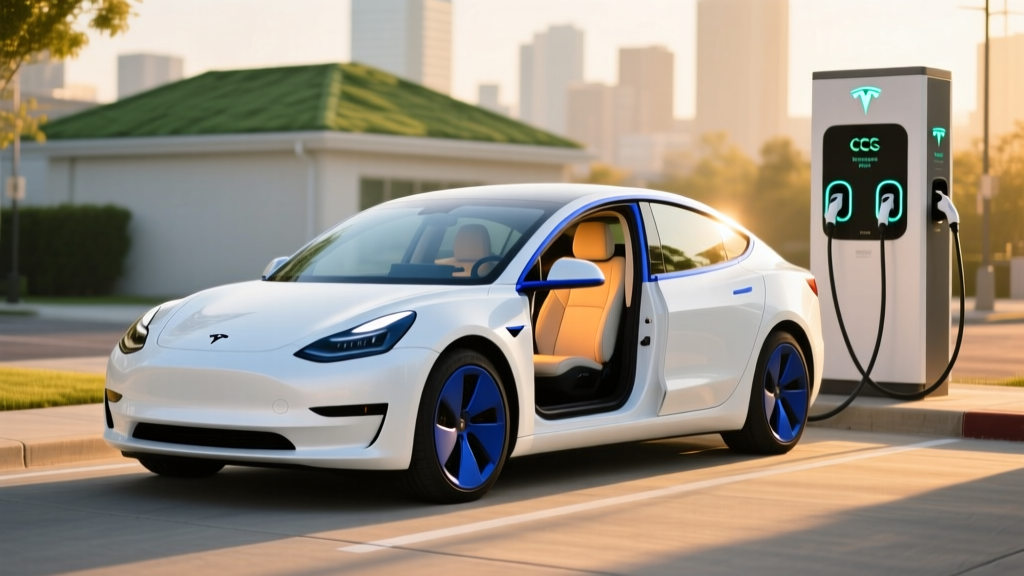
Charging speed is where the Model 3 continues to lead much of the competition. The Long Range and Performance trims peak at 250 kW on V3 Superchargers, while the Standard Range RWD peaks at 170 kW due to its smaller LFP pack. Remember: kW measures power (charge rate), while kWh measures energy (battery capacity).
| Charging Level | Power / Voltage | Miles Added per Hour | Notes |
|---|---|---|---|
| Level 1 (120V outlet) | ~1.4 kW | ~5 mi/hr | Emergency/trickle only |
| Level 2 (240V, 48A) | 11.5 kW | ~44 mi/hr | Full overnight charge in ~7–9 hrs |
| DC Fast (V3 Supercharger) | Up to 250 kW | ~1,000+ mi/hr peak | 10–80% in ~27 min (Long Range) |
| DC Fast (CCS adapter, 3rd-party) | Up to 250 kW | Varies by station | Works on Electrify America, EVgo, etc. |
Charging curve reality: The Model 3 does not hold its peak 250 kW rate for the full session. You'll see peak speed between roughly 10–30% state of charge, tapering to ~150 kW by 50%, and dropping sharply above 80%. That's why Tesla (and all EV makers) quote 10–80% times — the final 20% can add another 15–20 minutes. For road trips, plan to charge from 10–80% and keep moving.
Tesla now includes a CCS adapter in the glovebox (or sells one for ~$250 for older vehicles), opening access to Electrify America, EVgo, and other non-Tesla networks. However, Tesla's own Supercharger network remains the gold standard for reliability and seamless plug-and-charge billing.
Pricing, Lease Math, and Federal Tax Credit Eligibility
Buying vs. leasing a Tesla Model 3 involves different financial mechanics. When you buy, you may claim the §30D federal clean vehicle credit (up to $7,500) on your tax return — or transfer it to the dealer at point of sale as an instant discount — if you meet income caps and the vehicle meets battery-sourcing requirements.
When you lease, the tax credit technically goes to the lessor (Tesla Finance). However, Tesla has historically passed this through as a capitalized cost reduction, effectively lowering your monthly payment. This is often called the "lease loophole" — it bypasses the buyer income caps and MSRP caps because the commercial clean vehicle credit (§45W) applies to the leasing entity instead.
| Trim | Base MSRP | As-Tested (w/ common add-ons) | Est. Monthly Lease (36 mo, 10K mi/yr)* | §30D Credit Eligibility (Purchase) |
|---|---|---|---|---|
| Standard Range RWD | $38,990 | $40,490 (w/ paint + wheels) | ~$329–$379 | Up to $7,500 (income + sourcing rules apply) |
| Long Range AWD | $45,990 | $47,990 | ~$419–$469 | Up to $7,500 (income + sourcing rules apply) |
| Performance AWD | $52,990 | $54,490 | ~$499–$559 | Up to $7,500 (income + sourcing rules apply) |
*Lease estimates are approximate and depend on money factor, residual value, down payment, trade-in, state taxes, and whether Tesla passes through the $7,500 credit as a cap-cost reduction. Always confirm current offers on Tesla.com.
- MSRP cap: Sedans must be ≤ $55,000 (all Model 3 trims qualify)
- Buyer income cap (MAGI): $150,000 single / $225,000 head of household / $300,000 joint
- Battery sourcing: Critical minerals and battery components must meet phased-in domestic/free-trade thresholds (check IRS.gov for current-year percentages)
- Point-of-sale transfer: You can transfer the credit to the dealer for an instant price reduction at purchase
- Lease: Credit goes to lessor; Tesla typically passes it through — confirm before signing
Interior, Tech, and Daily Livability
The Highland-refreshed Model 3 interior is a meaningful step up from the pre-2024 cabin. Materials are softer, road noise is noticeably reduced thanks to acoustic glass all around, and the addition of ventilated front seats and a rear 8-inch touchscreen for climate/media controls addresses the two biggest complaints about the older model.
Dimensions and cargo:
- Front legroom: 42.7 inches
- Rear legroom: 35.2 inches
- Trunk: 23 cu ft (rear cargo) + 3.1 cu ft frunk = 26.1 cu ft total
- Ground clearance: 5.5 inches
The 15.4-inch center touchscreen handles everything — navigation, media, vehicle settings, and the optional FSD (Supervised) visualization. There is no separate instrument cluster; speed and drive info live in the top-left corner of the main display. The steering wheel integrates turn signals and gear selection (no stalks), which takes roughly a week of muscle-memory adjustment.
Driver assistance: Every Model 3 ships with Basic Autopilot (lane centering + adaptive cruise). The Enhanced Autopilot upgrade ($6,000) adds auto lane change, autosteer on interchanges, and Smart Summon. Full Self-Driving (Supervised) at $8,000 or $99/month adds traffic-light recognition and city-street autosteer. Important: FSD (Supervised) is an SAE Level 2 system — you must remain attentive with hands on the wheel at all times. It is not autonomous driving.
Performance and Driving Dynamics
Even the base Standard Range RWD Model 3 delivers 271 hp and a 5.8-second 0–60 mph time — quicker than most gas-powered sport sedans in its price range. The instant torque delivery from the rear-mounted permanent-magnet motor makes it feel faster than the numbers suggest around town.
The Long Range AWD steps to 346 hp and 4.2 seconds, with dual motors providing confident all-weather traction. The Performance trim (510 hp, 2.9 seconds) includes adaptive dampers, a carbon-fiber spoiler, track mode, and larger brakes — making it a legitimate sports sedan that happens to run on electricity.
The Highland suspension retuning struck a good balance: compliant enough for daily commuting over rough pavement, yet controlled enough for canyon roads. It's not a BMW 3 Series on a track, but it's no longer the crashy, overly firm ride that early Model 3s were known for.
Warranty, Reliability, and Ownership Costs
Tesla's warranty coverage is competitive with the EV segment:
- Basic vehicle: 4 years / 50,000 miles
- Battery & drive unit (Standard Range): 8 years / 100,000 miles (minimum 70% capacity retention)
- Battery & drive unit (Long Range / Performance): 8 years / 120,000 miles (minimum 70% capacity retention)
LFP batteries in the Standard Range trim have demonstrated exceptional longevity in fleet data — often showing less than 5% degradation at 100,000 miles. NMC packs in the Long Range typically show 8–12% degradation at the same interval, well within warranty thresholds.
Insurance: Model 3 insurance premiums run 15–30% higher than comparable gas sedans due to repair costs and aluminum/steel mixed construction. Expect $1,800–$2,600/year depending on your state, age, and driving record. Always get quotes before signing a lease.
Maintenance: Minimal. No oil changes, no spark plugs, no transmission fluid. Budget for cabin air filter replacement (~$150 every 2 years), wiper fluid, tire rotation, and brake fluid checks. Regenerative braking means brake pads often last 100,000+ miles.
Pros, Cons, and Who Should Lease a Tesla Model 3
- Best-in-class efficiency (25 kWh/100 mi on RWD)
- Access to Supercharger network — the most reliable DC fast-charging system in North America
- Over-the-air updates continuously add features
- Strong resale/lease residual values
- LFP battery option for worry-free 100% daily charging
- Highland refresh fixed most interior/refinement complaints
- No physical stalks — turn signals on the steering wheel take adjustment
- Rear seat is tighter than a Hyundai Ioniq 6 or BMW i4
- Insurance costs above segment average
- No Apple CarPlay / Android Auto (Tesla's native system only)
- Repair wait times can be long in areas with few service centers
- FSD (Supervised) remains Level 2 — not autonomous despite the name
- Choose the Model 3 Standard Range RWD if: You commute under 80 miles daily, have home Level 2 charging, live in a mild climate, and want the lowest monthly payment with LFP longevity.
- Choose the Model 3 Long Range AWD if: You take regular road trips (300+ miles), live in a cold-weather state, need dual-motor traction, or simply want the range buffer to charge less often.
- Choose the Model 3 Performance if: Driving dynamics matter as much as efficiency, and you want a daily-driver that can legitimately hit a track.
- Look at the Hyundai Ioniq 6 or BMW i4 instead if: You prefer physical controls, need a more spacious rear seat, want Apple CarPlay, or value traditional dealer service infrastructure.
Frequently Asked Questions
What is the real-world range of the Tesla Model 3?
The EPA rates the Long Range AWD at 363 miles and the Standard Range RWD at 272 miles. In real-world highway driving at 70 mph, expect roughly 300–320 miles from the Long Range and 220–240 miles from the Standard Range. In freezing temperatures, subtract 20–30% unless you precondition the battery while plugged in.
How fast does the Model 3 charge at home and on the road?
On a 240V Level 2 home charger (48A), the Model 3 charges at 11.5 kW, adding about 44 miles of range per hour — a full charge takes 7–9 hours overnight. On a V3 Supercharger, the Long Range and Performance peak at 250 kW, reaching 10–80% in about 27 minutes. The Standard Range RWD peaks at 170 kW with a 10–80% time of roughly 25 minutes.
Does the Tesla Model 3 qualify for the $7,500 federal tax credit?
All Model 3 trims fall under the $55,000 sedan MSRP cap. If you purchase, eligibility for the full $7,500 depends on your modified adjusted gross income (≤ $150K single / $300K joint) and whether the battery meets current-year critical-mineral and component sourcing thresholds per IRS §30D rules. If you lease, Tesla typically applies the credit as a capitalized cost reduction, bypassing buyer income caps — but confirm this before signing, as lessor pass-through is not guaranteed by law.
Is it better to buy or lease a Tesla Model 3?
Leasing makes sense if you want the lowest monthly payment, plan to upgrade in 3 years, and want to avoid long-term battery-depreciation risk. Buying makes sense if you drive over 15,000 miles/year (lease penalties add up), want to build equity, and plan to keep the car 5+ years to amortize the higher upfront cost. The lease route can also capture the federal credit regardless of your income level.
How does the Model 3 compare to key competitors?
Against the Hyundai Ioniq 6 (EPA 361 mi, ~$42K), the Model 3 offers better charging infrastructure and software but less rear-seat space and no CarPlay. Against the BMW i4 eDrive40 (EPA 301 mi, ~$57K), the Model 3 is far more affordable and efficient but less premium in materials. Against the Polestar 2 (EPA 276 mi, ~$49K), the Model 3 wins on range, charging speed, and price. The Model 3 remains the default recommendation for most buyers in this segment.
What happens at the end of a Model 3 lease?
As of 2026, Tesla typically does not offer a purchase option at lease-end for Model 3 leases (this policy has varied in prior years). You return the vehicle, pay any excess wear/mileage charges, and walk away — or lease/purchase a new vehicle. Confirm current lease-end terms directly with Tesla Finance before signing.
Does the Model 3 have Apple CarPlay or Android Auto?
No. Tesla uses its proprietary infotainment system exclusively. It includes native Spotify, Apple Music, Tidal, YouTube, Netflix (while parked), and a capable navigation system with real-time Supercharger routing. If CarPlay is a non-negotiable feature, consider the Ioniq 6 or BMW i4 instead.