Quick Verdict: Is the Nissan Leaf Still Worth Leasing?
The Nissan Leaf remains one of the most affordable entry points into electric-vehicle ownership in the United States. For 2026, the Leaf continues with two battery options — a 40 kWh pack and a 62 kWh pack — delivering EPA-estimated ranges of 149 and 212 miles, respectively. If you're considering whether to lease a Nissan Leaf, the value proposition is straightforward: low monthly payments, a proven powertrain, and a practical commuter footprint that works well for daily driving under 80 miles round-trip.
However, the Leaf's CHAdeMO fast-charging connector and passive air-cooled battery system are increasingly out of step with competitors that use NACS/CCS connectors and active liquid thermal management. Leasing — rather than buying — can mitigate long-term battery degradation risk, which makes a lease especially attractive for this model.
2026 Nissan Leaf Specifications at a Glance
| Spec | Leaf S / SV (40 kWh) | Leaf SV PLUS / SL PLUS (62 kWh) |
|---|---|---|
| EPA Range | 149 miles | 212 miles |
| Battery Capacity | 40 kWh usable | 62 kWh usable |
| Battery Chemistry | NMC (lithium-ion) | NMC (lithium-ion) |
| Horsepower | 147 hp | 214 hp |
| 0–60 mph | ~7.9 seconds | ~6.5 seconds |
| Drivetrain | FWD (single motor) | FWD (single motor) |
| Max DC Fast Charge | 50 kW (CHAdeMO) | 100 kW (CHAdeMO) |
| 10–80% DC Time | ~40 minutes | ~45 minutes |
| Level 2 Charge Rate | 6.6 kW (~22 mi/hr) | 6.6 kW (~25 mi/hr) |
| MPGe (Combined) | 111 MPGe | 104 MPGe |
| Efficiency | 30 kWh/100 mi | 32 kWh/100 mi |
| Cargo Volume | 23.6 cu ft (rear seats up) | 23.6 cu ft (rear seats up) |
| Base MSRP (2026 est.) | ~$29,135 | ~$37,135 |
| Battery Warranty | 8 yr / 100,000 mi | 8 yr / 100,000 mi |
Sources: fueleconomy.gov, Nissan USA specifications.
Real-World Range: What to Actually Expect
40 kWh Leaf: EPA 149 miles. Expect ~120–135 miles in mixed highway driving; ~100–115 miles in sustained cold weather (below 32°F).
62 kWh Leaf PLUS: EPA 212 miles. Expect ~175–195 miles highway at 70 mph; ~145–165 miles in winter conditions with cabin heat.
The Leaf's air-cooled battery is the elephant in the room. Unlike liquid-cooled competitors (Chevrolet Bolt, Hyundai Kona Electric, Tesla Model 3), the Leaf relies on passive thermal management. This means:
- Cold weather hits harder. Without an active battery heater, the pack cannot warm itself efficiently, increasing internal resistance and reducing usable capacity by 20–35% in sub-freezing temperatures.
- Highway efficiency drops. The Leaf's aerodynamics are dated, and at sustained 70+ mph speeds, the 62 kWh model typically delivers 3.0–3.3 miles/kWh rather than the 3.2–3.5 mi/kWh seen in city driving where regenerative braking recovers energy.
- Heat buildup limits repeated fast charging. Multiple DC fast-charge sessions in a single day (common on road trips) cause the battery to thermally throttle, progressively slowing charge speeds — a phenomenon owners call "Rapidgate."
For a commuter who charges at home nightly and drives under 80 miles per day, these limitations rarely matter. For road-trippers or those in extreme climates, they are deal-breakers.
Charging Speed: CHAdeMO in a NACS/CCS World
| Charging Level | Power | Miles Added per Hour | Notes |
|---|---|---|---|
| Level 1 (120V household) | ~1.4 kW | ~4–5 mi/hr | Emergency/top-up only |
| Level 2 (240V home/public) | 6.6 kW | ~22–25 mi/hr | Full charge overnight (~7–9 hrs) |
| DC Fast (40 kWh) | 50 kW peak | ~150 mi/hr (peak) | 10–80% in ~40 min |
| DC Fast (62 kWh PLUS) | 100 kW peak | ~240 mi/hr (peak) | 10–80% in ~45 min; tapers heavily above 80% |
The Leaf is the last mainstream EV sold in the U.S. using the CHAdeMO DC fast-charging standard. Every other major automaker has adopted NACS (Tesla's connector, now standard on Ford, GM, Rivian, Hyundai, and others) or CCS1. Here's what that means practically:
- CHAdeMO infrastructure is shrinking. Networks like Electrify America and EVgo have largely stopped deploying new CHAdeMO stalls. Existing stations still work, but availability is declining relative to CCS/NACS.
- Tesla Superchargers are off-limits without an adapter — and Nissan has not announced a NACS adapter for the Leaf as of early 2026.
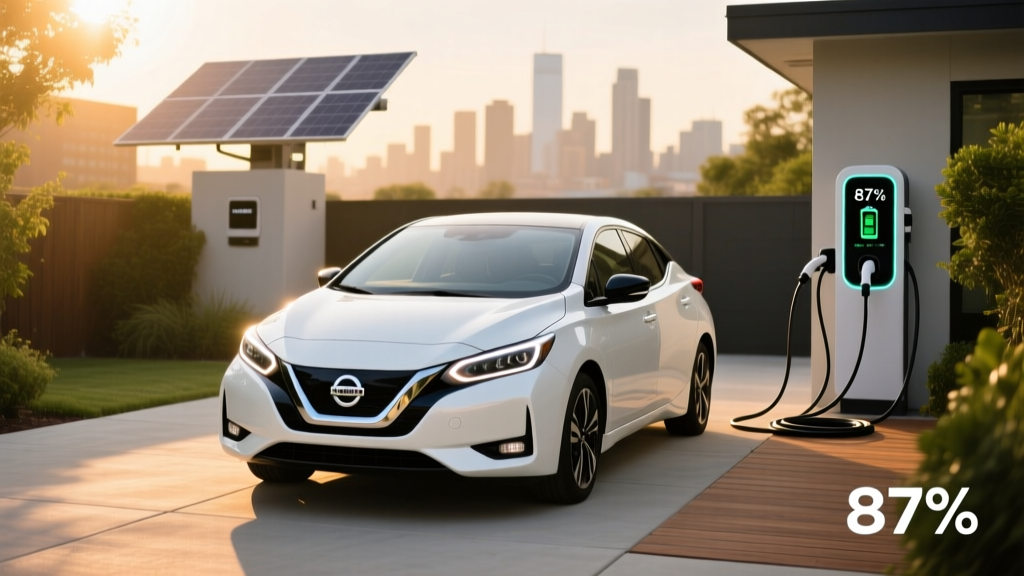
- Level 2 home charging is unaffected. The Leaf uses a standard J1772 connector for AC charging, which is universal across all home Level 2 chargers.
The 62 kWh PLUS model's 100 kW peak charge rate sounds competitive, but the charge curve tells a different story. The Leaf hits peak rate only between roughly 10–40% state of charge, then tapers significantly. From 60–80%, speeds drop to 40–50 kW, and above 80%, charging slows to a trickle to protect the air-cooled cells. A realistic 10–80% session takes 40–50 minutes depending on ambient temperature.
Performance and Driving Experience
The Leaf drives like the comfortable, competent hatchback it is — not a performance EV. The 147 hp base motor provides adequate city acceleration, while the PLUS model's 214 hp delivers genuinely quick off-the-line response (0–60 in roughly 6.5 seconds). Single-speed reduction gearing and instant electric torque make the Leaf feel punchier than its horsepower figures suggest in stop-and-go traffic.
Nissan's e-Pedal mode enables one-pedal driving with aggressive regenerative braking that can bring the car to a full stop without touching the brake pedal. It works well in urban environments and reduces brake wear significantly. The ProPILOT Assist system (standard on SV and above) provides SAE Level 2 adaptive cruise control with lane-centering — functional on highways but not class-leading compared to GM's Super Cruise or Ford's BlueCruise.
Ride quality is compliant and quiet at lower speeds. Road noise becomes noticeable above 65 mph, and the steering is light and numb — fine for commuting, uninspiring on back roads. There is no all-wheel-drive option.
Pricing, Lease Deals, and Federal Tax Credit Eligibility
For the 2026 model year, the Leaf lineup starts at approximately $29,135 for the base S trim (40 kWh) and climbs to around $41,000 for a fully loaded SL PLUS. Destination charges add roughly $1,095.
| Trim | MSRP (est.) | Battery | Key Features |
|---|---|---|---|
| Leaf S | $29,135 | 40 kWh / 149 mi | 8" touchscreen, Apple CarPlay/Android Auto, ProPILOT Assist |
| Leaf SV | $33,135 | 40 kWh / 149 mi | Navigation, fog lights, auto-dimming mirror, 17" wheels |
| Leaf SV PLUS | $37,135 | 62 kWh / 212 mi | All SV features + larger battery, 214 hp motor |
| Leaf SL PLUS | $40,635 | 62 kWh / 212 mi | Leather seats, Bose audio, LED headlights, ProPILOT 2.0 (if avail.) |
Does the 2026 Leaf Qualify for the §30D Federal Tax Credit?
The federal EV tax credit under IRS §30D is subject to several requirements that change frequently. As of early 2026, the key eligibility criteria include:
- MSRP cap: Vans, SUVs, and pickup trucks are capped at $80,000; sedans and hatchbacks (like the Leaf) at $55,000. All Leaf trims fall well under this limit.
- Buyer income cap: Modified adjusted gross income must not exceed $150,000 (single), $225,000 (head of household), or $300,000 (joint filers).
- Battery sourcing and critical minerals: A percentage of battery components must be manufactured or assembled in North America, and critical minerals must be sourced from the U.S. or free-trade-agreement countries. The Leaf's battery is assembled in Smyrna, Tennessee, but cell sourcing and mineral supply chains must meet evolving annual thresholds.
- Point-of-sale transfer: Buyers can elect to transfer the credit to the dealer at purchase, reducing the upfront cost — or claim it on their tax return.
The Leaf has historically qualified for a partial or full credit (up to $7,500), but the exact amount depends on the model year's battery-sourcing compliance. Verify current eligibility at IRS.gov or with your tax professional before purchasing.
Why Leasing May Be the Smarter Move
There's a compelling case for leasing a Nissan Leaf rather than buying outright:
- Lease credit passthrough: Under IRC §45W, the commercial clean vehicle credit can apply to leases, and the leasing company (the legal owner) may pass savings to you as a reduced monthly payment — even if the vehicle doesn't qualify for §30D due to sourcing rules. This has historically been a workaround for EVs that fail the battery-sourcing test.
- Depreciation protection: The Leaf depreciates faster than liquid-cooled competitors. A 36-month lease shields you from residual-value risk.
- Battery degradation risk transfer: If you lease for 36 months and return the car, you never face the prospect of an out-of-warranty battery replacement (estimated at $8,000–$12,000 for a 62 kWh pack).
- Lower monthly payments: Nissan frequently offers aggressive lease incentives. Expect $199–$299/month on a 36-month lease with $2,000–$3,000 down, depending on region and trim.
Interior, Cargo, and Technology
The Leaf's interior is functional but shows its age. The dashboard uses a mix of soft-touch and hard plastics, and the 8-inch infotainment touchscreen (standard on all trims) is smaller and less responsive than the 12.3-inch displays in rivals. Wireless Apple CarPlay is available on upper trims; Android Auto requires a USB cable.
Passenger space: Front legroom is generous at 42.1 inches. Rear legroom measures 33.5 inches — adequate for adults on shorter trips but tight for tall passengers on longer drives. The rear bench is flat and comfortable for two; the center position is best for children.
Cargo volume: 23.6 cubic feet behind the rear seats, expanding to approximately 30 cubic feet with the 60/40 split rear seats folded. That's competitive with the Chevrolet Bolt EUV (24.7 cu ft) but less than the Hyundai Kona Electric (25.5 cu ft). There is no front trunk (frunk) — the space under the hood houses conventional power electronics.
The Leaf's ProPILOT Assist provides lane-centering and adaptive cruise control at speeds above 0 mph (with stop-and-go). On SV PLUS and SL PLUS trims, Nissan's Around View Monitor (360-degree camera) aids parking. The SL PLUS may offer ProPILOT 2.0 with limited hands-off capability on mapped highways, though availability varies by market.
Battery Warranty and Longevity Considerations
Nissan covers the Leaf's lithium-ion battery with an 8-year/100,000-mile warranty against capacity loss below 9 bars (of 12) on the battery health gauge — roughly equivalent to 70% state of health. A separate defect warranty covers 8 years/100,000 miles (5 years/60,000 miles in California and CARB-adopting states under PZEV rules).
The air-cooled battery design is the primary longevity concern. Data from Leaf owners over the past decade shows:
- Hot climates accelerate degradation. Leafs in Arizona, Texas, and Southern California historically lose capacity faster than those in cooler regions due to chronic heat exposure without active cooling.
- Frequent DC fast charging compounds heat stress. Daily fast-charging without cool-down periods can reduce long-term state of health more than Level 2 home charging.
- Typical degradation at 5 years: 10–18% capacity loss depending on climate and charging habits. A 62 kWh pack that started at 212 EPA miles may deliver 175–190 miles after five years of moderate use.
This degradation profile is exactly why leasing — and returning the car before the battery ages significantly — is a rational strategy for the Leaf.
Pros and Cons: The Honest Assessment
- One of the lowest-cost new EVs available (from ~$29k)
- Comfortable ride, easy to park, practical hatchback cargo
- Proven powertrain with extensive service history
- e-Pedal one-pedal driving is intuitive and effective
- Battery assembled in Tennessee; competitive lease pricing
- 8-year/100,000-mile battery warranty
- CHAdeMO connector — declining fast-charge infrastructure
- Passive air-cooled battery — worse cold-weather range and long-term degradation in hot climates
- No Tesla Supercharger access; no NACS adapter announced
- Dated interior and infotainment vs. 2026 competitors
- DC fast-charging speed and charge curve below class average
- No AWD or towing capability
Who Should Lease a Nissan Leaf — and Who Shouldn't?
Lease the Leaf if:
- You commute under 80 miles round-trip and charge at home nightly
- You live in a mild climate (rarely below 20°F or above 100°F for extended periods)
- You want the lowest possible monthly EV payment and don't plan to road-trip frequently
- You want to test EV ownership for 36 months without long-term battery risk
- You have reliable Level 2 home charging access
Look elsewhere if:
- You regularly drive 200+ miles in a single day or take frequent road trips
- You live in an extreme climate (Upper Midwest winters, Southwest summers)
- You need access to Tesla Superchargers or the growing NACS network
- You need AWD, towing, or more than 212 miles of range
- You plan to keep the vehicle 7+ years and want minimal degradation risk
Frequently Asked Questions
What is the real-world range of the 2026 Nissan Leaf?
The 40 kWh Leaf delivers roughly 120–135 real-world miles in mixed driving; the 62 kWh PLUS manages 175–195 miles on the highway. In cold weather (below freezing), subtract 20–35% from EPA figures. The Leaf's lack of a heat pump (it uses resistive cabin heating) makes winter range loss more pronounced than competitors with heat-pump HVAC systems.
How fast does the Leaf charge at home and on DC fast chargers?
On a 240V Level 2 home charger, the Leaf charges at 6.6 kW, adding about 22–25 miles of range per hour. A full charge from near-empty takes 7–9 hours depending on battery size. DC fast charging peaks at 50 kW (40 kWh) or 100 kW (62 kWh PLUS), but sustained rates are lower due to the charge-curve taper and passive cooling limitations. Expect 10–80% in 40–50 minutes under ideal conditions.
How much does a 2026 Nissan Leaf cost after tax credits?
The base Leaf S starts around $29,135. If you qualify for the full $7,500 §30D credit (income, MSRP, and sourcing requirements met), the effective price drops to roughly $21,635. Through a lease, the commercial credit under §45W may provide similar savings as a capitalized-cost reduction, potentially bringing monthly payments to $199–$259/month on a 36-month term. Always confirm eligibility with your dealer and a tax professional.
Is the Leaf worth leasing versus the Chevrolet Bolt or Hyundai Kona Electric?
The Leaf wins on absolute base price and Nissan's frequent lease incentives. The Chevrolet Bolt EV/EUV (if still in production for 2026) and Hyundai Kona Electric offer CCS fast-charging, liquid-cooled batteries, and more modern interiors — but often at a $3,000–$5,000 premium. If CHAdeMO infrastructure is adequate in your area and you're leasing for 36 months, the Leaf's value proposition holds. If you plan to buy and keep long-term, the Bolt or Kona are stronger choices.
Does the Nissan Leaf qualify for the federal EV tax credit?
The Leaf has historically qualified for partial or full §30D credits. Its MSRP is well under the $55,000 hatchback cap, and its battery is assembled in the U.S. However, critical-mineral and battery-component sourcing thresholds tighten annually. Check the latest eligibility at IRS.gov before committing. Leasing may provide a credit passthrough even if purchase eligibility is limited.
Can I charge the Leaf at Tesla Superchargers?
No. The Leaf uses CHAdeMO for DC fast charging and J1772 for Level 2 AC charging. Tesla Superchargers use NACS connectors, and Nissan has not announced a CHAdeMO-to-NACS adapter for the Leaf as of early 2026. You'll rely on Electrify America, EVgo, ChargePoint, and other networks with CHAdeMO stalls — which are becoming less common.