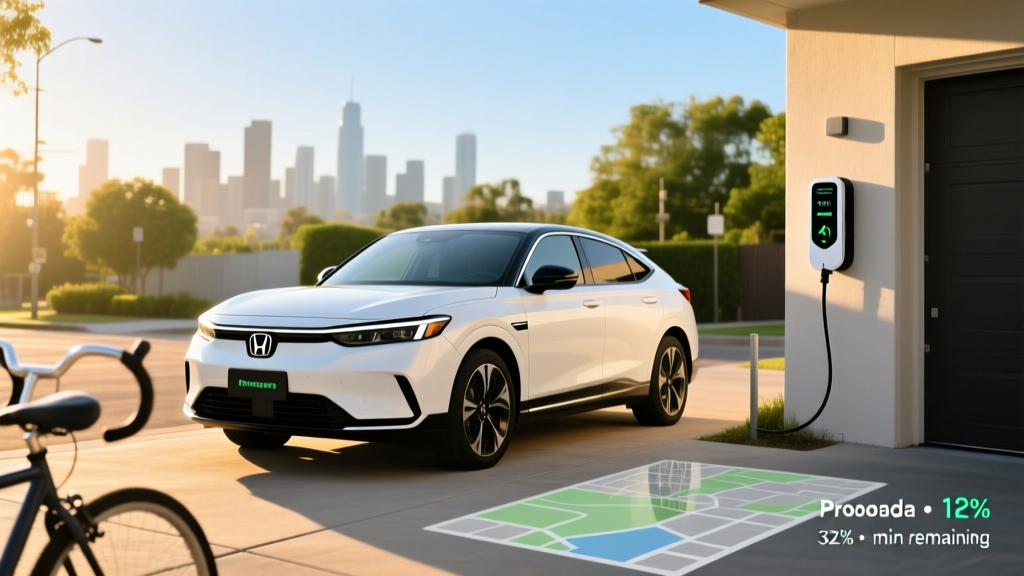
Honda's first dedicated battery-electric SUV, the Prologue, has become one of the most talked-about midsize electric crossovers on the market. Built on General Motors' Ultium platform, it offers competitive range, DC fast-charging capability, and a starting price that undercuts many rivals. But the real story for buyers in 2026 isn't just the sticker price — it's the lease structure, the federal tax credit pass-through, and how the Prologue stacks up on total cost of ownership against both gas SUVs and other EVs.
If you're researching whether to lease a Honda Prologue EV, this guide walks through every dollar: purchase price, federal and state incentives, fuel and charging costs, maintenance, insurance, and depreciation. We'll give you the exact math so you can decide if the Prologue fits your budget and driving habits.
Honda Prologue 2026: Key Specs at a Glance
Before we get into costs, here are the numbers that matter. The 2026 Honda Prologue is available in EX, EX-L, Touring, and Elite trims, with front-wheel-drive and all-wheel-drive configurations. Battery chemistry is NMC (nickel-manganese-cobalt) on the Ultium platform, with an 85 kWh usable pack.
| Spec | FWD (EX/EX-L) | AWD (Touring/Elite) |
|---|---|---|
| EPA Range | 296 miles | 281 miles |
| Battery (usable) | 85 kWh NMC | 85 kWh NMC |
| Peak DC Fast Charge | 150 kW | 150 kW |
| 10–80% DC Charge Time | ~30 minutes | ~30 minutes |
| Level 2 AC Charge Rate | 11.5 kW | 11.5 kW |
| Horsepower | 212 hp | 288 hp |
| 0–60 mph | ~7.2 sec | ~5.9 sec |
| MPGe (combined) | 99 MPGe | 95 MPGe |
| Starting MSRP (2026) | $48,795 | $57,095 (Elite AWD) |
| Battery/Powertrain Warranty | 8 years / 100,000 miles | |
The Lease Loophole: How the $7,500 Federal Credit Works on a Prologue Lease
Here's the single most important financial detail for anyone considering a Honda Prologue: the federal EV tax credit under IRS §30D has strict battery-sourcing and critical-mineral requirements that have disqualified many EVs from the full $7,500 credit when purchased. However, a separate provision — the commercial clean vehicle credit under §45W — allows leasing companies (the lessor) to claim the full $7,500 credit regardless of battery sourcing, and most automakers pass this savings directly to the lessee as a lease incentive.
As of 2026, Honda has been passing the full $7,500 through as a lease cash incentive on the Prologue. This means you can effectively knock $7,500 off the capitalized cost of your lease — a massive advantage over purchasing, where battery-sourcing rules may limit or eliminate the credit.
- Buyer income cap: AGI ≤ $150,000 (single), $225,000 (head of household), $300,000 (married filing jointly)
- MSRP cap: ≤ $80,000 for SUVs, vans, pickups; ≤ $55,000 for sedans (Prologue qualifies as SUV)
- Battery sourcing: Critical minerals and battery components must meet phased-in thresholds (increasing annually through 2032)
- Point-of-sale transfer: Eligible buyers can transfer the credit to the dealer at purchase for an immediate price reduction
- Assembly: Vehicle must undergo final assembly in North America
Source: IRS Clean Vehicle Credits. Rules are subject to change — verify current-year requirements with a tax professional.
Key distinction for leasing: When you lease, the leasing company (Honda Financial Services) is the legal purchaser. They claim the §45W commercial credit and pass it to you. You do not need to meet the §30D income caps or worry about battery-sourcing rules on a lease. This is why leasing the Prologue is often financially superior to buying, even if you'd normally prefer to own.
5-Year Total Cost of Ownership: Honda Prologue EV vs. Gas SUV
To understand whether the Prologue saves you money, we need to look beyond the monthly payment. Below is a 5-year / 75,000-mile total cost of ownership (TCO) comparison against a comparably priced gas SUV — the Honda CR-V Hybrid AWD (MSRP ~$36,000), which is the most common cross-shop for Prologue buyers.
| Cost Category | Honda Prologue (Leased, FWD EX) | Honda CR-V Hybrid AWD |
|---|---|---|
| Effective Vehicle Price (after incentives) | $41,295 ($48,795 − $7,500 lease credit) | $36,000 |
| 5-Year Fuel/Energy Cost | $4,050 (home charging, $0.14/kWh avg) | $8,100 ($3.60/gal, 37.5 MPG combined) |
| 5-Year Maintenance | $1,200 | $3,500 |
| 5-Year Insurance | $9,750 ($1,950/yr avg) | $7,500 ($1,500/yr avg) |
| Estimated Depreciation (5 yr) | $19,500 (~47% of effective price) | $12,600 (~35% of MSRP) |
| 5-Year Total Cost | $35,795 | $31,700 |
| Cost Per Mile | $0.477 | $0.423 |
The verdict: The Prologue lease with the $7,500 credit pass-through narrows the gap significantly, but the CR-V Hybrid still holds a modest TCO advantage over five years — primarily due to stronger resale value and lower insurance premiums. However, if you have access to cheap home charging (solar panels, time-of-use rates below $0.10/kWh), the Prologue's energy cost advantage widens considerably. At $0.10/kWh, 5-year charging drops to ~$2,890, making the TCO nearly identical.
Charging vs. Gas: The Per-Mile Math
| Metric | Prologue EV (Home Charging) | Prologue EV (Public DC Fast) | CR-V Hybrid (Gas) |
|---|---|---|---|
| Energy/Fuel Rate | $0.14/kWh (nat'l avg residential) | $0.42/kWh (avg DCFC) | $3.60/gallon |
| Efficiency | 3.0 miles/kWh (99 MPGe) | 3.0 miles/kWh | 37.5 MPG |
| Cost Per Mile | $0.047 | $0.140 | $0.096 |
| Annual Cost (15,000 mi) | $705 | $2,100 | $1,440 |
The takeaway is clear: home charging is where the savings live. At the national residential average of $0.14/kWh, the Prologue costs less than half per mile compared to the CR-V Hybrid. But if you rely exclusively on public DC fast chargers at $0.42/kWh, you'll actually spend more per mile than the gas SUV. This is why home Level 2 charging access is practically a prerequisite for EV ownership economics to work.
According to fueleconomy.gov, the Prologue FWD achieves 99 MPGe combined (34 kWh/100mi), which translates to roughly 3.0 miles per kWh. That's respectable for a 4,700-lb SUV, though it trails lighter EVs like the Hyundai Ioniq 5 (114 MPGe).
Maintenance Savings: Where EVs Win Decisively
| Maintenance Item | Prologue EV (5 yr / 75k mi) | CR-V Hybrid (5 yr / 75k mi) |
|---|---|---|
| Oil Changes | $0 (none required) | $750 (5 changes @ $150 ea.) |
| Brake Pad Replacement | $0 (regen braking extends life to 100k+ mi) | $600 (1 set) |
| Transmission Fluid | $0 (single-speed reduction gear, sealed) | $200 |
| Engine Air Filter | $0 | $150 |
| Cabin Air Filter | $200 (2 replacements) | $200 |
| Tire Rotation & Replacement | $1,000 (EVs wear tires ~15% faster due to weight/torque) | $800 |
| Coolant & Misc. Fluids | $0 (sealed thermal system) | $300 |
| Wipers, Bulbs, Misc. | $0 (no bulbs to replace; LED throughout) | $500 |
| Total 5-Year Maintenance | ~$1,200 | ~$3,500 |
The Prologue saves roughly $2,300 over five years on maintenance alone. Regenerative braking is the biggest factor — one-pedal driving means the friction brakes are barely used, often lasting well beyond 100,000 miles. The only area where EVs cost more is tires: the Prologue's 4,700-lb curb weight and instant torque accelerate tire wear, so budget for a tire replacement around 40,000–50,000 miles.
Insurance Costs: The Hidden EV Premium
EV insurance is typically 15–30% more expensive than comparable gas vehicles, and the Prologue is no exception. Based on national averages for a 35-year-old driver with a clean record, expect to pay $1,800–$2,100 per year for full coverage on a Prologue, compared to $1,400–$1,600 for the CR-V Hybrid.
Why EVs cost more to insure:
- Higher repair costs: EV battery packs, power electronics, and specialized sensors are expensive to replace after a collision
- Specialized repair networks: Fewer body shops are certified for high-voltage EV repairs, driving up labor rates
- Total-loss thresholds: Even minor battery damage can trigger a total-loss declaration, increasing insurer payouts
- Vehicle value: The Prologue's higher MSRP means higher comprehensive and collision premiums
Some insurers offer EV-specific discounts (State Farm, Progressive, and Geico have EV programs), so shop at least three quotes before signing a lease. The $2,250 insurance premium over five years is the single largest factor offsetting the Prologue's fuel and maintenance savings.
Depreciation and Resale: The EV Wildcard
EV depreciation has been volatile. In 2023–2024, used EV values dropped sharply due to Tesla's aggressive price cuts, rising inventory, and consumer hesitation. By 2026, the market has stabilized somewhat, but EVs still depreciate faster than gas or hybrid vehicles on average.
For the Prologue specifically:
- 5-year projected depreciation: ~45–50% of original effective price (after incentives)
- CR-V Hybrid comparison: ~30–35% over the same period, per historical Honda resale data
- Lease advantage: When you lease, depreciation is the leasing company's problem. Your lease payment is calculated on the projected residual value at signing, so if the Prologue depreciates more than expected, you simply return it at lease-end with no penalty
This is a critical reason why leasing the Prologue is often smarter than buying. You lock in Honda's residual value estimate upfront. If EV resale values recover, you can purchase at lease-end at the predetermined residual. If they continue to soften, you walk away. The risk is asymmetric in your favor.
Beyond the federal credit, many states and utilities offer additional rebates:
- California (CVRP): Up to $2,000 rebate for income-qualified buyers (check Energy Commission for current eligibility)
- Colorado: Up to $5,000 state tax credit for EVs under $80,000 MSRP (stacks with federal)
- Utility rebates: Many utilities offer $250–$1,000 for home Level 2 charger installation (e.g., PG&E, Xcel Energy, ConEdison)
- HOV lane access: Several states grant carpool-lane stickers for EVs (CA, CO, FL, GA, MD, etc.)
Check your state's energy office and your utility's EV programs — these can add $500–$5,000 in additional savings on top of the federal credit.
Lease vs. Buy Decision Framework for the Prologue
- You want the full $7,500 federal credit without worrying about battery-sourcing rules or income caps
- You plan to drive 12,000–15,000 miles/year (within standard lease limits)
- You want to hedge against EV depreciation risk
- You plan to upgrade to a newer EV in 3 years when solid-state batteries and faster charging arrive
- You have home Level 2 charging access
Choose to BUY the Honda Prologue if:
- You drive more than 15,000 miles/year (lease overage penalties are $0.20–$0.30/mile)
- You qualify for the full §30D purchase credit (income within limits, battery sourcing confirmed for your model year)
- You plan to keep the vehicle 7+ years (long-term ownership amortizes the higher upfront cost)
- You want to modify the vehicle (lift kits, wraps, aftermarket wheels)
Honda Prologue Charging Setup: What You Need at Home
The Prologue accepts up to 11.5 kW on Level 2 AC, meaning a 48-amp home charger will fully replenish the 85 kWh battery in roughly 8.5 hours — ideal for overnight charging. Honda includes a dual-voltage portable charging cord (Level 1 at 120V / Level 2 at 240V) with the Prologue, but most owners will want a dedicated wall-mounted Level 2 unit.
Home Level 2 installation costs:
- Level 2 charger hardware: $400–$700 (ChargePoint Home Flex, Emporia Vue, Tesla Wall Connector)
- Electrician (240V/50A circuit): $800–$2,000 depending on panel proximity
- Electrical panel upgrade (if needed): $1,500–$3,000 for older homes with 100A service
- Permit: $50–$200 depending on municipality
Total home charging setup typically runs $1,200–$2,500 for most homes with a 200A panel. Factor this into your first-year cost.
On DC fast charging, the Prologue peaks at 150 kW, reaching 10–80% in approximately 30 minutes. Note that the charge curve tapers significantly above 80% — charging from 80–100% can add another 20–25 minutes. For road trips, plan to charge to 80% and go; the last 20% is painfully slow on any EV, and the Prologue's 150 kW peak is moderate compared to rivals like the Hyundai Ioniq 5 (240 kW peak, 10–80% in ~18 minutes).
Frequently Asked Questions
How much does it really cost to own a Honda Prologue EV over 5 years?
Based on our analysis, a leased Prologue FWD EX with the $7,500 lease credit pass-through costs approximately $35,800 over five years / 75,000 miles, including energy, maintenance, insurance, and depreciation. That works out to roughly $0.48 per mile. A comparably equipped Honda CR-V Hybrid costs about $31,700 over the same period — a gap of ~$4,100 that narrows if you have access to cheap home electricity or additional state incentives.
Do I qualify for the $7,500 federal EV tax credit if I lease the Prologue?
Yes — but indirectly. On a lease, the leasing company claims the credit under §45W (commercial clean vehicle) and passes it to you as a lease incentive. You do not need to meet the §30D income caps ($150k single / $300k joint) or worry about battery-sourcing requirements. Honda has been passing the full $7,500 through on Prologue leases. Verify with your dealer that the current lease offer includes the full credit pass-through, as terms can change monthly.
How much do I save on fuel and maintenance with the Prologue?
At the national residential electricity average of $0.14/kWh and 15,000 miles driven annually, you'll spend roughly $705/year on home charging — compared to $1,440/year on gas for the CR-V Hybrid. Maintenance savings are even more dramatic: ~$240/year for the Prologue vs. ~$700/year for the hybrid, saving you about $2,300 over five years. Combined, fuel and maintenance savings total roughly $5,950 over five years.
Are EVs more expensive to insure than gas cars?
Yes, typically 15–30% more. For the Prologue, expect $1,800–$2,100/year for full coverage vs. $1,400–$1,600 for the CR-V Hybrid. The higher cost reflects expensive battery repairs, specialized shop requirements, and the Prologue's higher MSRP. Over five years, the insurance premium adds ~$2,250 in extra cost — the biggest single factor eroding the Prologue's operating-cost advantage.
How well does the Honda Prologue hold its value?
EV depreciation remains steeper than gas or hybrid vehicles. The Prologue is projected to lose 45–50% of its effective value over five years, compared to 30–35% for the CR-V Hybrid. However, this is precisely why leasing is attractive: you transfer the depreciation risk to Honda Financial Services. If EV resale values improve by 2029, you can buy out the lease at the predetermined residual. If they don't, you return the car and walk away.
Can I charge the Honda Prologue at Tesla Superchargers?
The 2026 Prologue comes equipped with a CCS1 (Combined Charging System) port, not NACS (Tesla's connector). However, Tesla has opened many Supercharger locations to non-Tesla EVs via the Magic Dock adapter. Additionally, Honda has partnered with various charging networks. Check the Honda Prologue official page for the latest charging network compatibility and any included free-charging promotions.
What happens if the Prologue battery degrades during my lease?
Honda covers the battery with an 8-year / 100,000-mile warranty guaranteeing at least 70% capacity retention. Over a typical 36-month lease, you'll see minimal degradation — likely 3–5% based on Ultium platform data from GM's other EVs. Battery degradation is a long-term ownership concern, not a lease concern.
Figures in this article reflect 2026 model-year data and current IRS §30D rules as of publication. Tax credit eligibility, incentive amounts, and lease terms change frequently. Always verify with your dealer, the IRS, and a qualified tax professional before making a purchase or lease decision.