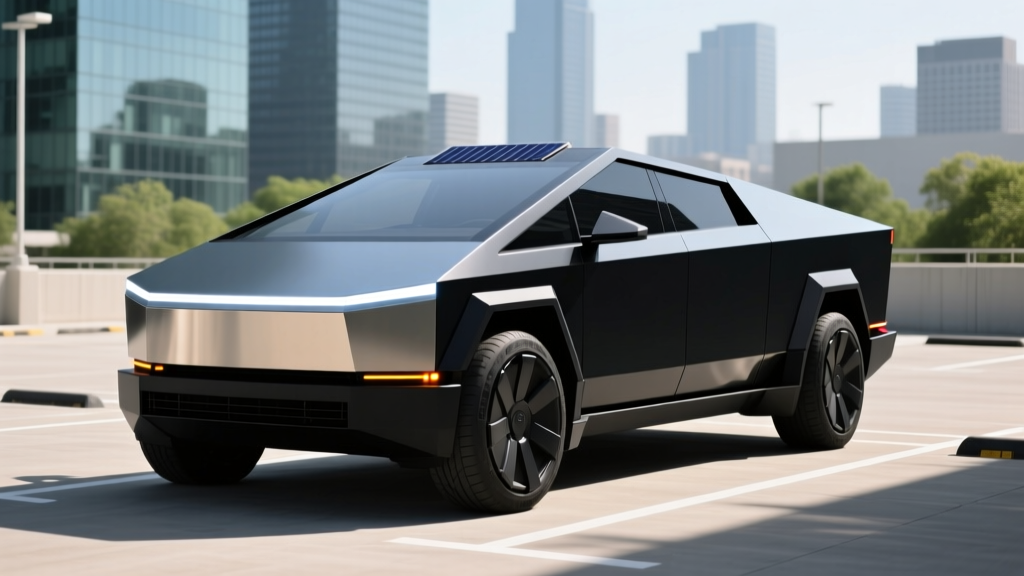
The Tesla Cybertruck remains one of the most polarizing vehicles on the road, but its stainless-steel exoskeleton and angular silhouette belie a genuinely capable electric pickup. For 2026, Tesla continues to offer the Cybertruck in dual-motor AWD and tri-motor Cyberbeast configurations, and leasing has emerged as a popular way to get into one without absorbing the steep upfront cost or worrying about long-term depreciation on such a novel platform.
This review breaks down every number that matters — EPA range versus what you'll actually see on the highway, peak and sustained charging speeds, battery chemistry, federal tax credit eligibility under current IRS §30D rules, and whether leasing makes more financial sense than buying outright in 2026.
Quick Verdict: Who Should Lease a Cybertruck?
Leasing a Cybertruck makes the most sense for buyers who want the tech-forward experience and towing capability of a full-size electric pickup but want to hedge against the unknowns: long-term stainless-steel body durability, 48-volt electrical system reliability, and residual-value risk on a low-volume, high-profile vehicle. If you plan to keep the truck for 3-5 years and drive under 15,000 miles annually, leasing can also let you capture the $7,500 federal EV tax credit as a lease-credit pass-through while keeping monthly payments predictable.
- You want a 300+ mile range electric truck with genuine off-road and towing capability
- You'd rather avoid depreciation risk on an unconventional vehicle platform
- You can meet the §30D income and sourcing requirements to capture the $7,500 credit via lease pass-through
- You need a traditional 6+ foot enclosed bed (the Cybertruck vault is 6 ft with the gate down, open-top)
- You regularly tow over 10,000 lbs (the F-150 Lightning or Rivian R1T may suit better)
- You prefer proven build quality over cutting-edge experimentation
Cybertruck Specs at a Glance
| Specification | AWD | Cyberbeast |
|---|---|---|
| EPA Range | 340 miles | 320 miles |
| Battery (usable) | ~123 kWh (NMC) | ~123 kWh (NMC) |
| Max DC Fast Charge | 350 kW (peak) | 350 kW (peak) |
| 10–80% DC Charge | ~17 min (ideal) | ~17 min (ideal) |
| Level 2 Home Charge | 11.5 kW (~37 mi/hr) | 11.5 kW (~37 mi/hr) |
| 0–60 mph | 4.1 sec | 2.6 sec |
| Horsepower | 600 hp | 845 hp |
| Drivetrain | Dual-Motor AWD | Tri-Motor AWD |
| Towing Capacity | 11,000 lbs | 11,000 lbs |
| Base MSRP (2026) | $79,990 | $99,990 |
| Efficiency (MPGe) | 67 MPGe combined | 62 MPGe combined |
Source: fueleconomy.gov, Tesla specifications. Figures reflect 2026 model-year data where available.
Real-World Range vs. EPA Estimates
🛣️ Real-World Highway (70 mph, 75°F): Expect ~270–290 miles (AWD) / ~255–275 miles (Cyberbeast)
❄️ Cold-Weather Highway (30°F, 70 mph): Expect ~220–250 miles (AWD) / ~200–230 miles (Cyberbeast)
🏙️ City/Commuter Mixed: Closer to EPA, ~300–320 miles (AWD)
The Cybertruck's massive frontal area and angular stainless-steel body create significant aerodynamic drag, which hits range hard at sustained highway speeds. Tesla's ~123 kWh usable battery pack (NMC lithium-ion chemistry) is one of the largest in any production EV, which partially offsets the efficiency penalty. In real-world testing by multiple outlets, the AWD model typically delivers between 2.0 and 2.2 kWh per mile on the highway — translating to roughly 270–290 miles before you need to find a charger.
Cold weather compounds the problem. The Cybertruck does include a heat pump for cabin and battery thermal management, which helps mitigate winter losses compared to resistive heating. But at 30°F with highway driving, plan on losing 20–30% from the EPA sticker. If your daily commute is under 80 miles round-trip, this won't matter — you'll charge at home nightly and rarely think about it. For road trips, the large battery and fast-charging capability mean fewer stops than smaller-battery trucks, even at reduced real-world efficiency.
The 47 MPGe combined figure often cited for earlier builds has been revised upward as Tesla refined the powertrain software; the 2026 AWD model now carries a 67 MPGe combined rating per the EPA, though the Cyberbeast's extra motor and weight reduce that to around 62 MPGe.
Charging: 350 kW Peak, but Mind the Curve
| Charging Level | Power / Rate | Miles Added | Notes |
|---|---|---|---|
| Level 1 (120V) | ~1.4 kW | ~4 mi/hr | Emergency/trickle only |
| Level 2 (240V, 48A) | 11.5 kW | ~37 mi/hr | Full charge in ~10–11 hrs |
| DC Fast (V4 Supercharger) | 350 kW peak | ~200 mi in 15 min | 10–80% in ~17 min (ideal) |
| DC Fast (3rd-party CCS/NACS) | Up to 350 kW | Varies | Requires NACS connector (native) |
The Cybertruck uses an 800-volt architecture, enabling its 350 kW peak DC fast-charge rate — but only at Tesla V4 Superchargers or compatible third-party stations that can deliver that power level. Here's the critical nuance that spec sheets omit: peak kW is not sustained kW.
The Cybertruck's charging curve peaks at roughly 350 kW between 10–30% state of charge (SoC), then tapers progressively. Between 50–80%, you'll typically see 120–180 kW depending on battery temperature. The advertised 10–80% time of ~17 minutes assumes ideal conditions: battery preconditioned via the in-dash navigation routing to a Supercharger, ambient temperatures above 60°F, and a V4 cabinet delivering full power. In practice at a busy Supercharger plaza on a cold day, expect 10–80% in 22–28 minutes.
For home charging, the Cybertruck accepts up to 11.5 kW on Level 2 (48 amps on a 60-amp circuit). That translates to roughly 37 miles of range per hour of charging, or a full overnight replenishment in about 10–11 hours. Tesla's Wall Connector ($420) is the recommended home unit, though any J3472/NACS-compatible Level 2 station will work with Tesla's native NACS port. Installation of a 60-amp dedicated circuit typically runs $800–$2,500 depending on your electrical panel's proximity to the garage and whether a panel upgrade is needed.
Performance and Drivetrain
The dual-motor AWD Cybertruck produces 600 horsepower and reaches 60 mph in 4.1 seconds — quick for a 6,600+ lb stainless-steel truck. The tri-motor Cyberbeast jumps to 845 hp and a supercar-rivaling 2.6-second 0–60 time. Both models feature adaptive air suspension with up to 16 inches of ground clearance in Extract mode, and steer-by-wire technology that eliminates the mechanical connection between the yoke-style steering wheel and the front wheels.
The steer-by-wire system is a genuine innovation: it allows variable steering ratios, meaning less hand movement at low speeds and more stability at highway pace. However, it takes acclimation — particularly for drivers accustomed to traditional steering feel. The yoke steering wheel (standard, no round-wheel option) also divides opinion; some owners love the open sightline to the 18.5-inch center touchscreen, while others find it awkward during multi-point turns.
Towing capacity is rated at 11,000 lbs for both trims. Be aware that towing at or near maximum will cut range roughly in half — expect 150–170 miles of real-world range with a heavy trailer. The Cybertruck includes an integrated trailer brake controller and Tesla's trailer-assist camera integration.
Pricing, Lease Math, and the Federal Tax Credit
| Trim | Base MSRP | §30D Credit | Effective Price | Est. Lease (36 mo) |
|---|---|---|---|---|
| AWD | $79,990 | $7,500* | $72,490 | ~$999–$1,199/mo |
| Cyberbeast | $99,990 | $7,500* | $92,490 | ~$1,299–$1,599/mo |
*Federal tax credit eligibility requires meeting all IRS §30D criteria. See checklist below. Lease structures may pass the credit through as a capitalized-cost reduction, but this depends on the leasing company's terms.
- ✅ MSRP Cap: Trucks/vans/SUVs must be under $80,000 MSRP — the Cybertruck AWD qualifies; the Cyberbeast at $99,990 does NOT qualify
- ✅ Buyer Income Cap: Modified AGI ≤ $300,000 (joint), $225,000 (head of household), $150,000 (single)
- ⚠️ Battery Sourcing: Critical minerals and battery components must meet phased-in domestic/free-trade-agreement sourcing thresholds — verify current-year compliance on irs.gov
- ✅ Point-of-Sale Transfer: You can transfer the credit to the dealer/lessor for an immediate price reduction at purchase or as a lease cap-cost reduction
- ⚠️ Lease Loophole (Commercial Clean Vehicle Credit §45W): Some lessors claim the commercial credit on leased vehicles, bypassing MSRP/income caps — the savings may be passed to you as a lower lease payment, but this is at the lessor's discretion
Here's where leasing a Cybertruck gets interesting. Under the IRS's "commercial clean vehicle credit" (§45W), vehicles classified as leased — technically owned by the leasing company — may qualify for a $7,500 credit regardless of MSRP caps or buyer income limits. Many Tesla lease offers in 2026 factor this into the monthly payment, effectively reducing it by $150–$250/month over a 36-month term compared to an equivalent loan without the credit.
However, the Cyberbeast's $99,990 MSRP means it cannot receive the §30D consumer credit if purchased outright. Leasing is the primary path to capturing any federal incentive on the top trim. Always confirm with Tesla Finance or your leasing company exactly how the credit is applied — whether as a cap-cost reduction (lowering your monthly payment) or as a rebate you claim at tax time.
Interior, Cargo, and Daily Practicality
The Cybertruck seats five across two rows, though the rear bench is tighter than a full-size F-150 or Silverado. Rear legroom measures approximately 38.5 inches, adequate for adults on shorter trips but not class-leading. The front features a minimalist dashboard dominated by the 18.5-inch touchscreen, which handles everything from climate control to media to vehicle settings — there are no physical buttons or stalks (turn signals are on the yoke).
The 6-foot composite bed (called the "vault") includes a motorized retractable tonneau cover that Tesla claims is strong enough to stand on. With the tailgate down, the bed extends to roughly 6 feet, but the open-top design and angular wheel wells limit traditional cargo configurations. Cargo volume in the bed is approximately 67 cubic feet. The front trunk (frunk) adds about 7 cubic feet of lockable storage — useful for groceries or a charging cable kit.
Notable practicality drawbacks include the truck's 8.5-foot width (including mirrors), which makes standard parking spaces a tight fit, and the absence of a traditional rear window (replaced by a camera feed displayed on the rearview mirror screen). The stainless-steel body is dent-resistant but shows fingerprints readily and cannot be painted without aftermarket wraps.
Driver Assistance and Technology
Tesla's Autopilot and Full Self-Driving (Supervised) are driver-assistance systems, not autonomous driving. The driver must remain fully attentive, keep hands on the yoke, and be prepared to take over at any moment. Only Level 4 services like Waymo operate without a human driver.
The Cybertruck comes standard with Tesla's basic Autopilot (adaptive cruise control + lane centering). Full Self-Driving (Supervised) remains an $8,000 option or $99/month subscription in 2026, adding automated lane changes, traffic-light and stop-sign recognition, and enhanced navigate-on-autopilot for highway interchanges. FSD has improved significantly, but it still requires active supervision — treat it as an advanced cruise control, not a self-driving system.
The Cybertruck also features Tesla's new Hardware 4 (AI4) compute platform, a 15-speaker premium audio system, HEPA air filtration, power-folding second-row seats, and built-in Wi-Fi hotspot capability. Over-the-air software updates continue to add features post-purchase, including recent additions like adaptive damping profiles and improved regenerative braking calibration.
Battery Warranty and Long-Term Ownership
Tesla covers the Cybertruck's battery and drive unit for 8 years or 120,000 miles (whichever comes first), with a minimum 70% capacity retention threshold over the warranty period. The vehicle limited warranty runs 4 years or 50,000 miles. Given the Cybertruck's relatively recent production start (late 2023), long-term degradation data specific to this platform is still limited — but Tesla's NMC chemistry in similar pack architectures (Model S/X) has historically shown 10–15% degradation over 100,000 miles.
The 48-volt electrical architecture (an industry first for a production vehicle) reduces wiring harness weight and enables features like steer-by-wire and the high-power audio system, but it also means that any electrical repairs will require specialized service. Tesla's service network has expanded, but Cybertruck-specific parts availability can involve wait times — a consideration for lease-end condition assessments.
Cybertruck vs. Key Competitors
| Spec | Cybertruck AWD | Rivian R1T Dual | F-150 Lightning Lariat |
|---|---|---|---|
| EPA Range | 340 mi | 352 mi (Max Pack) | 320 mi (Ext. Range) |
| 0–60 mph | 4.1 sec | 3.5 sec | 4.5 sec |
| Max DC Charge | 350 kW | 220 kW | 150 kW |
| Towing | 11,000 lbs | 11,000 lbs | 10,000 lbs |
| Base MSRP | $79,990 | $75,900 | $62,995 |
| Bed Length | 6 ft (vault) | 4.5 ft (w/ gear tunnel) | 5.5 ft |
The Rivian R1T offers a more refined interior, a clever gear tunnel for enclosed storage, and better off-road articulation, but charges slower and costs slightly less at the base level. The F-150 Lightning remains the value leader with a conventional truck layout, a massive frunk, and Ford's dealer network — but its charging speed and acceleration lag behind. The Cybertruck wins on raw charging speed and head-turning design, but loses on traditional truck practicality and build-consistency reputation.
Pros and Cons
- Class-leading 350 kW DC fast charging
- 340-mile EPA range (AWD) from a massive 123 kWh pack
- Standard air suspension with up to 16" ground clearance
- Stainless-steel exoskeleton is dent- and corrosion-resistant
- 11,000-lb towing capacity with integrated brake controller
- Over-the-air updates continue adding features
- Lease path captures $7,500 credit even on Cyberbeast (via §45W)
- Real-world highway range drops 15–20% vs. EPA (aero penalty)
- Cyberbeast at $99,990 MSRP does NOT qualify for §30D purchase credit
- Yoke steering and steer-by-wire require significant acclimation
- 6-ft bed is shorter than most full-size truck competitors
- 8.5-ft width makes parking challenging in standard spaces
- Build-quality inconsistency reported by early owners
- No physical buttons — all controls via touchscreen
- Stainless steel shows fingerprints; no factory paint options
Frequently Asked Questions
What is the real-world range of the Cybertruck?
The AWD model achieves an EPA-rated 340 miles, but real-world highway driving at 70 mph typically yields 270–290 miles. In cold weather (below freezing), expect 220–250 miles on the highway. The Cyberbeast, with its tri-motor setup and higher performance tuning, drops to 320 EPA / 255–275 real-world highway miles.
How fast does the Cybertruck charge?
On a Tesla V4 Supercharger or equivalent 350 kW DC fast charger, the Cybertruck can add approximately 200 miles in 15 minutes under ideal conditions. A 10–80% charge takes roughly 17 minutes when the battery is preconditioned, though real-world sessions at busy or cold-weather stations typically run 22–28 minutes. At home on a 48-amp Level 2 charger, you'll recover about 37 miles of range per hour.
Does the Cybertruck qualify for the federal EV tax credit?
The Cybertruck AWD at $79,990 MSRP qualifies for the $7,500 §30D federal tax credit if the buyer meets income limits ($150K single / $300K joint) and the battery meets current-year critical-mineral and component sourcing requirements. The Cyberbeast at $99,990 exceeds the $80,000 truck MSRP cap and does not qualify for §30D if purchased — but leasing may capture a $7,500 credit via the commercial clean vehicle credit (§45W), which has no MSRP or income cap. Always verify current rules at irs.gov.
Is leasing a Cybertruck better than buying?
Leasing offers three key advantages: (1) potential access to the $7,500 credit even on the Cyberbeast via §45W, (2) protection against depreciation on an unconventional platform with uncertain long-term residual values, and (3) lower monthly payments compared to financing the full purchase price. The downside is mileage restrictions (typically 10,000–15,000 miles/year) and no equity at lease-end. If you drive over 15K miles annually or plan to keep the truck 5+ years, buying may make more sense.
Can I tow with the Cybertruck?
Yes — both trims are rated for 11,000 lbs of towing. However, towing at or near max capacity will cut your range roughly in half, yielding approximately 150–170 real-world miles. The Cybertruck includes an integrated trailer brake controller, trailer light check, and hitch-assist camera views.
How reliable is the Cybertruck?
As a low-volume vehicle with novel technology (48V architecture, steer-by-wire, stainless-steel body), the Cybertruck has seen reports of panel-alignment issues, software glitches, and parts delays in its first two production years. Tesla has issued multiple service bulletins and OTA fixes. Long-term reliability data beyond 2–3 years does not yet exist. This uncertainty is a primary reason many buyers prefer leasing.
Sources: U.S. EPA / fueleconomy.gov, IRS Clean Vehicle Credits, Tesla product specifications. Pricing and tax-credit rules reflect 2026 guidelines and are subject to change. Consult a tax professional for personal eligibility.