Quick Verdict: Is Leasing a Model 3 the Smart Move?
The Tesla Model 3 remains one of the most compelling electric sedans on the market, and for 2026, the refreshed "Highland" platform brings meaningful improvements in ride quality, cabin insulation, and efficiency. But here's the question many buyers are asking: should you lease a Model 3 or buy one outright?
Leasing can unlock a lower monthly payment, sidestep some tax-credit eligibility headaches, and let you upgrade in three years when solid-state batteries and next-gen platforms arrive. Buying, on the other hand, lets you capture the full §30D federal tax credit (up to $7,500 if you qualify) and build equity in a car with proven long-term reliability. This review breaks down every spec, cost, and ownership factor so you can decide.
| Spec | RWD (Standard Range) | Long Range AWD | Performance |
|---|---|---|---|
| EPA Range | 272 mi | 363 mi | 315 mi |
| Battery (usable) | ~57 kWh (LFP) | ~75 kWh (NMC) | ~75 kWh (NMC) |
| Peak DC Fast Charge | 170 kW | 250 kW | 250 kW |
| 10–80% DC Charge Time | ~25 min | ~30 min | ~30 min |
| Level 2 Home Charge | 11.5 kW (~44 mi/hr) | 11.5 kW (~44 mi/hr) | 11.5 kW (~44 mi/hr) |
| 0–60 mph | 5.8 sec | 4.2 sec | 2.9 sec |
| Horsepower | 271 hp | 366 hp | 510 hp |
| Drivetrain | RWD | Dual-Motor AWD | Dual-Motor AWD |
| MPGe (combined) | 132 MPGe | 130 MPGe | 115 MPGe |
| Efficiency | 25 kWh/100mi | 26 kWh/100mi | 29 kWh/100mi |
| Base MSRP | $38,990 | $47,740 | $53,740 |
Real-World Range: What to Actually Expect
EPA Sticker: 272 mi (RWD) / 363 mi (Long Range AWD)
Real-World Expectation: In mixed driving at 70°F, expect roughly 245–260 miles from the RWD and 320–340 miles from the Long Range. At sustained highway speeds of 75+ mph, range drops to approximately 220–235 mi (RWD) and 290–310 mi (Long Range). In freezing temperatures (below 32°F), plan for a 20–30% reduction — bringing the RWD to around 185–210 miles and the Long Range to 240–280 miles before needing a charge.
Tesla's efficiency remains best-in-class among sedans, thanks in part to the Highland refresh's improved aerodynamics and the standard heat pump, which recovers waste heat from the drivetrain to warm the cabin rather than relying solely on resistive heating. That heat pump is the reason cold-weather range loss, while still significant, is less brutal than in older EVs without thermal management. Still, if you live in Minnesota or Maine, the Long Range AWD's larger battery buffer is a practical necessity, not a luxury.
The RWD model uses a lithium iron phosphate (LFP) battery, which Tesla recommends charging to 100% regularly — a meaningful advantage for daily commuters who want the full 272-mile buffer available every morning. The Long Range and Performance trims use nickel-manganese-cobalt (NMC) chemistry, which performs best when daily charging is limited to 80–90% to preserve long-term health.
Charging Speed: Home and DC Fast Charging
| Charging Level | Power | Miles Added per Hour | Notes |
|---|---|---|---|
| Level 1 (120V household) | ~1.4 kW | ~5 mi/hr | Emergency/trickle only; full charge takes 40+ hours |
| Level 2 (240V home, 48A) | 11.5 kW | ~44 mi/hr | Full charge overnight in ~6–8 hours; requires NEMA 14-50 or hardwired Wall Connector |
| Level 2 (240V, 32A Mobile Connector) | 7.7 kW | ~30 mi/hr | Included Mobile Connector with dryer adapter |
| DC Fast Charge (RWD) | Peak 170 kW | — | 10–80% in ~25 min; taper significant above 80% |
| DC Fast Charge (LR/Perf) | Peak 250 kW | — | 10–80% in ~30 min; V3 Supercharger compatible |
A critical nuance many buyers miss: peak kW is not sustained kW. The Long Range Model 3 hits 250 kW only briefly at a low state of charge (around 10–15%). As the battery fills, the charge curve tapers — by 60% SoC you'll see roughly 120–140 kW, and above 80% it drops below 50 kW. This is why the 10–80% time is the metric that matters for road trips, not the peak number.
For home charging, Tesla's Wall Connector at $420 is among the best Level 2 units available. It's hardwired, supports up to 48 amps on a 60-amp circuit, and can share a single circuit with a second Wall Connector via power sharing. Installation costs vary widely — expect $500–$2,000 depending on whether your electrical panel needs an upgrade. A 200-amp panel is generally sufficient; older homes with 100-amp service may need a $1,500–$3,000 panel upgrade.
On the road, the Model 3 uses the North American Charging Standard (NACS) connector natively — no adapter needed at Tesla Superchargers. With Tesla's Supercharger network now exceeding 6,000 U.S. stations, public charging access is the strongest argument for the Model 3 over CCS-equipped competitors. You can also use CCS stations with an adapter, though speeds and reliability vary by network.
Performance, Efficiency, and Driving Dynamics
Even the base RWD Model 3 delivers a 5.8-second 0–60 mph time — quicker than most gas-powered sport sedans in the $40,000 bracket. The instant torque from the rear-mounted permanent magnet motor makes city driving feel effortless, and the single-pedal driving mode (via regenerative braking) means you rarely touch the brake pedal in stop-and-go traffic.
The Long Range AWD adds a front induction motor for a combined 366 hp and all-weather traction. Its 4.2-second sprint to 60 mph is genuinely fast, while the Performance trim's 510 hp and 2.9-second 0–60 puts it in sports car territory. All trims feature Tesla's adaptive damping suspension (new for Highland), which dramatically improves ride comfort over the pre-2024 Model 3 — a complaint that used to dominate owner forums.
Efficiency is where the Model 3 truly excels. At 132 MPGe combined (25 kWh/100 mi) for the RWD, it sips less electricity per mile than nearly any EV on the market. For context, that translates to roughly $0.04–$0.06 per mile when charging at home on a national-average electricity rate of $0.16/kWh — compared to $0.12–$0.15 per mile for a 30-MPG gas car at $3.50/gallon.
Interior, Cargo, and Technology
The Highland interior is a significant step up in materials and quietness. Ventilated front seats are now standard, ambient lighting replaces the previous austerity, and a rear 8-inch touchscreen gives back-seat passengers control over climate and media. Cabin noise at highway speed is noticeably lower thanks to acoustic glass and additional sound deadening.
Cargo space: 23 cu ft total (15.6 cu ft trunk + 7.4 cu ft front trunk/frunk). That's competitive with compact luxury sedans but trails hatchbacks like the Hyundai Ioniq 5 or Tesla's own Model Y (76 cu ft with seats folded). Rear-seat legroom measures 35.3 inches — adequate for adults on shorter trips but tight for six-footers on long drives.
Tech highlights:
- 15.4-inch center touchscreen with Tesla's latest UI (no physical instrument cluster)
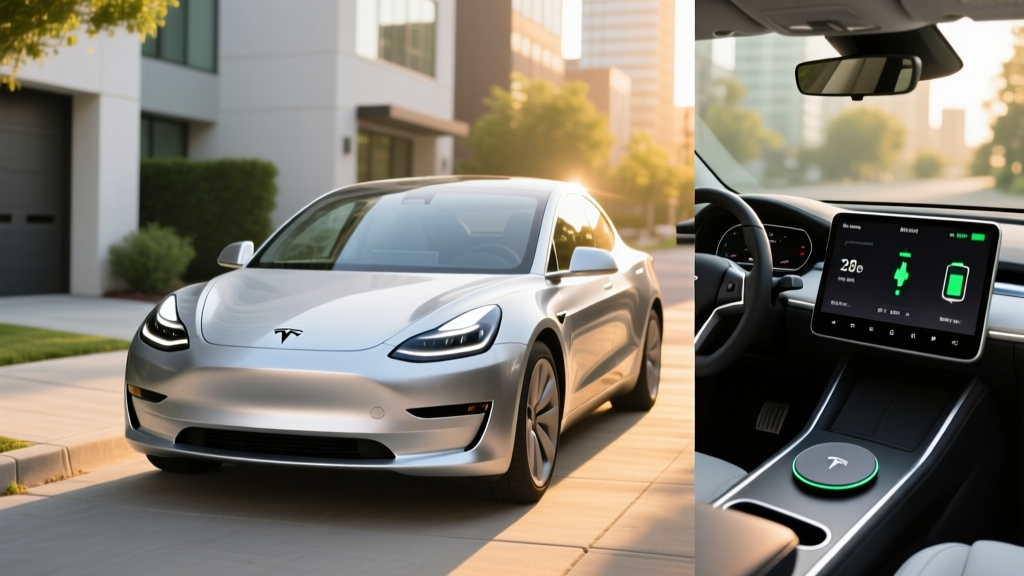
- Wireless phone charging pad (two phones)
- Tesla Autopilot standard (SAE Level 2 — requires hands on wheel and active supervision)
- Full Self-Driving (Supervised) available as a $8,000 option or $99/month subscription — still Level 2, not autonomous
- Over-the-air updates continuously add features
- Sentry Mode dashcam recording, Dog Mode, and Camp Mode
Important: Tesla Autopilot and FSD (Supervised) are SAE Level 2 driver-assistance systems. They do not make the Model 3 self-driving. You must remain attentive, keep your hands on the steering wheel, and be prepared to take over at any moment. Misuse of these systems has contributed to NHTSA-investigated crashes.
Notable drawbacks: No Apple CarPlay or Android Auto (Tesla uses its own ecosystem exclusively). No physical buttons for climate, wipers, or turn signals (all controlled via the touchscreen or steering-wheel stalks, though the Highland restored a turn-signal stalk after backlash). The minimalist approach is polarizing — some owners love it, others find it distracting.
Pricing, Lease vs. Buy, and Tax Credit Eligibility
This is where the "lease a Model 3" question gets interesting. Here's the current pricing landscape:
| Trim | Base MSRP | Federal Credit (§30D) | Effective Price (if eligible) | Est. Monthly Lease* |
|---|---|---|---|---|
| RWD (Standard Range) | $38,990 | Up to $7,500 | $31,490 | $329–$399/mo |
| Long Range AWD | $47,740 | Up to $7,500 | $40,240 | $449–$529/mo |
| Performance | $53,740 | Up to $7,500 | $46,240 | $549–$649/mo |
*Estimated lease payments based on 36-month/10,000-mile terms with $3,000–$4,500 due at signing. Actual offers vary by region and creditworthiness. Check Tesla.com for current promotions.
Does the Model 3 Qualify for the Federal EV Tax Credit?
The Model 3 can qualify for the full $7,500 §30D credit, but eligibility depends on several factors that change frequently:
- MSRP cap: Sedans must be under $55,000. The RWD and Long Range clear this; the Performance trim at $53,740 squeaks under but any options that push it above $55,000 will disqualify it.
- Buyer income cap: Adjusted gross income must not exceed $150,000 (single), $225,000 (head of household), or $300,000 (joint filing).
- Battery sourcing: A percentage of critical minerals and battery components must be sourced from the U.S. or free-trade-agreement countries. Tesla's supply chain has been shifting to comply, but specific eligibility can change month to month — always verify on the fueleconomy.gov credit lookup before purchasing.
- Point-of-sale transfer: As of 2024, you can transfer the credit to the dealer at purchase, effectively reducing the purchase price by $7,500 at the time of sale rather than waiting for a tax refund.
Why Leasing May Be the Better Path
Here's the key advantage of leasing a Model 3: the commercial clean vehicle credit (§45W) applies to leased EVs. When Tesla (or its financing arm) leases the car to you, the manufacturer captures a $7,500 credit and typically passes it through as a lower lease payment — regardless of your personal income, the vehicle's battery sourcing, or MSRP caps. This "lease loophole" means even high-income buyers who wouldn't qualify for §30D can access the $7,500 benefit.
Leasing also makes sense if:
- You want to drive a new EV every 3 years as battery tech evolves rapidly
- You're uncertain about long-term battery degradation or resale value
- Your state offers additional lease-specific incentives
- You drive under 12,000 miles per year (most leases cap at 10K–12K annually)
Buying makes more sense if you plan to keep the car 5+ years, drive high annual mileage, want to avoid lease-end disposition fees, or can fully utilize the §30D credit on a purchase.
Warranty and Long-Term Ownership
Tesla's warranty structure is straightforward:
- Basic vehicle: 4 years / 50,000 miles
- Battery & drive unit (RWD): 8 years / 100,000 miles, whichever comes first, with minimum 70% capacity retention
- Battery & drive unit (Long Range/Performance): 8 years / 120,000 miles, minimum 70% capacity retention
The 70% retention threshold means Tesla will replace or repair the battery if it degrades below 70% of original capacity within the warranty period. Real-world data from Tesla's fleet suggests most Model 3 batteries retain 85–90% capacity at 100,000 miles, with LFP packs (RWD) showing particularly strong longevity due to the chemistry's inherent cycle-life advantage. An out-of-warranty battery replacement runs approximately $12,000–$16,000 depending on the pack — a figure worth knowing for long-term planning, though relatively few owners need it.
Model 3 vs. Key Competitors: Is It Worth It?
Pros
- Best-in-class efficiency (132 MPGe RWD)
- Native NACS — seamless Supercharger access, no adapter needed
- Over-the-air updates keep the car current for years
- LFP battery on RWD can be charged to 100% daily
- Highland ride quality is dramatically improved
- Strong resale value relative to most EVs
- Lease loophole makes $7,500 credit accessible to all income levels
Cons
- No Apple CarPlay or Android Auto
- Rear seat legroom is tight for tall adults (35.3 in)
- Cargo space (23 cu ft) trails hatchback/crossover EVs
- Turn signals and climate on touchscreen frustrate some drivers
- Insurance costs run 15–25% higher than comparable gas sedans
- FSD subscription is expensive and still not truly autonomous
- Supercharger-only advantage is narrowing as other brands gain NACS access
The Model 3's most direct competitors include the Hyundai Ioniq 6 (361 mi range, $37,500, more rear room, but CCS charging and lower Supercharger access), the BMW i4 (premium badge, ~300 mi, $52,200, heavier and less efficient), and the Polestar 2 (320 mi, $49,800, Google-based infotainment, also switching to NACS). Against all of them, the Model 3 wins on efficiency and charging infrastructure; it trades blows on range and loses on interior space and smartphone integration.
Who Should Lease a Model 3?
The Model 3 is ideal for: daily commuters who want low running costs and a quiet, quick ride; tech-forward buyers who value OTA updates and a strong Supercharger network; and lease-minded shoppers who want to access the $7,500 credit without worrying about income or sourcing restrictions.
It's less suited for: families needing max cargo (consider the Model Y or Ioniq 5); frequent road-trippers in rural areas where Supercharger density is lower; and drivers who demand Apple CarPlay or traditional button-based controls.
Frequently Asked Questions
What is the real-world range of the Tesla Model 3?
The EPA rates the RWD at 272 miles and the Long Range AWD at 363 miles. In real-world mixed driving at moderate temperatures, expect about 245–260 miles (RWD) and 320–340 miles (Long Range). Sustained highway driving at 75+ mph and cold weather below freezing will reduce these figures by 15–30%.
How fast does the Model 3 charge at home and on the road?
At home on a 240V Level 2 charger (48A), the Model 3 adds roughly 44 miles of range per hour, fully charging overnight in 6–8 hours. On a DC fast charger, the RWD peaks at 170 kW (10–80% in ~25 minutes) and the Long Range/Performance peaks at 250 kW (10–80% in ~30 minutes). Actual speeds depend on state of charge, battery temperature, and charger availability.
How much does the Model 3 cost after tax credits?
If you qualify for the full §30D federal credit, the RWD drops to roughly $31,490, the Long Range to $40,240, and the Performance to $46,240. If you lease, the commercial credit (§45W) often passes through as a reduced monthly payment regardless of your income — making the effective savings similar without the eligibility hurdles.
Does the Tesla Model 3 qualify for the $7,500 federal EV tax credit?
It can, subject to IRS §30D rules. Your income must fall under the caps ($150K single / $300K joint), the vehicle MSRP must stay under $55,000 for sedans, and the battery must meet critical-mineral and component-sourcing requirements that change periodically. Always verify current eligibility at fueleconomy.gov and consult a tax professional before relying on the credit.
Is it better to lease or buy a Model 3 in 2026?
Leasing is advantageous if you want to access the $7,500 credit without income or sourcing restrictions, prefer lower monthly payments, and plan to upgrade in 3 years. Buying makes more sense if you'll keep the car 5+ years, drive high mileage, want to build equity, and can meet §30D eligibility requirements. Run the numbers for both using Tesla's online configurator and your state's specific incentives.
How long will the Model 3 battery last?
Tesla warranties the battery for 8 years / 100,000 miles (RWD) or 8 years / 120,000 miles (Long Range/Performance) with at least 70% capacity retention. Real-world fleet data suggests most Model 3 batteries retain 85–90% capacity at 100,000 miles. The LFP battery in the RWD model tends to show even slower degradation due to its chemistry.