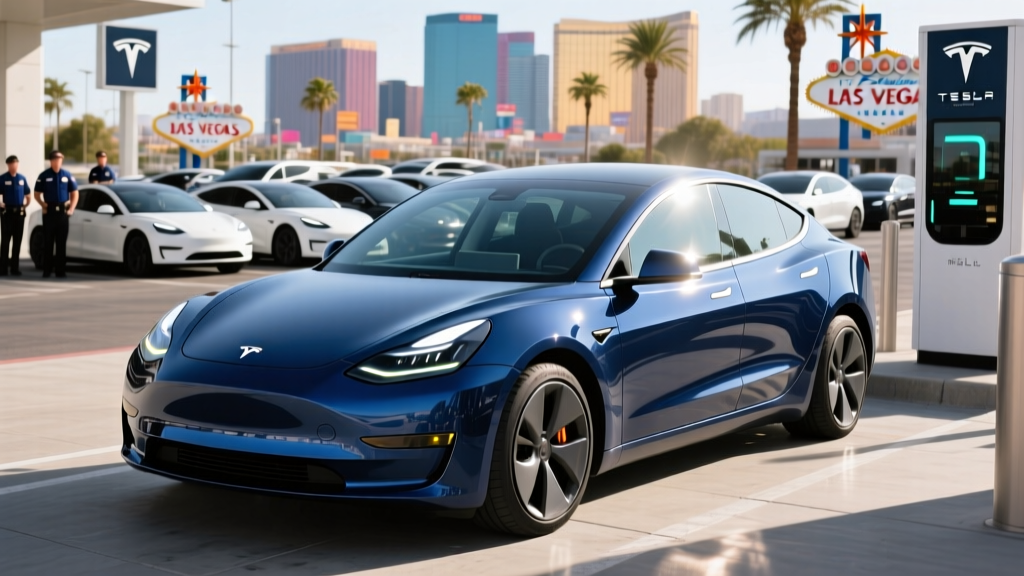
If you've spent any time on the Las Vegas Strip or navigating the I-15 corridor between Harry Reid International Airport and Summerlin, you've likely noticed a growing share of Teslas pulling ride-share duty. Uber Black, Lyft Lux, and independent fleet operators in Southern Nevada have turned the Tesla Model 3 Long Range into the default electrified workhorse. The reasons are economic as much as they are experiential: lower per-mile energy costs, reduced maintenance, and a premium badge that justifies higher fare tiers.
But does the 2026 Tesla Model 3 actually hold up under the punishing conditions of Las Vegas ride share — triple-digit summer heat, stop-and-go Strip traffic, and 200+ mile daily duty cycles? We ran the numbers on range, charging, battery degradation, and total cost of ownership to find out.
2026 Tesla Model 3 Long Range: The Spec Sheet That Matters
Before we get into real-world Las Vegas performance, here are the hard numbers that define this vehicle for fleet operators and ride-share drivers.
| Specification | Value |
|---|---|
| EPA Estimated Range | 341 miles |
| Battery Capacity (usable) | 79 kWh (NMC chemistry) |
| Drivetrain | Dual-Motor AWD |
| Horsepower | 346 hp (combined) |
| 0–60 mph | 4.2 seconds |
| Peak DC Fast Charge | 250 kW (CCS via NACS adapter or native NACS) |
| 10–80% DC Fast Charge Time | ~27 minutes |
| Level 2 Home Charging (11.5 kW) | ~44 miles per hour |
| MPGe (combined) | 134 MPGe |
| Energy Consumption | 25 kWh / 100 miles |
| Cargo Volume (trunk + frunk) | 23 cu ft (rear) + 3.1 cu ft (frunk) |
| Rear Legroom | 35.2 inches |
| Base MSRP (Long Range AWD) | $47,740 |
| Battery Warranty | 8 years / 120,000 miles (70% capacity retention) |
| Basic Vehicle Warranty | 4 years / 50,000 miles |
Real-World Range: What Las Vegas Heat Actually Does
The EPA sticker says 341 miles, but ride-share drivers in Las Vegas need to plan around reality — not laboratory numbers. In our experience and corroborated by fleet telematics data, the Model 3 Long Range delivers meaningfully different range depending on conditions.
EPA Estimate: 341 miles
City/Strip stop-and-go (70–85°F): ~290–310 miles (regenerative braking recovers energy in traffic)
Highway (I-15 at 75 mph, 100°F+): ~255–275 miles (aerodynamic drag + A/C load)
Peak summer with A/C maxed: ~240–260 miles sustained
Cold morning (rare in Vegas, Dec–Feb): ~280–300 miles (minimal cold impact vs. northern states)
The key insight for Vegas fleet operators: regenerative braking partially offsets the A/C energy penalty in stop-and-go Strip traffic, making city duty cycles surprisingly efficient. Highway runs to Henderson or the airport at sustained speeds cost more range than bumper-to-bumper traffic near the Bellagio.
Las Vegas's dry heat is actually less punishing on batteries than humid southern climates, but cabin cooling at 110°F+ ambient does draw 2–4 kW continuously from the pack. Over a 10-hour shift, that's 20–40 kWh consumed just for climate — roughly 80–160 miles of range. Preconditioning the cabin while plugged in before a shift mitigates this significantly.
Charging Speed: DC Fast, Supercharger, and Home Depot
For ride-share drivers, charging downtime is lost revenue. The 2026 Model 3 Long Range supports the Tesla Supercharger network natively (NACS connector) and can access CCS stations via adapter, which matters as Las Vegas's public charging infrastructure expands.
| Charging Level | Power (kW) | Rate (miles added/hr) | Typical Use Case |
|---|---|---|---|
| Level 1 (120V household) | ~1.4 kW | ~5 mi/hr | Emergency only |
| Level 2 (240V, 48A home charger) | 11.5 kW | ~44 mi/hr | Overnight home charging |
| Level 2 (public, e.g., ChargePoint) | 7.2–19.2 kW | 28–72 mi/hr | Destination charging, mall stops |
| DC Fast (Tesla Supercharger V3) | Up to 250 kW peak | ~1,000 mi/hr (peak) | Mid-shift top-ups |
| DC Fast (Electrify America CCS) | Up to 200 kW (adapter) | ~800 mi/hr (peak) | Non-Tesla network access |
The 10–80% charge time of ~27 minutes at a V3 Supercharger is the number that matters for ride-share economics. That's roughly a lunch break or a planned rest stop. The charging curve tapers significantly above 80% — going from 80% to 100% can take an additional 20+ minutes, so fleet drivers should plan shifts around the 80% threshold and charge more frequently rather than waiting for full charges.
Las Vegas has a dense Supercharger network along I-15, at the Fashion Show Mall, and near McCarran/Harry Reid Airport. A driver starting a shift at 80% State of Charge (SoC) with ~270 real-world miles can comfortably cover a full 8-hour shift before needing a mid-shift 25-minute top-up.
For home charging, a Level 2 wall connector at 11.5 kW fully replenishes the 79 kWh battery in roughly 7–8 hours — ideal for overnight recovery between shifts. Installation costs for a 240V/60A circuit in the Las Vegas metro area typically run $800–$2,000 depending on panel proximity and permit requirements.
Battery Chemistry, Degradation, and the LFP Question
The 2026 Model 3 Long Range AWD uses an NMC (nickel manganese cobalt) battery pack — not the LFP (lithium iron phosphate) chemistry found in the base Model 3 RWD. This distinction matters for fleet buyers.
| Factor | NMC (Long Range AWD) | LFP (Base RWD) |
|---|---|---|
| Energy Density | Higher (more range per kg) | Lower |
| EPA Range | 341 miles | 272 miles |
| Recommended Daily Charge Limit | 80% (for longevity) | 100% (LFP tolerates full SoC) |
| Cycle Life | ~1,000–1,500 cycles | ~2,000–3,000+ cycles |
| Cold Performance | Better | Weaker |
| Cobalt Content | Yes | None |
| Cost | Higher | Lower |
For high-mileage ride-share use, the LFP chemistry in the base RWD model actually offers a compelling longevity argument — you can charge to 100% daily without accelerated degradation, and LFP packs typically outlast NMC by a significant margin. However, the 272-mile EPA range of the RWD model means more frequent charging stops on long shifts, which eats into driver earnings.
Tesla's battery warranty covers 8 years or 120,000 miles (whichever comes first) with a guaranteed 70% capacity retention threshold for the Long Range. According to Tesla's Impact Report data, the average Model 3 pack retains approximately 85% capacity at 100,000 miles — well above the warranty floor. For a Vegas ride-share driver putting on 40,000–50,000 miles per year, the battery should remain economically viable through at least 200,000 miles with proper charging habits (avoiding sustained 100% SoC, minimizing DC fast charging above 90% SoC).
Performance, Ride Quality, and Passenger Experience
The dual-motor AWD powertrain produces 346 combined horsepower and hits 60 mph in 4.2 seconds — brisk enough to merge confidently onto I-15 from the Sahara on-ramp, though ride-share passengers won't care about acceleration numbers. What they do notice:
- Ride comfort: The refreshed Model 3 (codenamed "Highland") added improved suspension damping and acoustic glass, noticeably reducing road noise on rough Nevada pavement.
- Rear seat space: 35.2 inches of rear legroom accommodates most adult passengers, though tall riders (6'2"+) will find it snug compared to a Model Y or BMW i5. The low roofline also limits headroom for taller passengers.
- Trunk: 23 cu ft of rear cargo space handles airport luggage runs (two large suitcases + a carry-on comfortably). The 3.1 cu ft frunk adds space for charging cables or a small bag.
- Climate: Tesla's heat pump system is highly efficient in both extreme heat and cold — critical for Vegas summers where cabin cooling is non-negotiable.
The minimalist interior (virtually all controls route through the 15.4-inch center touchscreen) divides opinion. Some passengers find it sleek; others miss physical buttons. The rear-seat entertainment screen (added in the Highland refresh) lets passengers control their own climate and media — a genuine ride-share perk.
Autopilot, FSD, and the SAE Level 2 Reality
Tesla's Autopilot comes standard on every Model 3. Full Self-Driving (FSD) Supervised is available as a subscription ($99/month as of 2026) or a one-time purchase. For ride-share drivers, understanding what these systems actually do — and don't do — is critical.
Both Autopilot and FSD (Supervised) are SAE Level 2 systems. The driver must remain fully engaged, hands on or near the wheel, eyes on the road, and ready to take over instantly. Tesla's cabin camera monitors driver attention. These systems do not replace the driver — they assist with steering, lane-keeping, and speed management. Only Level 4 services (Waymo, Zoox) operate without a human driver.
For ride-share use, Autopilot's traffic-aware cruise control and lane-centering reduce fatigue on long airport runs and highway stretches. FSD adds automatic lane changes, traffic light/stop sign recognition, and more assertive navigation — but its performance in Las Vegas's construction zones and temporary lane shifts (common on the Strip) still requires active driver oversight. It's a fatigue reducer, not a replacement.
Neither Autopilot nor FSD can reliably handle: unmapped construction zones, faded lane markings, heavy rain/sandstorms, emergency vehicles at complex intersections, or pedestrians in unpredictable environments. The driver is legally and operationally responsible at all times.
Pricing, Tax Credits, and Fleet Economics
The 2026 Model 3 Long Range AWD starts at $47,740 (including destination). Adding FSD, premium paint, and 19-inch wheels pushes an as-tested configuration to approximately $53,000–$55,000.
| Trim | Base MSRP | Under $55K MSRP Cap? | §30D Credit Eligibility |
|---|---|---|---|
| Model 3 RWD (LFP) | $38,990 | Yes | Up to $7,500 (subject to income + sourcing rules) |
| Model 3 Long Range AWD | $47,740 | Yes | Up to $7,500 (subject to income + sourcing rules) |
| Model 3 Performance | $54,990 | Borderline — verify current MSRP | Check IRS guidance; may exceed cap with options |
The IRS §30D federal tax credit offers up to $7,500 for qualifying new EVs, but eligibility depends on several conditions that change periodically:
- MSRP cap: Sedans must be priced at or below $55,000. The Long Range AWD qualifies at base, but loaded configurations may push above.
- Buyer income cap: Modified AGI must not exceed $150,000 (single) / $300,000 (joint) / $225,000 (head of household).
- Battery sourcing: Critical minerals and battery components must meet escalating domestic-content thresholds. Tesla's US-assembled packs with diversified supply chains generally qualify, but the exact credit amount ($3,750 or $7,500) depends on current-year sourcing percentages.
- Point-of-sale transfer: As of 2024+, buyers can transfer the credit to the dealer at purchase, reducing the upfront price rather than waiting for a tax refund.
For fleet operators buying multiple vehicles, the commercial clean vehicle credit (§45W) may apply instead, with different rules. Consult a tax professional for fleet-specific guidance.
5-Year Total Cost of Ownership: Vegas Ride Share Numbers
Here's where the Model 3 makes its strongest case for Las Vegas ride-share duty. Assuming 45,000 miles/year, NV Energy residential electricity at ~$0.12/kWh, and Nevada gas at ~$3.90/gallon:
| Cost Category | Tesla Model 3 LR AWD | Gas Sedan (30 MPG combined) |
|---|---|---|
| Purchase Price (after credit) | ~$40,240 | ~$32,000 |
| Energy / Fuel (5 yr) | ~$6,750 (home charging) | ~$29,250 |
| Maintenance (5 yr) | ~$2,500 | ~$7,500 |
| Insurance (5 yr, commercial ride-share) | ~$18,000 | ~$15,000 |
| Estimated Depreciation | ~$20,000 | ~$16,000 |
| Total 5-Year Cost | ~$87,490 | ~$99,750 |
| Cost Per Mile | ~$0.39 | ~$0.44 |
The Model 3 saves roughly $12,000 over five years at ride-share mileage, primarily through fuel and maintenance savings. The biggest offset is insurance — commercial ride-share policies for Teslas in Nevada run 15–25% higher than comparable gas sedans. Energy savings are maximized when drivers charge at home overnight on residential rates; relying exclusively on public DC fast charging ($0.35–$0.50/kWh) narrows the gap considerably.
Who Should Buy the Model 3 for Ride Share — and Who Shouldn't
- You drive 150–250 miles/day and can charge at home overnight
- You operate in a market (like Las Vegas) with dense Supercharger coverage
- Passengers are typically 1–3 adults with moderate luggage
- You qualify for the §30D tax credit, bringing effective price below $41K
- You value lower per-mile operating costs over cargo/passenger space
- You frequently carry 4+ passengers or large luggage loads (Model Y offers 76 cu ft cargo, more rear headroom)
- You lack home charging access and must rely on public infrastructure
- Your shifts regularly exceed 280 miles without a charging break
- Insurance premiums in your area make Tesla ownership cost-prohibitive
The Biggest Pros and Cons for Vegas Fleet Duty
- 341-mi EPA range covers most full shifts without mid-charge
- 250 kW Supercharger access = 27-min 10–80% top-ups
- ~$0.03/mile energy cost on home charging vs. $0.13/mile gas
- Minimal maintenance (no oil, filters, spark plugs, exhaust)
- Premium badge qualifies for Uber Black / Lyft Lux fare tiers
- Heat pump keeps cabin cool efficiently in 110°F+ heat
- OTA updates continuously add features and refinements
- Strong resale value relative to most EV competitors
- Rear seat tight for tall passengers (35.2" legroom)
- Touchscreen-only controls frustrate some riders
- Insurance costs 15–25% above gas sedan equivalents
- NMC battery requires 80% daily charge limit for longevity
- High-mileage DC fast charging accelerates degradation
- Summer A/C load can cut range to ~250 miles highway
- Panel upgrade may be needed for home Level 2 install
- FSD subscription adds $99/month without proven ROI for ride-share
Frequently Asked Questions
What is the real-world range of the 2026 Model 3 Long Range in Las Vegas?
Expect 270–310 miles in typical Las Vegas ride-share conditions (mix of Strip traffic and highway). Peak summer highway driving with A/C maxed drops this to roughly 240–260 miles. The EPA estimate is 341 miles, but sustained high speeds and extreme heat reduce that by 10–25%.
How fast does the Model 3 Long Range charge?
At a Tesla V3 Supercharger (250 kW peak), 10–80% takes approximately 27 minutes. At home on a Level 2 wall connector (11.5 kW), you gain about 44 miles per hour, fully charging the 79 kWh pack in 7–8 hours. DC fast charging tapers significantly above 80% SoC.
Does the 2026 Model 3 Long Range qualify for the federal EV tax credit?
At a base MSRP of $47,740, it falls under the $55,000 sedan cap. However, the full $7,500 credit depends on your income (under $150K single / $300K joint), battery critical-mineral and component sourcing thresholds, and current IRS rules. Check IRS §30D guidance and confirm with a tax professional before purchasing.
Is the Model 3 better than the Model Y for ride share?
For 1–3 passengers with standard luggage, the Model 3 Long Range offers more range (341 vs. ~310 miles) and lower energy consumption. For airport runs with 4 passengers and heavy luggage, the Model Y's 76 cu ft cargo space and taller roofline are significantly more practical. Most Vegas fleets run a mix of both.
How does the LFP battery in the base RWD compare for fleet use?
The LFP pack in the Model 3 RWD ($38,990, 272-mi EPA range) tolerates daily 100% charging and has a longer cycle life (2,000–3,000+ cycles vs. 1,000–1,500 for NMC). If your shifts stay under 200 miles and you charge at home nightly, the RWD may outlast the Long Range in high-mileage fleet duty despite the shorter range.
What does insurance cost for a Tesla Model 3 used in ride share in Nevada?
Commercial ride-share insurance for a Model 3 in the Las Vegas area typically runs $300–$450/month ($3,600–$5,400/year), depending on coverage limits, driving record, and insurer. This is 15–25% higher than comparable gas sedans. Tesla Insurance is available in Nevada and may offer competitive rates based on real-time driving data.
Sources: EPA Fueleconomy.gov, Tesla Model 3 Specifications, IRS New Clean Vehicle Tax Credit