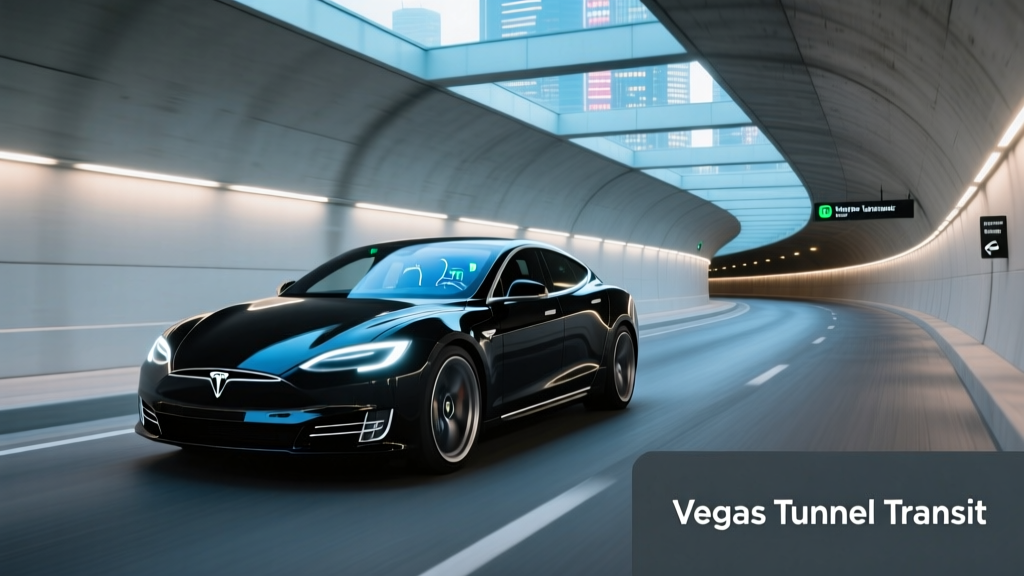
The Las Vegas Tesla Loop — officially branded the Vegas Loop — is The Boring Company's underground transit network that ferries passengers beneath the Las Vegas Strip and Convention Center in modified Tesla vehicles. What began as a single convention-center connector in 2021 has grown into a multi-station system serving tens of thousands of riders daily, with aggressive expansion plans targeting the Strip's major resorts and Harry Reid International Airport.
If you've searched for Las Vegas Tesla Loop and wondered what the experience is actually like, which vehicles run in the tunnels, how the underlying Tesla Model Y performs outside the tunnel context, and whether this system is a genuine transit alternative or a novelty — this guide covers all of it with hard numbers.
What the Vegas Loop Is (and Isn't)
The Vegas Loop is a point-to-point underground transportation system built by The Boring Company, Elon Musk's tunneling venture. Passengers hail a ride through an app or kiosk, descend to a station via elevator or escalator, and board a Tesla Model Y (or, in earlier phases, a Model 3) driven by a human operator through narrow, brightly lit tunnels at speeds up to roughly 35-40 mph.
Key facts as of early 2026:
- Operator: The Boring Company (contracted by the Las Vegas Convention and Visitors Authority, LVCVA)
- Vehicles: Tesla Model Y (primarily), with some Model 3 units from earlier phases
- Current stations: ~50+ stations across the Convention Center campus, Westgate, Resorts World, Wynn/Encore, and the University of Nevada, Las Vegas (UNLV)
- Planned expansion: Over 90 miles of tunnel and 69 stations are approved, including the Strip corridor and airport
- Autonomy level: SAE Level 0 — vehicles are human-driven in the tunnels; Autopilot/FSD is not engaged for transit operations
- Fare: Free for Convention Center attendees during events; paid fares expected for public Strip service
Tesla Model Y: The Vehicle Powering the Loop
The Tesla Model Y is the workhorse of the Vegas Loop fleet. Whether you're evaluating the Loop experience or considering buying a Model Y yourself, here are the complete 2026 specifications for the vehicle you'll actually ride in.
| Spec | Value |
|---|---|
| EPA Range | 320 miles |
| Battery Capacity | ~75 kWh usable (NMC chemistry) |
| Drivetrain | Dual-motor AWD |
| Horsepower | 384 hp |
| 0-60 mph | 4.8 seconds |
| Max DC Fast Charge | 250 kW peak (V3 Supercharger) |
| 10-80% DCFC Time | ~27 minutes |
| Level 2 Home Charge | 11.5 kW (~44 mi/hr) |
| MPGe (Combined) | 117 MPGe |
| Efficiency | 29 kWh/100 mi |
| Cargo Volume | 30.2 cu ft (rear seats up) / 72.1 cu ft (folded) |
| Rear Legroom | 35.2 inches |
| Battery/Drive Unit Warranty | 8 years / 120,000 miles |
| Base MSRP | $44,990 (Long Range AWD) |
Source: EPA Fuel Economy, Tesla.com
Charging Infrastructure: How Tesla Keeps the Fleet Running
The Vegas Loop fleet doesn't rely on public charging. The Boring Company maintains dedicated Supercharger stalls at depot locations where vehicles charge between shifts. Here's what the Model Y's charging architecture looks like in detail:
| Charge Level | Power (kW) | Miles Added per Hour | Typical Use Case |
|---|---|---|---|
| Level 1 (120V) | ~1.4 kW | ~3-4 mi/hr | Emergency / trickle |
| Level 2 (240V, 48A) | 11.5 kW | ~44 mi/hr | Home / depot overnight |
| DC Fast (V3 Supercharger) | 250 kW peak | ~1,000+ mi/hr (peak) | Fleet turnaround, road trips |
Charging curve reality: The Model Y's 250 kW peak rate is not sustained across the full session. The vehicle charges fastest between 10-50% SoC, then tapers significantly above 80%. A typical 10-80% session takes about 27 minutes at a V3 Supercharger, but pushing from 80-100% can add another 20+ minutes. Fleet operators optimize for 10-80% cycles to maximize vehicle uptime.
Riding the Vegas Loop: The Passenger Experience
For visitors and convention-goers, the practical question isn't the Model Y's spec sheet — it's whether the Loop actually saves time compared to walking, rideshare, or the Las Vegas Monorail.
Current Route Coverage
As of 2026, the Vegas Loop primarily connects:
- Las Vegas Convention Center (LVCC): Central, South, and West Halls — the original and most mature segment, with dedicated stations at each hall
- Westgate Las Vegas: Connected to the LVCC campus
- Resorts World: Northern Strip connection
- Wynn/Encore: High-end resort access
- UNLV: University campus station
- Additional resort and parking-structure stations across the convention district
Wait Times and Throughput
During peak convention hours (CES, SEMA, etc.), wait times can stretch to 15-25 minutes at popular stations. Off-peak, expect 2-5 minute waits. The system's throughput is limited by the number of vehicles in rotation and the single-lane tunnel design — unlike a subway with multiple trains, each Model Y occupies its own tunnel segment.
The theoretical maximum throughput per tunnel lane is roughly 4,000-4,800 passengers per hour (assuming 2-3 passengers per vehicle and headways of 2-4 seconds at speed), but real-world figures during conventions are considerably lower due to loading/unloading dwell time at stations.
Compared to the Las Vegas Monorail
The Monorail runs elevated along the east side of the Strip from MGM Grand to the SAHARA, covering 3.9 miles with 7 stations. It's faster for end-to-end Strip transit (roughly 15 minutes, MGM to SAHARA) but doesn't serve the Convention Center's interior halls or the expanding resort network. The Loop and Monorail are complementary rather than competitive — the Loop excels at last-mile convention campus connections, while the Monorail handles longer Strip corridor trips.
Expansion Plans: Where the Loop Is Heading
The Boring Company and Clark County have approved an ambitious expansion that would transform the Vegas Loop from a convention-center shuttle into a genuine regional transit network:
- Strip corridor: Stations planned at major resorts including Mandalay Bay, Luxor, Excalibur, New York-New York, Bellagio, Caesars Palace, and The Venetian
- Harry Reid International Airport (LAS): A dedicated tunnel connection would eliminate the need for rideshare or taxi from the airport to Strip hotels
- Downtown Las Vegas: Fremont Street connection is in long-range plans
- Total approved scope: 93+ miles of tunnel, 69 stations
Construction timelines remain fluid. Tunnel boring proceeds in segments, and individual resort partnerships determine station build-out schedules. The Strip corridor segments are expected to come online in phases through the late 2020s.
Tesla Model Y Pricing and Federal Tax Credit (For Buyers)
If riding in the Loop has you considering a Model Y purchase, here's the pricing and incentive landscape for 2026:
| Trim | MSRP | Est. After §30D Credit | Credit Eligible? |
|---|---|---|---|
| Long Range RWD | $42,990 | ~$35,490 | Yes (if sourcing rules met) |
| Long Range AWD | $44,990 | ~$37,490 | Yes (if sourcing rules met) |
| Performance AWD | $48,990 | ~$41,490 | Yes (if sourcing rules met) |
IRS §30D Federal Tax Credit Rules (2026): The up-to-$7,500 credit is available as a point-of-sale reduction (transferred to the dealer) or claimed on your tax return. Eligibility depends on:
- MSRP cap: SUVs/crossovers must be ≤$80,000 (all Model Y trims qualify)
- Buyer income cap: AGI ≤$150,000 (single), $225,000 (head of household), $300,000 (joint)
- Battery sourcing: Critical minerals and battery components must meet phased-in domestic/free-trade-partner percentages that tighten annually — verify current-year compliance on IRS.gov
- VIN verification: Confirm your specific vehicle's eligibility at fueleconomy.gov before purchase
The Model Y's credit eligibility has fluctuated as Tesla adjusts battery supply chains. Always confirm with Tesla and a tax professional before relying on the credit.
Is the Vegas Loop Worth It — and Is the Model Y Worth Buying?
- Convention attendees moving between LVCC halls — the Loop saves 10-20 minutes of walking across the massive campus
- Visitors staying at connected resorts (Westgate, Resorts World, Wynn) who want quick convention-center access
- Tech-curious travelers who want to experience The Boring Company's tunnel concept firsthand
- Strip-to-Strip transit — the Monorail, rideshare, or walking are still faster for most resort-to-resort trips
- Anyone expecting autonomous driving — these are human-driven Teslas in tunnels
- Large groups — vehicles seat 4 passengers maximum, and splitting up during peak waits is common
- Commuters and families: 320-mile EPA range, spacious cargo area, strong safety ratings (IIHS Top Safety Pick)
- Road trippers: Tesla's Supercharger network remains the most reliable DC fast-charging ecosystem in the US
- Tech-forward buyers: Over-the-air updates, minimalist interior, strong regenerative braking for one-pedal driving
- You want a more premium interior — Hyundai Ioniq 5, BMW iX
- You need 3-row seating — Kia EV9
- You want faster peak charging — Hyundai Ioniq 5 (350 kW peak on 800V architecture)
✓ Vegas Loop Pros
- Free during conventions
- Fast campus traversal vs. walking
- Climate-controlled (escape Vegas heat)
- Expanding station network
- Zero tailpipe emissions in tunnels
✗ Vegas Loop Cons
- Limited coverage outside convention district
- Long peak-hour waits (15-25 min)
- Human-driven, not autonomous
- 4-passenger vehicle capacity limits
- Expansion timelines frequently delayed
Frequently Asked Questions
Is the Las Vegas Tesla Loop free to ride?
During conventions at the Las Vegas Convention Center, the Loop is free for badge-holding attendees. For future public-facing Strip service, paid fares are expected but pricing hasn't been finalized as of early 2026.
How fast do the Tesla vehicles go in the Vegas Loop tunnels?
Vehicles travel at approximately 35-40 mph through the tunnels. The tunnels are narrow, single-lane (per direction), and have no passing — so actual trip speed depends on traffic density ahead of you.
Does the Vegas Loop go to the airport?
Not yet. A Harry Reid International Airport (LAS) connection is part of the approved 93-mile expansion plan, but construction and opening dates have not been confirmed as of 2026.
Are the Vegas Loop vehicles self-driving?
No. All Vegas Loop vehicles are operated by human drivers. Tesla's Autopilot and FSD (Supervised) are SAE Level 2 driver-assistance systems, not autonomous driving. The Loop does not use these systems for passenger transit operations.
How does the Vegas Loop compare to the Las Vegas Monorail?
The Monorail covers the east side of the Strip (MGM Grand to SAHARA, 3.9 miles, 7 stations) and is better for longer Strip corridor trips. The Loop serves the Convention Center campus and connected resorts with point-to-point service. They're complementary — use the Monorail for Strip travel and the Loop for convention campus connections.
What is the real-world range of the Tesla Model Y used in the Loop?
The EPA rates the Model Y Long Range AWD at 320 miles. Real-world highway driving yields 270-290 miles, and cold weather can drop that to 220-240 miles. In Las Vegas's desert climate, range is closer to EPA estimates since less energy is spent on cabin heating.
Does the Tesla Model Y qualify for the federal EV tax credit?
The Model Y is under the $80,000 SUV MSRP cap and may qualify for up to $7,500 under IRS §30D, depending on your income (≤$150K single / $300K joint), battery component sourcing compliance, and current-year rules. Always verify at IRS.gov and with a tax professional before purchasing.
Sources: EPA Fuel Economy, Tesla Model Y Specs, IRS Clean Vehicle Credits, IIHS, Las Vegas Convention and Visitors Authority (LVCVA)