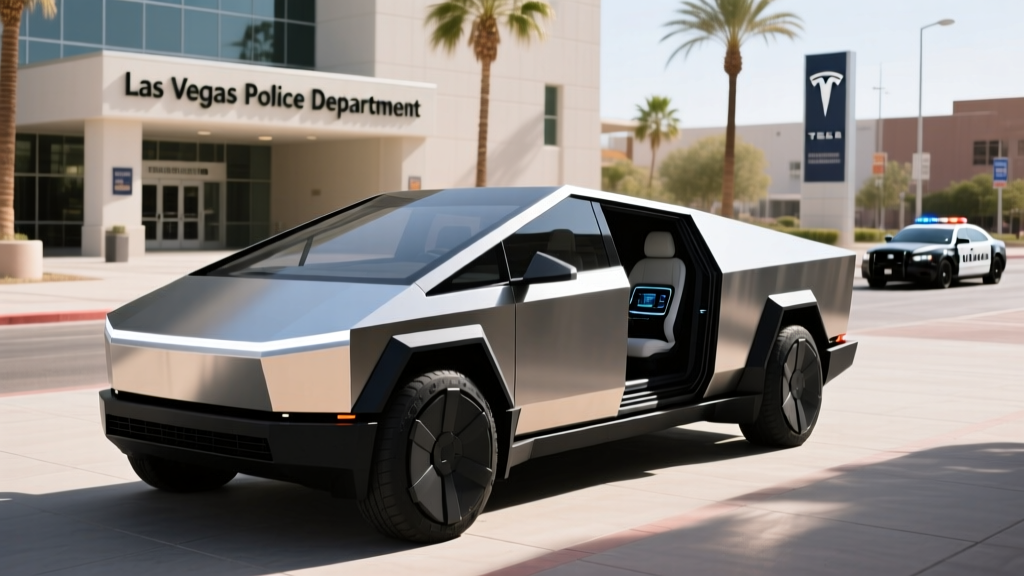
When the Las Vegas Metropolitan Police Department (LVMPD) began evaluating the Tesla Cybertruck for fleet duty, it wasn't just a publicity move — it was a stress test of whether a stainless-steel, 800-volt electric pickup could survive the extremes of Mojave Desert law enforcement. From 115°F summer tarmac to high-speed pursuit demands, the Las Vegas PD Cybertruck experiment offers one of the most rigorous real-world EV fleet evaluations in the country.
This review examines the Cybertruck platform that LVMPD evaluated — primarily the Dual Motor All-Wheel Drive and Cyberbeast trims — with a focus on the specs, charging logistics, and operational realities that matter to both fleet managers and civilian buyers considering the same vehicle.
Spec Sheet: Cybertruck Dual Motor & Cyberbeast at a Glance
| Specification | Dual Motor AWD | Cyberbeast (Tri-Motor) |
|---|---|---|
| EPA Range | 340 miles | 320 miles |
| Battery Capacity (usable) | ~123 kWh (est.) | ~123 kWh (est.) |
| Battery Chemistry | NMC (Nickel Manganese Cobalt) | NMC |
| Peak DC Fast Charge | 350 kW (800V architecture) | 350 kW (800V) |
| 10–80% DC Charge Time | ~15 minutes (peak conditions) | ~15 minutes |
| Level 2 Home Charging | 11.5 kW / ~44 mi/hr | 11.5 kW / ~44 mi/hr |
| 0–60 mph | 4.1 seconds | 2.6 seconds |
| Horsepower | 600 hp | 845 hp |
| Drivetrain | Dual Motor AWD | Tri-Motor AWD |
| Towing Capacity | 11,000 lbs | 11,000 lbs |
| Cargo Bed Volume | 67 cu ft (bed) + 7 cu ft (frunk) | 67 cu ft + 7 cu ft |
| MPGe (combined) | 79 MPGe | 74 MPGe |
| kWh/100 mi | 43 kWh/100 mi | 45 kWh/100 mi |
| Base MSRP | $79,990 | $99,990 |
| Battery/Drive Unit Warranty | 8 years / 120,000 miles | 8 years / 120,000 miles |
Real-World Range: What the EPA Sticker Doesn't Tell You
The Cybertruck's angular stainless-steel exoskeleton creates a drag coefficient significantly higher than a sedan like the Model 3. At highway speeds, aerodynamic drag dominates energy consumption. According to fueleconomy.gov, the Dual Motor AWD consumes approximately 43 kWh per 100 miles — meaning a full 123 kWh usable pack delivers its 340-mile EPA figure under mixed driving conditions.
For LVMPD patrol use, where vehicles idle extensively (running HVAC, light bars, radios, and onboard computers), effective "range" shifts from miles to operational hours. Tesla's Sentry Mode and auxiliary power capabilities allow the Cybertruck to serve as a mobile command post, though sustained accessory draw will erode range faster than EPA estimates suggest.
Charging Infrastructure: 800V Architecture Meets Fleet Logistics
The Cybertruck uses Tesla's 800-volt electrical architecture, enabling peak DC fast-charge rates up to 350 kW at V4 Supercharger stalls. Under ideal conditions — battery preconditioned, state of charge between 10–50% — the Cybertruck can recover approximately 200 miles of range in 10 minutes.
| Charge Level | Power (kW) | Miles Added Per Hour | Notes |
|---|---|---|---|
| Level 1 (120V household) | 1.2 kW | ~3 mi/hr | Emergency/trickle only |
| Level 2 (240V / 48A) | 11.5 kW | ~44 mi/hr | Home depot or fleet garage |
| DC Fast (V4 Supercharger) | Up to 350 kW peak | ~1,200 mi/hr (peak) | 10–80% in ~15 min; tapers above 80% |
| DC Fast (250 kW V3 stall) | Up to 250 kW peak | ~850 mi/hr (peak) | More common; 10–80% in ~20 min |
Charging curve reality: The 350 kW peak is not sustained across the full session. Like all EVs, the Cybertruck's charge rate tapers significantly above 80% state of charge to protect battery health. A typical 10–80% session at a V4 Supercharger takes approximately 15 minutes; pushing from 80–100% can add another 20+ minutes. Fleet operators programming overnight Level 2 charging at a depot (11.5 kW per vehicle) can fully replenish a depleted pack in roughly 10–11 hours.
For LVMPD, the Las Vegas metro area's Supercharger network — over 30 stations with 400+ stalls as of early 2026 — provides robust coverage. However, fleet-scale simultaneous charging requires dedicated depot infrastructure. Tesla offers commercial charging solutions, but electrical upgrades for a 10-vehicle fleet depot can exceed $100,000 in installation costs alone.
Performance & Drivetrain: Pursuit-Capable Acceleration
The Cybertruck Dual Motor AWD delivers 600 horsepower and a 4.1-second 0–60 mph time — figures that outpace most pursuit-rated internal-combustion vehicles, including the Dodge Charger Pursuit (5.2 seconds to 60 with the 5.7L HEMI V8). The Cyberbeast tri-motor variant, with 845 hp and a 2.6-second 0–60, is supercar-quick, though its $99,990 price tag and reduced range make it impractical for fleet procurement.
The dual-motor all-wheel-drive system provides instant torque vectoring without the mechanical complexity of a traditional transfer case. For patrol scenarios requiring rapid acceleration from stationary positions — traffic stops, emergency response, pursuit initiation — the Cybertruck's electric drivetrain eliminates the lag inherent in turbocharged or naturally aspirated engines.
However, sustained high-speed operation (above 100 mph for extended durations) generates significant battery heat and energy consumption. Tesla's thermal management system is robust, but fleet buyers should note that aggressive driving can halve effective range compared to EPA estimates.
Pricing, Trims & Federal Tax Credit Eligibility
The Cybertruck is offered in three primary configurations for the 2025–2026 model years:
| Trim | Base MSRP | Federal §30D Credit Eligible? | Effective Price (if eligible) |
|---|---|---|---|
| Rear-Wheel Drive (announced, limited availability) | $60,990 | Potentially — subject to battery sourcing rules | $53,490 |
| Dual Motor AWD | $79,990 | Subject to MSRP cap ($80K for trucks) & sourcing | $72,490 |
| Cyberbeast (Tri-Motor) | $99,990 | No — exceeds $80,000 truck MSRP cap | $99,990 |
Federal tax credit nuances (IRS §30D, 2026 rules): The Cybertruck Dual Motor AWD sits at $79,990 — just under the $80,000 MSRP cap for trucks, vans, and SUVs under current IRS rules. However, eligibility for the full $7,500 credit also depends on:
- Buyer income caps: Modified AGI must not exceed $150,000 (single), $225,000 (head of household), or $300,000 (joint filers).
- Battery critical-mineral sourcing: A percentage of critical minerals must be sourced from the U.S. or FTA partners, increasing annually. Tesla's supply chain has partially qualified in prior years, but compliance shifts yearly. Check the latest IRS guidance on qualifying vehicles.
- Battery component manufacturing: A percentage of battery components must be manufactured or assembled in North America.
- Point-of-sale transfer: As of 2024+, buyers can transfer the credit to the dealer at purchase, reducing the upfront cost rather than waiting for a tax refund.
For LVMPD and other government fleet buyers, the §30D credit is generally not applicable — tax-exempt entities cannot claim income tax credits. However, the Commercial Clean Vehicle Credit (§45W) offers up to $7,500 for qualified commercial vehicles placed in service by tax-exempt organizations, subject to separate rules. Consult a tax professional or the IRS for current fleet-specific incentive details.
Cargo, Interior Space & Patrol Configuration
The Cybertruck's 6-foot composite bed offers 67 cubic feet of lockable storage via the powered tonneau cover — a feature particularly relevant for law enforcement equipment transport. The front trunk (frunk) adds 7 cubic feet of secure, climate-adjacent storage for sensitive electronics or evidence.
Interior dimensions accommodate five passengers:
- Front legroom: 41.1 inches
- Rear legroom: 38.5 inches
- Front headroom: 40.2 inches
- Rear headroom: 38.0 inches
The rear bench seat folds in a 60/40 split, expanding cargo capacity into the cabin when needed. For patrol configurations, aftermarket upfitters have developed partition systems, equipment racks, and light-bar mounting solutions compatible with the Cybertruck's stainless-steel body panels — though drilling into the exoskeleton requires specialized tooling and may affect structural warranty.
Technology, Driver Assists & Standout Features
The Cybertruck ships with Tesla's 18.5-inch center touchscreen running the company's latest vehicle software, including:
- Tesla Autopilot (standard): Adaptive cruise control, lane-keeping assist, automatic emergency braking, and blind-spot monitoring. This is an SAE Level 2 driver-assistance system — the driver must remain fully engaged and hands-on-wheel at all times.
- Full Self-Driving (Supervised) — optional ($8,000 or $99/mo): Adds navigate-on-autopilot, auto lane change, autosteer on city streets, and traffic-light recognition. Despite the name, FSD remains SAE Level 2 and requires continuous driver supervision.
- Steer-by-wire: The Cybertruck eliminates the mechanical steering column, using redundant electronic actuators. This enables a variable-ratio steering rack (fewer turns lock-to-lock at low speeds) but introduces a dependency on electrical system integrity.
- 48-volt electrical architecture: Reduces wiring harness weight and enables higher-power accessories — relevant for aftermarket light bars, sirens, and communications equipment.
- Powered tonneau cover: Withstands up to 300 lbs of static load; lockable via the Tesla app.
- Bioweapon Defense Mode: HEPA-grade cabin air filtration — a feature LVMPD noted for potential hazmat/CBRN scenario response.
Pros, Cons & Verdict: Who Should Buy the Cybertruck?
✓ Pros
- Class-leading acceleration (4.1s / 2.6s 0–60)
- 800V architecture with up to 350 kW DC charging
- 11,000-lb towing capacity
- Stainless-steel body resists dents, corrosion
- Lockable bed + frunk for secure gear storage
- Over-the-air software updates improve the vehicle over time
- HEPA air filtration (Bioweapon Defense Mode)
- Low center of gravity (battery pack) reduces rollover risk
✗ Cons
- Real-world highway range ~270 mi — well below 340 EPA
- High energy consumption (43–45 kWh/100 mi)
- Steer-by-wire unproven at fleet scale; no mechanical backup
- Cyberbeast exceeds §30D MSRP cap — no federal credit
- Stainless panels difficult to repair/modify for upfitting
- No Apple CarPlay or Android Auto
- Visibility compromised by thick A-pillars, small rear window
- Limited service center capacity for fleet-scale maintenance
Who This EV Suits Best
Choose the Cybertruck if: You need a high-performance electric truck for towing, secure cargo transport, or rapid-response scenarios; you have access to reliable DC fast charging or can install depot-level Level 2 infrastructure; you value over-the-air updates and Tesla's Supercharger network.
Look elsewhere if: You need maximum real-world range above 300 miles highway; your fleet requires proven long-term durability data (Cybertruck launched late 2023); you depend on Apple CarPlay/Android Auto integration; you need easy body-panel repair and modification for custom upfitting.
Battery Warranty & Long-Term Ownership
Tesla warranties the Cybertruck's battery pack and drive units for 8 years or 120,000 miles (whichever comes first), with a guaranteed minimum 70% capacity retention over that period. The NMC chemistry offers high energy density but is more susceptible to calendar degradation from sustained high state-of-charge storage than LFP (lithium iron phosphate) batteries.
For fleet operators running high-mileage patrol shifts (40,000–60,000 miles/year), the 120,000-mile warranty threshold could be reached in 2–3 years. Tesla's commercial fleet support agreements may offer extended coverage, but terms are negotiated individually and not publicly listed.
Battery replacement cost for the Cybertruck, should it be needed out of warranty, is estimated at $15,000–$25,000 based on pack size and current Tesla service pricing for comparable vehicles. This figure may decline as battery costs continue their long-term downward trend.
Frequently Asked Questions
What is the real-world range of the Las Vegas PD Cybertruck?
The Dual Motor AWD Cybertruck carries an EPA-estimated 340 miles. In real-world highway driving at 70–80 mph, expect approximately 270–290 miles. In Las Vegas summer heat, thermal management loads can reduce this to 250–270 miles. For patrol use with extensive idle and accessory draw, operational range is better measured in duty hours than miles.
How fast does the Cybertruck charge at DC fast chargers and at home?
At a Tesla V4 Supercharger (350 kW capable), the Cybertruck charges from 10–80% in approximately 15 minutes under ideal conditions. At a 250 kW V3 Supercharger, expect 10–80% in roughly 20 minutes. At home or a fleet depot on Level 2 (11.5 kW), a full charge takes approximately 10–11 hours, adding about 44 miles of range per hour.
Does the Cybertruck qualify for the $7,500 federal EV tax credit?
The Dual Motor AWD at $79,990 sits just under the $80,000 MSRP cap for trucks under IRS §30D rules, making it potentially eligible. However, eligibility also depends on buyer income limits ($150K single / $300K joint), battery critical-mineral sourcing requirements, and North American component manufacturing rules that shift annually. The Cyberbeast at $99,990 exceeds the cap and does not qualify. Tax-exempt fleet buyers should investigate the §45W Commercial Clean Vehicle Credit instead. Always verify current eligibility at IRS.gov.
Is the Cybertruck worth buying vs. the Ford F-150 Lightning or Rivian R1T?
The Cybertruck excels in acceleration, charging speed (800V / 350 kW peak), and secure cargo storage. The Ford F-150 Lightning offers more conventional truck ergonomics, Pro Power Onboard for job-site power, and broader dealer service access — critical for fleet operations. The Rivian R1T provides superior off-road capability and a more refined interior but at a higher price point and with a less mature service network. For law enforcement specifically, the F-150 Lightning's established upfitter ecosystem and dealer support give it an edge in most fleet procurement scenarios.
What are the biggest drawbacks of the Cybertruck for fleet use?
The primary concerns are: (1) real-world range significantly below EPA estimates under highway or high-accessory-load conditions; (2) stainless-steel body panels are difficult to repair or modify for patrol equipment mounting; (3) steer-by-wire lacks a mechanical backup, which raises redundancy questions for mission-critical applications; (4) Tesla's service infrastructure is not yet scaled for high-volume fleet maintenance; and (5) the Cyberbeast trim's price eliminates federal tax credit eligibility.
Can the Cybertruck be used for towing, and what is its range while towing?
The Cybertruck is rated to tow up to 11,000 pounds. However, towing at or near maximum capacity can reduce range by 40–50%, bringing effective range down to approximately 150–180 miles for the Dual Motor AWD. Tesla's integrated trailer brake controller and tow mode help manage the load, but any fleet planning towing operations should route around reliable DC fast-charging infrastructure.