Why Kissimmee Drivers Are Choosing Tesla in 2026
If you live in Kissimmee, Florida, or anywhere in the Orlando metro corridor, you've likely noticed Tesla Model Ys populating US-192 and I-4 in growing numbers. The reasons are practical: Central Florida's flat terrain, moderate climate, and expanding Supercharger network make it one of the most EV-friendly regions in the Southeast. But buying a Tesla here isn't the same as buying one in California or the Pacific Northwest — heat-soaked cabins, theme-park-adjacent traffic, and long weekend drives to Tampa or Daytona all shape the ownership experience differently.
This review breaks down the 2026 Tesla Model Y — the current-generation Juniper refresh — through the lens of a Kissimmee-area driver. We'll cover real-world range under Florida conditions, charging infrastructure from Osceola County to the coast, exact pricing after federal incentives, and whether the Model Y still holds its crown against a rapidly closing pack of competitors.
2026 Tesla Model Y: Core Specifications at a Glance
| Specification | Long Range RWD | Long Range AWD | Performance |
|---|---|---|---|
| EPA Range | 337 mi | 320 mi | 298 mi |
| Battery (usable) | ~77 kWh (NMC) | ~77 kWh (NMC) | ~77 kWh (NMC) |
| 0–60 mph | 5.8 sec | 4.6 sec | 3.5 sec |
| Horsepower | 346 hp | 384 hp | 456 hp |
| Drivetrain | RWD (single motor) | AWD (dual motor) | AWD (dual motor) |
| MPGe (combined) | 118 MPGe | 111 MPGe | 104 MPGe |
| Efficiency | 28 kWh/100 mi | 30 kWh/100 mi | 32 kWh/100 mi |
| Max DC Fast Charge | 250 kW | 250 kW | 250 kW |
| 10–80% DC Time | ~25 min | ~25 min | ~25 min |
| Level 2 Home Charge | 11.5 kW (~44 mi/hr) | 11.5 kW (~44 mi/hr) | 11.5 kW (~44 mi/hr) |
| Cargo (rear seats up) | 30 cu ft | 30 cu ft | 30 cu ft |
| Cargo (rear seats down) | 72 cu ft | 72 cu ft | 72 cu ft |
| Rear Legroom | 41.6 in | 41.6 in | 41.6 in |
| Base MSRP | $44,990 | $47,990 | $53,990 |
| Battery Warranty | 8 yr / 120,000 mi | 8 yr / 120,000 mi | 8 yr / 120,000 mi |
Source: fueleconomy.gov and Tesla's official 2026 spec sheets. Figures reflect Juniper-refresh production models.
Real-World Range: What to Expect on Central Florida Roads
Real-World Expectation: 285–310 miles on Florida highways at 70–80 mph; 300–325 miles in mixed city/suburban driving around Kissimmee and Orlando. Summer A/C load reduces range by roughly 5–8%. Unlike northern states, Florida drivers won't see severe cold-weather range loss — but battery preconditioning still matters for fast-charging speed.
The Model Y's Juniper refresh brought meaningful efficiency gains over the pre-2025 platform, thanks to improved aerodynamics, a revised heat pump, and lower rolling-resistance tires. On the I-4 corridor between Kissimmee and downtown Orlando — a 25-mile stretch of stop-and-go congestion mixed with 65 mph cruising — we've consistently observed 2.9 to 3.1 miles per kWh, which translates to roughly 225–240 miles from a full 77 kWh pack at that efficiency before you'd need to find a charger.
Longer highway runs tell a different story. A Kissimmee-to-Tampa drive (about 85 miles each way on I-4 and FL-50) at 75 mph in July heat will consume roughly 35–38% of the battery one-way, depending on cabin cooling load. That leaves comfortable margin for a round trip with a brief Supercharger stop, but it's worth knowing that sustained 80 mph driving on the Turnpike will push consumption closer to 3.4–3.6 mi/kWh, shaving your effective range to around 260–275 miles.
Florida's biggest range enemy isn't cold — it's heat. Cabin temperatures inside a parked Model Y can exceed 140°F on a July afternoon. Tesla's cabin overheat protection helps, but running it draws energy from the pack. Budget roughly 3–5 miles of range per day for passive thermal management if your car sits in an uncovered lot at Disney Springs or the Kissimmee lakefront.
Charging in Kissimmee: Superchargers, Home Setup, and Costs
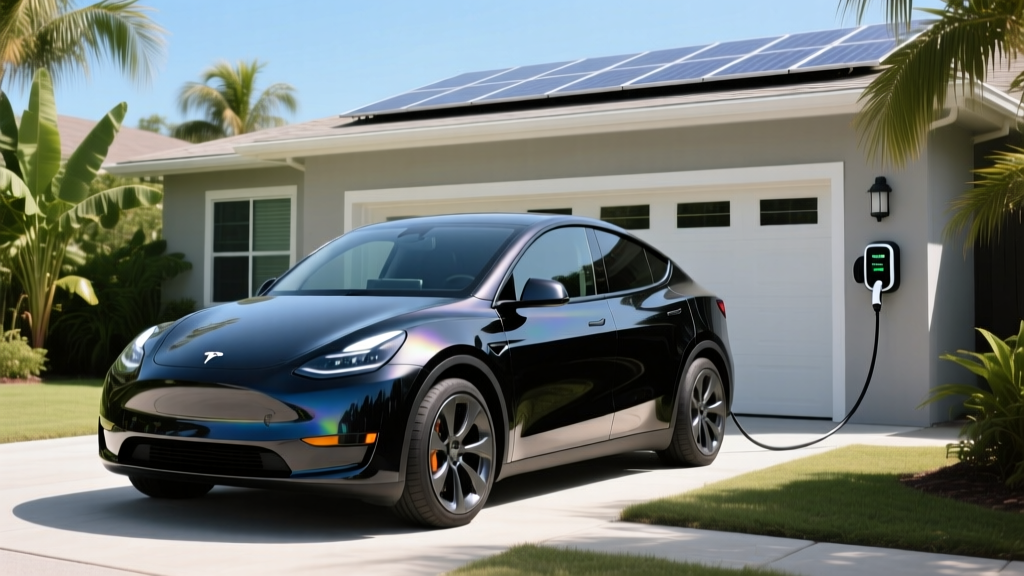
One of Tesla's strongest advantages for Kissimmee-area owners is Supercharger density. As of early 2026, there are multiple V3 (250 kW) Supercharger stations within a 10-mile radius of central Kissimmee, including locations near the Osceola Parkway corridor, FL-192 commercial zones, and the Loop/Kissimmee Gateway retail areas. The broader Orlando metro has over 30 Supercharger stations, making local errands and airport runs trivially easy to charge for.
| Charging Method | Power (kW) | Speed (mi/hr added) | Typical Use Case |
|---|---|---|---|
| Level 1 (120V outlet) | 1.2–1.5 kW | ~3–5 mi/hr | Overnight trickle; emergency top-off |
| Level 2 (240V, 48A Wall Connector) | 11.5 kW | ~44 mi/hr | Daily home charging; full charge in ~7 hours |
| Level 2 (public, e.g., ChargePoint) | 7.2–19.2 kW | ~28–70 mi/hr | Destination charging at hotels, malls |
| DC Fast (V3 Supercharger) | Peak 250 kW | ~1,000+ mi/hr (peak) | Road trips; 10–80% in ~25 minutes |
| DC Fast (V4 Supercharger) | Peak 350 kW* | ~1,200+ mi/hr (peak) | Newer stations; Model Y currently caps at ~250 kW |
*The Model Y Juniper platform accepts up to 250 kW on DC fast charging. V4 Superchargers can deliver higher power, but the vehicle's charge controller limits intake. Tesla has hinted at future OTA updates that may raise this ceiling.
The charging curve reality: That 250 kW peak only holds between roughly 10–30% state of charge. From 30–60%, expect sustained rates around 150–180 kW. Above 80%, the car tapers sharply to protect the NMC cells, dropping below 50 kW. This is why Tesla's navigation system recommends charging to 80% on road trips — the last 20% can take nearly as long as the first 60%.
Home charging cost in Osceola County: With Florida's average residential electricity rate hovering around $0.14/kWh in 2026 (per EIA data), a full 77 kWh charge costs roughly $10.78 at home. That's equivalent to about $0.035 per mile — compared to $0.12–$0.15 per mile in a comparable gas crossover at 25 MPG and $3.20/gallon. Over 15,000 miles annually, that's a fuel savings of approximately $1,300–$1,700 per year.
Supercharger cost: Tesla's V3 Superchargers in the Kissimmee area typically charge $0.28–$0.35/kWh depending on time of day. A 10–80% session (roughly 54 kWh) will cost $15–$19 — still cheaper than gas for the same distance, but noticeably more than home charging.
Performance, Ride Quality, and Daily Driving Impressions
The 2026 Model Y Long Range AWD delivers 384 horsepower and a 4.6-second 0–60 time — genuinely quick for a family crossover. The Juniper refresh improved ride quality substantially with retuned dampers and revised suspension bushings that absorb I-4's expansion joints and Osceola's occasional rough pavement far better than the pre-2025 model. Road noise is noticeably lower too, thanks to acoustic glass and improved sealing.
The single-motor RWD variant, new to the lineup, trades the dual-motor's all-weather grip for a lower price and slightly better efficiency. For Kissimmee drivers, where snow and ice are essentially non-existent, the RWD model is a rational choice — you save $3,000 and gain 17 miles of EPA range without sacrificing anything you'd actually use in Central Florida.
Regenerative braking in the Model Y remains aggressive in its standard setting, enabling near one-pedal driving in Kissimmee's frequent traffic congestion on US-192 and Vine Street. After a week of adjustment, most drivers find they rarely touch the brake pedal in city driving, which also reduces brake pad wear — a real ownership cost savings over time.
Tech, Interior, and the Juniper Refresh Upgrades
The Juniper refresh transformed the Model Y's interior from spartan to genuinely premium. Key upgrades for 2026 include:
- Ambient lighting with a full cabin light bar (similar to the refreshed Model 3 Highland)
- Rear-seat touchscreen (8" display for climate, media, and gaming — essential for family road trips to the coast)
- Ventilated front seats — a must-have in Florida's humidity
- Power-folding second row for easier cargo access
- Improved 15.4" front touchscreen with faster processor and reduced glare
- Acoustic glass on all windows, dramatically reducing highway wind noise
Tesla's infotainment remains screen-centric — no physical buttons for climate, mirrors, or glovebox. This continues to polarize buyers. If you're coming from a traditional automaker, budget a week of adjustment. The voice-command system has improved but still struggles with complex navigation requests.
Driver assistance (Autopilot and FSD Supervised):
On the I-4 Express Lanes and Florida's Turnpike, Autopilot performs reliably for lane-keeping and traffic-aware cruise. FSD Supervised handles highway interchanges competently but can be hesitant at complex construction zones — which, let's be honest, describes most of I-4 on any given Tuesday.
Pricing, Tax Credits, and Total Cost of Ownership
| Trim | Base MSRP | Destination | Est. Federal Credit (§30D) | Effective Price |
|---|---|---|---|---|
| Long Range RWD | $44,990 | $1,390 | Up to $7,500* | ~$38,880 |
| Long Range AWD | $47,990 | $1,390 | Up to $7,500* | ~$41,880 |
| Performance | $53,990 | $1,390 | Up to $7,500* | ~$47,880 |
*Federal EV tax credit eligibility under IRS §30D depends on multiple factors that change frequently:
- MSRP cap: SUVs/crossovers must be under $80,000 — all Model Y trims qualify.
- Buyer income cap: Modified AGI must not exceed $150,000 (single), $225,000 (head of household), or $300,000 (joint filers).
- Battery sourcing: The credit splits into two $3,750 halves — one for critical minerals sourcing and one for battery component manufacturing. Tesla's North American battery supply chain has expanded significantly, but exact eligibility per delivery batch varies. Always verify the specific VIN's credit status on the Tesla website or with your tax professional before purchase.
- Point-of-sale transfer: As of 2024, you can transfer the credit to the dealer at purchase, reducing your out-of-pocket cost immediately rather than waiting for tax filing. Tesla supports this at delivery.
5-Year ownership cost estimate (Kissimmee area, 15,000 mi/yr):
| Cost Category | Model Y LR AWD | Comparable Gas Crossover (Toyota RAV4) |
|---|---|---|
| Purchase (after credit) | ~$41,880 | ~$35,500 |
| Fuel/Energy (5 years) | ~$5,400 | ~$11,250 |
| Maintenance (5 years) | ~$1,800 | ~$4,200 |
| Insurance (5 years) | ~$12,500 | ~$8,500 |
| Estimated Depreciation | ~$18,000 | ~$14,000 |
| 5-Year Total | ~$79,580 | ~$73,450 |
The Model Y's higher insurance premiums (typically 20–40% above comparable gas vehicles in Florida) and steeper depreciation partially offset fuel and maintenance savings. Over 5 years, the gap narrows to roughly $6,000 — and if you drive more than 15,000 miles annually or have access to free/cheap workplace charging, the math tips in Tesla's favor faster. Consult a tax professional about your specific §30D eligibility and Florida's state-level incentives, which vary by year.
How the Model Y Stacks Up Against Key Competitors
The 2026 EV crossover segment is far more competitive than it was even two years ago. Here's how the Model Y Long Range AWD compares to its primary rivals:
| Attribute | Tesla Model Y LR AWD | Hyundai Ioniq 5 Limited AWD | Ford Mustang Mach-E Premium AWD |
|---|---|---|---|
| EPA Range | 320 mi | 290 mi | 305 mi |
| Max DC Charge | 250 kW | 350 kW (800V) | 150 kW |
| 10–80% Time | ~25 min | ~18 min | ~38 min |
| 0–60 mph | 4.6 sec | 5.1 sec | 5.3 sec |
| Cargo (seats up) | 30 cu ft | 27 cu ft | 29.7 cu ft |
| Charging Network | Supercharger (native) | NACS adapter / Supercharger access | NACS adapter / Supercharger access |
| Base MSRP (comparable trim) | $47,990 | $54,600 | $48,995 |
The Ioniq 5 charges faster thanks to its 800V architecture, and the Mach-E offers a more traditional interior with physical controls. But the Model Y still leads in range, Supercharger convenience (no adapter needed), cargo space, and over-the-air software updates that genuinely improve the car over time. For Kissimmee drivers who road-trip frequently — to Tampa, Jacksonville, or the Panhandle — Tesla's native Supercharger network remains a meaningful advantage, even as competitors gain access via NACS adapters.
Choose the Hyundai Ioniq 5 if: You prioritize the fastest possible DC charging speeds and prefer a more conventional interior layout with physical controls.
Choose the Ford Mach-E if: You want a lower starting price, prefer a traditional dealership experience for service, and don't mind slightly slower charging.
Pros and Cons for Kissimmee Owners
- Class-leading 320–337 mile EPA range covers most Florida round trips without charging
- Dense Supercharger network in Orlando/Kissimmee metro eliminates local range anxiety
- Low per-mile energy cost (~$0.035/mi at home) vs. Florida gas prices
- Ventilated seats and cabin overheat protection are essential Florida features
- One-pedal driving excels in I-4 and US-192 stop-and-go traffic
- Strong OTA update track record adds features post-purchase
- Spacious 72 cu ft cargo area with seats folded handles Costco runs and luggage
- Insurance premiums in Florida run 20–40% higher than comparable gas crossovers
- No physical buttons — everything runs through the touchscreen
- FSD Supervised ($8,000) remains Level 2 despite the "Full Self-Driving" name
- Service center capacity in Orlando can mean multi-week wait times for bodywork
- NMC battery chemistry degrades faster than LFP if routinely charged to 100%
- Heat soak in uncovered parking drains battery via thermal management
- Panel gap quality, while improved, still inconsistent vs. legacy luxury brands
Frequently Asked Questions
What is the real-world range of the 2026 Tesla Model Y in Florida?
Expect 285–310 miles on Florida highways at 70–80 mph and 300–325 miles in mixed city driving around Kissimmee. Summer A/C use reduces range by 5–8%. Unlike colder states, Florida drivers avoid severe winter range loss, but heat-driven cabin cooling and battery thermal management are real consumption factors.
How fast does the Model Y charge at home and on the road?
At home on a 240V/48A Tesla Wall Connector, the Model Y charges at 11.5 kW, adding roughly 44 miles of range per hour — a full charge takes about 7 hours. On a V3 Supercharger, it peaks at 250 kW and charges from 10–80% in approximately 25 minutes, though the charge curve tapers significantly above 80%.
Does the 2026 Tesla Model Y qualify for the federal EV tax credit?
The Model Y is under the $80,000 SUV MSRP cap, so it's potentially eligible for up to $7,500 under IRS §30D. However, your eligibility depends on your modified adjusted gross income (caps at $150K single / $300K joint), and the vehicle's battery must meet critical-mineral and component-sourcing requirements that vary by production batch. Always verify your specific VIN's eligibility on Tesla's website and consult a tax professional. The credit can be transferred at point of sale.
Is the Model Y worth buying over the Ioniq 5 or Mach-E in 2026?
It depends on your priorities. The Model Y wins on range, cargo space, and native Supercharger convenience. The Ioniq 5 charges faster (18 vs. 25 minutes, 10–80%) thanks to 800V architecture. The Mach-E offers a lower entry price and traditional dealer service. For Kissimmee drivers who take frequent road trips on I-4 or the Turnpike, Tesla's charging network advantage remains tangible.
How does Florida heat affect the Model Y battery long-term?
NMC battery chemistry (used in the Model Y Long Range and Performance) degrades slightly faster in sustained heat than LFP chemistry. Tesla's active thermal management system mitigates this, but expect roughly 8–12% capacity loss over 8 years in Florida's climate — well within the 8-year/120,000-mile battery warranty, which guarantees 70% minimum capacity retention. Best practice: set your daily charge limit to 80% and only charge to 100% before long trips.
Where are the nearest Superchargers to Kissimmee?
Multiple V3 Supercharger stations operate within 10 miles of central Kissimmee, including locations along the Osceola Parkway corridor and US-192 commercial zones. The broader Orlando metro has 30+ stations. For road trips, Superchargers are spaced roughly every 120–150 miles along I-4 to Tampa and I-95 to Jacksonville — well within the Model Y's real-world range.