Search for "kids Tesla car" and you'll land on a confusing mix of results: ride-on toys, aftermarket child-seat accessories, and the occasional parent strapping a toddler into the back of a real Model Y. If you've arrived here expecting a review of a miniature, street-legal Tesla your 8-year-old can drive to school, let's settle that immediately — no such vehicle exists. What does exist is a well-established category of Tesla-licensed ride-on toys for toddlers and young children, plus the very real question of how to safely transport kids in an actual Tesla.
This guide cuts through the noise. We'll review the most prominent "kids Tesla car" product on the market — the Tesla Model S for Kids by Radio Flyer — with the same spec-driven rigor we apply to full-size EVs. Then we'll pivot to what matters for parents shopping for a real Tesla: child-seat compatibility, safety ratings, and family practicality in the 2026 Model Y and Model X.
The Tesla Model S for Kids by Radio Flyer: What It Actually Is
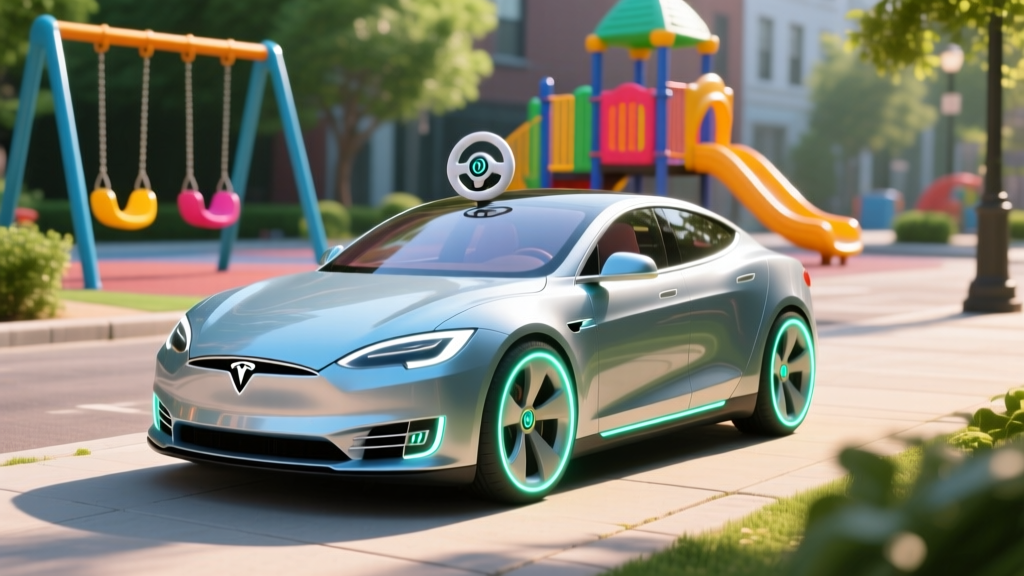
The Tesla Model S for Kids is a battery-powered ride-on toy manufactured by Radio Flyer under an official Tesla licensing agreement. It's aimed at children ages 3 to 8 and mimics the proportions and styling of the full-size Model S sedan, albeit at roughly one-quarter scale. It is not a miniature electric vehicle in any automotive sense — it's a toy with a 6-volt or 12-volt lead-acid battery, a plastic chassis, and a top speed of about 3 to 6 mph.
Radio Flyer has held the Tesla license since roughly 2016, and the product has gone through several revisions. As of 2026, availability is inconsistent — the product has periodically been out of stock or discontinued and reissued. Current retail pricing hovers around $600 to $750 depending on the color and retailer, which places it at the premium end of ride-on toys.
| Spec | Detail |
|---|---|
| Battery | 12V sealed lead-acid (rechargeable) |
| Top Speed | ~3 mph (low) / ~6 mph (high), parent-lockable |
| Run Time | Approximately 1–2 hours per charge |
| Charge Time | 8–12 hours (wall outlet, included charger) |
| Weight Capacity | Up to 81 lbs (varies by revision) |
| Age Range | 3–8 years |
| Features | Working headlights, horn, MP3/aux input, forward/reverse, remote parent control (some models) |
| Price | $600–$750 MSRP |
To be absolutely clear about units — since this is an EV publication: this toy uses a 12-volt lead-acid battery with a capacity typically around 7–12 amp-hours (Ah), which translates to roughly 0.08 to 0.14 kWh of energy storage. That's about 1/600th of the usable battery in a real 2026 Tesla Model S. The motor output is measured in tens of watts, not kilowatts. It's a toy, not a transportation device, and no EPA range, MPGe, or DC fast-charging spec applies here.
Safety and Practicality: What Parents Should Know
The Radio Flyer Model S ride-on is generally well-reviewed for build quality within its category. Key safety considerations include:
- Speed limiting: Most versions include a parent-controlled speed lock that caps the toy at ~3 mph. Use it, especially on any surface with an incline.
- No seat belts: The ride-on does not include a restraint system. Children can tip or slide out during turns or on uneven ground.
- Surface matters: It performs best on smooth, flat pavement. Grass, gravel, and slopes significantly reduce run time and can stall the motor.
- Supervision required: This is not an autonomous toy. A parent should always be within arm's reach of a child under 5.
- Battery care: Lead-acid batteries degrade if left discharged. Charge after every use and store indoors during winter to avoid permanent capacity loss.
If your search for a "kids Tesla car" was driven by the desire to give a child a realistic EV experience, this ride-on is the closest licensed product available. Competitors like Power Wheels (Mattel) offer similar ride-ons styled after Jeeps, trucks, and other vehicles at lower price points ($250–$400), though without the Tesla badge or styling.
Real Teslas and Real Kids: Family Practicality in 2026
If you're a parent researching Teslas with child transportation in mind, the relevant models are the 2026 Model Y (compact SUV) and Model X (midsize SUV). Here's how they stack up for family duty.
2026 Tesla Model Y — Family Specs at a Glance
| Spec | Value |
|---|---|
| EPA Range | 330 miles |
| Battery | ~75 kWh usable, NMC chemistry |
| Drivetrain | Dual-motor AWD |
| 0–60 mph | 4.8 seconds |
| Horsepower | ~384 hp combined |
| MPGe (combined) | 117 MPGe |
| Cargo Volume | 30.2 cu ft (rear seats up) / 72.1 cu ft (folded) |
| Second-Row Legroom | 41.6 inches |
| Max DC Fast Charge | 250 kW (peak) |
| 10–80% DC Charge | ~27 minutes |
| Level 2 Home Charge | 11.5 kW (~44 miles/hr) |
| Battery Warranty | 8 years / 120,000 miles |
| Base MSRP | ~$44,990 |
Child Seat Compatibility
The Model Y's second row includes two sets of LATCH anchors on the outboard seats and a top tether for the center seat. Rear-facing infant seats fit without significant front-passenger legroom compromise in most configurations. The Model Y earned a 5-star overall safety rating from NHTSA and a Top Safety Pick+ designation from IIHS (carryover ratings expected for the structurally unchanged 2026 model year).
The Model X offers more interior volume and standard falcon-wing rear doors that make loading children into car seats significantly easier in tight parking spaces. However, the Model X starts at approximately $79,990 and its larger battery (100 kWh) pushes it above the $80,000 MSRP cap for the federal EV tax credit on SUVs — meaning it does not qualify for the §30D credit regardless of buyer income.
Does a Tesla Qualify for the Federal EV Tax Credit?
This is where the distinction between the toy and the real car becomes financially meaningful.
- Vehicle MSRP cap: $55,000 for sedans, $80,000 for SUVs/pickups
- Buyer adjusted gross income cap: $150,000 (single), $225,000 (head of household), $300,000 (joint)
- Battery critical-mineral and component sourcing requirements (phased thresholds increase annually)
- Credit amount: up to $7,500, split between critical-minerals ($3,750) and battery-components ($3,750) requirements
- Point-of-sale transfer available — apply the credit at purchase rather than waiting for tax filing
- Vehicle must be new, purchased for personal use, and assembled in North America
Full rules at irs.gov. Consult a tax professional for your specific situation.
As of 2026, the Tesla Model Y Long Range AWD (base MSRP ~$44,990) falls under the $80,000 SUV cap. However, eligibility for the full $7,500 depends on battery-component and critical-mineral sourcing compliance, which Tesla has historically navigated through its supply chain adjustments. Some Model Y trims have qualified for the full credit; others have qualified for partial ($3,750) or none, depending on the production quarter and sourcing changes. Always verify the specific vehicle's VIN eligibility on the fueleconomy.gov tax credit lookup tool before purchase.
The Radio Flyer kids Tesla car, being a toy, is obviously ineligible for any automotive tax credit. No IRS §30D, no state EV rebate, no point-of-sale transfer applies to a $700 ride-on.
Comparing the Kids Tesla Car to Competitors
- Official Tesla licensing — authentic styling and badge
- Parent remote control on select models
- Working headlights, horn, and audio input
- Premium build quality for the ride-on category
- $600–$750 price is steep for a ride-on toy
- Lead-acid battery (heavy, slow to charge, degrades faster than lithium)
- Limited availability — frequently out of stock
- No seat belt or roll-over protection
- Outgrown by age 7–8 due to weight/size limits
For comparison, the Power Wheels Jeep Wrangler ride-on sells for approximately $300–$350, includes a 12V battery, seats two children, and offers similar speed and run-time specs. The trade-off is styling — it looks like a Jeep, not a Tesla. If brand authenticity matters to your household, the Radio Flyer Model S is the only licensed option. If you're optimizing for value and play versatility, the Power Wheels lineup offers more variety at lower prices.
Who Should Buy What
- Your child is 3–6 years old and fascinated by your Tesla
- You value the licensed Tesla styling and are willing to pay a premium
- You have a flat, paved play area (driveway, garage, smooth patio)
- Budget is under $400
- You want two-passenger seating or off-road-capable wheels
- Brand authenticity isn't a priority
- You need a family EV with 330 miles of EPA range, strong safety ratings, and LATCH anchors for child seats
- You can charge at home (Level 2 recommended)
- You meet the §30D income and MSRP requirements and verify VIN-level credit eligibility before purchase
Frequently Asked Questions
Is there a real drivable Tesla made for kids?
No. Tesla does not manufacture any vehicle designed for children to operate. The "kids Tesla car" refers to the Radio Flyer Model S ride-on toy, which is a 12-volt battery-powered toy with a top speed of about 6 mph. It is not street-legal, not registered, and not subject to any automotive safety standards.
How much does the kids Tesla car cost?
The Radio Flyer Tesla Model S for Kids retails for approximately $600 to $750 depending on the color, retailer, and revision. This does not qualify for any EV tax credit or incentive.
Is the Tesla Model Y a good family car?
The 2026 Model Y Long Range AWD offers 330 miles of EPA range, 5-star NHTSA safety ratings, IIHS Top Safety Pick+ status, two sets of LATCH anchors, and 72.1 cu ft of cargo space with rear seats folded. It is one of the most practical family EVs on the market, provided you have reliable home charging access.
Does the 2026 Tesla Model Y qualify for the $7,500 federal tax credit?
The Model Y's MSRP falls under the $80,000 SUV cap, and Tesla assembles it in North America (Austin, TX). However, full $7,500 credit eligibility depends on battery-component and critical-mineral sourcing compliance, which can vary by production batch. Verify the specific VIN on fueleconomy.gov before purchasing. Buyer income caps also apply ($300,000 joint AGI maximum).
What's the real-world range of a Tesla Model Y with kids and cargo?
With a full family load (two adults, two children in car seats, stroller, and luggage in the 30.2 cu ft cargo area), expect highway range to drop to roughly 250–280 miles at 70 mph in moderate temperatures. Cold weather (below 32°F) can reduce this further by 15–30%. Preconditioning the battery while plugged in mitigates some cold-weather loss.
Can I install three child seats across the Model Y's second row?
Three across is extremely tight in the Model Y. Two outboard LATCH positions accommodate most car seats comfortably. A narrow booster in the center is feasible, but three full-size car seats across the bench is generally not practical. The Model X offers slightly more width and the falcon-wing doors ease loading considerably.