Is the Kia Soul EV Worth Buying in 2026?
The 2026 Kia Soul EV delivers 243 miles of EPA range from a 64 kWh battery, charges at up to 77 kW DC (10-80% in roughly 54 minutes), and starts around $33,000 MSRP. It's a practical urban commuter with standout cargo space (24.2 cu ft) but faces real limitations: relatively slow DC fast charging by 2026 standards, no all-wheel-drive option, and cold-weather range loss of 25-30%. If you have home Level 2 charging and drive under 200 miles daily in moderate climates, the Soul EV saves roughly $1,100/year in fuel vs a comparable gas hatchback. If you road-trip frequently or live in sub-freezing regions, consider the Hyundai Ioniq 5 or Tesla Model Y instead.
2026 Kia Soul EV: Core Specifications at a Glance
| Specification | 2026 Kia Soul EV |
|---|---|
| EPA Range | 243 miles (S trim) / 201 miles (base) |
| Real-World Highway Range | ~195-210 miles (70-80 mph) |
| Battery Capacity | 64 kWh usable (NMC chemistry) |
| DC Fast Charge (peak) | 77 kW (CCS1) |
| 10-80% DC Charge Time | ~54 minutes |
| Level 2 AC Charge Rate | 7.2 kW (onboard charger) |
| Level 2 10-100% Time | ~9 hours |
| Motor Output | 201 hp / 291 lb-ft torque |
| 0-60 mph | 7.0 seconds |
| EPA Efficiency | 120 MPGe combined (28 kWh/100mi) |
| Cargo Volume | 24.2 cu ft (rear seats up) |
| Base MSRP | $32,990 (base) / $36,500 (S) |
| Battery/Powertrain Warranty | 10 years / 100,000 miles |
Real-World Range: What the EPA Sticker Doesn't Tell You
The EPA rates the 2026 Soul EV S trim at 243 miles, but that number assumes a mix of city and highway driving at moderate temperatures. Here's what you'll actually see:
Range Expectations by Scenario
- City/Suburban (under 45 mph, mild weather): 235-255 miles — regenerative braking recovers energy in stop-and-go traffic, sometimes exceeding EPA estimates.
- Highway (70-75 mph, 65°F): 195-215 miles — aerodynamic drag dominates; the Soul EV's boxy shape hurts efficiency at speed.
- Cold Weather (30°F, mixed driving): 165-185 miles — lithium-ion batteries lose 25-35% capacity in freezing temps, and cabin heating draws significant power. The Soul EV uses a resistive PTC heater, not a heat pump, which increases energy consumption in winter.
- Hot Weather (95°F, A/C on): 210-225 miles — battery thermal management and cabin cooling reduce range modestly.
If your daily commute is 40-60 miles round-trip and you can charge at home overnight, even cold-weather range is more than adequate. But if you regularly drive 150+ miles one-way, the Soul EV's limited fast-charging speed becomes a real constraint — plan for 45-60 minute stops at 50-150 kW chargers.
Charging the Soul EV: Home vs Public Infrastructure
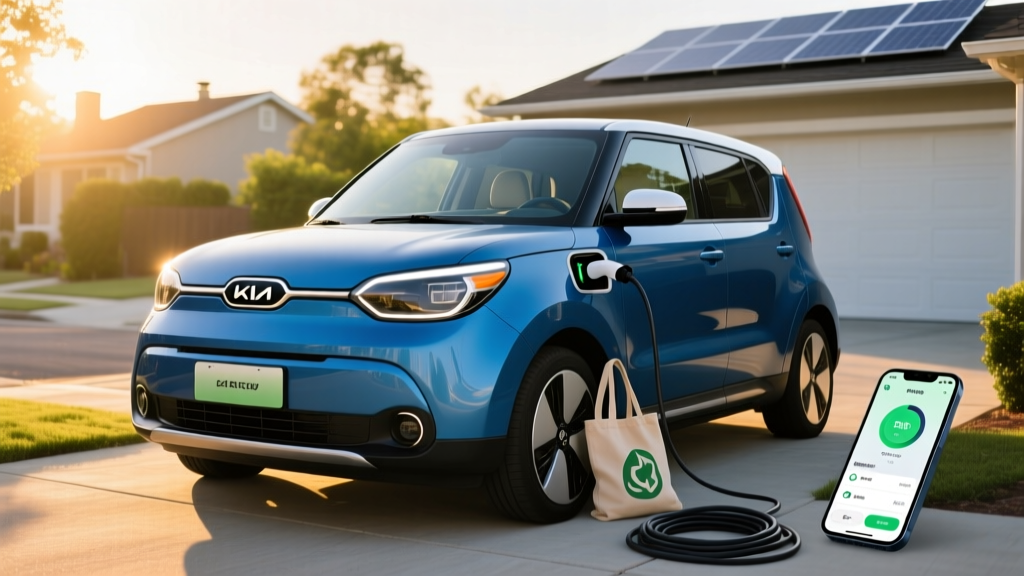
The Soul EV uses a CCS1 connector for DC fast charging and a J1772 inlet for Level 1/Level 2 AC charging. Here's what each charging level delivers:
| Charging Level | Power (kW) | Miles Added per Hour | Typical Use Case |
|---|---|---|---|
| Level 1 (120V household outlet) | 1.2-1.4 kW | 4-5 miles | Overnight top-up, emergency only |
| Level 2 (240V home/public) | 7.2 kW (max) | 25-28 miles | Daily home charging, workplace |
| DC Fast Charge (CCS1) | 77 kW (peak) | ~170 miles (peak rate) | Road trips, quick top-ups |
Home Charging Setup: What You'll Actually Spend
Most Soul EV owners install a Level 2 home charger (240V, 32-40 amp circuit) for overnight charging. Here's a realistic cost breakdown:
| Item | Cost Range |
|---|---|
| Level 2 Charger Hardware (e.g., ChargePoint Home Flex, Emporia Vue) | $400-$700 |
| Electrician Labor (240V circuit, 40-amp breaker) | $600-$1,500 |
| Permit & Inspection (varies by municipality) | $50-$200 |
| Panel Upgrade (if needed — older homes with 100A service) | $1,500-$3,500 |
| Total (typical install, no panel upgrade) | $1,050-$2,400 |
Key caveat: If your home has a 100-amp electrical panel that's already near capacity, an upgrade to 200A may be required, adding $1,500-$3,500. Always get a licensed electrician to assess your panel before purchasing a charger.
Public DC Fast Charging: The 77 kW Limitation
The Soul EV's 77 kW peak DC charge rate is the slowest in its class for 2026. For comparison, the Hyundai Ioniq 5 peaks at 240 kW (10-80% in 18 minutes), and the Tesla Model Y peaks at 250 kW. On a road trip, the Soul EV will take roughly 54 minutes to charge from 10-80% at a compatible 150+ kW CCS station — nearly three times longer than the Ioniq 5.
The charge curve also matters: the Soul EV sustains ~70-77 kW only between 10-50% state of charge (SoC), then tapers to 40-50 kW above 60%, and drops below 20 kW past 85%. This means charging from 80-100% at a DC fast charger is inefficient — plan to charge to 80% and drive, rather than waiting for a full battery.
Cost of Ownership: Soul EV vs Gas Hatchback
Let's compare the 2026 Kia Soul EV (S trim, $36,500 MSRP) against a gas-powered 2026 Kia Soul GT-Line (1.6L turbo, 201 hp, ~$26,000 MSRP) over 5 years and 75,000 miles.
| Cost Category | 2026 Soul EV (S) | 2026 Soul Gas (GT-Line) |
|---|---|---|
| Purchase Price (MSRP) | $36,500 | $26,000 |
| Federal Tax Credit (§30D, if eligible) | -$0 to -$7,500 (see caveats below) | $0 |
| Effective Purchase Price | $29,000-$36,500 | $26,000 |
| Fuel/Energy (75,000 miles) | $2,100 (home L2) / $4,500 (public DC) | $7,500 (gas at $3.50/gal, 29 MPG avg) |
| Maintenance (5 years) | $800 (cabin filter, wipers, brake fluid) | $3,200 (oil changes, filters, brakes, spark plugs) |
| Insurance (5-year avg) | $7,500 | $6,000 |
| Total 5-Year Cost | $39,400-$46,900 | $42,700 |
Tax Credit Reality Check
The 2026 Soul EV's eligibility for the federal §30D tax credit (up to $7,500) depends on battery sourcing, critical mineral content, buyer income caps, and MSRP limits. As of 2026, many Kia EVs face partial or full credit reduction due to battery component sourcing rules. Check the IRS Clean Vehicle Credit page for current eligibility before purchase. Income caps: $150k single / $300k joint filers. MSRP cap: $55,000 for SUVs/hatchbacks (Soul EV qualifies). The credit can now be transferred to the dealer at point-of-sale as an instant discount.
Charging Cost Breakdown
Electricity costs vary dramatically by location and charging method:
- Home Level 2 (national avg $0.16/kWh): 28 kWh/100mi × $0.16 = $0.045/mile. For 15,000 miles/year = $675/year.
- Public DC Fast Charging (avg $0.40/kWh): 28 kWh/100mi × $0.40 = $0.112/mile. For 15,000 miles/year = $1,680/year.
- Time-of-use rates (off-peak $0.08/kWh): 28 kWh/100mi × $0.08 = $0.022/mile. For 15,000 miles/year = $330/year.
If you rely exclusively on public DC fast charging (no home access), your annual "fuel" cost roughly doubles — and you'll spend 2-3 hours/week at charging stations. Home charging access is the single biggest factor in EV ownership satisfaction.
EV vs Gas vs Hybrid: Which Soul Should You Buy?
Kia offers the Soul in three powertrains for 2026: gas (ICE), mild-hybrid (not available in US), and full EV. Here's how they stack up:
| Factor | Soul EV (2026) | Soul Gas (2026) | Hyundai Kona Hybrid (comparison) |
|---|---|---|---|
| MSRP | $32,990-$36,500 | $22,500-$28,000 | $28,500-$33,000 |
| EPA Range/MPG | 243 mi / 120 MPGe | 29 MPG combined | 50 MPG combined |
| Annual Fuel Cost (15k mi) | $675 (home) / $1,680 (public) | $1,810 | $1,050 |
| 0-60 mph | 7.0 sec | 7.5 sec | 8.2 sec |
| Maintenance (5-yr) | $800 | $3,200 | $2,400 |
| Best For | Home chargers, urban commuters | Road-trippers, no home charging | High-mileage drivers, no plug needed |
The Soul EV makes financial sense if: (1) you have home Level 2 charging, (2) you drive under 200 miles/day, and (3) you qualify for at least a partial tax credit. If you lack home charging or regularly drive 300+ miles between stops, the gas Soul or a hybrid like the Kona Hybrid is more practical.
Common Misconceptions About the Soul EV
| Myth | Fact |
|---|---|
| "The battery will need expensive replacement after 5 years." | Kia's battery warranty covers 10 years/100,000 miles against degradation below 70% capacity. Real-world data from 2020-2024 Soul EVs shows ~8-12% degradation after 100k miles — well within warranty. Full battery replacement (if out of warranty) costs $8,000-$12,000, but this is rare before 200k miles. |
| "I can charge it at any Tesla Supercharger." | As of 2026, the Soul EV still uses CCS1. Tesla's NACS connector is not natively compatible. You'll need a Tesla-approved CCS adapter (sold separately, ~$200) to access select Superchargers, and only those enabled for non-Tesla vehicles. Check the Tesla app for station compatibility. |
| "Electricity is just as expensive as gas." | At the national average of $0.16/kWh, the Soul EV costs $0.045/mile to fuel at home — equivalent to a gas car getting 78 MPG. Even at peak public DC rates ($0.48/kWh), it's $0.13/mile, equivalent to 27 MPG. Gas at $3.50/gal and 29 MPG = $0.12/mile. |
| "EVs don't work in cold climates." | The Soul EV loses 25-30% range in freezing temps (243 mi → ~170 mi), but this is still sufficient for most daily driving. Preconditioning the battery while plugged in restores some range and improves charging speed. For extreme cold (below 0°F), consider an EV with a heat pump (e.g., Ioniq 5, Model Y). |
| "The Soul EV qualifies for the full $7,500 tax credit." | Tax credit eligibility depends on battery sourcing, critical minerals, and your income. As of 2026, many Kia EVs receive only partial credit ($3,750) or none due to foreign-sourced battery components. Always verify on IRS.gov before purchase. |
Decision Framework: Should You Buy the 2026 Kia Soul EV?
Buy the Soul EV If:
- You have access to home Level 2 charging (garage or driveway with 240V circuit).
- Your daily driving is under 150 miles round-trip.
- You live in a moderate climate (rarely below 20°F).
- You prioritize cargo space and upright seating over sporty handling.
- You can qualify for at least a partial federal or state EV incentive.
- You want a 10-year/100k-mile battery warranty for peace of mind.
Consider Alternatives If:
- You lack home charging and rely on public infrastructure (the 77 kW charge rate means long waits).
- You road-trip frequently (300+ miles between stops) — the Ioniq 5 or Model Y charge 2-3x faster.
- You live in a cold climate (below 0°F regularly) — the lack of a heat pump hurts winter efficiency.
- You need all-wheel drive (Soul EV is front-wheel drive only; consider the Ioniq 5 AWD or Model Y).
- You tow — the Soul EV is not rated for towing; the Model Y tows up to 3,500 lbs.
First-Time EV Buyer Checklist
If the Soul EV is your first electric vehicle, here's what to prepare before purchase:
- Assess your home electrical panel: Hire an electrician to confirm you have capacity for a 240V/40A circuit. Budget $1,000-$2,500 for installation (more if a panel upgrade is needed).
- Verify your daily driving pattern: Track your mileage for two weeks. If you consistently drive under 150 miles/day, the Soul EV's range is sufficient.
- Check tax credit eligibility: Visit IRS.gov and use the VIN lookup tool. Confirm your income is under the cap ($150k single / $300k joint).
- Download charging apps: PlugShare, ChargePoint, and EVgo show real-time station availability. Map out DC fast chargers along your common routes.
- Understand charging etiquette: Don't unplug other EVs. Don't park at a charger without plugging in ("ICEing" or "hogging"). Move your car when charging is complete.
- Plan for winter: Precondition the battery while plugged in (via the Kia Access app) to preserve range. Keep the state of charge above 20% in cold weather.
- Budget for insurance: EV insurance premiums are typically 15-25% higher than gas equivalents. Get quotes from Geico, Progressive, and State Farm before purchase.
Frequently Asked Questions
How long does it take to charge the Kia Soul EV at home?
On a Level 2 (240V, 7.2 kW) home charger, the Soul EV charges from 10-100% in roughly 9 hours. Most owners plug in overnight and wake up to a full battery. On a standard 120V outlet (Level 1), a full charge takes 50+ hours — impractical for daily use but usable for occasional top-ups.
Can I road-trip in the Soul EV?
Yes, but plan carefully. With 243 miles of EPA range and a 77 kW charge rate, expect 45-60 minute stops at DC fast chargers every 150-180 miles (accounting for highway efficiency loss and charging to 80% for speed). Use PlugShare to map CCS-compatible chargers along your route. For frequent road-trippers, the Hyundai Ioniq 5 (18-minute 10-80% charge) is a better choice.
Does the Soul EV qualify for the $7,500 federal tax credit?
Eligibility varies based on battery sourcing, critical mineral content, your income, and the vehicle's MSRP. As of 2026, many Kia EVs receive partial credit or none due to battery component rules. Check the IRS Clean Vehicle Credit page and ask the dealer for the current credit amount before purchase. The credit can be applied at point-of-sale as an instant discount.
What happens if the battery degrades?
Kia's battery warranty covers 10 years/100,000 miles against capacity loss below 70%. Real-world data from 2020-2024 Soul EVs shows 8-12% degradation after 100k miles — meaning you'll still have 210-220 miles of range. If the battery fails or degrades below 70% within warranty, Kia replaces or repairs it at no cost. Out-of-warranty replacement costs $8,000-$12,000 but is rare before 200k miles.
Is the Soul EV good in snow and ice?
The Soul EV is front-wheel drive only, which limits traction in deep snow compared to AWD EVs like the Ioniq 5 or Model Y. However, the instant torque and low center of gravity (battery pack under the floor) provide stable handling on plowed roads. Winter tires are strongly recommended for snow-belt states. Expect 25-30% range loss in freezing temperatures.
How does the Soul EV compare to the Hyundai Kona Electric?
Both use similar 64 kWh batteries and offer ~240-260 miles of range. The Kona Electric has slightly faster DC charging (100 kW vs 77 kW) and a more car-like driving position. The Soul EV wins on cargo space (24.2 cu ft vs 19.2 cu ft) and headroom. If you prioritize practicality and upright seating, choose the Soul. If you want faster charging and a lower price, the Kona Electric is worth considering.