Quick Verdict: Does a Kia Soul EV Lease Make Financial Sense in 2026?
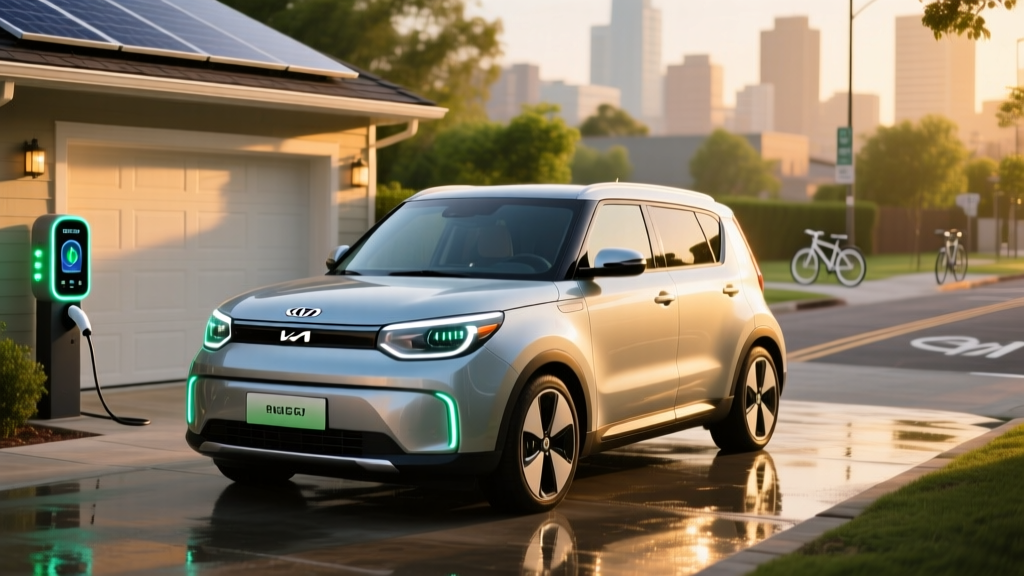
If you're researching a Kia Soul EV lease, you're likely drawn to its boxy practicality, upright seating position, and the promise of cheap electric commuting. The Soul EV remains one of the most recognizable compact electric crossovers on the road, and leasing can be a smart way to sidestep EV depreciation risk while locking in a predictable monthly payment.
But the real question isn't the sticker price — it's what this EV actually costs you over five years once you factor in electricity, insurance, maintenance, depreciation, and available incentives. Below, we run the numbers with concrete data, not marketing claims.
| EPA Range | 243 miles (Long Range trim) |
| Real-World Highway Range | ~195–215 mi (70 mph, moderate temps); ~165–185 mi in cold weather |
| Battery | 64 kWh usable, NMC lithium-ion |
| Efficiency | 120 MPGe combined (28 kWh/100 mi) |
| DC Fast Charging | Peak ~77 kW (CCS); 10–80% in ~54 minutes |
| Level 2 Charging | 7.2 kW onboard charger; ~9 hours for full charge |
| Motor Output | 201 hp / 291 lb-ft torque |
| 0–60 mph | ~7.0 seconds |
| Starting MSRP | ~$35,000 (before incentives) |
| Battery/Powertrain Warranty | 10 years / 100,000 miles |
The Real 5-Year Total Cost of Ownership
Leasing an EV changes the math compared to buying, but understanding the full ownership cost picture is essential whether you're signing a 36-month lease or purchasing outright. Here's what five years looks like for the Kia Soul EV, assuming 12,000 miles driven annually and home Level 2 charging as the primary method.
| Category | Estimated Cost | Notes |
|---|---|---|
| Vehicle Acquisition (lease total, 60 mo equivalent) | $21,600–$25,200 | $360–$420/mo typical lease; varies by dealer and money factor |
| Electricity (home charging) | $2,350–$2,880 | $0.13–$0.16/kWh avg; 60,000 mi total |
| Public DC Fast Charging | $480–$720 | ~15% of charging at $0.35–$0.48/kWh |
| Insurance | $9,000–$11,400 | $150–$190/mo avg for EV compact crossover |
| Maintenance | $600–$900 | Tire rotations, cabin filter, wipers, brake fluid check |
| Tires (replacement set) | $600–$800 | EV-specific tires wear ~15% faster due to torque/weight |
| Depreciation (if purchasing) | $14,000–$17,500 | EVs depreciate ~40–50% over 5 years; leasing transfers this risk |
| Total (Leasing Scenario) | $34,630–$41,900 | Excludes incentives; varies by region and driving habits |
The key insight for lessees: you don't absorb depreciation directly. The leasing company (typically Kia Finance) sets the residual value, and you pay only the difference between the negotiated price and that residual, plus the money factor (lease interest). This is the primary financial advantage of a Kia Soul EV lease over purchasing — you're insulated if EV resale values continue to soften.
Federal Tax Credit: Do You Qualify Under §30D?
The federal EV tax credit under IRS §30D can reduce your effective cost by up to $7,500, but eligibility is far from automatic. The rules changed significantly after the Inflation Reduction Act, and they continue to evolve. Here's the current checklist for 2026:
- MSRP Cap: Vehicle must have an MSRP at or below $55,000 for SUVs/crossovers (the Soul EV qualifies as a small SUV under IRS classification, so the $55K cap applies).
- Buyer Income Limits: Modified Adjusted Gross Income (MAGI) must not exceed $150,000 (single), $225,000 (head of household), or $300,000 (married filing jointly).
- Battery Sourcing: A percentage of critical minerals must be sourced from the US or a free-trade-agreement country, and battery components must be manufactured or assembled in North America. These percentages increase annually — check current-year IRS guidance before signing.
- Point-of-Sale Transfer: As of 2024, you can transfer the credit to the dealer at purchase, effectively reducing the sale price by up to $7,500 at the point of sale. This also applies to leases — the leasing entity claims the credit and may pass the savings to you as a reduced capitalized cost (negotiate this explicitly).
- Final Assembly: Vehicle must undergo final assembly in North America.
- One Credit Per Vehicle: The credit applies once per VIN; you cannot claim it on a vehicle that already received it.
Lease-specific note: When you lease, the leasing company technically claims the §30D credit because they are the legal owner. Reputable dealers factor this into the lease's capitalized cost, effectively passing the savings to you. But this is not automatic — always ask the dealer to show you how the federal credit is applied to your lease terms. If they can't or won't, shop elsewhere.
The Kia Soul EV's critical-mineral and battery-component sourcing has been a moving target. Before committing, verify the current-year eligibility on the fueleconomy.gov tax credit lookup or confirm directly with your Kia dealer's finance department.
Charging vs. Gas: The Per-Mile Cost Reality
This is where the Soul EV lease makes the strongest financial case — if you can charge at home. Let's run the math against a comparable gas-powered subcompact crossover getting 30 MPG combined.
| Scenario | $/Mile | Annual (12,000 mi) |
|---|---|---|
| Soul EV — Home L2 ($0.14/kWh) | $0.039 | $468 |
| Soul EV — Public DCFC ($0.42/kWh avg) | $0.118 | $1,416 |
| Soul EV — Blended (85% home, 15% DCFC) | $0.051 | $612 |
| Gas Crossover — 30 MPG @ $3.40/gal | $0.113 | $1,356 |
Assumes 28 kWh/100 mi for the Soul EV (EPA combined). Your rate depends on your utility's $/kWh and whether you have access to time-of-use or off-peak EV plans.
At a blended charging mix, the Soul EV costs roughly $0.05/mile vs. $0.11/mile for gas — a savings of about $744 per year, or $3,720 over five years. That's meaningful, but it depends entirely on home charging access. If you're relying solely on public DC fast chargers at $0.40+/kWh, the savings evaporate and you may actually pay more per mile than a fuel-efficient gas car.
Charging speed caveat: The Soul EV's peak DC charge rate of ~77 kW is modest by 2026 standards. On a 150 kW or 350 kW station, you won't use anywhere near the stall's capacity. A 10–80% session takes roughly 54 minutes — plan road-trip stops accordingly. The charge curve tapers noticeably above 60% SoC, so don't expect linear charging times.
Maintenance Savings: What You Actually Skip
EVs eliminate many routine maintenance items that gas cars require. Here's what the Soul EV owner avoids over five years and 60,000 miles:
| Service Item | Gas Car Cost | Soul EV Cost |
|---|---|---|
| Oil changes (5–6 over 60K mi) | $300–$480 | $0 |
| Transmission fluid service | $150–$250 | $0 (single-speed reduction gear) |
| Spark plugs | $200–$400 | $0 |
| Brake pads (front set) | $250–$400 | $0–$150 (regen braking extends pad life 2–3×) |
| Engine air filter | $40–$80 | $0 |
| Cabin air filter | $40–$80 | $40–$80 |
| Coolant flush | $100–$150 | $100–$150 (battery thermal system) |
| Tire rotation (5–6×) | $100–$180 | $100–$180 |
| Total Estimated | $1,180–$2,020 | $340–$710 |
Net maintenance savings: roughly $700–$1,300 over five years. It's real, but it's not the thousands-per-year figure some EV advocates claim. The savings are meaningful primarily because you eliminate oil changes and extend brake life through regenerative braking — the Soul EV's regen system is strong enough for near-one-pedal driving in most city conditions, which significantly reduces friction brake wear.
One cost to budget for: EV-specific tires. The Soul EV's instant torque and ~3,700 lb curb weight chew through tires about 15% faster than a comparable gas car. Expect to replace one set during a five-year ownership period, adding $600–$800.
Insurance: The Hidden EV Premium
Here's the cost category most EV buyers underestimate. Insurance for the Kia Soul EV typically runs 15–25% higher than an equivalent gas-powered subcompact crossover. In our research, annual premiums range from $1,800 to $2,280 depending on your state, driving record, and coverage level.
Why the premium?
- Higher repair costs: EV battery packs and power electronics are expensive to replace after collision damage. Even minor rear-end impacts can trigger battery safety inspections that total a claim.
- Specialized labor: Fewer body shops are certified to work on high-voltage EV systems, which drives up labor rates.
- Replacement parts pricing: EV-specific components (charge ports, onboard chargers, battery modules) carry premium pricing vs. commodity gas-car parts.
- Vehicle MSRP: The Soul EV starts around $35,000 — higher than a base gas Soul (~$22,000), so collision/comprehensive coverage costs more.
Actionable tip: Before signing a lease, get an insurance quote with the specific VIN. Some insurers (Geico, Progressive, State Farm) offer EV-specific discounts of 5–10%. Bundling with homeowners or renters insurance can knock another 10–15% off. Over five years, shopping your insurance can save $1,000–$2,000.
State, Local, and Utility Incentives
Beyond the federal §30D credit, many buyers can stack additional incentives:
- State rebates: States like California (CVRP, up to $7,000 for income-qualified buyers), Colorado (up to $5,000 tax credit), Massachusetts (MOR-EV, up to $3,500), and New York (Drive Clean Rebate, up to $2,000) offer significant point-of-sale or post-purchase rebates.
- Utility rebates: Many electric utilities offer $250–$1,000 rebates for purchasing an EV and/or installing a Level 2 home charger. Examples include PG&E, SCE, ConEdison, and Xcel Energy programs. Check with your local provider.
- HOV lane access: Several states grant EVs access to carpool lanes with a single occupant — a significant time savings in metro areas like Los Angeles, the Bay Area, and Washington D.C.
- Reduced registration fees: Some states waive or reduce annual EV registration surcharges; others impose them (typically $50–$200/year) to offset lost gas-tax revenue. Know your state's policy.
For a Kia Soul EV lessee, the stacking potential is real: a California buyer with moderate income might combine the $7,500 federal credit (passed through the lease), a $7,000 CVRP rebate, and a $500 utility charger rebate — reducing effective cost by over $15,000. But this is the best-case scenario; most buyers will see $7,500–$10,000 in total incentives.
Depreciation and Resale Value: Why Leasing Makes Sense
EV depreciation has been a sore spot for early adopters. According to industry data from sources like iSeeCars and Kelley Blue Book, EVs have depreciated faster than gas cars in recent years — partly due to rapid technology advancement, aggressive Tesla price cuts pulling down the entire used-EV market, and consumer uncertainty about battery longevity.
The Kia Soul EV typically retains 50–60% of its MSRP after three years and roughly 35–45% after five years. That's below the segment average for gas subcompact SUVs (which hold ~50–55% at five years).
This is precisely why leasing is strategically sound for the Soul EV:
- You transfer depreciation risk to the leasing company.
- If battery technology leaps forward (solid-state, 400-mile affordable packs), you're not stuck with an outdated asset.
- You can upgrade to a newer model with faster charging and better range at lease end.
- The 10-year/100,000-mile battery warranty provides peace of mind during the lease term, but it's the second and third owners who benefit most from that coverage.
If you do choose to purchase instead of lease, plan to hold the vehicle for 7–10 years to amortize the steeper initial depreciation curve. The Soul EV's battery warranty (10 years/100,000 miles, with coverage if capacity drops below 70%) supports long-term ownership.
Frequently Asked Questions
How much does a Kia Soul EV lease typically cost per month in 2026?
Expect monthly lease payments in the range of $340–$450 for a 36-month term with 10,000–12,000 annual miles, depending on the trim, dealer negotiation, money factor, and whether the federal tax credit is applied to the capitalized cost. Putting money down reduces the monthly payment but isn't always advisable — a zero-down lease preserves your cash and the federal credit still reduces the cap cost.
Can I claim the federal tax credit on a leased Kia Soul EV?
Technically, the leasing company claims the credit as the vehicle's legal owner. However, under current IRS rules, the credit can be passed through as a reduction in the lease's capitalized cost (the "sell price" of the lease). Always confirm this with your dealer's finance office and get it in writing before signing. The IRS §30D guidance page details how commercial clean vehicle credits interact with leases.
Is the Kia Soul EV good for road trips?
It's adequate but not class-leading. The 243-mile EPA range is fine for daily driving and shorter trips, but highway driving at 70+ mph reduces real-world range to roughly 195–215 miles. Combined with the ~77 kW peak DC charge rate and 54-minute 10–80% sessions, road trips require more planning than in vehicles with 300+ mile range and 200+ kW charging (like the Hyundai Ioniq 5 or Tesla Model Y). If road trips are frequent, consider whether the Soul EV's charm and practicality outweigh its charging-speed limitations.
Does the Kia Soul EV qualify for HOV lane access?
In most states that offer HOV lane stickers or decals for EVs (California, Colorado, Virginia, Maryland, etc.), the Soul EV qualifies. However, some states have capped their programs or introduced income-based eligibility. Check your state's DMV or energy office for current rules.
What happens if the battery degrades during my lease?
Kia's battery warranty covers capacity loss below 70% for 10 years/100,000 miles. During a typical 36-month lease, meaningful degradation is extremely unlikely — most NMC batteries lose 5–8% capacity over three years under normal use. If you do experience abnormal degradation, the warranty claim would be handled between Kia and the leasing company. You're protected.
How much does home Level 2 charger installation cost?
A typical 240V / 40-amp Level 2 home charger installation runs $800–$2,000 including equipment and electrician labor, assuming your electrical panel has capacity. If you need a panel upgrade (200-amp service), add $1,500–$3,000. Many utilities offer $250–$500 rebates for charger installation — check with your provider before scheduling the work.
A Kia Soul EV lease makes the most sense for buyers who: (1) have reliable home Level 2 charging, (2) drive under 300 miles in a typical day, (3) want to avoid EV depreciation risk, and (4) qualify for the federal tax credit. The five-year cost advantage over a gas crossover is real — roughly $3,000–$5,000 in net savings after accounting for higher insurance — but it hinges on cheap home electricity and stacked incentives. If you rely entirely on public charging or live in a state with no additional rebates, the math narrows considerably. Run your own numbers with your utility rate, insurance quote, and state incentives before signing.