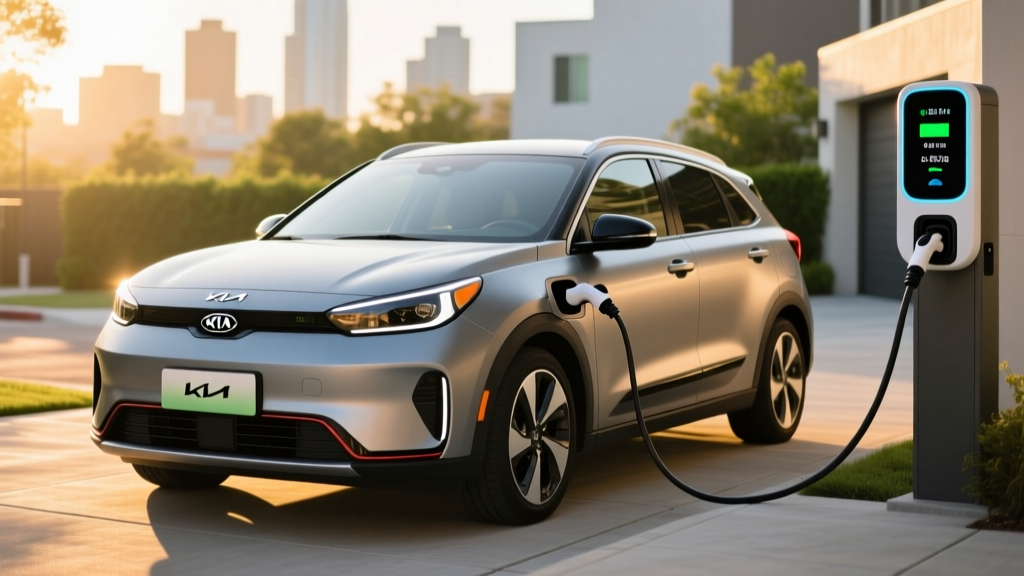
The 2026 Kia Niro EV Wind trim sits in the sweet spot of the Niro lineup: it adds premium features over the base S trim without jumping to the top-tier GT-Line price. If you're researching the Kia Niro EV Wind as your next vehicle, here's what you need to know immediately.
Quick Answer: The Kia Niro EV Wind delivers an EPA-estimated 239 miles of range from a 64.8 kWh NMC battery, charges at up to 85 kW DC (10–80% in roughly 43 minutes), and starts around $39,600 MSRP. Real-world highway range drops to roughly 205–220 miles; cold-weather range can fall to 170–190 miles. Federal tax credit eligibility under §30D is limited — verify battery sourcing and your income before assuming the full $7,500.
Range, Battery, and Efficiency: What the Numbers Actually Mean
The Niro EV Wind shares its powertrain with every other 2026 Niro EV: a front-mounted 150 kW (201 horsepower) permanent-magnet synchronous motor fed by a 64.8 kWh usable battery pack using NMC (nickel-manganese-cobalt) chemistry. That's enough for an EPA-estimated 239 miles of combined driving and a combined rating of 113 MPGe, per fueleconomy.gov.
| Spec | Value |
|---|---|
| EPA Range | 239 miles (combined) |
| Battery Capacity | 64.8 kWh usable (NMC) |
| Motor Output | 150 kW / 201 hp / 188 lb-ft torque |
| 0–60 mph | ~7.0 seconds |
| MPGe (City / Hwy / Combined) | 126 / 101 / 113 |
| Max DC Fast Charge Rate | 85 kW (CCS1) |
| 10–80% DC Charge Time | ~43 minutes |
| Level 2 Charge Rate | 11 kW onboard charger |
| Level 2 10–100% Time | ~6.5 hours |
| Base MSRP (Wind trim) | ~$39,600 |
| Battery/Powertrain Warranty | 10 years / 100,000 miles |
Real-World Range Reality Check: The EPA's 239-mile figure blends city and highway driving at moderate temperatures. Expect roughly 205–220 miles on a sustained highway trip at 70+ mph. In freezing weather (below 30°F), cabin heating and battery cold-soak can reduce range to 170–190 miles. The Niro EV lacks a heat pump on the Wind trim in some markets — confirm with your dealer whether the 2026 Wind includes one, as it significantly improves cold-weather efficiency.
Charging Speeds: Home and Public
The Niro EV Wind's 85 kW peak DC fast-charging rate is modest by 2026 standards. Many competitors in this price range (Hyundai Ioniq 5, Tesla Model Y, Kia EV6) accept 150–350 kW. That means the Niro EV takes roughly twice as long at a DC fast charger. For daily driving, this matters less than it sounds — most charging happens at home.
| Level | Power (kW) | Miles Added per Hour | Best For |
|---|---|---|---|
| Level 1 (120V household) | ~1.4 kW | ~4–5 mi/hr | Overnight top-up, emergencies |
| Level 2 (240V home/work) | Up to 11 kW | ~32–36 mi/hr | Daily primary charging |
| DC Fast (CCS1 public) | Up to 85 kW | ~250 mi/hr (peak) | Road trips, quick top-ups |
A critical nuance: the 85 kW figure is a peak, not a sustained rate. The Niro EV's charge curve tapers significantly above 60% state of charge. You might see 80–85 kW from 10–40% SoC, but it drops to 50–60 kW by 60% and falls further above 80%. This is normal for NMC packs without advanced thermal preconditioning, but it's why the 10–80% time stretches to 43 minutes rather than the ~25 minutes you'd see on an 800V architecture vehicle.
Home Charging Setup Costs
Most Niro EV owners will want a Level 2 home charger. Budget for the following:
| Item | Cost Range |
|---|---|
| Level 2 EVSE (charger unit, 32–48A) | $350–$700 |
| Electrician labor (240V/50A circuit run) | $500–$2,000 |
| Permit and inspection | $50–$250 |
| Electrical panel upgrade (if needed, 100A→200A) | $1,500–$3,500 |
| Total (no panel upgrade) | $900–$2,950 |
| Total (with panel upgrade) | $2,400–$6,450 |
If your home already has a 200A panel with spare breaker slots, expect to spend roughly $1,000–$2,500 total. Older homes with 100A service will likely need a panel upgrade — factor in the higher range. Always get a quote from a licensed electrician before committing.
Niro EV Wind vs. Gas Niro and Niro Hybrid: Cost Comparison
Kia sells the Niro in three powertrains: conventional hybrid (HEV), plug-in hybrid (PHEV), and battery electric (BEV). Here's how the Wind-trim EV stacks up against the gas hybrid alternative over five years of ownership.
| Category | Niro EV Wind (BEV) | Niro HEV EX (Hybrid) |
|---|---|---|
| Base MSRP | ~$39,600 | ~$30,000 |
| Fed. Tax Credit (§30D, if eligible) | Up to $7,500* | $0 (not a BEV/PHEV with sufficient battery) |
| Effective Purchase Price | ~$32,100* | ~$30,000 |
| Fuel/Energy (5 yrs, 15K mi/yr, $0.14/kWh avg, $3.40/gal) | ~$3,800 | ~$5,950 |
| Maintenance (5 yrs) | ~$1,200 | ~$3,000 |
| Insurance (5 yrs, avg) | ~$9,500 | ~$7,800 |
| Home Charger Install (one-time) | ~$1,500 | $0 |
| Estimated 5-Year Total Cost | ~$48,100 | ~$46,750 |
*Tax credit eligibility depends on battery sourcing, buyer income, and MSRP caps under IRS §30D rules. The Niro EV's eligibility has fluctuated as Kia adjusts supply chains. Verify current status at irs.gov or with your dealer before purchase. Point-of-sale transfer is available if eligible.
The numbers are close. The EV wins on fuel and maintenance savings (~$2,150 less in fuel, ~$1,800 less in maintenance over five years) but gives back ground on higher insurance premiums (~$1,700 more) and the home charger installation. If you qualify for the full $7,500 credit, the EV becomes the cheaper option. If you don't qualify, the hybrid has a slight cost edge — though the EV still eliminates tailpipe emissions and offers a smoother, quieter drive.
What the Niro EV Wind Trim Actually Gets You
The Wind trim sits between the base S and the top GT-Line. For 2026, the Wind typically adds:
- SynTex (synthetic leather) heated front seats with ventilated driver seat
- Wireless phone charging pad
- Power liftgate
- Smart cruise control with stop-and-go (Level 2 ADAS)
- Highway Driving Assist (lane centering + adaptive cruise)
- 10.25-inch dual panoramic displays (instrument cluster + infotainment)
- LED headlights and LED interior lighting
What it doesn't include (reserved for GT-Line): head-up display, Harman Kardon premium audio, remote smart parking assist, and the sportier exterior styling package. For most buyers, the Wind trim offers the best value in the lineup — you get the comfort and tech upgrades that matter daily without paying for cosmetic enhancements.
The Niro EV Wind comes equipped with Kia's full suite of driver-assistance features under the Drive Wise branding: forward collision-avoidance assist, blind-spot collision-avoidance, rear cross-traffic collision-avoidance, lane-keeping assist, and driver attention warning. These are SAE Level 2 systems — they assist with steering and speed but require continuous driver attention and hands on the wheel. They are not self-driving.
ADAS Limitations: Kia Drive Wise and Highway Driving Assist are SAE Level 2 driver-assist systems. You must keep your hands on the wheel and eyes on the road at all times. These systems do not handle construction zones, sudden obstacles, or complex urban intersections reliably. They reduce fatigue on highways but do not replace an attentive driver.
Common Misconceptions About the Niro EV
| Myth | Fact |
|---|---|
| "239 miles of range means I can drive 239 miles before recharging." | EPA range is a lab estimate. Sustained 75 mph highway driving yields ~205–220 real miles. Below-freeing temps drop it to ~170–190. |
| "It charges at 85 kW, so a full charge takes under 45 minutes." | 85 kW is peak, not sustained. The charge curve tapers above 60% SoC. Expect ~43 min for 10–80%, and significantly longer if you need 80–100%. |
| "EV batteries need replacement every few years." | Kia warranties the Niro EV battery for 10 years / 100,000 miles against capacity loss below 70%. Real-world data shows NMC packs losing roughly 10–15% over 8–10 years with normal use. |
| "I'll save $7,500 on taxes no matter what." | The §30D credit requires meeting buyer income caps ($150K single / $300K joint), MSRP caps ($55K for SUVs), and battery critical-mineral/sourcing thresholds. Eligibility can change — always verify. |
| "Public charging is unreliable everywhere." | Reliability varies widely. Electrify America and Tesla Supercharger (with adapter) tend to have higher uptime. Always have a backup charging plan on road trips using apps like PlugShare. |
Tax Credit and Incentive Eligibility Checklist
The federal §30D Clean Vehicle Credit can reduce your effective purchase price by up to $7,500 — but only if every requirement is met. Here's the 2026 checklist:
- Buyer Income Cap: Modified AGI must not exceed $150,000 (single), $225,000 (head of household), or $300,000 (married filing jointly).
- MSRP Cap: The vehicle's MSRP (including destination, before options) must not exceed $55,000 for SUVs. The Niro EV Wind at ~$39,600 clears this easily.
- Battery Sourcing: A percentage of critical minerals must be sourced from the US or FTA partners, and battery components must be manufactured/assembled in North America. These thresholds tighten annually. Kia's Niro EV sourcing compliance has varied — confirm with your dealer for the specific build month.
- Point-of-Sale Transfer: If eligible, you can transfer the credit to the dealer at purchase, reducing your out-of-pocket cost immediately rather than waiting for tax filing.
- Final Assembly: Must occur in North America. The Niro EV is assembled in South Korea, which has historically disqualified it from the §30D credit. This is a critical factor — verify current assembly location with Kia or fueleconomy.gov's tax credit lookup.
State and local incentives vary significantly. Some states (California, Colorado, Massachusetts) offer additional rebates of $1,000–$7,500 for EV purchases, sometimes income-dependent. Check your state's energy office or the AFDC incentive database for specifics.
Decision Framework: Is the Kia Niro EV Wind Right for You?
Choose the Niro EV Wind if:
- You have access to Level 2 home charging (or can install it).
- Your daily commute is under 80 miles round-trip — the 239-mile range gives massive buffer.
- You want a practical compact crossover with strong cargo space (22.8 cu ft behind rear seats, 53.0 cu ft folded).
- You prioritize Kia's 10-year/100,000-mile battery warranty.
- You qualify for the §30D credit or a meaningful state rebate.
Consider the Niro Hybrid instead if:
- You lack reliable home charging access (apartment, street parking only).
- You regularly drive 300+ miles between stops in areas with sparse DC charging infrastructure.
- You live in an extremely cold climate (sustained sub-zero winters) and want to eliminate range-loss concerns entirely.
- Your budget is firm at ~$30,000 and you don't qualify for the EV tax credit.
Look at a competitor (Ioniq 5, Model Y, EV6) if:
- DC fast-charging speed is a priority — the Niro's 85 kW peak is slow for road trips compared to 150–350 kW rivals.
- You want 300+ miles of EPA range.
- You need AWD (the Niro EV is front-wheel drive only).
First-Time EV Buyer Essentials
If the Niro EV Wind is your first electric vehicle, here's what to prepare before delivery day:
- Schedule your electrician visit early. A Level 2 home charger installation can take 2–6 weeks to schedule, especially if a panel upgrade is needed. Do this before the car arrives.
- Download charging apps now. PlugShare, ChargePoint, EVgo, and Electrify America — create accounts and add payment methods before your first road trip.
- Learn to precondition. The Niro EV lets you schedule departure times via the infotainment system. Preconditioning warms the battery while plugged in, which preserves range and improves charge speed if you're heading to a DC fast charger.
- Understand kW vs. kWh. kW (kilowatts) measures power — how fast energy flows into the car (charge rate). kWh (kilowatt-hours) measures energy — how much the battery holds (64.8 kWh). A 85 kW charger fills a 64.8 kWh battery faster than a 50 kW charger, but not in a linear relationship due to charge-curve taper.
- Budget for insurance. EV insurance premiums run 10–25% higher than comparable gas vehicles. Get quotes from 3+ insurers before purchasing.
- Plan your road-trip charging. The Niro's CCS1 connector works with Electrify America, EVgo, and most non-Tesla networks. Tesla Superchargers are increasingly opening to CCS vehicles via adapter — confirm Kia's Niro compatibility with Tesla's NACS adapter program.
Frequently Asked Questions
What is the real-world range of the Kia Niro EV Wind?
The EPA rates it at 239 miles combined. In real-world highway driving at 70–75 mph, expect 205–220 miles. In freezing weather, plan for 170–190 miles. For daily commuting under 50 mph, you may match or slightly exceed the EPA figure.
How long does it take to charge the Niro EV at home?
On a 240V Level 2 charger at 11 kW, a full 0–100% charge takes approximately 6.5 hours. Most owners plug in each evening and wake to a full battery. On a standard 120V outlet (Level 1), expect roughly 4–5 miles of range per hour of charging — adequate only for low-mileage days or overnight top-ups.
Does the Kia Niro EV qualify for the $7,500 federal tax credit?
It depends. The Niro EV has historically been assembled in South Korea, which disqualifies it from the §30D credit's North American final assembly requirement. Kia has discussed shifting production, but as of early 2026, buyers should verify assembly location and battery-sourcing compliance for their specific vehicle before assuming eligibility. Check fueleconomy.gov for the current status.
Is the Niro EV Wind good for road trips?
It's adequate but not ideal. The 239-mile range covers most legs between charging stops, but the 85 kW peak DC charge rate means ~43-minute stops for 10–80% — noticeably longer than 18–25-minute stops in vehicles with 150+ kW charging. If road trips are a major part of your driving, consider the Ioniq 5 or EV6, both of which charge roughly twice as fast.
How does the Niro EV compare to the Niro Hybrid for daily commuting?
The EV is quieter, smoother, and cheaper to "fuel" — electricity at $0.14/kWh costs roughly $0.04/mile versus $0.10–$0.12/mile for the hybrid at 50 MPG and $3.40/gallon gas. The EV also requires less maintenance (no oil changes, fewer brake replacements due to regenerative braking). The hybrid wins if you can't charge at home or frequently drive in extreme cold.
What is the Niro EV's cargo space?
22.8 cubic feet behind the rear seats and 53.0 cubic feet with the rear seats folded. There is no front trunk (frunk) — the space under the hood houses the motor and electronics. Cargo capacity is competitive for the compact crossover segment.