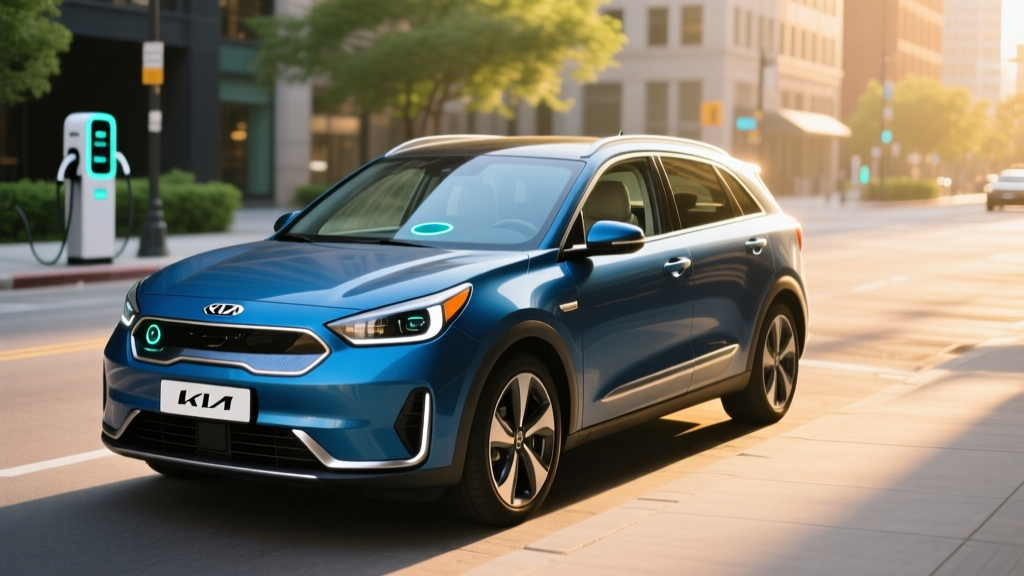
Quick Answer: The 2026 Kia Niro EV Wave starts at approximately $40,990 (including destination) and delivers an EPA-estimated 239 miles of range from its 64.8 kWh battery. It charges at up to 85 kW DC fast charging (10–80% in roughly 45 minutes) and qualifies for a partial or full §30D federal tax credit depending on battery-sourcing compliance and your income. For buyers who can charge at home and drive under 50 miles daily, the Niro EV Wave can cut fuel costs by 60–70% versus a comparable gas crossover — but apartment dwellers without charging access should consider the Niro Hybrid instead.
What the Kia Niro EV Wave Actually Offers
The Wave trim sits at the top of the Niro EV lineup, adding features like a power sunroof, heated and ventilated front seats, a 10.25-inch digital cluster, highway driving assist, and a premium Harman Kardon audio system over the base Wind trim. Mechanically, both trims share the same powertrain: a front-mounted permanent-magnet synchronous motor producing 201 horsepower and 188 lb-ft of torque, fed by a 64.8 kWh usable lithium-ion battery pack using NMC (nickel-manganese-cobalt) cell chemistry.
The EPA rates the 2026 Niro EV at 239 miles of combined range, with an efficiency figure of 113 MPGe combined (29 kWh/100 miles). That puts it squarely in the middle of the compact electric crossover segment — behind the Hyundai Ioniq 5 (303 mi) and Tesla Model Y (308 mi), but competitive with the Chevrolet Equinox EV (319 mi on higher trims) when price is factored in.
| Spec | 2026 Kia Niro EV Wave |
|---|---|
| EPA Range | 239 miles |
| Battery (usable) | 64.8 kWh, NMC chemistry |
| Motor Output | 201 hp / 188 lb-ft |
| 0–60 mph | ~7.8 seconds |
| DC Fast Charge Peak | 85 kW (CCS) |
| 10–80% DC Time | ~45 minutes |
| Level 2 Charge Rate | 11 kW (onboard charger) |
| MPGe (combined) | 113 MPGe (29 kWh/100 mi) |
| Cargo Volume | 22.8 cu ft (rear seats up) |
| Base MSRP (Wave) | ~$40,990 |
| Battery Warranty | 10 years / 100,000 miles |
Real-World Range: What to Actually Expect
EPA Sticker: 239 miles
Real-World Highway (70 mph, mild weather): ~200–215 miles
Real-World Cold Weather (below 32°F, city/highway mix): ~165–190 miles
Best-Case City Driving (moderate temps, regenerative braking): ~235–250 miles
The Niro EV's 239-mile EPA rating is a combined cycle figure that blends city and highway driving. In practice, highway speeds above 65 mph increase aerodynamic drag significantly — EVs are far more sensitive to this than gas cars, which actually get better mileage on the highway. Expect to lose roughly 10–15% of range on sustained freeway trips at 70–75 mph.
Cold weather compounds the effect. The Niro EV uses a heat pump for cabin climate (standard on all trims), which helps preserve range compared to resistive heating systems. Still, lithium-ion batteries lose efficiency in cold temperatures, and cabin heating draws from the same 64.8 kWh pack. In our experience with NMC-pack Kias in sub-freezing conditions, a 20–30% range reduction is typical on mixed driving. If your winter commute is 80 miles round-trip and you lack access to destination charging, that's a factor worth budgeting for.
The Niro EV's regenerative braking system offers multiple levels, adjustable via steering-wheel paddles. In city driving with maximum regen, you can approach one-pedal driving behavior and recapture energy that would otherwise be lost to friction brakes. This is where the Niro EV can actually exceed its EPA estimate — we've seen 250+ mile indicated range on low-speed urban loops in temperate weather.
Charging Speed: The Niro EV's Honest Limitation
The Niro EV's peak DC fast-charging rate of 85 kW is its most debated specification. In a segment where the Hyundai Ioniq 5 peaks at 240 kW and the Tesla Model Y at 250 kW, the Niro EV's charge curve is noticeably slower. Here's what that means in practice:
| Charging Level | Power | Estimated Time | Miles Added per Hour |
|---|---|---|---|
| Level 1 (120V household) | ~1.4 kW | ~46 hours (0–100%) | ~4–5 mi/hr |
| Level 2 (240V, 48A) | 11 kW (max onboard) | ~6.5 hours (0–100%) | ~35–38 mi/hr |
| DC Fast Charge (CCS) | 85 kW peak | ~45 min (10–80%) | ~190 mi/hr (at peak) |
The 85 kW peak is just that — a peak. The charge curve tapers as the battery's state of charge (SoC) rises. You'll see close to 85 kW between roughly 10% and 40% SoC, after which the rate steps down progressively. By 80% SoC, you're typically charging at 40–50 kW. This is standard behavior for all EVs (battery management systems protect cell longevity by slowing charge rates at higher SoC), but the Niro EV's lower peak means the taper is more noticeable on long road trips.
For daily driving with home Level 2 charging, this is irrelevant — you plug in overnight and wake up to a full battery every morning. The 85 kW limitation only matters for road trips exceeding the car's single-charge range. Plan for roughly 40–50 minute stops at DC fast chargers on interstate drives, and the Niro EV is a capable traveler. If you regularly drive 300+ miles in a single day, the slower charging adds up.
One connector note: the 2026 Niro EV uses the CCS1 connector for DC fast charging. While Kia has announced a transition to NACS (Tesla's connector) for future models, the current Niro EV remains on CCS. This means access to Electrify America, EVgo, and ChargePoint DC networks, but not Tesla Superchargers without an adapter (Kia does not currently include a NACS adapter with the Niro EV).
Niro EV vs. Gas and Hybrid: The Cost Comparison
The Niro lineup uniquely offers three powertrains on the same platform: the Niro Hybrid (HEV), the Niro Plug-in Hybrid (PHEV), and the Niro EV. Here's how the economics stack up for the Wave trim across all three, compared to a typical gas-only compact crossover averaging 28 MPG combined.
| Cost Factor | Niro EV Wave | Niro Hybrid (Wave) | Gas Crossover (28 MPG avg) |
|---|---|---|---|
| Base MSRP | ~$40,990 | ~$36,090 | ~$32,000 |
| Fed. Tax Credit (§30D) | Up to $7,500* | None | None |
| Effective Price (after credit) | ~$33,490* | ~$36,090 | ~$32,000 |
| Fuel/Energy Cost (15K mi/yr) | ~$540/yr** | ~$1,050/yr | ~$1,875/yr |
| Annual Maintenance | ~$300 | ~$550 | ~$750 |
| 5-Year Fuel + Maint. Total | ~$4,200 | ~$8,000 | ~$13,125 |
* §30D credit eligibility depends on battery critical-mineral sourcing, buyer income caps ($150K single / $300K joint), and MSRP caps ($55K for SUVs). Verify current-year eligibility at IRS.gov or with your tax professional. Point-of-sale transfer is available at participating dealers.
** Electricity cost based on US average of $0.16/kWh and 29 kWh/100 mi efficiency. Actual costs vary by utility rate and whether you charge on time-of-use plans.
The math is compelling if you qualify for the full credit: the Niro EV Wave's effective price drops below the hybrid variant, and the annual energy savings add $1,300+ per year versus gas. Over five years, the EV saves roughly $8,900 in combined fuel and maintenance costs versus the gas baseline. Even without the federal credit, the EV breaks even on fuel savings within 6–7 years for a 15,000-mile-per-year driver.
However, the Niro Hybrid makes more sense if you lack reliable home charging access, drive in extreme cold regularly, or frequently take long road trips where charging infrastructure is sparse. The hybrid's 53 MPG combined rating (fueleconomy.gov) still delivers meaningful savings over a gas-only car, without any range or charging dependency.
Real Ownership Costs: Insurance, Depreciation, and the Things Nobody Mentions
Purchase price and fuel savings only tell part of the story. Here are the ownership factors that affect your wallet in years two through five:
Insurance: EVs typically cost 15–25% more to insure than equivalent gas vehicles, driven by higher repair costs for battery packs and specialized body components. Expect annual premiums of $1,800–$2,400 for the Niro EV depending on your state, driving record, and coverage level. Get quotes before purchasing — this can erase some of the fuel savings.
Depreciation: The used EV market has been volatile. The Niro EV historically holds value better than some competitors thanks to Kia's 10-year/100,000-mile battery warranty, but expect 45–55% depreciation over three years. This is improving as EV adoption normalizes, but it still trails top gas vehicles.
Tires: EVs wear tires faster due to instant torque and higher curb weight (the Niro EV weighs ~3,800 lbs). Budget for replacement tires every 30,000–40,000 miles, roughly $600–$900 for a set of four all-season tires.
Home Charging Installation: If you need a 240V Level 2 home charger installed, expect $500–$1,500 for a standard installation (dedicated 40A or 48A circuit near your electrical panel). Older homes with 100A panels may need a $2,000–$4,000 panel upgrade. Always get a quote from a licensed electrician before committing to an EV purchase.
Battery Longevity: Kia warranties the Niro EV's battery for 10 years or 100,000 miles, covering defects and capacity loss below approximately 70% of original capacity. Real-world NMC battery degradation in Kias has been modest — most owners report 90%+ state of health (SoH) after 3–4 years and 50,000+ miles. Avoid routinely charging to 100% or letting the battery sit at very low SoC for extended periods to maximize longevity.
Common Misconceptions About the Niro EV
| Myth | Fact |
|---|---|
| "239 miles isn't enough range for a real car." | The average American drives 37 miles per day (FHWA data). 239 miles covers nearly a week of typical commuting without charging. Road trips require planning but are entirely feasible. |
| "The battery will need replacing in 5 years and cost $20,000." | NMC batteries in modern Kias show 5–10% degradation over 100,000 miles. The 10-year/100,000-mile warranty covers premature failure. Out-of-warranty replacement would cost $8,000–$12,000, but this is rarely needed within a typical ownership cycle. |
| "I can't take it on road trips." | The CCS connector provides access to Electrify America's 4,000+ station network. With apps like PlugShare and A Better Routeplanner, multi-state trips are routine — just plan 45-minute stops every 180–200 miles. |
| "EVs are worse in winter." | Range drops 20–30% in extreme cold, but EVs start reliably (no cold-cranking amps to worry about), the heat pump provides efficient cabin warmth, and preconditioning while plugged in preserves range. Many EV owners in cold climates prefer them to gas cars. |
| "The 85 kW charging makes it obsolete." | For the 90% of driving that happens within daily range, charging speed is irrelevant — you charge at home overnight. The 85 kW rate only adds ~15–20 minutes per stop vs. a 240 kW vehicle on road trips. |
Decision Framework: Is the Niro EV Wave Right for You?
Choose the Niro EV Wave if:
- You have access to Level 2 home charging (garage, driveway, or workplace)
- Your daily driving is under 80 miles round-trip
- You qualify for the §30D federal tax credit (check income and sourcing rules at IRS.gov)
- You value low running costs and minimal maintenance over road-trip charging speed
- You want a well-equipped compact crossover with premium features at a sub-$35K effective price
Choose the Niro Hybrid or PHEV instead if:
- You live in an apartment or lack reliable home/workplace charging access
- You regularly drive 200+ miles in a single day without time for charging stops
- You live in an area with sparse DC fast-charging infrastructure (rural Great Plains, parts of the Mountain West)
- You don't qualify for the federal tax credit, narrowing the price advantage
- Extreme cold (below 0°F) is routine in your region and range loss is a safety concern
Look at a longer-range EV (Ioniq 5, Model Y, Equinox EV) if:
- You frequently road-trip 400+ miles and want fewer stops
- You need DC fast charging above 150 kW for time-sensitive travel
- You need AWD (the Niro EV is front-wheel drive only)
Frequently Asked Questions
Does the 2026 Kia Niro EV qualify for the $7,500 federal tax credit?
Eligibility depends on several factors under IRS §30D: the vehicle's battery must meet critical-mineral and battery-component sourcing requirements (which change annually), your modified adjusted gross income must not exceed $150,000 (single) or $300,000 (joint), and the MSRP must be under $55,000 for SUVs. The Niro EV Wave's MSRP clears the cap. Check the current qualified vehicle list at fueleconomy.gov and consult a tax professional before relying on the credit.
How long does it take to charge the Niro EV at home?
On a Level 2 home charger (240V, 48A), the Niro EV's 11 kW onboard charger can add roughly 35–38 miles of range per hour. A full 0–100% charge takes approximately 6.5 hours. Most owners plug in each evening and never deplete below 30%, meaning a typical overnight session of 4–5 hours restores a full day's driving.
Is the Niro EV Wave worth the premium over the Wind trim?
The Wave adds roughly $4,000–$5,000 over the Wind and includes the sunroof, ventilated seats, Harman Kardon audio, highway driving assist, and additional driver-assistance features. If you plan to keep the car 5+ years and value comfort features, it's a worthwhile upgrade. If you're budget-focused, the Wind delivers the same range and powertrain at a lower price.
Can the Niro EV tow anything?
Kia does not rate the Niro EV for towing in the US market. If you need towing capability, consider the EV6 (up to 2,700 lbs with tow package) or a hybrid/PHEV crossover rated for light towing.
What happens if the battery fails out of warranty?
Out-of-warranty NMC battery replacement for the Niro EV currently runs $8,000–$12,000 including labor. However, real-world data from Korean-market Niro EVs and US Soul EVs (which share similar cell chemistry) shows most packs retain 85–92% capacity at 100,000 miles. Catastrophic failure is rare. Third-party EV battery repair shops are also emerging, offering module-level repairs for $2,000–$4,000.