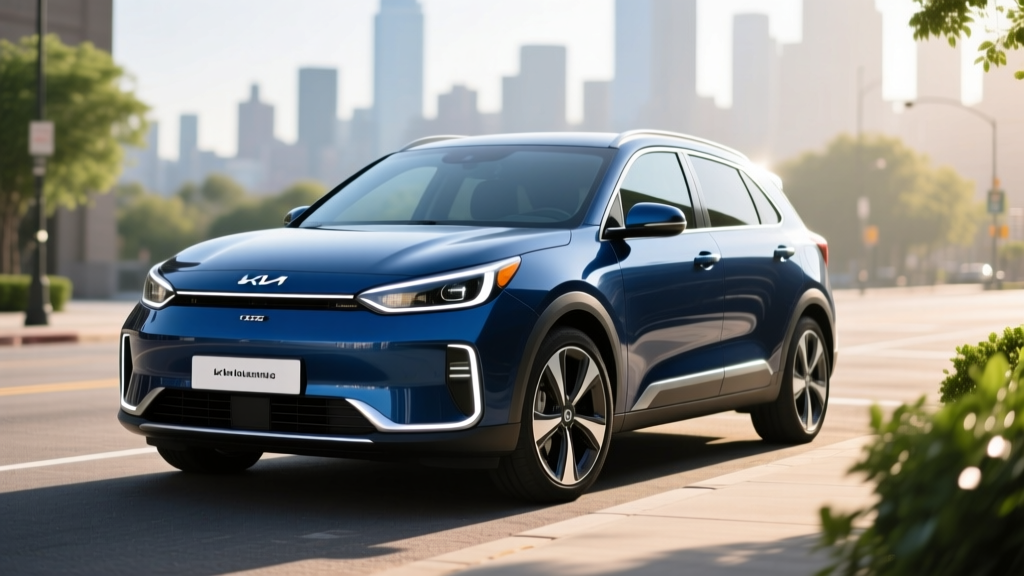
Quick Verdict: The 2026 Kia Niro Electric (Niro EV) delivers an EPA-estimated 239 miles of range from its 64.8 kWh battery, peaks at roughly 80 kW DC fast charging (10–80% in about 45 minutes), and starts near $39,600 before incentives. It's a practical, value-oriented compact electric crossover for daily commuters with home charging access — but its modest fast-charging speed and limited federal tax credit eligibility mean buyers should cross-shop carefully against the Hyundai Ioniq 5, Chevrolet Equinox EV, and even the Niro's own hybrid sibling.
What the 2026 Kia Niro Electric Actually Offers
The Kia Niro EV rides on the same dedicated platform as the Niro Hybrid and Niro Plug-In Hybrid, but swaps the internal combustion components for a front-mounted permanent-magnet synchronous motor producing 201 horsepower and 188 lb-ft of torque. That power routes exclusively to the front wheels — no all-wheel-drive option is available.
The energy source is a 64.8 kWh (usable) lithium-ion polymer battery pack using NMC (nickel-manganese-cobalt) chemistry, mounted low in the floor for a favorable center of gravity. Kia pairs this with a heat pump as standard equipment on most trims, which helps preserve range in cold weather — a meaningful advantage over competitors that charge extra for thermal management.
| Spec | Value |
|---|---|
| EPA Range | 239 miles (Wind trim); 207 mi (GT-Line) |
| Battery (usable) | 64.8 kWh, NMC chemistry |
| Motor Output | 201 hp / 188 lb-ft (FWD) |
| 0–60 mph | ~6.8 seconds |
| DC Fast Charge (peak) | ~80 kW (CCS1) |
| 10–80% DC Fast Charge | ~45 minutes |
| Level 2 AC Charge Rate | 11 kW (onboard charger) |
| Level 2 10–100% Time | ~7 hours |
| EPA Efficiency (combined) | 113 MPGe (Wind trim) |
| Cargo Volume (rear seats up) | 19.1 cu ft |
| Base MSRP (Wind) | $39,600 |
| Battery/Powertrain Warranty | 10 years / 100,000 miles |
Real-World Range Expectations: The EPA rates the Niro EV Wind at 239 miles, but real-world results depend heavily on conditions. In mild weather at city speeds, owners report achieving 240–260 miles. On sustained highway driving at 70+ mph, expect roughly 195–215 miles. In freezing temperatures (below 32°F), range can drop to 165–190 miles depending on cabin heat usage — though the standard heat pump mitigates some of this loss compared to resistive heating systems.
Charging Speed: The Niro EV's Biggest Limitation
If there's one area where the Niro EV shows its age relative to newer 800-volt platforms, it's DC fast charging. The peak rate of approximately 80 kW means you're looking at roughly 45 minutes for a 10–80% session at a compatible CCS1 station. That's competitive with older-generation EVs but noticeably slower than the Hyundai Ioniq 5 (which peaks around 240 kW on its 800V architecture and completes 10–80% in about 18 minutes) or the Tesla Model Y on V3 Superchargers.
The charging curve also tapers significantly above 80% state of charge. Pushing from 80% to 100% on DC fast charging can add another 30–40 minutes, making it impractical for road-trip top-offs. Plan to charge to 80% and go.
| Level | Power | Miles Added per Hour | Use Case |
|---|---|---|---|
| Level 1 (120V outlet) | ~1.4 kW | ~4–5 mi/hr | Emergency / overnight trickle |
| Level 2 (240V, 48A) | 11 kW | ~35 mi/hr | Home daily charging |
| DC Fast Charge (CCS1) | ~80 kW peak | ~130 mi in 45 min (10–80%) | Road trips |
For daily driving, Level 2 home charging is where the Niro EV excels. With an 11 kW onboard charger, a full charge from 10% takes roughly 6–7 hours — easily accomplished overnight on a dedicated 240V/48A home charger. Home charging installation typically costs $800–$2,000 depending on your electrical panel capacity and run distance, but it transforms EV ownership from a chore into a convenience.
Niro Electric vs. Niro Hybrid: The Cost and Efficiency Showdown
Many shoppers cross-shop the Niro EV against the Niro Hybrid (HEV), and for good reason — they share a platform, similar interior dimensions, and Kia's warranty. But the economics diverge sharply.
| Factor | Niro EV (Wind) | Niro Hybrid (EX) |
|---|---|---|
| Base MSRP | $39,600 | $28,290 |
| EPA Range / MPG | 239 mi / 113 MPGe | 53 MPG combined |
| Fuel/Energy Cost per Mile | ~$0.04 (home charging at $0.13/kWh) | ~$0.06 (gas at $3.20/gal) |
| Annual Fuel Cost (15,000 mi) | ~$600 | ~$905 |
| Maintenance (annual est.) | ~$200 | ~$500 |
| Federal Tax Credit (§30D) | Up to $7,500 (eligibility varies) | Not eligible |
| 5-Year Fuel + Maintenance | ~$4,000 | ~$7,025 |
| Cargo (rear up) | 19.1 cu ft | 22.8 cu ft |
The Niro EV commands an $11,310 premium at purchase. However, if you qualify for the full $7,500 federal tax credit under IRS §30D rules, that gap narrows to roughly $3,810 — and the EV's lower operating costs can close the remainder within 3–4 years of average driving.
The hybrid wins on cargo space (22.8 vs 19.1 cu ft, due to the EV's battery packaging), road-trip flexibility, and lower upfront cost. The EV wins on per-mile cost, smoothness, instant torque, and zero tailpipe emissions.
Real Costs of Ownership: What the Sticker Doesn't Show
Buying an EV involves financial variables beyond MSRP. Here's a realistic five-year breakdown assuming 15,000 miles annually, home charging at the national average of $0.13/kWh, and no tax credit applied (conservative estimate — your actual credit depends on income, battery sourcing, and MSRP caps).
| Cost Category | Niro EV | Niro Hybrid |
|---|---|---|
| Purchase Price (MSRP) | $39,600 | $28,290 |
| Federal Tax Credit (est.) | –$3,750 to $7,500 | $0 |
| Home Charger Install | $1,200 (avg) | $0 |
| Fuel/Energy (5 yrs) | $3,000 | $4,525 |
| Maintenance (5 yrs) | $1,000 | $2,500 |
| Insurance (5 yrs, avg) | $8,500 | $7,200 |
| Estimated Depreciation | $16,000 | $11,500 |
| Total (pre-credit) | $69,300 | $54,015 |
| Total (w/ max credit) | $58,050 | $54,015 |
Key observations: EV insurance premiums tend to run 10–20% higher than comparable gas or hybrid vehicles due to repair cost complexity and battery replacement exposure. Depreciation on EVs has historically been steeper, though this is stabilizing as the market matures. The Niro EV's strong 10-year/100,000-mile battery warranty provides downstream protection if you hold the vehicle long-term.
Also note: the §30D federal tax credit has strict eligibility requirements. Your modified adjusted gross income must fall below $150,000 (single) or $300,000 (joint). The vehicle must meet battery critical-mineral and component sourcing thresholds that shift annually. And the credit can now be transferred to the dealer at point of sale as an upfront discount, which simplifies cash flow. Always verify current-year eligibility on IRS.gov before committing.
Common Misconceptions About the Niro EV
| Myth | Fact |
|---|---|
| "The battery will need replacing in 5 years." | Kia warrants the battery for 10 years/100,000 miles against capacity loss below 70%. Real-world NMC degradation data shows ~8–12% loss over 100,000 miles in moderate climates. |
| "239 miles isn't enough range." | The average American drives 37 miles/day (fueleconomy.gov). A 239-mile range covers nearly a week of commuting. Road trips require planning but are feasible with CCS1 corridor coverage. |
| "Charging takes forever." | Home Level 2 charging replenishes overnight while you sleep — zero time spent at a "station." DC fast charging at 80 kW adds ~130 miles in 45 minutes, adequate for highway rest stops. |
| "EVs don't work in cold weather." | The Niro EV's standard heat pump preserves range better than resistive heating. Expect 25–30% range loss in sub-freezing temps — significant but manageable for a 239-mile EPA vehicle. |
| "I need to install a special charger." | A standard NEMA 14-50 outlet (same as an electric dryer) with a quality Level 2 EVSE handles daily needs. A hardwired 48A unit is faster and more permanent but not mandatory. |
Who Should Buy the Niro Electric — And Who Shouldn't
Choose the Niro EV if:
- You have access to Level 2 home charging (garage, driveway, or workplace)
- Your daily driving is under 80 miles round-trip
- You value low per-mile operating costs and a quiet, smooth commute
- You live in a moderate climate or value the standard heat pump for winter
- You want a mainstream brand with a strong dealer network and 10-year warranty
- You qualify for at least a partial federal or state tax credit
Choose the Niro Hybrid (or a different EV) if:
- You lack reliable home or workplace charging access
- You frequently take road trips over 300 miles and don't want to plan charging stops
- You live in an area with sparse CCS1 public charging infrastructure
- You need maximum cargo space (the hybrid offers 3.7 cu ft more)
- You want faster DC charging — consider the Hyundai Ioniq 5 or Kia EV6 instead
- You regularly drive in extreme cold (below 0°F) where range loss compounds significantly
The Niro EV occupies a specific niche: it's not the longest-range or fastest-charging EV in its price bracket, but it's one of the most approachable. The controls are intuitive, the ride is comfortable, and Kia's infotainment system is among the better mainstream offerings. For a first-time EV buyer with a predictable commute and home charging, it removes most of the friction from going electric.
Frequently Asked Questions
Does the 2026 Kia Niro EV qualify for the $7,500 federal tax credit?
Eligibility depends on several factors under IRS §30D: your income must be below $150,000 (single filer) or $300,000 (joint), the vehicle's MSRP must not exceed $80,000 (SUVs), and the battery must meet critical-mineral and component sourcing thresholds that tighten each year. Kia's credit eligibility has fluctuated as supply chains shift. Check the latest status on IRS.gov or ask your dealer about point-of-sale transfer options before purchasing.
How long does it take to charge the Niro EV at home?
On a Level 2 (240V) home charger delivering the Niro's maximum 11 kW AC rate, a full charge from near-empty takes approximately 7 hours. In practice, most owners plug in nightly and charge from 30–80%, which takes about 3 hours — well within an overnight window.
Is the Niro EV good for road trips?
It's workable but requires more planning than longer-range EVs. With 239 EPA miles (and realistically 200 on the highway), you'll stop every 180–200 miles. The 80 kW DC fast charging rate means ~45-minute stops for a 10–80% session. If you road-trip frequently, a vehicle with 300+ miles of range and 150+ kW charging (like the Ioniq 5 or Model Y) will make trips noticeably easier.
What happens if the battery degrades?
Kia covers the high-voltage battery for 10 years or 100,000 miles against capacity falling below approximately 70% of original. Industry-wide NMC degradation data suggests most packs retain 88–92% capacity at 100,000 miles under normal use. A full out-of-warranty battery replacement would likely cost $8,000–$12,000, but this scenario is uncommon within the first decade.
Can I tow with the Niro EV?
Kia does not rate the Niro EV for towing in the US market. If you need towing capability, look at the Kia EV6 (rated up to 2,300 lbs with trailer brakes) or a larger electric SUV.
Sources: EPA estimates via fueleconomy.gov, Kia America official specifications, IRS §30D clean vehicle credit guidelines at irs.gov.