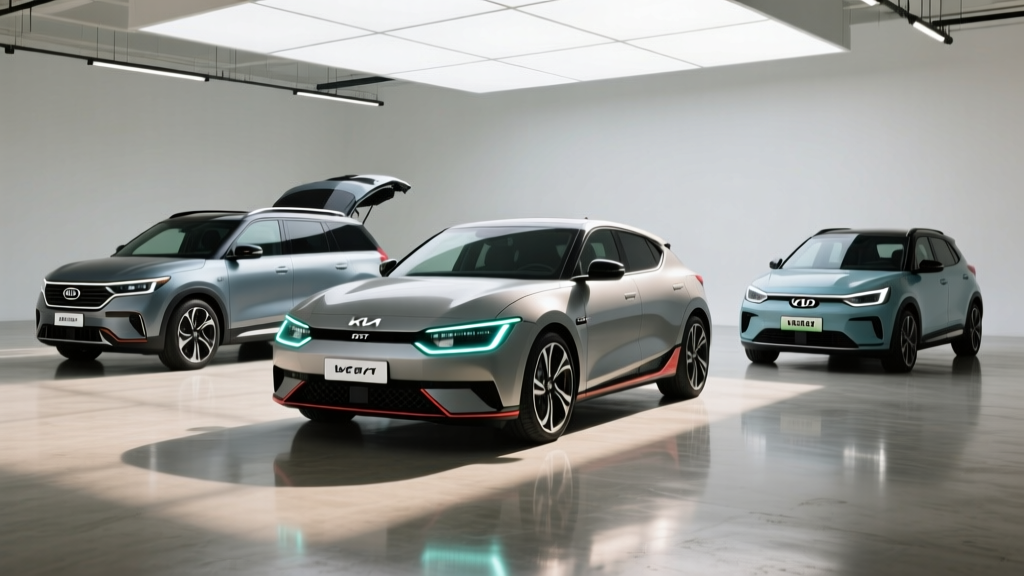
Quick Answer: Kia's 2026 EV lineup includes three core models: the Niro EV (239 miles EPA, ~$40,990), the EV6 (up to 310 miles EPA, ~$44,990), and the three-row EV9 (up to 304 miles EPA, ~$56,490). All use Kia's 800V architecture (EV6/EV9) for fast DC charging, carry a 10-year/100,000-mile battery warranty, and qualify for the §30D federal tax credit (up to $7,500) depending on your income, MSRP caps, and battery sourcing. The Niro EV is the practical commuter pick; the EV6 balances range and performance; the EV9 fills the family-hauler gap few EVs address.
Which Kia EVs Are Available Now?
If you're searching for Kia EVs for sale, three models dominate dealer lots in 2026. Kia also sells the Sorento PHEV and Sportage PHEV for buyers not ready to go fully electric, but this guide focuses on the battery-electric (BEV) lineup.
| Model | EPA Range | Battery (kWh) | Peak DC Charge | 10–80% Time | 0–60 mph | Starting MSRP |
|---|---|---|---|---|---|---|
| Niro EV | 239 mi | 64.8 (NMC) | 85 kW | ~43 min | 7.4 sec | $40,990 |
| EV6 (Long Range RWD) | 310 mi | 77.4 (NMC) | 240 kW | ~18 min | 7.2 sec | $44,990 |
| EV6 GT | 206 mi | 77.4 (NMC) | 240 kW | ~18 min | 3.4 sec | $62,990 |
| EV9 (RWD) | 304 mi | 100.0 (NMC) | 200 kW | ~24 min | 7.8 sec | $56,490 |
| EV9 (AWD) | 270 mi | 100.0 (NMC) | 200 kW | ~24 min | 5.0 sec | $60,490 |
Source: fueleconomy.gov and Kia America. Real-world highway range typically runs 10–15% below EPA; cold-weather (below 30°F) can cut range by 20–30% without preconditioning.
Real-World Range Reality: The EV6 Long Range RWD posts an EPA 310 miles, but on a 75-mph highway loop in mild conditions, expect roughly 260–275 miles. In winter at 20°F, that drops to 220–240 miles if you don't precondition the battery. The EV9's brick-like aerodynamics hit highway efficiency harder — plan for ~250 real-world highway miles from the 304-mile EPA sticker.
Kia EV vs Gas: What Does Ownership Actually Cost?
The sticker price of a Kia EV is higher than a comparable gas-powered Kia Sportage or Sorento, but the math shifts when you factor in fuel, maintenance, and tax incentives. Here's a five-year cost comparison using the EV6 Long Range RWD versus a gas Sportage AWD (~$32,000 MSRP, 28 MPG combined).
| Cost Factor | EV6 LR RWD | Sportage AWD (Gas) |
|---|---|---|
| Purchase Price (MSRP) | $44,990 | $32,000 |
| Federal Tax Credit (§30D) | –$7,500* | $0 |
| Effective Purchase | $37,490 | $32,000 |
| 5-Yr Fuel/Energy (60,000 mi) | $4,200** | $9,450*** |
| 5-Yr Maintenance | $1,800 | $4,500 |
| 5-Yr Insurance (avg) | $9,500 | $7,200 |
| 5-Year Total | $52,990 | $53,150 |
*§30D credit eligibility depends on income caps ($150K single / $300K joint), MSRP caps ($55K sedans / $80K SUVs), and battery-sourcing requirements. Verify at IRS.gov. Point-of-sale transfer available at participating dealers.
**Based on $0.14/kWh national average, 3.5 mi/kWh efficiency.
***Based on $3.50/gal, 28 MPG combined.
The EV6 essentially breaks even with the gas Sportage over five years despite the higher sticker — and that's before factoring in state rebates, HOV lane access, or potential utility off-peak charging rates below $0.10/kWh. The Niro EV, with its lower MSRP, pulls ahead faster in cost savings for commuters who charge at home.
Charging: Home, Public, and What You Need to Know
Kia's 800V architecture in the EV6 and EV9 is a genuine differentiator. While most competitors peak at 150–180 kW on DC fast chargers, the EV6 can sustain 240 kW on a compatible 350 kW station, pulling from 10% to 80% in roughly 18 minutes. The Niro EV, on a 400V platform, is slower at 85 kW peak — adequate for daily driving but noticeably longer on road trips.
| Charging Level | Power | EV6 Miles/Hour | EV9 Miles/Hour | Niro EV Miles/Hour |
|---|---|---|---|---|
| Level 1 (120V outlet) | ~1.4 kW | ~5 mi/hr | ~4 mi/hr | ~5 mi/hr |
| Level 2 (240V home) | 7.2–11.5 kW | ~28–42 mi/hr | ~24–38 mi/hr | ~28–32 mi/hr |
| DC Fast Charge | 85–240 kW | ~600+ mi/hr peak | ~500+ mi/hr peak | ~250 mi/hr peak |
Home charging setup: A Level 2 home charger (Level 2, 240V, 48-amp circuit) costs $500–$800 for the unit plus $800–$2,500 for electrician installation, depending on panel capacity and run length. If your home has a 200-amp panel with spare capacity, you're in good shape. Older 100-amp panels may need a $1,500–$3,000 upgrade. Always get a licensed electrician's assessment before committing.
Connector note: Kia's 2026 models use the CCS1 connector for DC fast charging, but Kia has committed to adopting NACS (Tesla's connector) on future models. As of 2026, Kia EVs can access Tesla Superchargers using a Kia-provided CCS-to-NACS adapter — check with your dealer for availability and compatibility with your model year.
Federal Tax Credit and Incentive Reality Check
The §30D clean vehicle credit offers up to $7,500, but qualification is not universal. Here's what determines your eligibility for a Kia EV in 2026:
- Income caps: Adjusted gross income must be ≤$150,000 (single), ≤$225,000 (head of household), or ≤$300,000 (joint filers)
- MSRP caps: Vehicle base price must be ≤$55,000 for sedans/wagons (EV6, Niro EV) or ≤$80,000 for SUVs/trucks (EV9 qualifies)
- Battery sourcing: The credit splits into two halves — $3,750 for critical minerals and $3,750 for battery component assembly. Kia's supply chain has shifted substantially, but exact sourcing compliance varies by model and build date
- Point-of-sale transfer: You can transfer the credit to the dealer at purchase, reducing your out-of-pocket cost immediately rather than waiting for tax filing
- Final assembly: Vehicle must be assembled in North America — all three Kia EVs currently qualify
Always verify current eligibility on fueleconomy.gov and consult a tax professional. Rules change, and battery-sourcing compliance can shift mid-year.
Common Misconceptions About Buying a Kia EV
| Myth | Fact |
|---|---|
| "The battery will need replacing in 5 years and cost $20,000" | Kia warranties the battery for 10 years/100,000 miles against defects and capacity loss below 70%. NMC degradation data shows typical 8–12% loss over 100K miles. Full replacements are rare and covered under warranty for defects. |
| "I can't take road trips — charging takes too long" | The EV6/EV9 800V system charges 10–80% in 18–24 minutes at a 350 kW station. Plan a 20-minute break every 2.5–3 hours. Slower than gas, but compatible with normal rest-stop habits. |
| "EVs are worse in the cold" | Range drops 20–30% in sub-freezing temps, but preconditioning (warming the battery while plugged in) recovers much of that loss. The EV6/EV9 heat pump option further mitigates cabin-heating energy drain. |
| "Public charging is unreliable everywhere" | Network reliability varies. Electrify America and EVgo have improved uptime. Tesla Superchargers (accessible via adapter) remain the gold standard at 97%+ uptime. Plan routes using PlugShare or A Better Routeplanner. |
| "I need a $10,000 home charger installation" | Most Level 2 installations run $1,300–$3,300 total (unit + labor). Only homes needing a panel upgrade push toward $5,000+. Federal 30C credit may cover up to $1,000 of charger installation cost. |
Decision Framework: Which Kia EV Fits You?
Choose the Niro EV if: You commute under 60 miles daily, have home Level 2 charging, want the lowest entry price, and rarely take road trips exceeding 200 miles. It's the most cost-effective daily driver in Kia's lineup.
Choose the EV6 Long Range if: You want a balance of 300+ mile range, fast 800V charging for road trips, and engaging performance. It's the strongest all-rounder and the model most cross-shoppers compare to the Tesla Model Y, Hyundai Ioniq 5, and Ford Mustang Mach-E.
Choose the EV6 GT if: Performance matters more than range (206 miles EPA is the trade-off). The 576 HP and 3.4-second 0–60 make it a legitimate sports sedan rival — but you'll charge more often.
Choose the EV9 if: You need three rows and 6+ passenger seating. The EV9 has almost no direct BEV competitor at its price point (the Rivian R1S costs significantly more). Plan for ~250 real-world highway miles and budget for the higher MSRP.
Consider a Kia PHEV instead if: You lack home charging access, regularly drive in extreme cold, or frequently take trips into charging-desert regions. The Sorento PHEV (32 miles electric-only, 79 MPGe) gives you electric commuting with gas flexibility.
Frequently Asked Questions
Do Kia EVs qualify for the full $7,500 federal tax credit?
It depends on your income, the vehicle's MSRP, and current battery-sourcing compliance. The Niro EV and EV6 fall under the $55,000 sedan MSRP cap; the EV9 qualifies under the $80,000 SUV cap. Check the latest sourcing status on fueleconomy.gov and confirm with your tax advisor before purchase.
How long does a Kia EV battery last?
Kia warranties the high-voltage battery for 10 years or 100,000 miles (whichever comes first) against defects and capacity loss below 70% of original. Industry data on NMC cells suggests 85–92% capacity retention at 100,000 miles under normal use. Many owners report minimal degradation in the first 3–4 years.
Can I charge a Kia EV at a Tesla Supercharger?
Yes, using a Kia-approved CCS-to-NACS adapter. Kia began providing adapters to owners, and new 2026 models may ship with adapter compatibility. Verify your specific model year's adapter support with your dealer before relying on Supercharger access.
Is the Kia EV6 or EV9 better for road trips?
The EV6 Long Range edges out the EV9 for road-trip efficiency — lighter weight and better aerodynamics yield more real-world miles per charge. But the EV9's 800V charging still delivers a 10–80% fill in ~24 minutes. If you need three rows, the EV9's road-trip penalty is modest; if you don't, the EV6 is the more efficient traveler.
What does a Level 2 home charger installation actually cost?
Expect $500–$800 for a quality Level 2 unit (ChargePoint Home Flex, Emporia Vue, or Wallbox Pulsar Plus) plus $800–$2,500 for electrician labor and permits. Total: $1,300–$3,300 for most homes with a 200-amp panel. Homes needing a panel upgrade add $1,500–$3,000. The federal 30C credit may reimburse up to $1,000 (30% of installation cost) — confirm eligibility with a tax professional.
How does Kia's EV warranty compare to competitors?
Kia's 10-year/100,000-mile battery and powertrain warranty is among the best in the industry. Tesla covers 8 years/120,000 miles (Model Y), Hyundai matches Kia at 10/100K, and Ford covers 8 years/100,000 miles. Kia's longer basic vehicle warranty (5 years/60,000 miles vs. the typical 3/36K) adds further ownership peace of mind.