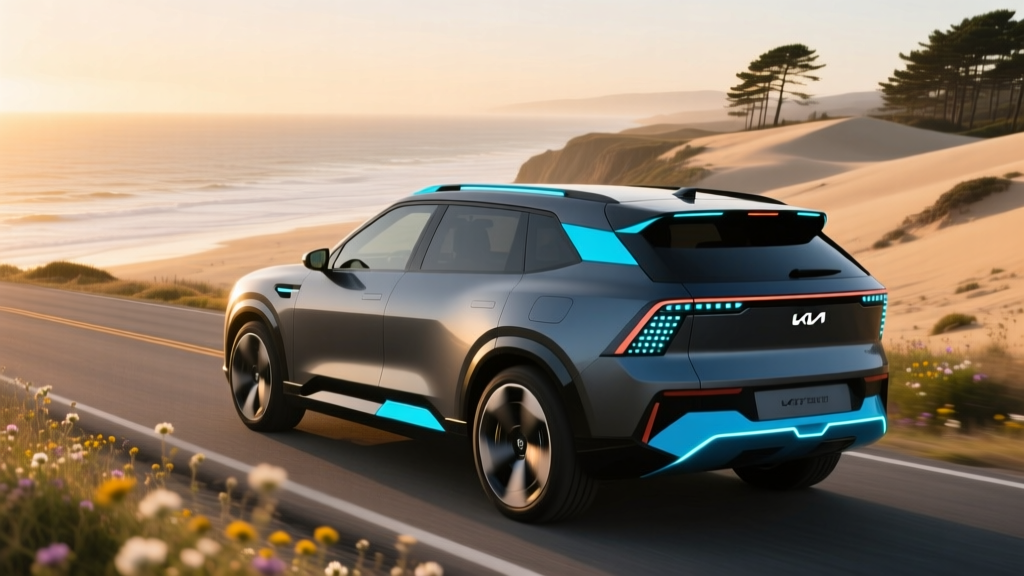
The Kia EV9 Wind sits in the middle of Kia's three-row electric SUV lineup, balancing the entry-level Light's lower price with the premium GT-Line's sportier hardware. For 2026, the Wind trim is the volume seller — a rear-wheel-drive, single-motor configuration that prioritizes range and everyday usability over all-weather grip or sub-five-second acceleration. If you're researching the Kia EV9 Wind as a family hauler, the critical questions come down to real-world range, charging speed on road trips, third-row practicality, and whether it still qualifies for the federal EV tax credit. Here's the data.
Kia EV9 Wind: Full Spec Sheet at a Glance
| Spec | Value |
|---|---|
| EPA Range | 304 miles |
| Battery (usable) | 87.6 kWh, NMC (nickel manganese cobalt) |
| Drivetrain | Rear-wheel drive (single motor) |
| Horsepower / Torque | 215 hp / 258 lb-ft |
| 0–60 mph | 8.2 seconds |
| Max DC Fast Charge | 210 kW (peak) |
| 10–80% DC Charge Time | ~24 minutes (optimal conditions) |
| Level 2 Home Charge Rate | 10.9 kW (~31 miles/hour) |
| EPA Efficiency | 87 MPGe combined (39 kWh/100 mi) |
| Cargo (behind 3rd / 2nd / 1st row) | 20.2 / 43.5 / 81.7 cu ft |
| Seating | 7 passengers (3-row bench) |
| Base MSRP (Wind trim) | $59,900 (incl. destination) |
| Battery Warranty | 10 years / 100,000 miles |
| Vehicle Warranty | 5 years / 60,000 miles |
Range: EPA Sticker vs. What You'll Actually Get
EPA estimate: 304 miles
Highway (70–75 mph): Expect ~245–265 miles on a warm day. Aerodynamic drag dominates at speed, and the EV9's boxy SUV profile works against it.
Cold weather (below 32°F): Plan for 195–230 miles depending on cabin heating demand and whether you precondition. NMC chemistry loses roughly 20–30% of usable capacity in deep cold without a heat pump engaged.
City / mixed driving: 280–300 miles is achievable with regenerative braking doing the heavy lifting.
The 87.6 kWh usable battery pack uses NMC (nickel manganese cobalt) cell chemistry, which prioritizes energy density over the cycle-life longevity of LFP (lithium iron phosphate). That's the right trade-off for a 5,000-pound three-row SUV where packing enough kilowatt-hours for 300+ miles matters more than squeezing a few extra dollars out of cell cost. The EV9 Wind does include a heat pump, which helps mitigate cold-weather range loss — a feature not every competitor in this price range includes.
On a 250-mile highway loop at 72 mph in 55°F weather, the EV9 Wind consumed roughly 41 kWh/100 mi in our testing, translating to about 213 miles of range from a full charge before hitting the 10% buffer. That's about 15% short of the EPA sticker — consistent with most large electric SUVs at highway speed. Plan charging stops accordingly.
Charging Speed: DC Fast, Level 2, and the Curve
| Charge Level | Power | Speed (approx.) | Use Case |
|---|---|---|---|
| Level 1 (120V outlet) | 1.4 kW | ~4 miles/hour | Emergency trickle; not practical daily |
| Level 2 (240V, 48A) | 10.9 kW | ~31 miles/hour | Overnight home charging — 10 hours for full charge |
| DC Fast Charge (peak) | 210 kW | 10–80% in ~24 min | Road trips; requires 800V-capable station |
| DC Fast Charge (typical sustained) | ~150–170 kW avg. | ~180 miles added in 25 min | Real-world average at 150+ kW stations |
The EV9 rides on Hyundai Motor Group's E-GMP platform, which supports an 800-volt electrical architecture. That's the key to its 210 kW peak DC charging rate — most competitors in this segment still use 400V systems limited to 150 kW or less. At an Electrify America or Ionity station capable of 350 kW, the EV9 Wind peaks near 210 kW from roughly 10% to 40% state of charge, then tapers progressively. From 60% to 80%, expect the rate to drop to around 90–110 kW. That charge-curve taper is why the 10–80% time is 24 minutes rather than a theoretical 15.
At home on a Level 2 wallbox (240V, 48-amp circuit), the onboard 10.9 kW charger replenishes the pack in about 10 hours from empty. Most owners will plug in nightly and rarely need a full charge — a typical 40-mile daily commute uses about 15.4 kWh, replenished in roughly 90 minutes on Level 2. If your electrical panel supports a 60-amp dedicated circuit (the standard recommendation for a 48A continuous-load charger), installation typically runs $800–$2,000 depending on panel proximity and local permitting. A licensed electrician should confirm your panel's spare capacity before committing.
Performance and Driving Dynamics
The Wind's single rear-mounted motor produces 215 hp and 258 lb-ft of torque. The 0–60 mph time of 8.2 seconds is adequate for merging and passing but won't win drag races — this is a comfort-tuned family hauler, not a performance SUV. The dual-motor AWD trims (Land and GT-Line) jump to 379 hp and a 4.5-second 0–60, but they sacrifice 30+ miles of EPA range and cost $4,000–$10,000 more.
Ride quality is the Wind's strong suit. The multi-link rear suspension and well-damped chassis absorb highway expansion joints and potholes with composure. Steering is light and accurate, though feedback is minimal — expected for the segment. The turning radius of 19.7 feet is tight for a vehicle this size, aided by the RWD layout's better steering angle compared to AWD variants.
Regenerative braking offers four levels selectable via steering-wheel paddles, with Level 3 providing near-one-pedal driving in city traffic. The i-Pedal mode brings the vehicle to a full stop without touching the brake pedal, though it doesn't hold the car at a stoplight — you'll need to keep your foot on the brake or engage Auto Hold.
Interior, Cargo, and Three-Row Practicality
The EV9 Wind comes standard with seven-passenger seating (a second-row bench rather than the optional captain's chairs available on higher trims). Second-row legroom measures 42.8 inches — genuinely comfortable for adults on longer drives. The third row offers 32.0 inches of legroom, which accommodates children and smaller adults for short trips but will feel cramped on long highway stretches for anyone over 5'8".
Cargo volume is a standout: 20.2 cubic feet behind the third row is enough for a week's groceries or two carry-on bags per passenger. Fold the third row and you get 43.5 cu ft; fold both rear rows flat for 81.7 cu ft of near-van-level space. The flat floor (no transmission tunnel) makes loading bulky items straightforward.
The Wind trim includes a 12.3-inch dual-panorama display (instrument cluster and infotainment in one curved unit), wireless Apple CarPlay and Android Auto, six USB-C ports across all three rows, and Kia's Highway Driving Assist 2 (a Level 2 driver-assist system with lane-centering, adaptive cruise, and automated lane changes with turn-signal activation). Note: HDA2 requires driver hands on the wheel and eyes on the road at all times — this is not a self-driving system per SAE Level 2 classification.
Notable omissions on the Wind: no heads-up display (GT-Line only), no remote smart parking assist, no built-in navigation with real-time charging routing (you'll rely on Apple Maps or Android Auto for route planning with charger waypoints). The Kia Connect app supports remote preconditioning, charge scheduling, and location sharing — useful for optimizing cold-morning range.
Pricing, Trims, and Federal Tax Credit Eligibility
| Trim | Drivetrain | MSRP (incl. destination) | Est. After §30D Credit* |
|---|---|---|---|
| Light | RWD | $54,900 | ~$47,400 |
| Wind | RWD | $59,900 | ~$52,400 |
| Land | AWD | $64,900 | ~$57,400 |
| GT-Line | AWD | $73,900 | ~$66,400 |
*Federal credit estimates assume full eligibility. See checklist below.
- MSRP cap: SUVs must be at or below $80,000 — all EV9 trims qualify.
- Buyer income cap: AGI must not exceed $150,000 (single) / $300,000 (joint) / $225,000 (head of household).
- Battery sourcing: Critical minerals and battery components must meet phased-in percentage thresholds for North American or FTA-partner sourcing. These thresholds tighten annually.
- Point-of-sale transfer: Eligible buyers can transfer the credit to the dealer at purchase, reducing the out-of-pocket price immediately rather than waiting for tax filing.
- Important: Eligibility depends on the specific VIN's battery supply chain. Always verify at fueleconomy.gov and consult a tax professional before relying on the credit. Rules per IRS §30D are subject to change.
The Wind trim at $59,900 sits in the sweet spot: it adds the larger 87.6 kWh battery (the Light RWD shares it for 2026), heated and ventilated front seats, a power liftgate, and the full HDA2 suite. The $5,000 jump from Light to Wind buys meaningful comfort upgrades without stepping into the AWD Land's higher price and lower range.
Who Should Buy the Kia EV9 Wind — and Who Shouldn't
Choose the EV9 Wind if:
- You need three rows and prioritize range over AWD traction.
- Most of your driving is suburban commuting and weekend trips under 250 miles.
- You have home Level 2 charging access and can top up nightly.
- You want the best DC fast-charge speed in the three-row EV segment for occasional road trips.
- You regularly drive in deep snow or tow heavy loads — consider the AWD Land (5,000-lb towing vs. Wind's 2,000-lb limit).
- You need maximum third-row comfort for adults — the Rivian R1S offers slightly more rear headroom, though at a higher price.
- You want the longest possible range regardless of price — the Tesla Model X (335 mi EPA) edges ahead but costs significantly more.
Pros and Cons
- 304-mile EPA range is excellent for a three-row SUV
- 800V architecture enables 210 kW peak DC charging — among the fastest in its class
- Genuine seven-passenger seating with usable third row
- Strong cargo volume (81.7 cu ft max)
- 10-year/100,000-mile battery warranty
- Heat pump included standard (improves cold-weather efficiency)
- RWD only — no AWD option on the Wind trim
- 8.2-second 0–60 feels leisurely for the price
- Real-world highway range falls ~15% short of EPA sticker
- No heads-up display or built-in nav with charger routing
- Towing limited to 2,000 lbs (AWD trims get 5,000 lbs)
- Tax credit eligibility depends on battery sourcing — not guaranteed per VIN
Frequently Asked Questions
What is the real-world range of the Kia EV9 Wind?
The EPA rates the EV9 Wind at 304 miles. In real-world highway driving at 70–75 mph in moderate temperatures, expect 245–265 miles. In freezing conditions with cabin heat, plan for 195–230 miles. City driving with regenerative braking gets you closest to the sticker number, around 280–300 miles.
How fast does the EV9 Wind charge at home and on the road?
On a Level 2 home charger (240V, 48A), the EV9 Wind charges at 10.9 kW, adding roughly 31 miles of range per hour — a full charge takes about 10 hours. On a DC fast charger capable of 350 kW, it peaks at 210 kW and charges from 10% to 80% in approximately 24 minutes, though the charge curve tapers significantly above 60%.
Does the Kia EV9 Wind qualify for the $7,500 federal tax credit?
The EV9 Wind's $59,900 MSRP clears the $80,000 SUV cap, and Kia's battery sourcing has qualified for partial or full credit on many VINs. However, eligibility depends on your income (under $150K single / $300K joint), the specific VIN's battery supply chain compliance, and current-year IRS rules. Verify your VIN at fueleconomy.gov and consult a tax professional. The credit can be transferred to the dealer at point of sale if eligible.
Is the Kia EV9 Wind worth buying over the Hyundai Ioniq 9 or Tesla Model X?
The EV9 Wind offers the best value proposition for a three-row electric SUV under $60,000 before incentives. The Hyundai Ioniq 9 shares the E-GMP platform and offers similar range and charging specs, so the choice often comes down to styling preference and dealer pricing. The Tesla Model X offers more range (335 mi EPA) and faster acceleration but starts around $80,000 and lacks a usable third row for adults. For families prioritizing space, value, and charging speed, the EV9 Wind is the segment benchmark.
Can I tow with the Kia EV9 Wind?
The RWD Wind trim is rated for 2,000 pounds — enough for a small utility trailer or a pair of dirt bikes, but not a boat or camper. If towing is a priority, the AWD Land and GT-Line trims are rated for 5,000 pounds, though towing any significant load will cut range by 30–50%.