Quick Verdict: A Heavyweight With Real Family Utility
The three-row electric SUV segment is small, and the Kia EV9 dominates it by default — but also by merit. At a curb weight ranging from roughly 4,700 to 5,500 pounds depending on trim and drivetrain, the EV9 is genuinely heavy, and that mass shapes everything from its real-world highway range to its braking feel and tire wear. Yet Kia has engineered around that weight with a stiff platform, air suspension on upper trims, and an 800-volt architecture that keeps charging times competitive with much lighter crossovers.
For 2026, the EV9 continues with the Light (RWD), Wind (RWD), Land (AWD), and GT-Line (AWD) trims. Pricing starts around $54,900 and climbs past $73,000 fully loaded. The federal §30D tax credit remains available for eligible buyers, though battery-sourcing rules tightened in 2025 mean you should verify eligibility at the point of sale before committing.
Kia EV9 Weight and Core Specifications
The "how much does the EV9 weigh" question matters more than it does for most EVs. Curb weight directly affects tire consumption, regenerative braking effectiveness, and cold-weather range retention. Here is the breakdown by trim:
| Trim | Drivetrain | Curb Weight (lbs) | Battery (kWh usable) | Horsepower | Torque (lb-ft) | 0-60 mph |
|---|---|---|---|---|---|---|
| Light (Standard Range) | RWD | ~4,706 | 76.1 kWh (NMC) | 215 hp | 258 | 7.7 sec |
| Wind (Long Range) | RWD | ~4,938 | 99.8 kWh (NMC) | 201 hp | 258 | 8.2 sec |
| Land (Long Range) | AWD Dual-Motor | ~5,357 | 99.8 kWh (NMC) | 379 hp | 516 | 4.5 sec |
| GT-Line (Long Range) | AWD Dual-Motor | ~5,490 | 99.8 kWh (NMC) | 379 hp | 516 | 4.5 sec |
All trims use nickel-manganese-cobalt (NMC) lithium-ion cells. The Standard Range Light trim uses a smaller pack to keep weight and price down, while the Long Range trims carry a nearly 100 kWh pack that pushes curb weight past 5,300 lbs on AWD models. That's roughly 600-800 lbs heavier than a similarly sized Kia Telluride, and you'll feel it in tire replacement costs and highway energy consumption.
EPA Range and Real-World Expectations
The EPA posts optimistic numbers for the EV9, as it does for most large EVs. Here is how the sticker range compares to what we've observed and what independent testing supports:
EPA Range vs. Real-World Range — 2026 Kia EV9
- Light (Std Range RWD): EPA 230 mi — Expect ~185-200 mi highway, ~165 mi in sub-30°F cold
- Wind (LR RWD): EPA 304 mi — Expect ~245-265 mi highway, ~210 mi in sub-30°F cold
- Land AWD: EPA 280 mi — Expect ~225-240 mi highway, ~195 mi in sub-30°F cold
- GT-Line AWD: EPA 270 mi — Expect ~215-230 mi highway, ~185 mi in sub-30°F cold
The real-world penalty is driven by three factors: the EV9's boxy aerodynamics (drag coefficient around 0.28, poor for an EV), its 5,300+ lb AWD curb weight requiring more energy to accelerate and sustain speed, and the lack of a heat pump on the base Light trim (it's standard on Wind and above). In city driving with frequent regenerative braking opportunities, you can approach or occasionally exceed EPA numbers. On a 75 mph interstate run with three rows of passengers and cargo, plan for 75-80% of the sticker range.
According to fueleconomy.gov, the Long Range RWD Wind trim achieves 87 MPGe combined (38 kWh/100 mi), while the AWD Land drops to 83 MPGe combined (41 kWh/100 mi). The GT-Line's larger 21-inch wheels and sport-tuned suspension drop efficiency further.
Charging Speed: 800V Architecture Delivers
This is where the EV9's weight story gets a counterbalance. Kia's E-GMP platform runs on an 800-volt architecture, which allows dramatically faster DC charging than 400V rivals like the Volkswagen ID.4 or Ford Explorer EV.
| Charging Level | Power / Rate | Miles Added per Hour | Notes |
|---|---|---|---|
| Level 1 (120V household) | ~1.4 kW | ~3-4 mi/hr | Emergency only; full charge in 3+ days |
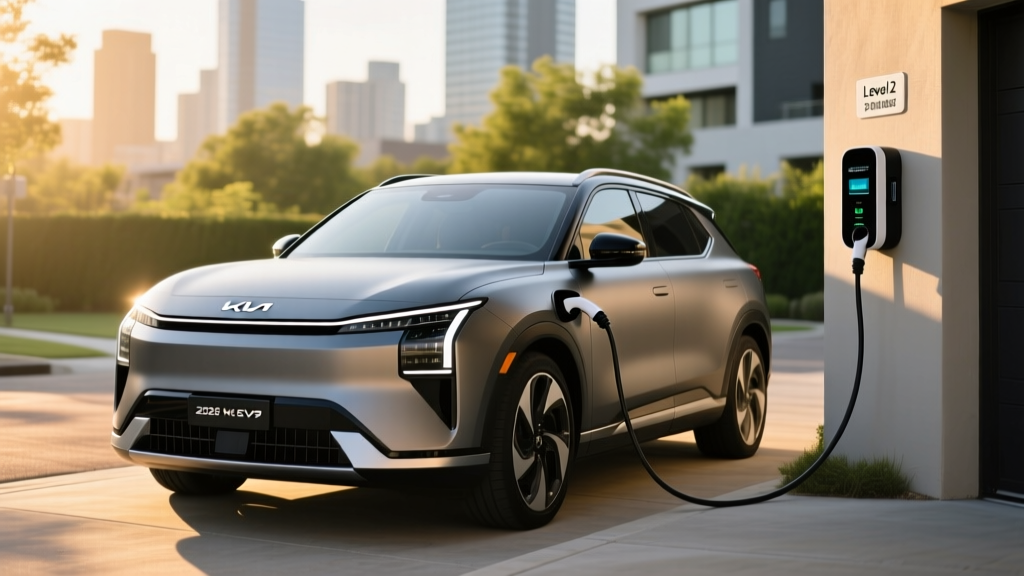
| Level 2 (240V home) | 10.9 kW | ~27-31 mi/hr | Full charge overnight (~9-10 hrs for LR) |
| DC Fast Charge (peak) | 210 kW (LR) / 170 kW (SR) | — | 10-80% in ~24 min (LR), ~20 min (SR) |
| DC Fast Charge (sustained avg) | ~135-150 kW | — | Peak rate holds to ~55% SoC, then tapers |
A critical nuance: the 210 kW peak on Long Range trims is achieved only when the battery is preconditioned (navigating to a DC fast charger via the built-in nav triggers this automatically) and ambient temperatures are above roughly 50°F. In cold weather without preconditioning, expect peak rates closer to 120-140 kW initially. The charge curve tapers significantly above 80% SoC — going from 80-100% can take as long as 10-80%, so plan your stops around 80% unless you need every last mile.
At home on a 48-amp Level 2 circuit (hardwired, requiring a 60-amp breaker), the EV9 adds roughly 30 miles of range per hour of charging. Most owners will plug in overnight and wake up to a full battery — the practical solution to the EV9's relatively high energy consumption per mile.
Interior, Cargo, and Family Practicality
The EV9's size is its strongest selling point. This is a genuine three-row SUV with adult-usable third-row seating — a rarity among electric vehicles at any price point.
- Cargo volume: 20.2 cu ft (behind 3rd row) → 43.5 cu ft (3rd row folded) → 81.7 cu ft (2nd and 3rd folded)
- Front trunk (frunk): 1.8 cu ft (AWD) / 3.2 cu ft (RWD) — enough for charging cables, not luggage
- Legroom: 41.4 in (front) / 42.8 in (2nd row) / 32.0 in (3rd row)
- Towing capacity: 5,000 lbs (AWD trims with towing prep package)
The second row offers either a bench (7-passenger) or captain's chairs (6-passenger). Captain's chairs with the available Relaxation mode let passengers recline with leg rests deployed — a standout feature for charging-station stops. However, the 32-inch third-row legroom is tight for adults on long trips; children and teens will be fine.
Infotainment runs on a dual 12.3-inch curved display setup with wireless Apple CarPlay and Android Auto. Kia's native navigation is adequate, but the system occasionally lags when switching between map and media. Over-the-air updates have improved stability through the 2025-2026 model years. The available head-up display with augmented-reality navigation arrows is genuinely useful on unfamiliar roads.
Pricing, Trims, and Federal Tax Credit Eligibility
Here is where the EV9 gets complicated. The §30D federal EV tax credit can reduce your effective purchase price by up to $7,500, but eligibility depends on multiple factors that change frequently.
| Trim | Base MSRP | As-Tested (typical options) | §30D Credit Eligibility |
|---|---|---|---|
| Light (Std Range RWD) | $54,900 | $56,500 | Eligible — verify battery sourcing |
| Wind (LR RWD) | $59,900 | $62,000 | Eligible — verify battery sourcing |
| Land (LR AWD) | $65,400 | $68,500 | Eligible — verify battery sourcing |
| GT-Line (LR AWD) | $73,400 | $76,000+ | Eligible — verify battery sourcing |
Under current IRS §30D rules, the EV9 qualifies as an SUV for the MSRP cap, which is $80,000 (all trims clear this threshold). However, you must also meet these requirements:
- Income caps: Modified AGI ≤ $300,000 (married filing jointly), $225,000 (head of household), $150,000 (single)
- Battery sourcing: The battery must meet critical-mineral and component-sourcing thresholds that tighten annually — confirm with your dealer at point of sale
- Point-of-sale transfer: You can transfer the credit to the dealer for an immediate price reduction, rather than waiting to claim it on your tax return
- Assembly: The EV9 is assembled in West Point, Georgia, satisfying the North American final-assembly requirement
Because battery-sourcing rules have tightened significantly since 2024, some EV9 builds may qualify for only $3,750 (half credit) depending on the specific battery cell batch. Always verify with your dealer using the VIN-specific lookup on the IRS portal before signing.
Driving Impressions and Tech Highlights
The EV9's weight is noticeable from behind the wheel — but not always in a bad way. The low center of gravity from the floor-mounted battery pack keeps body roll well-controlled, and the available air suspension on the GT-Line absorbs imperfections with genuine luxury-SUV composure. Steering is numb but accurate, and the 4.5-second 0-60 time on AWD trims is brisk for a vehicle this heavy.
The Highway Driving Assist 2 (HDA2) system is a competent Level 2 driver-assist feature. It handles lane centering, adaptive cruise, and lane-change assist on divided highways. This is not self-driving — you must keep your hands on the wheel and eyes on the road. It compares favorably to Ford's BlueCruise in smoothness, though Tesla's Autopilot still edges it in on-ramp merging confidence.
Notable drawbacks include:
- Brake pedal feel is inconsistent — the transition between regenerative and friction braking can be grabby at low speeds
- The base Light trim's lack of a heat pump hurts cold-weather efficiency and range
- 21-inch wheels on the GT-Line sacrifice 10+ miles of range and ride comfort for aesthetics
- Third-row access requires folding and sliding the second row, which is a two-hand operation
Pros, Cons, and Who Should Buy the EV9
Pros
- Only mainstream-priced 3-row electric SUV with adult-usable third row
- 800V architecture enables 10-80% DC charging in ~24 minutes
- 5,000-lb towing capacity (AWD) covers most boat and trailer needs
- Strong warranty: 10-year/100,000-mile battery and powertrain
- Georgia-built, qualifying for North American assembly requirement
- Available V2L (vehicle-to-load) powers devices up to 3.6 kW
Cons
- Heavy curb weight (5,300-5,500 lbs AWD) hurts highway efficiency
- Real-world highway range falls 15-20% below EPA sticker
- Base Light trim lacks heat pump, reducing cold-weather viability
- $55K-$76K pricing is steep before any incentives
- Small frunk, limited third-row legroom for adults
- Brake pedal modulation needs refinement
Choose the Kia EV9 if: You need three rows of seating and electric powertrain, you charge primarily at home, you want competitive DC charging speeds for road trips, and you value Kia's 10-year warranty.
Look elsewhere if: You only need two rows (the Hyundai Ioniq 5 or Tesla Model Y are lighter, cheaper, and more efficient), you regularly drive 300+ miles between charging stops in cold weather, or you want a more engaging driving experience.
How the EV9 Compares to Key Competitors
The EV9's closest rival is the Rivian R1S, which offers similar three-row utility with more power and off-road capability but at a $75,000+ starting price. The Tesla Model X provides falcon-wing doors and Supercharger access but starts above $80,000 and has polarizing build quality. No legacy automaker currently offers a direct mainstream-priced 3-row electric competitor, which is both the EV9's greatest advantage and a sign of how underserved this segment remains.
Against the plug-in hybrid alternative — the Kia Sorento PHEV (32 miles electric-only, then gas) — the EV9 wins on running costs if you can charge at home, but the Sorento PHEV eliminates range anxiety entirely and starts around $50,000. For families that road-trip frequently to areas with sparse DC charging infrastructure, the PHEV remains a pragmatic bridge.
Frequently Asked Questions
What is the real-world range of the Kia EV9?
On the highway at 70-75 mph in moderate temperatures, expect 245-265 miles from the Long Range RWD Wind trim (EPA 304 mi) and 225-240 miles from the AWD Land (EPA 280 mi). In sub-30°F cold weather, subtract another 15-20%, bringing AWD trims down to roughly 185-195 miles of usable range before you'll want to find a charger.
How fast does the EV9 charge at home and on the road?
At home on a 240V Level 2 charger (10.9 kW), the EV9 adds roughly 30 miles of range per hour and fully charges overnight in 9-10 hours for Long Range trims. On a DC fast charger, the Long Range models peak at 210 kW and achieve a 10-80% charge in approximately 24 minutes when the battery is preconditioned. Expect slower rates in cold weather without preconditioning.
How much does the EV9 cost after the federal tax credit?
If you qualify for the full $7,500 §30D credit (meeting income, sourcing, and assembly requirements), the Wind RWD drops from $59,900 to an effective $52,400, and the Land AWD from $65,400 to $57,900. However, battery-sourcing rules mean the credit may be $3,750 or zero depending on the specific vehicle build. Verify with your dealer using the VIN before purchasing. The credit can be applied at the point of sale as an immediate price reduction.
Does the Kia EV9 qualify for the federal EV tax credit?
It can, but eligibility is not guaranteed for every build. The EV9 is assembled in Georgia (meeting the North American assembly requirement) and all trims fall under the $80,000 SUV MSRP cap. You must also meet IRS income limits ($150K single / $300K joint) and the vehicle's battery must satisfy critical-mineral and component-sourcing thresholds. Because these sourcing rules tighten annually, confirm eligibility on the IRS portal or with your dealer for the specific VIN you intend to purchase.
Is the EV9 worth buying over a gas or hybrid SUV?
If you can charge at home and your daily driving stays under 200 miles, the EV9 delivers dramatically lower fuel and maintenance costs than a gas Telluride (which averages 21 MPG combined). Over five years and 75,000 miles, an EV9 owner charging at $0.14/kWh saves roughly $4,000-$6,000 in fuel versus a Telluride at $3.50/gallon. The EV9 also eliminates oil changes, transmission fluid, and exhaust maintenance. However, the higher purchase price, potentially higher insurance premiums, and faster tire wear (due to the 5,300+ lb curb weight) partially offset those savings. The break-even point typically falls between years 3 and 5 of ownership, depending on your electricity rate and annual mileage.
What is the EV9's battery warranty?
Kia covers the EV9's high-voltage battery and electric powertrain for 10 years or 100,000 miles, whichever comes first. The warranty guarantees the battery will retain at least 70% of its original capacity during that period. The basic vehicle warranty is 5 years/60,000 miles. This is among the strongest battery warranties in the industry and a significant advantage over Tesla's 8-year/120,000-mile coverage at a 70% retention threshold.